














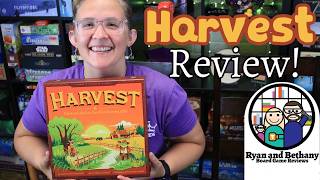



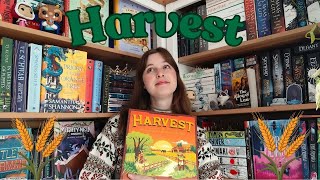











Harvest Deep Dive
What the Community Thinks About Harvest
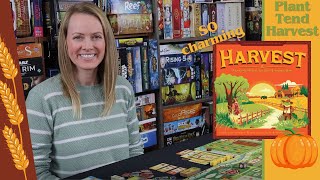
Harvest has captured the hearts of board game reviewers across the hobby, earning consistent praise for its elegant design and engaging gameplay. Reviewers describe it as a surprisingly approachable farming game that manages to pack meaningful strategic depth within a light-to-medium weight framework. The game strikes a balance that appeals equally to newcomers seeking gateway games and experienced players looking for something fresh. Its charming theme, beautiful artwork, and satisfying resource management create an experience that feels both comforting and intellectually engaging.
Core Mechanics That Define Harvest
Worker Placement with Wheelbarrow Efficiency
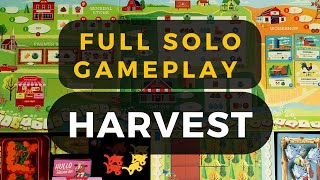
At its heart, Harvest is a worker placement game centered on managing three wheelbarrows across a shared board of action spaces. Each round, players place their limited wheelbarrows strategically to access different areas: the fields for planting and harvesting crops, the workshop for upgrading tools and clearing land, the general store for purchasing seeds, and rotating farmer's market spaces that offer powerful but temporary actions. The tension comes not just from competing for valuable spots, but from the careful resource economy these decisions create. Reviewers note that every placement feels meaningful because the game forces difficult choices between immediate gains and long-term setup. The scarcity of actions creates a satisfying efficiency puzzle where players must plan multiple rounds ahead.
Asymmetric Player Powers with Farmhouse Abilities
What elevates Harvest beyond a basic worker placement framework is its deep asymmetry. Every player selects a unique character with distinct abilities and a farmhouse that generates different income each round. Characters like Penny the Pig reduce seed costs, while others like Jamie the Bunny grant an extra wheelbarrow. These asymmetries reshape how each player approaches the game entirely. Reviewers emphasize that the developers spent considerable time playtesting to ensure no single character-farmhouse combination dominated the table. The beauty of this system is that different characters appeal to different play styles without being strictly stronger or weaker. Some characters are easier to play and forgiving, while others demand precise planning but offer higher ceilings. This design philosophy means every player gets to express their own farming philosophy through their character choice.
The Harvest Experience
A Satisfying Efficiency Puzzle
Reviewers consistently describe Harvest as a deeply satisfying efficiency puzzle. The core loop of planting seeds, tending them with water to multiply their yields, and harvesting them for victory points creates a meditation-like rhythm. Players spend the game optimizing their field layouts and timing their harvests to maximize point generation. The Farmers Market spaces shake things up each round with new and varied actions, preventing the puzzle from becoming rote. Reviewers appreciate that the game rewards both clever planning and adaptation when competitors block your preferred spaces. There is palpable joy in executing a turn where everything comes together: buying the right seeds, planting efficiently with minimal resource waste, and harvesting multiple crop types for a massive point swing.
Building Your Farm as a Personal Tableau
Part of Harvest's charm comes from the personal nature of your farm board. You control the layout, clearing forest tiles to make room for crops or buildings that provide immediate abilities or end-game scoring bonuses. This polyomino-style puzzle of arranging your space creates constant small decisions that feel thematic and satisfying. Reviewers highlight how the buildings available to purchase change each round, forcing players to adapt their strategies based on what the market offers. Some buildings synergize beautifully with certain characters, rewarding players who spot these combinations early in their planning.
What Makes Harvest Stand Out
Accessible Complexity with Real Strategic Depth
One of Harvest's greatest achievements is balancing accessibility with surprising strategic richness. The base rules are straightforward enough for newcomers to grasp within one teach, yet the interplay between character abilities, farmhouse incomes, crop economics, and spatial puzzles creates enough complexity to keep experienced players engaged across multiple plays. Reviewers describe it as "Agricola light" in the best way possible, offering farming simulation and resource management without the overwhelming decision trees of heavier titles. The game demonstrates that you do not need complicated rules to create meaningful gameplay where every decision matters.
Charming Aesthetic with Thematic Resonance
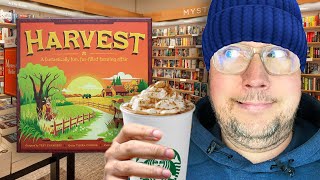
The visual presentation of Harvest deserves significant credit for its appeal. Reviewers universally praise the beautiful artwork and character design, particularly noting how the Fantastic Mr. Fox-style aesthetic makes the game instantly appealing on a table. Yet this charm is not superficial; the game's mechanics consistently reinforce its farming theme. Planting, tending, and harvesting feel like actual farming activities rather than abstracted point collection. The wheelbarrows make thematic sense as transportation, and the fields genuinely feel like spaces you are cultivating. This intersection of excellent aesthetics and thematic coherence creates a complete package that draws players in and keeps them invested.
Potential Drawbacks
Perceived Power Imbalance in Character Selection
Some competitive players on Board Game Arena have expressed concerns that certain characters feel significantly stronger or weaker than others. However, reviewers and developers note that extensive playtesting and collected data show all characters can achieve competitive scores with skilled play. What some perceive as weakness is often merely higher difficulty. Characters with fewer wheelbarrows require more precise play but offer higher theoretical ceiling scores. The perception of imbalance sometimes stems from the different skill floors of each character, not from actual balance issues. Still, newer players may occasionally feel disadvantaged by character selection until they learn optimal strategies for each option.
Setup and Component Management
While not a major complaint, some reviewers mention that Harvest has more components and setup requirements than its light rule set might suggest. The game requires careful organization of seeds, fertilizer, water tokens, buildings, and character boards. This can slow down the initial table time, though once everything is properly arranged, plays move smoothly. The component-heavy nature also means the game requires a decent table footprint. For casual players prioritizing quick setup, this minor friction might be worth noting, though most reviewers consider the visual organization and table presence worth the effort.
If You Enjoy Harvest
Players who love the farming simulation and efficiency puzzle of Harvest should explore Agricola, the heavier farming classic that inspired much of this design, or Viticulture, which offers similar asymmetric gameplay in a wine-making setting. For those drawn to the accessible worker placement mechanics without the farming theme, Calico offers a beautifully illustrated puzzle game that rewards careful planning and pattern recognition. Everdell shares the charming aesthetic paired with tableau building and worker placement. Players seeking a deeper farming experience might enjoy Hallertau, which offers more complex resource chains within a similar agricultural framework.
What Reviewers Are Saying
"The youthful art and fantastic Mr. Foxes characters might lead you to believe this is a kids game, but it's really bordering the line between light and medium in a way that makes it the perfect little package."
— Neon Gorilla
"I love this game so much. I packed quite a bit of strategy in it. It's a fairly simple gameplay but you really do have to think about your turns. You're only placing three of your workers per round and there are four rounds, so twelve turns in total where you're really trying to get as much done as possible."
— The Board Game Garden
"Harvest is an approachable lighter euro that does a good job of teaching core mechanisms like worker placement and tableau building. Swift plays with meaningful decisions make it a solid introductory title for the genre."
— The Board Gaming Doctor