
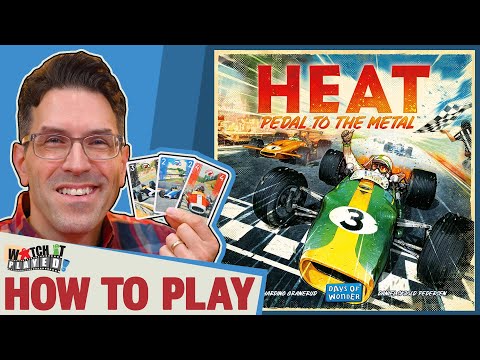










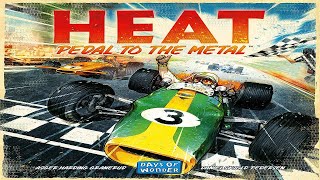







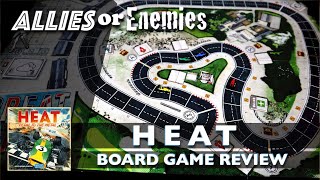







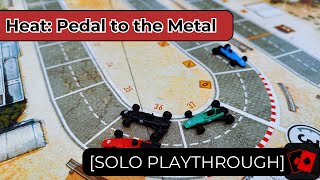















Based on simple and intuitive hand management, Heat: Pedal to the Metal puts players in the driver's seat of intense car races, jockeying for position to cross the finish line first, while managing their car's speed if they don't want to overheat. Selecting the right upgrades for their car will help them hug the curves and keep their engine cool enough to maintain top speeds. Ultimately, their driving skills will be the key to victory!
Drivers can compete in a single race or use the "Championship System" to play a whole season in one game night, customizing their car before each race to claim the top spot of the podium. They have to be careful as the weather, road conditions, and events will change every race to spice up their championship. Players can also enjoy a solo mode with the Legends Module or add automated drivers as additional opponents in multiplayer games.
—description from the publisher
Heat in about 3 minutes
- Surprisingly deep despite a seemingly gimmicky premise
- Strong replay value through multiple difficulty layers
- Engaging table presence and emotional engagement
- Some find the rules fiddly during transitions between modes
- gear-shift control, risk management, and speed
- Competitve racing with modular difficulty layers
- accessible, sport-like progression with seasonal depth
Mechanics (from transcript analysis)
- card hand management — Players manage a hand of cards each round to decide speed vs. control.
- hand management — Players manage a hand of cards each round to decide speed vs. control.
- Modular board — Base game for casual players; Championship and Legends modes add depth.
- modular difficulty — Base game for casual players; Championship and Legends modes add depth.
- Variable player count support — Supports 1–6 players with scalable play.
- Variable Set-up: Player — Supports 1–6 players with scalable play.
Video topics + discussion points
Quotes (from this video)
- It's approachable enough that new players can learn it in one session, but deep enough that you're still finding new strategies after 30 plays.
- The expansions add modules instead of replacing the base game. So, you're building a collection, not cycling through versions.
- It's Dune. That IP isn't going anywhere. As long as people are watching Dune movies, they're going to want to play Dune games.
- The magic is in the gear shift mechanism.
- It's creating a new genre, strategic deduction.
- "No, you're a ghost now. You still matter."
- "The objectives change every game."
References (from this video)
- Appealing, well-presented components and a cinematic dashboard aesthetic.
- Clear, intuitive core loop that emphasizes gear management and hand shaping.
- Heat and slipstream provide dynamic and satisfying strategic tension.
- Variants (weather, upgrades, champion mode, bots) add depth and replayability.
- Good fit for families and casual players; playable with many players; duration is tight (about an hour).
- Rulebook and iconography are problematic; learning curve and onboarding are weak for a Days of Wonder title.
- Spinning out can cause real player-elimination feel; recovery is slow, which can stall competition.
- Occasional incongruities between theme and mechanics (e.g., certain corners not represented, legend system unclear).
- Component quality is mixed (thin boards, fragile insert).
- Pricing perception fluctuates; MSRP cited as high for what is offered.
- Array
- Racetrack
- Deck-building with simultaneous action and speed-driven racing
- Mario Kart
- Crash Nitro Kart
- 7 Wonders
- Camel Up
- Ready Set Bet
- Catan
Mechanics (from transcript analysis)
- Adrenaline (Last-Move Bonus) — If you're the last card to move, you get an extra move and/or extra cool-down opportunity; enhanced in multi-card plays.
- Check Corner / Corner Speed — Crossing a corner triggers a check against the corner's speed limit; overspeed costs heat; failure can cause a spin-out.
- Deck building — Starting with a basic deck, players add, trash, and manage heat/stress cards to shape future hands across laps.
- Deck Trash / Top-Decking — Upgrade variants can trash cards from the top of your deck to accelerate deck thinning; heat is permanently removed when trashed.
- Gear-Based Card Play — The gear you are in determines how many cards you can play; movement equals the sum of played cards.
- hand management — Each turn you examine seven cards and decide how to play them in gear-limited actions.
- Heat management — Heat cards are tracked as a resource; you gain heat from certain actions and must cool by downshifting; heat cannot be discarded at will.
- Legend / Seasoning Variants — Legend lines and season-style maps add additional routes and pacing; a flexible solo/bot legend system.
- Simultaneous action selection — Players secretly choose gear adjustments at the same time, then reveal and execute.
- Simultaneous Actions — Players secretly choose gear adjustments at the same time, then reveal and execute.
- Slipstream (Drafting) — Being adjacent to or next to another car allows you to slipstream to move extra spaces without increasing corner speed; rewards proximity.
- Upgrades / Weather / Variants — Optional upgrade cards, weather effects, and various modes (champion, tournament) alter rules and track behavior.
Video topics + discussion points
Quotes (from this video)
- Heat is made by Days of Wonder for widespread appeal and they got that initial charm with how good-looking this game is.
- The first is that heat does the speed manipulation idea well for some cool hand management of your seven cards.
- My personal score for Heat is going to be a 5 out of 10.
- recommener score of 7 out of 10.
- Final pro is that this game really does run true to time. It really takes about an hour.
- Heat is actually a fair substitute for the drafty game seven wonders.
- Is the game overhyped from 2022? I would say probably a little bit.
- But I've been seeing its massive continuous success on BGA.
References (from this video)
- Flexible with up to six players
- content-rich with expansions
- Lengthy playtime
- Push-your-luck elements can be punishing
- Quest for El Dorado
- Jamaica
Mechanics (from transcript analysis)
- Deck building — players build a deck to enable car actions and pacing.
- deck-building — players build a deck to enable car actions and pacing.
- Race — real-time-ish racing with push-your-luck decisions.
- racing — real-time-ish racing with push-your-luck decisions.
Video topics + discussion points
Quotes (from this video)
- It's your game night, so you get to decide.
- Storing your games vertically isn't perfect.
- If your shelves are overflowing, why not play a game that doesn't take up any space because it's Hearthstone.
- This is your game night.
References (from this video)
- Highly thematic, engaging with car racing feel
- varied upgrade options; multiple tracks/maps
- Complex heat management can be punishing for beginners
- racing with heat management
- High-speed car race tracks
- immersive, thematic deck-building with engine heat mechanic
- Dominion
- Clank!
Mechanics (from transcript analysis)
- Deck building — build a deck to power your car and perform actions.
- deck-building — build a deck to power your car and perform actions.
- Heat management — manage 'heat' to avoid penalties; upgrading cards helps control heat.
Video topics + discussion points
Quotes (from this video)
- I LOVE IT
- OG OG
- The deck moves the game.
References (from this video)
- fun, fast-paced racing experience
- works well at four players
- great for introducing new gamers
- engaging gear-shift mechanic
- rulebook can be a bit dense and slow to digest
- not as strong at two players
- Speed, competition, and gear-shifting in a kart-race feel
- Racing on fast, compact tracks with a cartoonish, high-energy vibe
- Array
- high-energy, cinematic racer vibe with light humor
- Aquatica
- Red Rising
Mechanics (from transcript analysis)
- Catch-up — the mechanism for the last-place racer to gain extra movement.
- gear progression — upgrading gears increases speed opportunities but costs heat.
- hand management — players manage a hand of numbers and speed cards to navigate the track.
- heat as resource — heat is spent to expand on the Tableau and accelerate progress.
- random draw stress — stress cards push players to draw until a random number appears, adding tension.
- slip speed / catch-up — the mechanism for the last-place racer to gain extra movement.
- Track advancement — upgrading gears increases speed opportunities but costs heat.
Video topics + discussion points
Quotes (from this video)
- it's Mario Kart in board game form without the blue shells and all the fun little items
- Blood Rage has quickly escalated up my top games chart
- Ankh is super super fun I absolutely love this game
- Nemesis is cinematic
References (from this video)
- Some people view it as one of the better racing games
- Feels like the game plays itself; few meaningful decisions
- Runaway victories can occur; luck can dominate
- Speed, cornering, and risk management in a racing context
- Racing in a stylized, fast-paced circuit environment
Mechanics (from transcript analysis)
- Cornering risk and speed control — Decisions about speed and cornering create tension and potential mishaps.
- hand management — Managing cards to influence speed and position.
Video topics + discussion points
Quotes (from this video)
- Agricola is dated; it shows its age.
- The Crew I just can't recommend.
- A Feast for Odin after quite a few plays is a pretty decent game.
References (from this video)
- great production and variability
- supports varied strategies with expansions
- can be table-heavy with all expansions
- hand management and heat management as you push your car
- High-speed street racing
Mechanics (from transcript analysis)
- hand management — Play cards to move along the track and manage the heat resource
- Heat management — Balance pushing speed with cooling to avoid failures
- Modular board — Different tracks and modules alter play
- modular maps / expansions — Different tracks and modules alter play
Video topics + discussion points
Quotes (from this video)
- it's a war game for all intents
- Love Letter is the game I think I've probably played the most
- Cascadia is a fantastic game
- Heat is amazing
- Undaunted is fabulous
- It's pure fun
References (from this video)
- Immersive racing feel
- Expansions add new tracks and bots
- Accessible sense of speed
- Can be chaotic
- Learning curve for new players
- Competitive racing with risk management through 'heat' resource
- Racing world of high-speed car racing
- descriptive, cinematic
Mechanics (from transcript analysis)
- Dice-based movement — Players roll dice to determine movement; heat allows faster progress through corners
- risk-reward cornering — Decide when to push through corners using heat, risking a spin-out
Video topics + discussion points
Quotes (from this video)
- There's tons of board games in the world, but only some are so freaking hot.
- This is one of the most thematic Lord Rings experiences you can get
- Welcome to the best racing board game. Ruin the freaking world.
- The cockpit of your car. You're going to put it in gear and then play as many cards as the gear says, three, for example, and hope you don't crash.
- This is a good game.
- In this game, you will be your own faction where you will collect these set resources or little workers that you will then use to place on the map.
References (from this video)
- Excellent solo mode with Bots that scale to any player count
- Heat system creates a satisfying risk-reward loop
- Tension and strategic depth via slipstreaming and corner sequencing
- High replayability through modular components and potential expansions
- Fast, thinky racing experience that remains accessible
- Learning curve can be steep for new players
- Base maps may feel limited to some, inviting demand for more maps or variants
- Racing action, heat management, and risk-reward decision making
- Racetrack racing with modular tracks, weather variations, and road conditions
- Competitive, fast-paced, and strategically tense with push-your-luck elements
- F-Zero (reference for expansions)
Mechanics (from transcript analysis)
- Bot/solo system — Bots simulate opponents to allow six-car races and consistent tension across varying player counts.
- Cooldown and discard — Used heat cards enter the discard pile and re-enter play after cooldown, tying pace to card economy.
- Heat management — Heat acts as a resource to power actions; overheating cycles back into the discard and requires cooldown, creating tempo and risk management.
- Modular board — Garage cards for parts, weather, and road-condition modules increase replayability and customization.
- modular components — Garage cards for parts, weather, and road-condition modules increase replayability and customization.
- Push Your Luck — Stress cards push risk toward turns and corners; drawing more stress increases heat, forcing tough timing decisions.
- Simultaneous Actions — All players play cards at once, preserving uncertainty and enabling clever tactical plays.
- Simultaneous card play — All players play cards at once, preserving uncertainty and enabling clever tactical plays.
- slipstreaming — Players secretly position behind others to gain slipstream advantages; information is imperfect, driving tension and strategic planning.
- Stress cards / push-your-luck — Stress cards push risk toward turns and corners; drawing more stress increases heat, forcing tough timing decisions.
Video topics + discussion points
Quotes (from this video)
- it's easily my favorite pure racing game
- the Bots mean that it's great at every player count
- absolutely absolutely recommend
- incredibly easily expandable
References (from this video)
- Sensory, cinematic feel; fast, energetic play
- Accessible to party game crowds while offering depth
- Interesting card/power economy and strategic choices
- Rules can be dense for first-timers
- The chaos can overwhelm some players in large groups
- Racing, betting, and dramatic action in a chaotic setting
- High-octane car racing with cinematic, Mad-Max/Borderlands vibes.
- cinematic, fast-paced, chaotic
- Jamaica
- El Dorado
- Flame Rouge
Mechanics (from transcript analysis)
- bingo-like bidding — A Bingo-style mechanic for determining power and movement opportunities.
- combat/shooting actions — Shooting and interactions affect opponents and change the track state.
- hand management — Hand-management and speed cards drive racing pace; gears limit/enable moves.
- special abilities on boards — On your player board you can activate powers that alter movement or interactions.
- speed/gear management — Hand-management and speed cards drive racing pace; gears limit/enable moves.
- Unique player powers — On your player board you can activate powers that alter movement or interactions.
Video topics + discussion points
Quotes (from this video)
- it's Indiana Jones feelings of running into the forest to get to El Dorado
- it's a very simple game but it's super fun to play
- this is a party game for board gamers
- the adrenaline dump is real mate
- the best racing game on the market
- the best racing game ever made
References (from this video)
- High-tension, adrenaline-fueled solo playthrough with dramatic finish potential
- Rich upgrade options (wings, four-wheel drive, etc.) add strategic depth
- Clear, engaging turn-by-turn narration that teaches the game's rhythm and decisions
- Legends mechanic provides a satisfying AI challenge with unique interactions
- Complexity and ongoing resource management can be intimidating for newcomers
- Weather and road condition interactions add complexity and potential downtime in a solo run
- Racing, vehicle customization, risk management
- Racing on an Italian map with weather effects and road conditions
- Live, instructional commentary with decision-making and painting a strategic picture
Mechanics (from transcript analysis)
- Adrenaline boosts — A late-stage option to gain additional movement at the cost of cooldowns or heat, with strategic risk-reward implications.
- Corner checks and racing line — Speed must be checked against corner limits; speed and corner checks determine whether heat must be spent.
- Garage module / Advanced Tech upgrades — Drafting upgrades (wings, four-wheel drive, etc.) add capabilities but impose heat costs to gain speed or maneuverability.
- Gear shifting and position-based actions — Movement and actions are tied to your current gear/position, influencing how many cards you can play and what options you have.
- Heat and stress resource management — Players manage heat to enable faster actions and must draw stress cards that grant negative effects or demand mitigation.
- Legend deck (bot racers) — A deck of legend cards drives the movement of AI racers; movement resolves against corners and racing lines.
- Slipstream / drafting — Drafting behind another car grants extra movement, with interactions around corners and heat costs.
- Weather and road condition tiles — Weather introduces additional stress; road conditions can modify heat costs and corner checks.
Video topics + discussion points
Quotes (from this video)
- we're gonna be racing on the Italian map
- the wings look fun they're gonna cost a lot of heat but it's gonna let us go really fast and sort of speed around corners
- garage module which will let us customize our car with Advanced Tech
- Adrenaline which is just going to let you move in additional space
- These Wings Are fantastic
- thank goodness for these tires
- this is going to be a photo finish I think
- it really comes all down to this we need basically anything less than 16
- cheating
References (from this video)
- tight racing feel with actual race tempo
- excellent production and art
- modular expansions add lasting value
- rule explanations can be lengthy for new players
- hand management, push-your-luck racing
- 60s-era Formula car racing
- fast, competitive race feel with strategic depth
- Moon
- Western Legends
Mechanics (from transcript analysis)
- Deck building — optional modules (garage) allow deck customization and car tuning
- deck-building modules — optional modules (garage) allow deck customization and car tuning
- hand management / push-your-luck — players manage a hand of cards to accelerate, brake, and manage engine heat
- race track variety / weather modules — different tracks and weather add variability and strategy
Video topics + discussion points
Quotes (from this video)
- you live and die by your own strategy
- the more you learn, the more you want to play again
- it's one of the most sophisticated advanced games on this list
References (from this video)
- Strong thematic integration where heat and gear mechanics feel natural
- Simple core rules but deep strategic decision-making
- High component quality and artwork
- Rich expansion options that add significant replayability (Garage, Weather, Heavy Rain)
- Effective AI system for solo/limited-player play
- Great potential for multiple play modes and campaigns
- Expansion content may overcomplicate for newcomers or bind players to buy more to experience full depth
- Not a must-buy for everyone; base game already very strong
- Some players may find the tempo slows with exploratory drafting
- High-speed racing, risk management, and tactical engine heat control
- Golden Age 1960s Formula One era with scale-model cars
- thematic fusion of racing drama with mechanical deck-building
- Ticket to Ride
Mechanics (from transcript analysis)
- AI cars with simplified rules — Up to 6-player with AI cars offering predictable yet challenging competition.
- Catch-up — Mechanisms to keep players in contention, including extra movement and slipstream options.
- deck-building / card drafting — Your deck evolves as cards are played; some cards cycle out as heat is spent and need to cooldown.
- Gear system (gears 1-6) — Choosing gear determines movement and card usage; higher gears move farther but risk heat.
- hand management — Each turn you select two or more cards from a 7-card hand to drive; managing what to play is core to risk/reward.
- Heat management / risk vs reward — Spending heat allows faster movement but increases crash risk; managing engine heat creates tension.
- Modular expansions and draftable garage cards — Garage module allows drafting unique cards to customize your car and deck; weather/mods add variability.
- Rubber-banding / catch-up mechanics — Mechanisms to keep players in contention, including extra movement and slipstream options.
- Track action planning with speed limits at corners — Corners impose speed limits; exceeding them costs penalties and heat.
Video topics + discussion points
Quotes (from this video)
- it's a tremendous example where everything makes sense thematically
- it's a fantastic game
- this is the base game and you can absolutely play the base game nothing else and it’s still a ton of fun
- if you want a racing game that's like look no further this is the game for you
References (from this video)
- subtle, satisfying racing feel with strategic timing
- solo bot drivers enable full track play at any player count
- revitalizes the racing genre with solo access
- some may prefer more overt engine-building or combat elements
- solo might feel different from multiplayer races
- tempo, risk, and risk mitigation in a fast race
- racing circuit with stylistic heat management
- slick, adrenaline-fueled racing
Mechanics (from transcript analysis)
- Card Cycling — Movement cards cycle in and out; players balance heat and speed.
- solo bot drivers — AI drivers provide a racing challenge and keep the race feeling dynamic at all player counts.
Video topics + discussion points
Quotes (from this video)
- Voidfall is one of my favorite games of all time.
- I love that he brought completely new mechanisms to solitare voidfall that aren't used in the competitive multiplayer mode.
- Ultimately, Voidfall shows that even highly interactive games can make for great solo experiences as long as you have a designer dedicated to the art form.
- Solo tricktaking. Actually, is tricktaking one word? Maybe I only need two words.
- Heat not only exposes how ridiculous that opinion is, but I think it shows how much the genre has suffered by not including solo play.
References (from this video)
- Pure racing feel with strong solo support
- simple yet satisfying AI
- Some players may want more variability in AI
- speed, overtaking, and strategic heat management
- pure racing track
- mechanical, abstract racing
Mechanics (from transcript analysis)
- AI Opponents — predictable but challenging, scalable for solo.
- card-driven racing — use movement cards and heat to gain boosts and manage pace.
Video topics + discussion points
Quotes (from this video)
- these are 10 games that I love where I would have a really hard time choosing between just Solo or just multiplayer
- the list actually very hard to make
- I am going to just focus on competitive games competitive games that work well both solo and multiplayer
- this list is really the way I thought about it
- it's such an amazing game
- it's a pure racing game no betting no controlling multiple cars you're one car racing around the track
References (from this video)
- Strong simultaneous play with multiple players
- Lots of variety in base box
- racing with hand management and program movement
- Racing event track
- brisk, competitive
- Earth
Mechanics (from transcript analysis)
- hand management — Players manage a hand to drive actions
- Pattern Movement — Plan movements in a shared track space
- Program movement — Plan movements in a shared track space
Video topics + discussion points
Quotes (from this video)
- The perfect board game collection doesn't exist until now.
- This game's got a ton of replayability as well because every single time you play, you're going to set up a different module and it's going to change how you play.
- And remember, corporai never dies.
- Code Names. You can play this game wherever, whenever, with whoever.
- Spirit Island is the greatest cooperative game ever made.
References (from this video)
- Two new tracks add variety and unique challenges
- Chicanes on the Germany track provide a satisfying risk-reward experience
- Gravel on the South Africa track adds spice without being devastating
- Expansion integrates well with existing game systems and feels cohesive
- High enjoyment for casual play with family
- Chicanes can be punishing if misplayed, increasing difficulty
- Complexity added by weather rules may deter new players
- Some players might prefer base game pace without expansion-specific features
- Heat management and risk-reward racing dynamics with slipstream interactions.
- World of competitive car racing around real-world courses represented by Germany and South Africa tracks, with heat-based resource management.
- enthusiastic, personal-review narrative with emphasis on challenge and fun
Mechanics (from transcript analysis)
- Garage cards and aggressive legends — Expansion adds new garage card options and aggressive legend rules that affect championship play.
- Heat management — Players must manage engine heat, paying heat to continue moving on gravel and during turns; heat is expended to avoid penalties.
- Slipstream — Card-based action that allows extending the slipstream opportunity, with a new rule in the expansion permitting a second slipstream.
- Track hazards (gravel, chicanes) — New track hazards like gravel spaces causing heat loss and chicanes that challenge precise navigation.
- weather modules — Weather-related effects can modify how track features interact, altering strategies.
Video topics + discussion points
Quotes (from this video)
- This is another great expansion to your game of heat.
- On the Cody scale as an expansion, I'm going to give Heat Rocky Roads an eight.
- Heat Rocky Roads is a lot of fun.
- The Germany track can be treacherous... the chicanes are tough.
- Gravel adds spice and sugar to the South Africa track.
- Two new tracks introduce new strategic decisions and hazards.
- Slipstream rule change allows deeper risk-taking.
References (from this video)
- Fast, punchy engine that rewards timing and risk-reward decisions.
- Slipstreaming adds a powerful, satisfying layer of strategy.
- Modular content with garage/Legends/weather modules increases variety.
- Expansions and modules can bloat perceived complexity for new players.
- The base game may feel expensive relative to its components for some players.
- Racing with emphasis on heat management and strategic risk-taking.
- High-octane racing on dynamic tracks with variable weather and track conditions.
- Competitive racing with tactical decision-making and gear/boost management.
- Formula D
Mechanics (from transcript analysis)
- Card-driven actions — Use stress/boost cards to influence speed, position, and curve handling.
- Heat management — Players manage heat to boost speed; overheating leads to penalties and misfortune.
- slipstreaming — Draft behind other cars to gain momentum without excessive heat expenditure.
Video topics + discussion points
Quotes (from this video)
- it's a really refreshing blend
- the quick play of it is really refreshing
- this is gonna go to my city
- Bird strategy is a standout and very satisfying when it comes together
- slip streaming is huge because it doesn't add to your total speed when going around a curve
- this is the type of game I would keep around as a cornerstone
References (from this video)
- exciting racing feel on a compact board
- tight, real-time decision points for families
- rules can be on the heavier side for casual players
- card-driven racing with heat management
- High-speed racing
- tension-filled, fast-paced
- Sky Team
- Gadia
Mechanics (from transcript analysis)
- card-driven racing — Players secretly select movement cards to navigate tracks with corners and speed limits.
- risk/reward management — Overheating and cornering decisions require timing to maximize speed without penalties.
Video topics + discussion points
Quotes (from this video)
- gadia is a game that is super simple quick with simple rules and yet fun absolutely
- it's a deck building game which means we all have a small deck of cards that we will play and get new cards as the game goes by
- definitely great if you want to try deck building which is one of the if not the best por gaming
- Legacy takes it to the next level if you ever wanted to play a legacy game your family that's the one to go for
- Seven Wonders is a drafting game one of the first ones that ever did it
- Clank is a deck building game where we each have a character that is going deep underground to steal an artifact from a dragon and get out before the dragon eats you
- Everdale is a tableau building game take a people place it on the board get resources for that and then use these resources to play out cards
- Wingspan yeah Birds we have games already similar to Splendor duel here and Wingspan I think or is an original
- Tick ride Legacy tick generally is a great family game Legacy
- Harmony is a game where you collect trains and animals and all the animals like specific places to live
References (from this video)
- pure racing game
- simple to teach
- fast gameplay
- works solo with 5 AI players
- advanced garage cards add variety
- good with different player counts
- well-produced
- multiple maps available
- expansions slightly overpriced
- may not scale well to 8-9 players
- racing
- cars
- heat management
- Downforce
Mechanics (from transcript analysis)
Video topics + discussion points
Quotes (from this video)
- all these factors that go into this list and the games that I enjoy at any particular time
- I like deck builders, it's a good fun mechanic
- watch their brains click and then you're like yes got you hook line and singer
- it's only a game
- these people should not touch card games - hate those people
References (from this video)
- immersive racing feel with tactile components
- strong sense of momentum and tension during play
- learning curve for new players or those unfamiliar with racing titles
- some may find the risk-versus-reward balance variable
- speed and risk-taking in a competitive racing circuit
- high-octane street racing, stylized circuit environments
- fictional racing world with competitive dynamics
- Downforce
- Thunder Alley
Mechanics (from transcript analysis)
- card-driven engine — cards influence speed, positioning, and track events
- racing track action selection — players choose actions to accelerate progress or block opponents
Video topics + discussion points
Quotes (from this video)
- I'm already getting my wish of Terraforming Mars going into it.
- Stranger Things Upside Down is coming straight to retail in 2023.
- The global board game market size is growing and mainstream, and we're part of that wave.
- Happy Salmon is being given away as part of the festivities, which is a fun party game to kick off the holidays.
References (from this video)
- So much fun
- Excellent racing game
- Cool Formula One theme
- Strategic with cards
- Not quite beating out other racing games yet for Jamie
- Racing and strategy
- 1960s Formula One racing
- Thematic racing simulation
- Formula One (real sport reference)
Mechanics (from transcript analysis)
- Card Play — Playing gear shift and heat cards strategically
- hand management — Managing boost cards and heat cards in hand
- Race — Moving around tracks while managing speed and strategy
- racing — Moving around tracks while managing speed and strategy
Video topics + discussion points
Quotes (from this video)
- Azul is just a classic classic game
- I will always want to play this game it's a staple
- Racing is my favorite game mechanic
- I love watching everything kind of like waterfall off of each other
- Castles of Burgundy is incredible I love Castle's birdie
- I love this game so basically like the world is dying
- The best part about Black Angel the little robot guys
- Bet on yourself always always I don't even care if I lose the game believe in yourself
- Dice Throne is an incredible 1v1 battle Yahtzee game
- Wingspan I am almost always in a game of Wingspan on BGA
- This game is beautifully designed it just feels good when you play it
- I can't win and I am getting freaking sick of it
- It's always a great time when it hits the table
- Paint the Roses is a Cooperative deduction game
- I've fallen back in love with it
- Some of the best gaming experiences I've had is playing that game
- I really really love Flamme Rouge it is an excellent game
- I will fall in love with this game it's got the recipe for it to be like a top 10 game
References (from this video)
- Excellent blend of card management and risk mitigation
- Fast-paced, satisfying racing feel
- AI system works well for solo or small groups
- Potential for deep championship rules
- Could benefit from a more robust team-system
- Advanced rules add complexity
- Championship system could be deeper
- Speed, risk management, engine heat
- Racing circuits with modern Formula 1-inspired tracks
- Explanatory, tutorial-like
- Flamme Rouge
- Formula D
Mechanics (from transcript analysis)
- AI-controlled NPC cars — An AI system runs non-player cars to keep the race flowing
- Deck building — Each player starts with a deck of basic cards to determine movement; upgrades can be added
- deck-building / card management — Each player starts with a deck of basic cards to determine movement; upgrades can be added
- gear-based movement — Gear selection determines number of cards used; downgrading requires handling heat
- Heat and stress management — Heat tokens accumulate on the engine; must cool or take penalties; heat acts like engine health
- Slipstream / drafting — Position behind another car can grant extra movement; limited by space
Video topics + discussion points
Quotes (from this video)
- heat is about as good a racing game as it gets
- the best thing about this game is finishing the race with no heat left in your engine, run that car to its limit
- this is an excellent racing game and should be a hit with just about any group
- Heat is an evolution of Flamme Rouge
References (from this video)
- high-energy theme
- easy to pick up for quick sessions
- less widely known, may have accessibility issues
- speed, adrenaline, car culture
- car racing in a pyrotechnic, fast-paced environment
- arcade racer vibe with tactical decisions
Mechanics (from transcript analysis)
- racing action and speed management — players optimize moves to maximize speed and position
Video topics + discussion points
Quotes (from this video)
- this is my Holy Grail game
- imagine a boy of 10 eagerly finishing his homework ... the most magical thing he's ever seen
- this game is hard to get to the table the rules are tough and it's an absolute geekfest
- two people can geek out and play their part in the story of midd Earth
- I must feel like I deserve it
References (from this video)
- very accessible for a mid-weight game
- great group interaction at multiple player counts
- some groups may want heavier strategies later
- Racing competition with marketing flair
- Miniature race track chaos
- Accessible, kinetic racing feel
Mechanics (from transcript analysis)
- Catch-up — ways to help trailing players keep up
- catch-up_mechanisms — ways to help trailing players keep up
- Modular board — variable track layouts and components
- modular_board — variable track layouts and components
- Race — speed and racing track movement with strategic choices
- racing — speed and racing track movement with strategic choices
Video topics + discussion points
Quotes (from this video)
- Wingspan got I got four plays of wingspan in this last year and now that thinking back on it I did have a couple that I introduced it to earlier in the year
- I played 49 games of Uno 49 sessions
References (from this video)
- easy to set up and play
- fun racing feel and quick sessions
- lighter in depth than heavier co-ops
- light, fast-paced micro-management and racing
- racing/battle racing with bots
- arcade-like racing action
- Sentinels of the Multiverse
Mechanics (from transcript analysis)
- solo bots — playable solo with multiple bot opponents
Video topics + discussion points
Quotes (from this video)
- solo board gaming isn't really that weird
- it's a very smart and Savvy thing to do if you are infectious
- these six I would highly recommend as a great entry point to solo gaming
- it's fun to set up the game and go racing
- you can set up all parts and play all factions by yourself to understand a game
References (from this video)
- Feels like a true racing game in movement and pace
- Strong replayability with multiple race courses and potential expansions
- Spins and mistakes can be punishing; precision matters
- High-speed racing with strategic card play
- Racing circuit with gears and speed
- Energetic, adrenaline-fueled racing
Mechanics (from transcript analysis)
- Card-driven movement — Use cards to shift gears and advance on the track.
- Stress/heat management — Track stress and heat effects impact performance.
- Take-that competition — Interactions that slow or hinder opponents’ progress.
Video topics + discussion points
Quotes (from this video)
- I absolutely love the sanctury cards in this game. They offer a lot of endgame scoring.
- it's mean like really mean
- it's a rockus blast to play
- this is such a fun racing game and it's one of the few racing games that actually feels like a racing game
- I'll never understand why this game doesn't get pushed more as a mainstream title
- you cut the right wire
- it's co-op
- the big chunky gavel smashing it off the ground
References (from this video)
- Novel racing mechanics with deck management
- Risk/reward with overheating
- Interesting corner management
- Can lead to bad card draw if player pushes too hard
- Racing
- Competition
Mechanics (from transcript analysis)
Video topics + discussion points
Quotes (from this video)
- 170,000 logged plays... almost 500 times each day - how can this be the most played game
- the news must be fake in 365 days
- by the mission 35 you're like are we even playing the same game
- you have to go fast but the faster you go the closer the corner gets
- took something classic trick taking games been around for hundreds of years and made it into something more modern
- a lot of people play solo and if you play game solo it's much easier to get the gaming group together
- what's on the board stays on the board
References (from this video)
- Exciting racing experience
- Modular track variety
- Solo/AI options available
- Can be chaotic with multiple players
- Rule depth may be challenging for new players
- Competitive racing
- Auto racing on modular circuit tracks
- Race progression with modular scenarios
Mechanics (from transcript analysis)
- Card-driven movement — Movement and actions determined by a hand of action cards.
- hand management — Players manage their hand to optimize speed and maneuver.
Video topics + discussion points
Quotes (from this video)
- I like making my own decisions I like the competitive aspect when I sit down to play that game.
- I really enjoy the whole universe of gloomhaven I really do.
- it's almost like a video game that's right in the palm of your hand as a board game.
- the undaunted series brings me back to my childhood.
- Happy Father's Day to all the fellow fathers out there.
References (from this video)
- Strong thematic integration with cars, heat, and racing atmosphere
- Excellent scaling: solo with bots, up to six players, and approachable for beginners yet rich for hobbyists
- Modular upgrades and championship mode create high replayability and long-term engagement
- Rulebook can be dense and potentially overwhelming to new players due to upgrade options
- Upgrades may feel incremental rather than giving dramatic shifts in power
- Some players seeking heavier puzzle depth might wish for more impactful customization
- Automobile racing with emphasis on risk management, tactical pit-forward planning, and car customization.
- A stylized, competitive racing world where drivers manage cards, heat, and gear to outpace opponents on a multi-lap track.
- Sporting, semi-realistic racing simulation that scales from casual to more serious play via modular upgrades and championship play.
- Long Shot the Dice Game
- Downforce
Mechanics (from transcript analysis)
- Campaign — A campaign-style series of races that lets players accumulate a title, extending play beyond a single race.
- Championship mode — A campaign-style series of races that lets players accumulate a title, extending play beyond a single race.
- deck customization and upgrades — Before each race players build their deck with upgrades; these mods provide additional powers and cooldown tweaks.
- gear management — On your turn you decide which gear to be in; you can shift up or down to balance movement, heat, and hand size.
- hand management — Players choose how many cards to play; more cards mean more movement but higher heat and risk.
- risk/heat system — Heat cards impose pressure; paying heat allows advanced maneuvers, but failing or overextending risks spinning out.
- Slipstream — Following closely behind another car can extend movement slightly, introducing position-based strategic decisions.
- Stress cards — Stuck cards in hand during certain events add unpredictability by forcing random movement options.
- track and corner management — Corners impose limits; reckless speed can cause spin-outs, forcing strategic pacing and planning ahead three corners.
Video topics + discussion points
Quotes (from this video)
- This is a perfect Gamers racing game.
- The theme is very strong.
- It also feels like the little kid that loves cars inside you.
- This is serious hobby for sure.
- One to six players, solo play with bots is great.
- Championship mode lets you play multiple races in a row.
References (from this video)
- Engaging blend of deck-building movement, hand management, and risk-reward decisioning.
- High-energy banter and live commentary enhance viewer engagement.
- The core tension between speed and heat/stress creates compelling last-gear decisions.
- Rule interactions can be fiddly and intimidating on first play (learning curve).
- Luck of the draw (stress/heat cards) can heavily influence outcome, potentially dampening skill differences.
- Urban/garage-hustle racing with risk management, engine heat, and tactical positioning.
- A high-speed, stylized race around a track (in the video, framed as a two-lap race in France) with chaotic moments and a flashy competition vibe.
- Playful, banter-heavy live commentary that blends race-day excitement with board-game mechanics.
- Cosmic Encounter
- Wavelength
- Skull
- Lifeboats
Mechanics (from transcript analysis)
- Adrenaline and catch-up mechanics — Adrenaline cards give a free movement or other benefits for trailing players as a catch-up mechanic.
- Corner checks and spin-outs — Crossing a corner requires paying heat to avoid penalties; failing to pay results in spinning out, moving back and generating extra stress cards.
- Heat, adrenaline, and cooldown — Heat can be burned to boost movement or to facilitate gear changes; heat is tracked in engine and discard piles to regulate tempo.
- Movement by gear cards — Each turn players choose a gear value (1–4) and play that many movement cards from their hand; movement is resolved simultaneously with others.
- Slip streaming — If you end a turn behind or beside another car, you may slipstream to gain extra forward movement, though it is optional and situational.
- Stress cards — Stress cards are drawn (and sometimes revealed via a plus symbol) to modify movement; they can speed you up on straights but hurt you in corners.
Video topics + discussion points
Quotes (from this video)
- heat is a hand management game with push your luck elements
- the first two steps of a turn happen simultaneously for all players
- Corner check
- spin out which takes you back to before the corner
- slip streaming will move your car two spaces forward into any unoccupied space
- the player with the most victory points at the end will be the winner
- two steps of a turn happen simultaneously for all players
- Adrenaline as a little catchup mechanic
References (from this video)
- Engaging risk-reward heat mechanic
- Tense, cinematic moments during corners
- Encourages bold gambits and strategic planning
- Rule complexity can be intimidating for new players
- Luck and heat deck timing can lead to frustrating spins/spin-outs
- Motor racing risk-reward and heat management
- Racing track with cars racing around a circuit
- Competitive, high-tension racing with live banter
- Sushi Go
- Thunder Road Vendetta
Mechanics (from transcript analysis)
- card crafting — The number of cards you can (or must) play is tied to your current gear.
- Card play by gear — The number of cards you can (or must) play is tied to your current gear.
- Cool down — A mechanism to reduce heat in hand, enabling brighter late-game options.
- Corner risk and penalties — Exceeding a corner value costs heat or can cause spin-outs.
- gear progression — Players set a gear, which determines how many cards they must play this round.
- Heat management — Higher speeds can generate heat that can clog hands and force penalties.
- Slipstream — If you end your move directly in front of or behind another car, you can gain extra movement for free.
Video topics + discussion points
Quotes (from this video)
- Gambling is way more fun than being safe.
- Blitz around the corners so you can pay the heat and still push through.
- I am going to go down to second gear to break before a corner.
- This is the end of the game.
References (from this video)
- family-friendly and accessible
- engaging racing tension
- some may find the theme light
- solo/replay depth limited
- racing, risk management
- car racing circuit with heat as a resource
- light, family-friendly racing
- Citizens of the World: Heat expansion
Mechanics (from transcript analysis)
- Card-driven movement — cards determine gear shifts and speed for positioning
- Resource management — heat acts as a resource you must manage each corner
Video topics + discussion points
Quotes (from this video)
- In PX Premiere, you are playing an Afghan tribesman trying to appease all the giant nations that have come in here and trying to make fortune for themselves.
- First to reach 30 fame wins the game.
- The Gang has been my go-to simple co-op game where if you know poker, you're going to love this.
References (from this video)
- tight racing feel
- strong expansion support with new tracks
- dynamic engine management
- can be punishing when mismanaging heat
- formula-style racing and overheating danger
- high-speed deck-building race with engine management
- tunnel-vision racing drama with expansions
- Heat expansion
- Other high-speed Euro racing
Mechanics (from transcript analysis)
- Deck building — players draft and play cards to perform actions and manage engine status
- deck-building — players draft and play cards to perform actions and manage engine status
- engine overheating management — players must avoid overheating to maintain speed and position
- Track advancement — tracks with tunnels and distinct sections shape decisions
- track-based racing — tracks with tunnels and distinct sections shape decisions
Video topics + discussion points
Quotes (from this video)
- hours of epic exploration and a world waiting to be discovered from the comfort of our own home planet
- cooperative fight against superpowered villains
- This is currently the number one ranked game on Board Game Geek
References (from this video)
- strong thematic feel and race atmosphere
- variety and modularity keep the game fresh
- supports solo play via AI
- learning curve for new players
- rule clarification can be helpful
- Racing with deck-building and heat mechanics
- 60s styling on a racing track
- thematic, fast-paced
- Downforce 2.0
Mechanics (from transcript analysis)
- deck-building — players manage their hand to optimize moves and track position
- hand-management — limits on how many cards can be used each turn; strategic disposal
- racing — tokens move along a track toward the finish line
- risk/heat mechanic — heat cards create tension and can clog actions, affecting moves and strategy
Video topics + discussion points
Quotes (from this video)
- look to the helpers Mr Rogers
- look to the helpers can evolve into being one of the helpers and I think that's part of being a good human
- the singular they
- the declarative or the imperative creates a feeling of intimacy as though you're speaking to the reader
- this entire piece and my PhD dissertation research is all about creating a big tent hobby
References (from this video)
- Solid performance for a racing card game
- Encourages bold plays and dramatic comebacks
- High variance can frustrate some players
- Speed and risk-taking in a race to the finish
- Arcade-style racing card game with high-risk choices
- Competitive, fast-paced, push-your-luck mechanics
Mechanics (from transcript analysis)
- Card incentives and timing — Strategic timing of moves to maximize position while managing risk
- Racing with risk — Players push cards to accelerate, risking costly mistakes or big gains
Video topics + discussion points
Quotes (from this video)
- "I am learning to love this game more and more as I become more familiar with it."
- "this game struck a really nice balance of making the cards important but not making it entirely card driven."
- "this is a pretty wild bidding game"
- "some really cool swings, some good kind of guer manipulation"
- "not a tug-of-war game... it's more of a traditional euro"
- "it's a really good one. very mass appeal and I'd highly recommend Push."
References (from this video)
Mechanics (from transcript analysis)
Video topics + discussion points
Quotes (from this video)
- Black history is American history.
- We are rating games we played in 2022.
- OMPG endorsed.
References (from this video)
- Racing game with heat elements matching winter theme
- Includes weather conditions like rain and ice
- Thematically appropriate for winter play
- Fast-paced gameplay
- High-speed racing with heat management
- Racing circuits with various weather conditions
- Racing competition mechanics
Mechanics (from transcript analysis)
- racing — Competitive race game where players move around a track
- Weather conditions — Includes rain, ice, and possibly snow weather elements
Video topics + discussion points
Quotes (from this video)
- it's almost like a cozy kind of game cuz you can play it solo if you want
- heat is something that we all need in the winter because if you don't have heat guess what you freeze to death
- when I see a train I think winter every time
- it might be the weirdest racing game we've ever played
- winter was such a thing it was a Vibe
- the snowsuits were on point
- winter I would I would have been doing two things all winter I was either on the pond skating playing hockey or I was um at my neighbors like my grandparents Hill sledding sledding all winter that's all I did
- Jeff I just wish winter would end but it is endless
- you wear a mask when it's cold outside protect your face that's good advice
References (from this video)
Mechanics (from transcript analysis)
Video topics + discussion points
Quotes (from this video)
- it's an experience
- it's incredibly mean in Cutthroat
- I would never stop playing it on BGA
- this is the best game one of the best games ever in my opinion
- it's crazy chaos I love this game
- it's not overly light racing game
- I love this game I wish so badly was on BGA
- it's an engine builder
References (from this video)
- brilliant racing feel with strategic depth
- compelling slipstream and heat mechanics
- components can be expensive
- learning curve for optimal heat management
- strategic racing with heat and slipstream mechanics
- racing in a competitive circuit
- tight, skill-based racing experience
Mechanics (from transcript analysis)
- Engine Building: Efficiency — managing heat to optimize car performance and speed
- Heat management — managing heat to optimize car performance and speed
- slipstreaming — drafting behind opponents to gain small advantages without increasing heat
Video topics + discussion points
Quotes (from this video)
- the monuments are just beautiful looking
- the engine building ... pump up the points
- Welcome To The Moon adds a really interesting twist on it
- the simultaneous play which is a huge one honestly
- bag drawing from the bag push your luck
- every scenario has its own custom deck
- diagonal movement which feels like a game-changing change
- the production value I think is great
References (from this video)
- exciting racing feel
- step up from Downforce
- learning curve
- component complexity
- Racing and engine management
- 60s racing
- thrilling, competitive
- Downforce
Mechanics (from transcript analysis)
- hand_management — manage cards to progress on track
- racing_track — hairpin turns and track management
- set_collection_or_selection — obtain cards to affect track positions
Video topics + discussion points
Quotes (from this video)
- the tower itself has a role other than just filtering out the cylinders
- The whole thing is a puzzle
- Earth is a good one to give for graduates
- I knew you would pick Arc Nova
- it's not gateway
- balance is hard for me
- the art is great
References (from this video)
- engaging engine-building core
- solid pacing and compact playtime
- appealing to two-player sessions
- theme and depth may be niche for some players
- rule clarity can be a hurdle for new players
- speed, engineering, race strategy
- auto racing around tracks in a competitive setting
- procedural/engine-building flavor
- Splendor Duel
- other two-player engine-builders by Bruno Cathala
Mechanics (from transcript analysis)
- engine-building — players optimize vehicle components to maximize speed and consistency
- hand/resource management — manage components and resources to execute efficient moves
- Simultaneous action selection — round structure invites players to plan ahead and anticipate opponents
Video topics + discussion points
Quotes (from this video)
- it's definitely on my top 10 of the year
- two-player editions by Bruno Cathala kill it
- it's so good
- this is one of my all-time favorite
- it's really smart; the three win conditions were a big perk