/pic4215695.png)











Honga Deep Dive
What the Community Thinks About Honga
Reviewers who sit down with Honga keep returning to the same hook: a single circular action card, rotated into one of four positions, decides an entire turn. Getting Games walks through a full three-player game and treats the card-and-dial system as the reason every turn carries weight, since a player has only one card and must commit it to a location and orientation before seeing how the rest of the board reacts. Meeple University reaches a similar conclusion after a two-player run-through, showing how quickly a card can feel wasted if its hands do not line up with what a player actually needs that turn. Game Night Picks - Pair Of Dice Paradise, covering Honga as part of a countdown list, lands on the same read from the outside, describing it as an entry level family game that still has bite and a real competitive nature when players lean into it.
Where the channels diverge is in tone toward Honga himself, the saber-toothed tiger who sits in the center of the board. Getting Games walks through the mechanic in careful detail: if a player neglects Honga on their own turn, he moves onto their board and starts eating their food, and he keeps eating there each turn until some other player also neglects him and draws him away instead. Meeple University is more openly annoyed by the same mechanic in the moment, calling it annoying when Honga shows up and eats food that was being saved for a bartering card. Both channels end up appreciating the pressure Honga adds, they simply describe the feeling differently.
Core Mechanics That Define Honga
One Card, Four Orientations
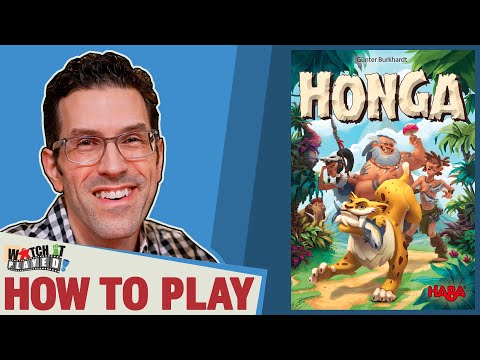
Every turn, a player places a single circular card onto one of four intersections on the board's central grid and rotates it into whichever of four orientations suits them, which Getting Games describes as producing up to sixteen effective options from one card. Each of the four hands on the card activates one of the eight surrounding action spaces once, so two hands pointing at the same location trigger that action twice. Watch It Played breaks the same system down during its teach, noting that cards drawn from the mammoth-tooth pile always carry five hands instead of the standard four, making them a stronger draw whenever a player can claim one.
Four Paths to Points
Around the center, the action spaces cover gathering mushrooms, berries, fish, or water, paying homage to move a chieftain up the sacred mountain, bartering resources for cards, combing the forest for action cards, and spending food to attract mammoths. Getting Games lays out each of these while teaching the game, and Meeple University demonstrates the bartering path directly, spending an entire hand of resources, including two water standing in for a fish, to complete two order cards worth eight points in a single turn.
The Honga Experience
A Tiger Nobody Wants to Feed
The recurring texture of play, according to both playthrough channels, is negotiating who ends up stuck with Honga. If no hand points at his central space on a player's own turn, he moves into that player's area and eats their best available food, and if he is still there at the start of their next turn, he eats again. Getting Games explains that Honga will keep sitting in that player's territory until a different opponent neglects him on their own turn instead, which pulls Honga away and onto that opponent's board; sending a hand toward Honga protects a player from being the one who draws him over, but it does nothing to remove him once he has already arrived.
Chasing Majority and Bigger Cards
Meeple University highlights how claiming the majority of mammoths on the shared herd track hands a player the mammoth tooth card pile, and drawing from it gives access to five-hand cards, which the channel describes as getting a more powerful turn card. That swing, paired with the pressure to keep Honga fed, is what both playthroughs point to as the source of tension on nearly every turn.
What Makes Honga Stand Out
Bursty, Swingy Scoring
Getting Games singles out the scoring as a highlight, describing Honga as a bursty type of game where points arrive in large chunks rather than trickling in, whether through climbing the sacred mountain or cashing in a run of bartering cards in the middle of the game. Meeple University's own play backs that up, turning an entire hand of resources into an eight point swing across two barter cards in a single turn.
A Predator That Forces Interaction
Because Honga only moves on once a different player neglects him and draws him away, the mechanic pushes players into direct interaction rather than parallel solitaire play. Getting Games shows this as a deliberate choice in action, sending a hand toward Honga on one turn specifically so he stays parked on an opponent's board instead of moving onto their own.
Potential Drawbacks
Feeding Honga Can Feel Like a Tax
The same mechanic reviewers praise for interaction also draws direct criticism. Meeple University calls it annoying when Honga arrives to eat food that was being held for a bartering card, and later describes a turn where every option means wasting three hands, either petting Honga or claiming a single mammoth, calling the resulting card very inefficient.
The Endgame Can Stretch Out
Crossing the point threshold does not end Honga immediately. Getting Games explains that once a player passes the target score, everyone else still finishes the round so that all players have taken the same number of turns, which can leave trailing players grinding out extra turns after the outcome already looks settled.
If You Enjoy Honga
The Cardboard Herald, talking with HABA about the publisher's catalog, grouped Honga together with Miyabi as one of the "game night approved" family strategy titles in HABA's lineup, describing both as games that "absolutely killed it" in the channel's own game group.
What Reviewers Are Saying
"This is a very bursty type game. Points can be acquired in a very big way with really big terms that can happen through the mountain that is climbed by the Chieftains, but also with the bartering you can get tons of points."
— Getting Games
"We have to have at least one hand going into the center of the table, or Honga's going to come and eat our food, and that's annoying."
— Meeple University
"It was fantastic. It's an entry level family game, but man, it really still can have some bite and real competitive nature to it if you really want it to."
— Game Night Picks - Pair Of Dice Paradise