/pic7952898.png)






















House of Fado Deep Dive
What the Community Thinks About House of Fado
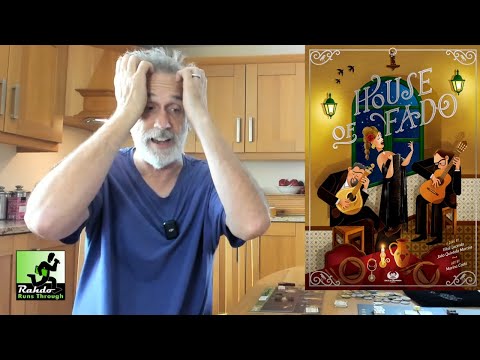
Rahdo Runs Through, across both a full two-player run-through and an earlier monthly-ranking video, frames House of Fado as a sharp, cleanly designed game from Vital Lacerda, praising the Portuguese fado theme and the streamlined, lighter-weight design compared to Lacerda's heavier catalog. Before You Play, who played a prototype copy ahead of the game's Kickstarter campaign, likewise praised the theme and the quick teach, ranking it against Lacerda's other recent codesigns.
Where the channels diverge is on how the two-player game actually plays. Rahdo's own two-player session with Jen fell flat for them personally, feeling dry and calculation-heavy, even while Rahdo insisted the design itself is excellent and recommended higher player counts instead. Before You Play's prototype session surfaced a related but distinct complaint: at two players, the kicked-out action spots felt far less dynamic, since there was usually one obvious best option to chase rather than real competition for space.
Core Mechanics That Define House of Fado
Worker Bumping That Never Leaves the Board
Rahdo explained that House of Fado's version of worker bumping breaks from the version popularized by designer Jamie Stagmire's Euphoria: once a worker is placed on the board, it never returns to a player's hand. Instead, bumping a worker off a space gives the bumped player a choice of one of up to three bonuses, and that worker then has to move into a new space elsewhere on the board, since the only way to act again is to keep cycling from location to location.
Running a Restaurant to Promote Musicians
Rahdo described the game's loop as only nominally about running a restaurant: players bring in customers to make money, but spend that money hiring fado singers and guitarists, and the real objective is pushing those performers up through the ranks until they can be sent out into the world for a big score. Before You Play's Navine laid out the same loop from the teaching side, describing how customers arrive, spend money, and the resulting reputation is what keeps the business, and its musicians, thriving.
The House of Fado Experience
A Tense, Timing-Driven Two-Player Game
Both Rahdo and Before You Play found the two-player experience notably tighter than expected. Rahdo called it a very dry, calculation-heavy, crunchy game at two players, one where missing a single coin can mean moving to a space and getting no bonus at all because none of the available options are affordable. Navine made a related point from the prototype table: with just two players, whoever reaches the better kicked-out spots first tends to keep them, so that portion of the design does not come alive the way it would with a third or fourth player in the mix.
Thematic Touches That Bring the Restaurant to Life
Rahdo singled out small details that reinforce the theme, like performers standing to applaud once a player closes up shop for the night, calling it a silly little idea that still brings the theme to life. Before You Play's Navine likewise praised the Portuguese music history woven into the design, noting both designers are Portuguese, and comparing the experience to how much they had already learned about Portuguese history through Lacerda's earlier Lisboa.
What Makes House of Fado Stand Out
A Genuinely New Twist on a Familiar Mechanism
Rahdo called this one of the best examples of worker bumping they have seen, crediting the never-off-the-board twist with increasing the odds of players interfering with, and helping, each other, which they count among their favorite kinds of positive player interaction. They noted that another board game YouTube show built an entire episode around the game's particular take on bumping.
A Lighter, More Accessible Lacerda
Both channels connected House of Fado to Lacerda's larger body of work. Rahdo described it as the latest in a run of codesigns, alongside Bot Factory, that strip Lacerda's usual heavy, crunchy design down to its simple core system without burying players in thematic special rules. Before You Play ranked it directly against that same lineage of games, treating the comparison as the clearest way to place it.
Potential Drawbacks
Thin at Two Players Without the Assistants Promo
Rahdo found that House of Fado's fixed game length, which ends once three stars are collected regardless of player count, means two players have to do the work four players would otherwise share, a trade-off they said they are rarely a fan of. They noted the two-player mode includes an assistants system meant to tighten the board, and that a promo pack of alternate performers with special powers helps offset the otherwise identical default performers, but said they would never play without that promo and still found the base two-player game too dry for Rahdo and Jen's taste.
Limited Dynamics at Low Player Counts
Before You Play, playing a prototype version ahead of the game's Kickstarter launch, found the kicked-out action spaces far less dynamic at two players than at three or four, since there was rarely more than one obviously best option to chase. They also noted the musician-exchange system, where performers rotate in and out of a restaurant's roster, becomes more dynamic at higher player counts than it does head-to-head.
If You Enjoy House of Fado
Rahdo drew a direct line from House of Fado's worker bumping to Euphoria, the game they credit with introducing the mechanism to the hobby, and noted that designer Jamie Stagmire later revisited the same idea in Apiary. Both Rahdo and Before You Play connected the design to Lacerda's own The Gallerist, citing the shared worker-bumping core, and Before You Play ranked it directly alongside Lacerda's other recent codesign, Bot Factory, which they said they still preferred overall.
What Reviewers Are Saying
"But I love the idea here that no, once a worker is on the board, they're never coming off the board. They're always just going to be cycling from one place to another. One, that increases the opportunity for interference and overlap between players, which means more bumping, which is the most fun part."
— Rahdo Runs Through
"I love worker bumping, and I love the subject matter. I love the theme where we are restaurant tours who are less focused on actually trying to make brilliant meals, although that is the way we make money."
— Rahdo Runs Through
"That was a pretty refreshing for a Euro style game like this. Very, very simple concept, I, I do enjoy it. I think at the two-player count, the kicked out actions are not as dynamic as I would imagine at a three or four player game, because the board, at least for this prototype version, is the same no matter the player count."
— Before You Play