/pic5390676.jpg)


















Hues and Cues Deep Dive
What the Community Thinks About Hues and Cues
Hues and Cues stands as one of the most accessible and engaging party games for mixed groups, praised primarily for its elegant simplicity and inclusive design. The game succeeds at what many party games attempt; bringing players of varying experience levels together through a mechanic that requires no prior knowledge. Reviewers consistently highlight the game's remarkable ability to reveal how differently players perceive color, creating moments of genuine surprise and laughter as teammates guess wildly different interpretations of the same clue. The 480-color board presents both a strength and a limitation, offering incredible variety while simultaneously exposing how challenging it is to communicate abstract color concepts with just one or two words.
Core Mechanics That Define Hues and Cues
Compound Scoring and Strategic Choice
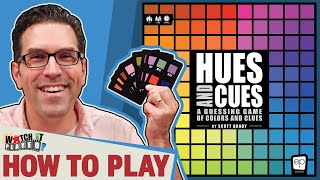
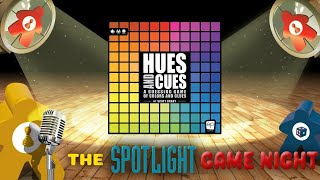
The scoring system operates on multiple tracks simultaneously, creating an elegant tension between helping your team and protecting your lead. When a cue giver reveals their chosen color, they earn one point for each piece placed within the scoring frame. Guessers score three points for exact matches, two points for pieces within the frame, and one point for adjacent spaces. Critically, cue givers face a strategic decision after the first round: they can choose whether to give a second clue. If enough teammates are already close to the target, a second clue might help competitors more than it helps the cue giver accumulate points. This creates a meta-game where controlling information becomes as important as communicating it. Watch It Played breaks down how a cue giver might withhold a second clue to prevent opponents from climbing the score track, adding a layer of push-your-luck calculation to an otherwise straightforward party game.
One- and Two-Word Clue Restraints
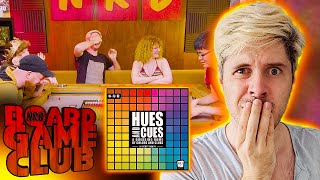
The ruleset restricts cue givers from using standard color names, spatial references, relative descriptors like lighter or darker, or objects visible in the room. This constraint forces creative thinking and abstract association. Reviewers describe how common reference categories emerge quickly: fruit (lemon, blueberry, cherry), vegetables (olive), sky phenomena, and pop culture references (Mario, Jigglypuff, Barney). The elegance lies in how these restrictions keep the game challenging without feeling punitive. No Rolls Barred's playthrough demonstrates how a single clue can send players in wildly different directional guesses across the board, with the same word evoking different mental images for each player depending on their personal associations and experience.
The Hues and Cues Experience
Accessible Gateway to Party Gaming
The game requires no learning curve beyond understanding that players should try to find the color on the board that matches the given clue. There is no turn order complexity, no resource management, and no catch-up mechanics needed for newer players to feel invested. Banter and Boards emphasizes how the 480-color grid ensures that even players who miss the mark remain competitive, since the scoring frame provides points for proximity rather than precision. This forgiving design makes Hues and Cues ideal for casual gatherings where not everyone knows each other well or where board game experience varies dramatically. The game works equally well with three players or ten, scaling naturally through team configurations.
Color Perception as Human Signal
Reviewers repeatedly marvel at how the game exposes the subjective nature of color perception. When one player interprets a clue entirely differently from their teammates, it becomes a moment of discovery rather than failure. Might I Suggest A Game notes that the more players involved, the merrier the experience, because each person brings their own color associations and memories. This turns the game into a fascinating window into how teammates' minds work, revealing shared cultural touchstones (everyone agrees tennis balls are yellow-green, for instance) while discovering surprising individual variations in how people categorize and name shades.
What Makes Hues and Cues Stand Out
Language-Independent Communication
Unlike clue-based games that rely heavily on wordplay or cultural knowledge, Hues and Cues transcends language barriers because the core mechanic operates through visual association rather than linguistic nuance. A cue giver from any background can use their own language to describe a color, and players from different language communities can participate without translation friction. Banter and Boards highlights this as one of the game's greatest strengths; you can play with any mixed-language group and success depends on shared color perception rather than shared vocabulary. The game has found adoption in international settings and casual play where traditional party games would require localization.
Vibrant Visual Design That Defines the Aesthetic
The 480-color rainbow grid serves as both the game board and the primary visual appeal. Reviewers repeatedly reference the gorgeousness of the color spectrum laid out before them. The grid creates a hypnotic visual landscape that draws players in and makes the game instantly recognizable on a shelf. No Rolls Barred describes it as a gorgeous rainbow road, and the colors range subtly enough that distinguishing between adjacent hues becomes part of the challenge. The physical components, while sometimes criticized for their cone-shaped markers, contribute to a cohesive aesthetic that feels like playing with a paint manufacturer's swatch guide. The visual presentation makes the game feel premium and collectible despite its straightforward mechanics.
Potential Drawbacks
Clue Exhaustion and Repetition
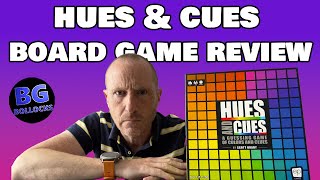
The most substantial criticism reviewers raise centers on clue depletion. Once players have cycled through obvious categories (fruit, vegetables, sky references, fabric textures), the well of intuitive associations runs dry. BoardGameBollocks articulates this problem clearly: after you've covered banana for yellow and blueberry for blue, where do you go next? The rules prevent repeating previously used clues, which accelerates the game's journey toward exhaustion. This limitation means Hues and Cues works best as an occasional party game rather than something pulled out frequently within the same friend group. The game does not reward deep, repeated play among a consistent group the way others might. Some reviewers compare this unfavorably to Wilmont's Warehouse, another clue-based game, which faces identical degradation issues.
Visual Impact Disconnected from Gameplay Depth
BoardGameBollocks notes a mismatch between the vibrant, colorful presentation and the relative emptiness of the experience. Despite the gorgeous grid, the game feels minimalist in action; players place pieces, colors get revealed, scoring is tallied. The striking visuals promise more gameplay heft than exists mechanically. For players seeking complex puzzle-solving or strategic depth, the accessibility that defines Hues and Cues becomes a liability. The game excels at what it does but never pretends to do more, and some reviewers find the disconnect between colorful presentation and straightforward execution unsatisfying for regular rotation play.
If You Enjoy Hues and Cues
Players drawn to Hues and Cues typically value social interaction over strategic depth and accessibility over complexity. If your gaming group includes non-gamers, if you host regular gatherings with variable attendance, or if you seek games that work across language and experience barriers, Hues and Cues remains a perennial winner. The game scratches the same itch as Wavelength or Just One, where the core appeal lies in revealing how teammates' minds work through collaborative guessing. For party planners, Might I Suggest A Game positions Hues and Cues as essential when you want everyone at the table engaged without needing extensive rulebook study. Consider pairing it with games that offer more strategic meat if your core group plays frequently, but its unmatched accessibility makes it an indispensable party staple.
What Reviewers Are Saying
"It's fascinating to see how everyone's perception of color is slightly different. If you've been picking out a lot of paint chips during the pandemic but you're tired of all the house projects, then might I suggest Hues and Cues."
— Might I Suggest A Game
"The scoring square is such that you could probably stray quite a bit out of its range and you're still going to score points. You've got a fighting chance even if you are not very accurate."
— BoardGameBollocks
"It's one of the best language independent games that I've played. This is just a fun game that you can pull out anywhere and everywhere. You can start playing instantly."
— Banter and Boards