/pic8280787.jpg)
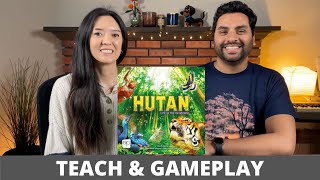
Step into a world of wonder and natural splendor with HUTAN: Life in the Rainforest, an immersive family game inspired by the Indonesian word for rainforest.
In HUTAN, all players have their own rainforest patch where they will plant sprouts and flowers that over time grow into towering trees. When a habitat is created, an iconic forest animal arrives: the orangutan, the sumatran tiger, the rhinoceros hornbill, the cassowary, or the sumatran rhino.
HUTAN plays over nine rounds, and all players have two turns each round. On your turn, you take a flower card from the shared market pool and place the flowers into your rainforest. If you place a flower on top of a matching flower, you grow a tree. When an area is completed with trees, the last tree is replaced by an animal.
At the end of the game, the player who grew the best rainforest and attracted the most animals will score the most points and win.
—description from the publisher



- Really pretty game
- Really neat
- Enjoy the game a lot
- Don't think I'll ever get rid of it
- Some people may like Aqua better
- Life in the Rainforest
- Aqua: Biodiversity in the oceans
Mechanics (from transcript analysis)
- Spatial Organization — but you're trying to get these different um uh you're trying to get these different animals into your staying, but you're also trying to collect, I guess you could say, different areas of animals and those different areas are going to score you different levels of points based upon where they are in your in your rainforest sector.
Video topics + discussion points
Quotes (from this video)
- Marvel Dice Throne is one of the games that as a spiritual crossover?
- This is a really fun This is a game that any my kids any one of my kids will take take it and ask for it at game night.
- Champions of Midgard is a fantastic game.
- This is the game that encapsulates what I think the zombie apocalypse would be if it were to happen.
- It's so thematically rich.
- The mechanics are just so clean and smooth.
- Blood Rage? Blood Rage is my number 11.
- It's a hard way It's a hard game to teach new people how to play. And have them enjoy it.
- Oathsworn is an amazing game where you take on your characters. You go through this campaign story that's It's riveting from the first beginning until you're going through town.
- And then the second half is a boss battler and that boss battler is top notch.
References (from this video)

- Fantastic game
- Didn't think I would like as much as I do
- Very puzzly game
- Very satisfying
- Always forget the full name
- Ecosystem building
- Rainforest
- Calico
- Cascadia
Mechanics (from transcript analysis)
- Area Majority — Placing the last tree in a land area allows placement of an animal, which fertilizes adjacent spaces.
- Drafting — Players draft a card that allows them to take specific colors of flowers.
- Pattern Building — Players aim for groupings of the same color flowers and layer flowers to place trees and animals.
- Tile Placement — Players place flowers onto their board.
Video topics + discussion points
Quotes (from this video)
- If you have a top 100 games, I'd love to see your's down in the comment section.
- This is a fantastic game.
- I really want to try in the future, and like even starting from now, just trying to get more games to the table that I want to play.
- Maybe that is me doing more solo playthroughs. Maybe that's something that you guys would want to see or just trying to figure out a way to bring in more playing of games onto the channel rather than talking about them.
- This is a wonderful and very unique worker placement game about cheese.
- This is a game that is slept on time and time again.
- It has made me a little bit sad that it has dropped down to 76, but I think this one is just in that category of games that I've just played so many times that I still really enjoy it.
- I feel like this is a game that has not gotten enough love.
- This is such a fantastic game and one that I didn't think I would like as much as I do, but it is just a very puzzly game.
- I would love to own it, but realistically, I don't really need to own it unless I wanted to play it solo.
- The two plays that I've had of this game have been absolutely fantastic.
- If you have not played Sweet Lands, you need to play it because it is fantastic.
References (from this video)
- Engaging spatial puzzle
- Good for casual players and families
- High replayability with optional goals and scenarios
- Easy to teach and quick to play
- Surprising depth and strategic choices
- Can be unforgiving with negative points
- Luck factor can be more pronounced in 2-player games
- Some board sides are difficult to manage
- Life in the rainforest
- Rainforest
Mechanics (from transcript analysis)
- area enclosure — The way you're doing this is at my turn, I'm going to take a card. For example, this card, which has a yellow and a black on it. I'm going to take a yellow and a black flower token and I'm going to place them on the board.
- Card Drafting — you will be drafting cards to place flower tokens out on your board to try to grow trees and try to attract animals.
- Scoring objectives — You're going to score points for the areas where you have only one color. You're going to score two points for each tree. You're going to score points for the animals depending on the areas that you are playing in.
- Set Collection — What I want to do is to not mix up the colors in these different areas on the board. So, for example, I don't want to do this and place that. It wouldn't make any sense because that would net me negative points at the end of the game.
- Variable player powers — Also the board makes the game more easier or more difficult because you have some of the sides. These you can like have different sides of and some of two sides, not more. It's not like it's four sides of each board. It's not a cube. It's just like a board and you have six sides.
- Worker Placement — When I place a second one of the color, I place a tree over there. And if I manage to place a second red over here, I will instead attract an animal if there's more red animals left because I have finished this as a perfect area.
Video topics + discussion points
Quotes (from this video)
- It can be a little deceiving because actually pretty tight the puzzle.
- And that makes this game a little unforgiving especially to new players and also uh younger players.
- I feel like if you if you want a very light but with crunch and especially since you can add the missions and the scenarios make it so that even if you're playing with casual players or if you are a family or a light gaming group you want to play a game a lot of times you can learn to get better and better and of course the interaction and the drafting makes also the replayability higher because of that.
- I think that Tutan was a a surprise for me that I had no like feelings about how good would be and I I just enjoyed playing it and I was happy to be like oh let's just play it again and I was happy to play it again and again which is a positive thing for me.
References (from this video)

- beautiful components
- cohesive family-weight strategy
- slightly lighter than Amazonia
- growth and forest biodiversity
- rainforest life, animal placements
- accessible ecological theme
- Aqua/Biodiversity
Mechanics (from transcript analysis)
- Set Collection — gain points via matching cards
- Tile Placement — flowers -> trees -> animals progression
- tile placement and growing trees — flowers -> trees -> animals progression
Video topics + discussion points
Quotes (from this video)
- We are AI police.
- SHACKLES OFF MY FEET, YEAH.
References (from this video)

- Really enjoyed it
- Simple and quick
- Nice game
- Other games in the genre are preferred
- Played enough, no desire to explore more
- Life in the rainforest
- Rainforest
Mechanics (from transcript analysis)
- Drafting — It's a very simple and quick tile placement drafting kind of game.
- Tile Placement — It's a very simple and quick tile placement drafting kind of game.
Video topics + discussion points
Quotes (from this video)
- Girl I never got around to play. When I tried to getting into solo, I don't remember when it was like a couple years ago. I try thinking I'm gonna make a solo series because that's going to be a good idea and I didn't enjoy myself too much because it felt like work.
- It's one of those where it's a very clever game. It's very good. It's just a little bit dry and a little bit long for what it was.
- I feel like I played it enough because we got to play this a couple of times, a few times uh when we got it.
- Legacies was for me too much work for the fun I had. It is a little convoluted. It's it's a it's a cool game, but it's not my kind of game.
- In a crowded market of so many tile drafting, tile placement games, we have like we have harmonies, we have spectacular, what else do we have? Cascadia, we have still have Baron Park, we have King Domino, like we have ASU, we have so many games in this category.
- But I think I would have chosen to play for example Spectacular over it.
References (from this video)
- Gets pretty puzzly by the end.
- Gets cascading combos.
- Can be quick.
- The wild flowers/first player marker are very nice.
- Can get tough and complicated later.
- Easy to get into corners and difficult situations.
- Can lead to negative points for incomplete or mixed areas.
- Starting too many areas can lead to not being able to finish them.
- Some areas become impossible to complete due to placement restrictions (lakes, trees).
- building ecosystems to attract animals
- rainforest
Mechanics (from transcript analysis)
- action selection — Players draft cards and decide where to place flowers and build trees, influencing future plays and scoring.
- Animal placement — If an area is completely filled with trees of the same color flower, players "place a matching animal in that spot."
- Area Majority/Control — The goal is "hoping to complete areas with only one color of flower."
- Card Drafting — Players "drafting cards that show flowers" and "each round there will be cards available for the players to take."
- Objective scoring — There are "public scoring objectives" and "advanced rules that introduce these ecosystem cards" that provide end-game scoring conditions.
- Pattern Building — Flowers must be placed "adjacent to another flower that was already on the board and then the next flower must be adjacent to the one you just placed."
- Set Collection — Players aim to complete areas with "the same color of flower" to score points.
- Tile Placement — Players are "placing those flowers onto our rainforest board" and "place the depicted flowers into your rainforest."
- Tree Placement — Players can "place a second flower of the same color on top of an existing one and if you do you will remove the second flower and place a tree in its place."
Video topics + discussion points
Quotes (from this video)
- this is a game where we are going to be drafting cards that show flowers we're placing those flowers onto our rainforest board hoping to complete areas with only one color of flower plant trees on those flowers perfect ecosystems to attract the animals you see right here and we also have some kind of public scoring objectives uh to boot uh this is a a quick one it won't take up too much ofier time and it gets uh pretty puzzly by the end you'll see
- your goal is to fill in these various areas that are separated by the rivers with the same color of flower
- if you do not finish the area or you mix flowers within the area you will lose these points at the end of the game
- it starts getting more complicated it's it in the beginning it's oh so easy so open like oh hold on now like sometimes you have a three flower one you're like I don't want to see that that's just that's too scary that's tough
- my negatives really killed me
- it's like as you go along you just start at least I start working myself in a corners and you're like this is not good
References (from this video)

Mechanics (from transcript analysis)
Video topics + discussion points
Quotes (from this video)
- you really do bring it to life with all the trees all the animals
- it's just a magical place
References (from this video)
- 3D trees and wooden animals look great
- Engaging objective variety and setup variability
- growth, biodiversity, and habitat optimization
- tropical rainforest with tile placement and color-based scoring
- light, nature-forward
Mechanics (from transcript analysis)
- scoring via color completion — completing color groups and advancing trees and animals for points
- Tile Placement — place flower tiles to build out your rainforest
- variable setup — each game uses different starting tiles for replayability
Video topics + discussion points
Quotes (from this video)
- Hello and welcome to 2026. So this year I am doing four lists for my top games of 2025.
- This is the medium box game list.
- What would you put in this category? What do you think of my choices?
- Parks and Potions. This is a wonderful game. It looks amazing.
- I adore this game. I cannot wait for the expansion to come out in 2026.
- The artwork on this is incredible. It is really, really fun.
- This game for only being in a box this size is a table hog, but it is really cool.
- Obviously, I enjoy an ocean theme.
- There’s a ton of amazing tiny components in here with no lid.
References (from this video)
- planting flowers, growing trees, and attracting animals to create habitats for scoring points
- Indonesia
- instructional/tutorial
Mechanics (from transcript analysis)
- board areas and completion — the rainforest is divided into areas (2-5 spaces). an area is complete when all spaces are filled with the same color flowers; areas are scored at the end.
- deck, market, and card drafting — shuffle the deck of flower cards, deal nine face-down piles, create a market by flipping a stack, and players take turns drawing from the market.
- end game scoring and variants — after the market is exhausted, final scoring compares trees, animals, and completed areas; variants include family and advanced rules with ecosystem cards.
- flower token placement with adjacency rules — place flower tokens on a rainforest board in spaces, tokens must be in separate spaces, must be connected to each other, and cannot be placed in lake spaces.
- growing trees from flowers — after the plant phase, replace top flowers with trees to enable future scoring; trees are valued at the end of the game.
- perfect habitats and animal attraction — if an area is a complete habitat (single color with trees on every space), you may replace the last tree with an animal of that color; attracting an animal scores points and may fertilize adjacent spaces.
- round structure and market control — the game progresses through rounds with two turns per player per round; a Pangolin token determines first player for the next round and market-related actions influence turn order.
Video topics + discussion points
Quotes (from this video)
- huton life in the rainforest players will be planting flowers on their boards growing trees in their spaces and trying to fill in the areas of their boards in order to attract animals all of these things can help you score points in various ways and if you have the most points by the end of the game you win
- is played over nine rounds
- on your turn you'll complete three phases in order starting with planting flowers to do this pick anyone face up flower card from the market and then collect the matching flower tokens
- the flowers you collect on your turn must each go into their own spaces and be connected to each other
- you can only attract at most one animal per turn
- once there are flowers in your rainforest the first flower you place each new turn must be set adjacent or on top of a flower already in your rainforest
- First every player gains two points for every tree on their rainforest boards recording it on this top row
References (from this video)

- Engaging, puzzle-forward design with high variability and strong solo mode.
- Aesthetically pleasing with Vincent Dutrait's art; tactile components.
- Solid bridge for Cascadia/Harmonies fans and a distinct drafting/placement twist.
- Rich solo content: scenarios, achievements, and customization options.
- Endgame can punish incomplete groups and create potential frustration.
- Requires careful planning and can induce analysis paralysis for some players.
- Ecology and biodiversity in a stylized puzzle
- A rainforest environment where players place flowers, trees and animals on four boards to form color groups and ecosystems.
- Abstract puzzle with ecological theme; open-ended storytelling during play
- Cascadia
- Harmonies
- Aqua Biodiversity in the Ocean
Mechanics (from transcript analysis)
- Animal fertilization — Animals placed on a group fertilize adjacent spaces, enabling more placements and expanding scoring opportunities.
- Card Drafting — Drafts three cards and escolher one to place flowers on your board while discarding the other two.
- Compound Scoring — Four boards can be rearranged; layout influences scoring opportunities and strategies.
- End-game and objective-based scoring — Objectives grant points for trees, animals, and completed rows/columns, with penalties for incomplete groups.
- multi-board scoring — Four boards can be rearranged; layout influences scoring opportunities and strategies.
- Set Collection — Complete colors and groups to gain victory points; placing second flower on a group yields animals or trees that contribute to scoring.
- Set collection and grouping — Complete colors and groups to gain victory points; placing second flower on a group yields animals or trees that contribute to scoring.
- Tile Placement — Place flowers on your board adjacent to existing neighboring flowers to form groups.
- tile/board placement — Place flowers on your board adjacent to existing neighboring flowers to form groups.
Video topics + discussion points
Quotes (from this video)
- Speed huton is the play.
- I'm Filipino, so I'm required to love karaoke.
- This is Huton.
- Speed Huton is the play. Oh my goodness.
- Two reds on top of one another here, I'm going to take that away and we are going to add a tree.
- OBS is just not liking me today.
- I love this game, it's fantastic.
References (from this video)

- accessible for newcomers
- adds objectives for depth
- flower growth and tree-building
- tropical rainforest
- open drafting with objective choices
Mechanics (from transcript analysis)
- Card Drafting — draft flower cards; then place adjacent to form groups; layering flowers to grow trees; animals unlock scoring.
Video topics + discussion points
Quotes (from this video)
- Railroad Tiles is a game from Horrible Guild and this is a tile placement version of Railroad Ink.
- Huton Life in the Rainforest is absolutely wonderful and it is definitely one that I recommend.
- Pergola is such a beautiful game and the base gameplay is straightforward.
- The Anarchy is Hrien's Wall but different and just so good.
- For the Emperor is a fun, easy two-player game that's great as a stocking stuffer.
- A Nice Cupa has been really, really fun and one that I recommend for a stocking stuffer.
References (from this video)

- Accessible and quick to learn
- Deep drafting decisions with meaningful choices
- High variability due to a large pool of cards and maps
- Engaging engine-builder feel within a light-weight framework
- Good replayability, including solo mode and alternate maps
- Some luck elements in card draws
- Limited thematic integration compared to heavier, more narrative games
- Strategic depth not as grand as heavier abstract games
- eco-friendly tile drafting and growth through trees and animals
- Rainforest environment with flora and fauna, trees and color tiles to develop a landscape
- abstract-strategic tile placement with light thematic narration
- Zulto
- Colorado
- Nova Luna
- Applejack
- Acropolis
- Patchwork
- Heat
- Framework
Mechanics (from transcript analysis)
- Animal collection — If you fully plant trees, you may obtain limited animals for additional points.
- Card-driven variability — About 70 cards exist; roughly half are visible each game, driving variability and replayability.
- Fertilization (tile spreading) — Fertilize to place another colored tile in adjacent spaces, expanding your layout and scoring opportunities.
- Multi-Use Cards — About 70 cards exist; roughly half are visible each game, driving variability and replayability.
- Solo mode and map variety — Multiple maps and solo variants provide additional pathways for play.
- tile drafting — Draft tiles (colored flowers) from a common pool to determine what you can place on your board.
- Tile Placement — Place tiles to completely fill closed-off areas of the same color; scoring is based on completed areas.
- Tile placement and area fulfillment — Place tiles to completely fill closed-off areas of the same color; scoring is based on completed areas.
- Tree planting — Placing a second tile of the same color on a space allows planting a tree for end-game points.
- turn order control — Drafting the first-player token can influence next-round order, offering strategic flexibility.
Video topics + discussion points
Quotes (from this video)
- This game really stood out as something intriguing and replayable to me.
- It's not as strategic, but you still have the opportunity to understand your board and know where to start.
- This game is a lighter Rosenberg-style tile drafting experience with meaningful decisions.
References (from this video)

- Innovative modular board and chaining actions
- Replayability via configurations
- Solo mode with objectives
- Rules can be complex
- Placement constraints can create tense early games
- flower drafting, color placement, and tree growth
- Jungle/Rainforest with flowers and wildlife
- puzzle-driven, modular board design
Mechanics (from transcript analysis)
- Card Drafting — draft flower cards of various colors, including wilds
- layering to unlock trees/animals — placing layers enables trees and, later, animals that affect scoring
- Tile Placement — place flowers on a modular board to form color clusters
- tile/flower placement — place flowers on a modular board to form color clusters
Video topics + discussion points
Quotes (from this video)
- This is a game that I had never heard of before.
- I absolutely loved it.
- It is such a cool game, such a unique game.
- I think it's such a cool unique game.
- Emberleaf is such a fun game and I have really enjoyed playing it.
- Galaxy Trucker vibes in a different container—fun to watch engines grow and explode.
References (from this video)

- beautiful components and insert
- engaging puzzle with nice table presence
- solitary or solo puzzle appeal
- some players found two-player interaction weak
- rule clarity could improve
- habitat building and wildlife rewards
- tropical rainforest with animals
- eco-themed with visual delight
- Canopy, Amazonia
Mechanics (from transcript analysis)
- limited animal supply — scarce animals influence scoring and blocking
- pattern matching — score based on completing outlined areas
- tile placement and area completion — place trees/flowers to complete areas and attract animals
Video topics + discussion points
Quotes (from this video)
- it's a fun game
- Monopoly Deal is on point
- we are in love with Word Flux
- the rule book needs to be better
References (from this video)
Mechanics (from transcript analysis)
Video topics + discussion points
Quotes (from this video)
- it's simple in rule set but it is crunchy decision-making
- the decision-making is not going to be that simple
- we are playing with the advanced variant
- tile placement game where the tiles are flowers
References (from this video)
- Engaging and crunchy decision-making
- Rich endgame scoring with ecosystem cards
- Clear rainforest habitat theme
- Multiple variants (solo, family, advanced) for replayability
- Rules can be complex and crunchy; notable learning curve
- Endgame scoring depends on selecting lines of play and can punish riskier choices
- Randomized ecosystem cards add variability that may feel opaque to new players
- biodiversity, habitat creation, ecosystem balance
- Indonesian rainforest
- educational, ecological simulation
Mechanics (from transcript analysis)
- Animal placement — attract animals when habitats are completed; animals score points and fertilize adjacent spaces
- area scoring — areas score based on completing color-homogeneous groups; incomplete or mixed colors incur penalties
- fertilization — attracting an animal fertilizes orthogonally adjacent spaces, enabling color choices for future tiles
- market/draft — three face-up cards plus a pengalin token to draft or claim, with drafting order determined by turns
- Scoring variants — advanced endgame scoring cards (ecosystem cards) provide additional goals; solo and family variants exist
- Tile Placement — place flower tiles orthogonally with color-matching constraints and connect tiles to form areas
- tree growth — a second tile on a stack can grow a tree; the top tile is discarded and the tree scores later
Video topics + discussion points
Quotes (from this video)
- it's simple in rule set but it is crunchy decision-making
- the decision-making is not going to be that simple
- we are playing with the advanced variant
- tile placement game where the tiles are flowers