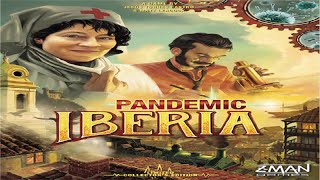


























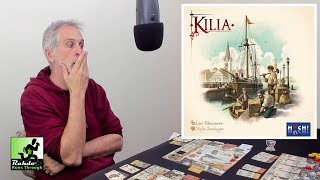


Iberia box art

Iberia

Game ID: GID0164796
Collection Status
Description

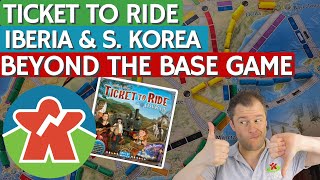
Welcome to the Iberian Peninsula! Set in 1848, Pandemic Iberia asks you to take on the roles of nurse, railwayman, rural doctor, sailor, and more to find the cures to malaria, typhus, the yellow fever, and cholera.

From Barcelona to Lisboa, you will need to travel by carriage, by boat, or by train to help the Iberian populace. While doing so, distributing purified water and developing railways will help you slow the spread of diseases in this new version of Pandemic.

Discover a unique part of the world during a historically significant time period: the construction of the first railroad in the Iberian Peninsula during the Spring of Nations.

The game comes with two variants that can be added :

Influx of Patients : the cubes, representing patients, will tend to flock to hospitals to try to get cured. Hospitals also are a bit more powerful.
Historical Diseases : instead of being generic, each disease has a specific power to better represent what it is (Malaria, Cholera, Yellow Fever etc.)

Part of the Pandemic series.

Year Published
2016
Transcript Analysis
Browse transcript mentions, sentiments, pros/cons, mechanics, topics, quotes, and references.
Total mentions: 9
This page: 9
Sentiment: pos 5 · mix 3 · neu 1 · neg 0
Mentions per page
Top
Showing 1–9 of 9
Video b23ZLUiNOAQ Danielle rules teach at 0:03 sentiment: mixed
video_pk 60918 · mention_pk 153336
Danielle - Iberia video thumbnail
Click to watch at 0:03 · YouTube ↗
Overall sentiment (raw)
mixed
Pros
  • Clear, thematic icon-driven action system that is approachable for teaching
  • Accessible setup and explicit walk-through of potential strategies
  • Solid solo play with meaningful decisions around management of stock, flash, and platform cards
Cons
  • Luck-based elements can make early turns feel unforgiving (described as 'pusher luck')
  • Learning curve can be steep for new players due to multiple interrelated zones and upgrade paths
  • Early inability to repair machines can lead to quick losses if not lucky with draws
Thematic elements
  • automation, resource management, and logistical puzzle solving
  • Industrial factory/robot assembly environment with a sci-fi flavor
  • abstract, component-driven skirmish with a focus on planning and execution
Comparison games
  • Onirim
  • Only Rim
Mechanics (from transcript analysis)
  • deck management — draws from robot decks into the flash; some icons allow you to move or retrieve robots from different zones
  • end-of-turn cleanup and stock management — discard and refill steps, with tokens and debits to manage the factory and platform rows; some tokens provide special one-time effects
  • fail-safes and deck cycling — fail save tokens provide a last-resort mercy when you cannot fulfill a machine; after cycling the deck you flip a reminder token to track progression
  • Icon-driven actions — five icons on the main board determine how you manipulate robots between stock, flash, platform, and discard areas, driving core decisions every turn
  • machine repair and requirements — machines require specific robot sizes or combinations to repair; cards are spent to fulfill machine requirements, pushing strategic tradeoffs
  • upgrading and experience — experience cards upgrade robots to higher levels, enabling more powerful actions and enabling eventual completion of higher-tier machines
  • win condition — the objective is to clear all machines from the factory; once the factory is empty you win
Video topics + discussion points
No key topics recorded for this video.
Quotes (from this video)
  • solo tutorial for Siberon
  • my top one is only rim and then this one is going to be the second one in my ranking
  • it's not easy
  • it's kind of like a pusher luck game
  • the point of the game is to complete all of these machines
  • you win the game when there are no machines left in the Factory
References (from this video)
No references stored for this video.
Video KhkpphUJB04 Board Gaming Doctor playthrough at 0:06 sentiment: positive
video_pk 42886 · mention_pk 130349
Board Gaming Doctor - Iberia video thumbnail
Click to watch at 0:06 · YouTube ↗
Overall sentiment (raw)
positive
Pros
  • Offers a compelling solo challenge format that encourages optimization and learning through repeated play.
  • Appeals to fans of Rosenberg designs and Agricola due to thematic and mechanical overlap.
  • Potential for depth and mastery with continued practice and exploration of solo rules.
Cons
  • Solo rules contain edge cases that can be confusing or non-intuitive at times.
  • Performance in this video was impacted by illness, which may not reflect typical play.
  • Overall complexity may be intimidating to new players or those new to Rosenberg-design games.
Thematic elements
  • Dwarven resource management and cavern expansion, with a strong thematic link to Rosenberg's game design sensibilities and Agricola-inspired lineage.
  • A dwarven cavern settlement with mining and caverns, positioned as a resource-driven puzzle environment.
  • Puzzle-like solo optimization with a focus on improving efficiency and strategic planning over multiple sessions.
Comparison games
  • Agricola
  • Glass Road
  • Applejack
Mechanics (from transcript analysis)
  • Resource management — Balance and manage resources (food, wood, stone, ore, etc.) with constraints and solo-specific rules.
  • resource_management — Balance and manage resources (food, wood, stone, ore, etc.) with constraints and solo-specific rules.
  • tile placement — Players lay cavern tiles and rooms to shape their cavern layouts and scoring opportunities.
  • tile_placement — Players lay cavern tiles and rooms to shape their cavern layouts and scoring opportunities.
  • worker placement — Players assign dwarves to actions to gather resources, build structures, and develop their caverns.
  • worker_placement — Players assign dwarves to actions to gather resources, build structures, and develop their caverns.
Video topics + discussion points
No key topics recorded for this video.
Quotes (from this video)
  • this is the first of many weekly challenges that I portray on this channel.
  • I'm ready to tackle a new puzzle essentially in Kverna.
  • this sort of serves as a baseline for me to get better at in the future.
  • without further ado I'll let you watch and analyze the game for yourselves.
  • Thank you.
References (from this video)
No references stored for this video.
Video DBveL_yUoQM War Game Garden top_10_list at 21:22 sentiment: positive
video_pk 40027 · mention_pk 120992
War Game Garden - Iberia video thumbnail
Click to watch at 21:22 · YouTube ↗
Overall sentiment (raw)
positive
Pros
  • very beautiful component art
  • satisfying puzzly flow
Cons
  • may feel repetitive after a few plays
Thematic elements
  • aesthetics and tile-layered floor plan
  • a cafe floor-building puzzle
  • elegant and immersive
Comparison games
none
Mechanics (from transcript analysis)
  • color-based tile placement — place colored cards to build out a cafe floor with nested rings
  • hand management — draw more cards to access new floor pieces
  • hand-management / drawing — draw more cards to access new floor pieces
  • tile placement — place colored cards to build out a cafe floor with nested rings
Video topics + discussion points
No key topics recorded for this video.
Quotes (from this video)
  • Creature Caravan is absolutely wonderful
  • these expansions add a little bit more player interaction which I think is absolutely amazing
  • I think this is one of the most aesthetically pleasing games I've played
  • Beyond the Sun is space-themed
  • Fromage is truly just a really great game
  • MOS: Dawn of the Bronze Age is absolutely wonderful
References (from this video)
No references stored for this video.
Video bLPWZ-MPvA8 Board Game Garden general_discussion at 18:52 sentiment: positive
video_pk 37861 · mention_pk 113764
Board Game Garden - Iberia video thumbnail
Click to watch at 18:52 · YouTube ↗
Overall sentiment (raw)
positive
Pros
none
Cons
none
Thematic elements
Comparison games
none
Mechanics (from transcript analysis)
Mechanics unknown.
Video topics + discussion points
No key topics recorded for this video.
Quotes (from this video)
  • you are somebody's reason to smile
  • we are so close to 30,000 Garden members
  • thank you all so much for watching and for your support
  • I am leaving for Japan and I cannot wait to document it
References (from this video)
No references stored for this video.
Video YZAjQpwHdyY Totally Tabled playthrough at 0:08 sentiment: mixed
video_pk 27923 · mention_pk 81542
Totally Tabled - Iberia video thumbnail
Click to watch at 0:08 · YouTube ↗
Overall sentiment (raw)
mixed
Pros
  • Engaging engine-building and upgrade system that creates emergent play opportunities.
  • Clear, tactile management of robots across platform, stock, and flash zones.
  • High tempo and decision density; interesting risk/reward when choosing upgrades and discards.
  • Solo playthrough feels like a well-designed puzzle with multiple viable paths.
Cons
  • Heavy reliance on draw luck can make early rounds feel punishing or inconsistent.
  • Steep learning curve; non-intuitive zone interactions require careful setup and reminders during play.
  • Complex upgrade economy may overwhelm new players or slow down the pacing in a solo session.
Thematic elements
  • Robot repair and upgrade loop within a time-limited factory setting.
  • A factory world where players repair machines using modular robots and upgrades.
  • Abstract puzzle/gameplay loop with a focus on optimization rather than a story arc.
Comparison games
none
Mechanics (from transcript analysis)
  • Color/size matching — Repairs require specific robots by color and/or size to satisfy machine demands.
  • Deck building — Draw from a robot deck, discard, and upgrade via an experience pile to exert more control over future turns.
  • deck manipulation — Certain robots let you peek at or manipulate the top cards of decks/discards to steer future draws.
  • deck-building/hand management — Draw from a robot deck, discard, and upgrade via an experience pile to exert more control over future turns.
  • Fail-safes and time pressure — A finite number of fail-safe tokens and a battery-reshuffle mechanic creates a hard time limit; failing to repair enough machines risks losing the game.
  • Progressive ability effects — Robot abilities scale with level, unlocking stronger actions (e.g., look at top of deck, add cards to flash, or manipulate the stock).
  • Special actions and look-at mechanics — Certain robots let you peek at or manipulate the top cards of decks/discards to steer future draws.
  • Stock/Platform/Flash zones — Robots exist in three zones: platform (active), stock (permanent reserve), and flash (temporary holding), with decisions about moving cards among zones shaping round flow.
  • Upgrades and experience — Repaired machines contribute to an experience pool that powers robot upgrades and special abilities.
Video topics + discussion points
No key topics recorded for this video.
Quotes (from this video)
  • we're going to be repairing some machines
  • wow we have a lot of green cards
  • not sure if that was a good idea or not
  • not quite there but that was a complete solo game of Siberon
References (from this video)
No references stored for this video.
Video 6-5zolfAVP8 Heavy Cardboard playthrough at 1:01 sentiment: mixed
video_pk 10963 · mention_pk 103682
Heavy Cardboard - Iberia video thumbnail
Click to watch at 1:01 · YouTube ↗
Overall sentiment (raw)
mixed
Pros
  • The knowledge limiter creates meaningful pacing decisions
  • Two rondelles create dynamic spatial competition
  • Multiple scoring routes encourage varied strategies
  • Pleasant theme integration with historical flavor
Cons
  • Pace can be frenetic, especially at higher player counts
  • End-game scoring depends on tiles; can feel punishing or ‘sniped’
  • Limited appeal to 2-player; setup and tempo may be too heavy
Thematic elements
  • tableau-building, exploration, and river trade in ancient river valleys
  • Ancient Mesopotamia along the Tigris and Euphrates
  • puzzle-like tableau-building with multiple scoring tracks
Comparison games
  • Carcassonne
  • Cascadia
Mechanics (from transcript analysis)
  • End-game scoring and majority scoring — End-game scoring uses majorities in temples, cities, trees, mountains, technologies, rivers; multiple paths to reach end-game tiles.
  • Knowledge track limiter and scoring — A knowledge track on the board limits how many points you can score in a single action; raises as you acquire knowledge.
  • Movement and bumping — On turns players move their pieces 1-2 (sometimes 3) spaces; can displace opponents by paying lapis and stealing papyrus.
  • Priest/landscape interaction — A priest piece moves to new tiles and can teleport when lineups enable; exploration mechanics interact with tile placement.
  • Resource management — Lapis and papyrus are produced by tiles; lapis is used to move and bump opponents, papyrus is scarcer and valuable.
  • resource management and production — Lapis and papyrus are produced by tiles; lapis is used to move and bump opponents, papyrus is scarcer and valuable.
  • Rondel — Nested rondelles control movement of boats and wanderers; movement pace is limited by lapis and can be augmented by taxing opponents.
  • Rondelle movement — Nested rondelles control movement of boats and wanderers; movement pace is limited by lapis and can be augmented by taxing opponents.
  • Scoring tiles and set collection — Face-up tiles provide immediate and end-game scoring; players collect tiles during play and later confirm their final values.
  • set collection — Face-up tiles provide immediate and end-game scoring; players collect tiles during play and later confirm their final values.
  • tile placement — Tiles are placed to form paths and scoring opportunities; tiles near priests can be rotated and colorful placements affect scoring.
  • tile placement and rotation — Tiles are placed to form paths and scoring opportunities; tiles near priests can be rotated and colorful placements affect scoring.
Video topics + discussion points
No key topics recorded for this video.
Quotes (from this video)
  • Rondell's meets Carcassonne.
  • It's a tableau builder, tile lane game.
  • The knowledge track is your limiter.
  • The game ends when tiles run out and you finish that round.
  • It's a race game to get to those scoring tiles.
References (from this video)
No references stored for this video.
Video RqAko422vUE Unknown Channel game_review at 0:16 sentiment: positive
video_pk 9096 · mention_pk 93392
Unknown Channel - Iberia video thumbnail
Click to watch at 0:16 · YouTube ↗
Overall sentiment (raw)
positive
Pros
  • high production quality and superb artwork
  • rulebook is clear with helpful pictures and examples
  • strong strategic depth with little randomness
  • variety of useful, well-designed cards
  • rules become intuitive after the first round
Cons
  • grain market dynamics can make catch-up difficult for players who fall behind
  • limited mechanisms to move players up in markets, reducing comeback potential
  • initial complexity can be intimidating for some new players
Thematic elements
  • building monuments (Sphinx, Obelisks, Graves, Pyramid/Temple) with workers and resources
  • Egypt, Nile valley during ancient times
  • historical-legendary with objective-driven scoring
Comparison games
none
Mechanics (from transcript analysis)
  • Compound Scoring — Sphinx cards and graves/obelisk tiles provide end-of-round and end-of-game scoring opportunities
  • Deck and card management — drawing from Nile card decks and Sphinx card decks; using start cards and Sphinx cards to drive actions and scoring
  • Market-driven scoring — stone and grain markets influence scoring and penalties through production and feeding mechanisms
  • Resource management — managing stones and grain to support construction and to feed workers; limited markets influence resources
  • round-based building phases — five rounds with distinct building priorities and scoring opportunities; phase progression determines actions and available tiles
  • set/objective scoring — Sphinx cards and graves/obelisk tiles provide end-of-round and end-of-game scoring opportunities
  • ship placement along the Nile — placing ships along the Nile from the Source to build on various spaces; downstream/upstream placement rules constrain options
  • Variable Phase Order — five rounds with distinct building priorities and scoring opportunities; phase progression determines actions and available tiles
Video topics + discussion points
No key topics recorded for this video.
Quotes (from this video)
  • The quality is superb
  • the artwork is nice
  • there's a lot of strategy involved with little to no Randomness
  • we give it an 8.5 out of 10
  • the rule book has great pictures and examples
  • this game was a lot of fun
References (from this video)
No references stored for this video.
Video MZSnz8lAjQ4 Board Game Rules rules teach at 0:02 sentiment: neutral
video_pk 5665 · mention_pk 81506
Board Game Rules - Iberia video thumbnail
Click to watch at 0:02 · YouTube ↗
Overall sentiment (raw)
neutral
Pros
  • Strategic decision-making
  • Limited resources create tension
Cons
none
Thematic elements
  • Crafting wooden ornaments
  • Artisan workshop
  • Competitive crafting
Comparison games
none
Mechanics (from transcript analysis)
  • Card placement — Strategically use cards to construct ornament pieces
  • pattern matching — Match ornament pieces to tool board tiles
  • Point collection — Earn victory points from completed ornaments and tool tiles
Video topics + discussion points
No key topics recorded for this video.
Quotes (from this video)
  • In Inaria, you step into the shoes of a skilled Artisan crafting beautiful wooden ornaments
References (from this video)
No references stored for this video.
Video eAf9BpsDZBk Unknown general_discussion at 2:54 sentiment: positive
video_pk 3198 · mention_pk 9413
Unknown - Iberia video thumbnail
Click to watch at 2:54 · YouTube ↗
Overall sentiment (raw)
positive
Pros
  • short to medium play with euro feel
  • easy to teach compared to giants
Cons
  • not as deeply known as other euro giants
Thematic elements
  • merchant exploration and routes
  • late 18th-century Iberian trade and exploration
  • economic/trade game flavor
Comparison games
  • Brass Birmingham
  • Agricola
  • Through the Ages
Mechanics (from transcript analysis)
  • route/rail-like network — Build a supply network across Iberia to gain points.
Video topics + discussion points
No key topics recorded for this video.
Quotes (from this video)
  • gloomhaven well everybody knows that right
  • pandemic season one is a cooperative game
  • it's the crew
  • code names
  • magic maze
  • the correct answer is sheriff of Nottingham
  • subscribe like and comment on this video
  • time stories isn't it but time stories isn't as well so one point for you
  • you don't know board games
  • Terraforming Mars
References (from this video)
No references stored for this video.
Transcript Navigation
Top
Showing 1–9 of 9
View on BoardGameGeek