
























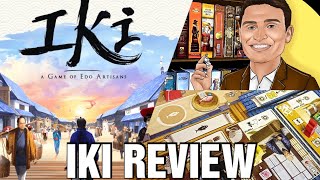


Edo — what we now know today as Tokyo, Japan — was a thriving city with an estimated population of one million, half townspeople and half samurai. With a huge shopping culture, Edo's main district, Nihonbashi, was lined with shops, selling kimonos, rice, and so much more.
Nihonbashi is the focus of IKI: A Game of EDO Artisans, which brings you on a journey through the famed street of old Tokyo. Hear the voices of Nihonbashi Bridge's great fish market. Meet the professionals, who carry out 700-800 different jobs. Enter the interactivity of the shoppers and vendors. Become one with the townspeople.
One of the main professions in the world of Edo is the artisan. Each of the Edo artisans uses their own skill of trade to support the townspeople's lives. In this game, not only are there artisans, but street vendors, sellers at the shops, and professions unique to this time and age. Meet the puppet masters, putting on a show. Meet the ear cleaners that people would line up for.
The goal of this game is to become the annual Edoite, best personifying what is known as "IKI", an ancient philosophy believed to be the ideal way of living among people in Edo. Knowing the subtleties of human nature, being refined and attractive — these are all elements of a true IKI master.
- Tapestry
Mechanics (from transcript analysis)
Video topics + discussion points
Quotes (from this video)
- Dinosaur Island oh my gosh this is impossible there's no way to beat them all
- the mill is victorious in the league for rankings
- we tie at two goals and we go times three 2 * 3 is 6 for both of us
- next time we are going to league three
- the mill team might not end up victorious in this league
References (from this video)
- Calming, beautiful artwork across board, cards, and player mats
- Gorgeous, screen-printed components and clean iconography
- Tightly designed engine that remains approachable despite multiple moving parts
- Excellent player aids and layout that keep gameplay brain-free
- Strong replayability due to multiple strategic focuses and year/season transitions
- Adapts well to 2-4 players with minimal flow disruption
- Midweight design that may not satisfy players seeking heavier simulation
- Cannot do everything in a single session, requiring thoughtful prioritization
- Two-player variant reduces available spaces and slightly alters pacing
- Economic development, trade, and guild dynamics in a historic urban setting
- Edo period, Japan, 1600s, bustling marketplace of Edo
- Historical flavor with procedural, resource-management gameplay and seasonal progression
Mechanics (from transcript analysis)
- action_selection — choose order of actions on the turn order track using ikibana; walking distance and timing are affected by your choice
- card drafting — draft cards each season to represent items, buildings, and actions that influence scoring and options
- card_drafting — draft cards each season to represent items, buildings, and actions that influence scoring and options
- economic_engine — manage money, resources (fish, pipes, buildings), and fires to optimize scoring
- set_limitation_and_choices — a tight set of choices constrained by space, timing, and the threat of fires that shapes your path
- tableau building — build a personal tableau with buildings and items that provide ongoing effects
- tableau_building — build a personal tableau with buildings and items that provide ongoing effects
- worker placement — place workers to activate spaces, gain money, and hire new characters
- worker_placement — place workers to activate spaces, gain money, and hire new characters
Video topics + discussion points
Quotes (from this video)
- the art is lovely from the board to the player mats
- the icons are also all really clear and simple
- totally brain free so you can focus on the fun stuff
- gorgeous design
- drop dead gorgeous
- this should be a game that connects with most gamers
References (from this video)
- Deep, weighty strategy with a strong rondelle mechanic
- Solid depth for 2-4 players
- Rich thematic feel with meaningful decisions across multiple action spaces
- Longer playtime (approximately 90 minutes)
- Complex rules may be less accessible to casual players
- trading race through historic Tokyo
- historic Tokyo
- mechanics-driven, rondelle-based movement
- Planet Unknown
Mechanics (from transcript analysis)
- Rondel — board is a rotating circle; players move to spaces around the wheel to access actions
- Rondelle movement — board is a rotating circle; players move to spaces around the wheel to access actions
- variable turn order through movement — distance moved determines the order; further moves can push you later in the round but unlocks different actions
- worker placement — place a worker on a space to gain the action of the space you’re underneath
- worker placement / space activation — place a worker on a space to gain the action of the space you’re underneath
Video topics + discussion points
Quotes (from this video)
- these are three Dynamite games I think they did a great job picking them
- the game is all in the cards and really how you're making your deck building it exactly the way you want to build it
- Planet Unknown totally takes it
- I think Challengers is a great game
- I think Iki is a really good game and a game that's going to stay
- this is a real treat it is a real delight
References (from this video)
- unique rondel mechanism with a strong decision cadence
- tight scoring with interesting trade-offs
- attractive components and presentation
- rules can be dense for new players
- rondel-based action selection and set collection
- Japanese-inspired marketplace
- elegant euro with a shop-building flavor
- Lorenzo il Magnifico
- The Quacks of Quedlinburg
Mechanics (from transcript analysis)
- Rondel — players take actions around a central wheel, affecting shop tiles and development
- round rondel action selection — players take actions around a central wheel, affecting shop tiles and development
- set collection / tile/piece upgrades — collect shop components to build a functional marketplace and gain points
Video topics + discussion points
Quotes (from this video)
- "tile placement and open market..., it's a smooth and perfect tile placement game"
- "Cascadia is a fantastic game that you can play with everyone"
- "endless winter paleo Americans is wide and thinky; a big, ambitious euro"
- "mind management is the best sort of one game you can buy"
- "production is insane—deluxe, beautiful components"
- "unsettled is a giant puzzle with every planet different"
- "Iki is a tremendous Euro game I absolutely love"
References (from this video)
- transparent objective tracks
- readable opponents' priorities
- depends on tile draws
- potential for suboptimal draws if luck dominates
- structured planning with visible objectives
- Tile-based progression and objective tracks
- transparent, track-driven scoring
- Sky Mines
Mechanics (from transcript analysis)
- tile drafting — players draft or receive tiles that may fulfill objectives or create new ones
Video topics + discussion points
Quotes (from this video)
- these are games like wingspan or Ark Nova in general these games are a lot of fun
- the designer's intent is that over the course of the game the luck is going to balance out
- it's up to the player to make calculated risks and mitigate for bad luck
- it's those times where the games can get really frustrating for me
- the remedy for players who like me don't like bad luck due to cards
References (from this video)
- Strong thematic integration with Edo market life and the civic life concept implied by Iky.
- Engaging shopfront and worker progression mechanics that create a sense of growing a business over time.
- Clear lifecycle from recruitment to retirement that provides a strong narrative arc within a Euro-style framework.
- Vibrant market atmosphere implied by the main street board and the bustle of shopfronts.
- Tension added by fire risk, which adds strategic weight beyond straightforward resource collection or action selection.
- Not discussed explicitly in the transcript, so any potential drawbacks are not cited directly by the speaker.
- Some players may find the card-front/worker progression system dense if unfamiliar with micro-management mechanics, though this is not stated by the speaker and would require playtesting to confirm.
- Civic life, urban commerce, and personal prestige in a traditional Japanese market. The game frames entrepreneurship as a civic duty and a personal career, with social status tied to shop management and community standing.
- Edo-period Japan, a bustling main street market in the city of Edo, structured around a year-long cycle of 13 rounds (12 months plus a new year).
- Economic simulation with a focus on micro-management of workers and shopfronts, presented through a market-street lens with a narrative of career progression from recruitment to retirement.
Mechanics (from transcript analysis)
- Employee progression and retirement — Each worker in a shop can advance along the micro-tracks printed on the card, gaining bonuses as they progress. When a worker reaches the end of the card, they retire, which represents a personal lifecycle and has implications for scoring and shop performance.
- Prestige scoring and career illusion — Prestige is accumulated through actions taken, shop management success, and the progression of workers, weaving thematic success with numeric scoring in a way that reward structures feel tied to career advancement.
- risk management — There is a thematic risk element in the form of fires that can threaten shopfronts, introducing tension and the need to balance growth with protection of existing assets.
- Risk management (fires) — There is a thematic risk element in the form of fires that can threaten shopfronts, introducing tension and the need to balance growth with protection of existing assets.
- Shop front cards as action tiles — Cards represent individual shop fronts. Players deploy CO figures to work there as employees, with the card providing a set of actions and, as workers advance along micro-tracks on the card, additional bonuses are unlocked. Cards act as both the spatial and functional backbone of the economy in the game.
- Track advancement — Each worker in a shop can advance along the micro-tracks printed on the card, gaining bonuses as they progress. When a worker reaches the end of the card, they retire, which represents a personal lifecycle and has implications for scoring and shop performance.
- worker placement — Players move oyata figures around a circular market circuit on the main street board, stopping at different shop fronts to take actions dictated by the shop front cards. This creates a spatial, route-based decision process rather than a simple one-action-per-turn model.
- Worker placement / market circuit — Players move oyata figures around a circular market circuit on the main street board, stopping at different shop fronts to take actions dictated by the shop front cards. This creates a spatial, route-based decision process rather than a simple one-action-per-turn model.
- Yearly progression and timing — The game unfolds over 13 rounds—a full year consisting of 12 months and a lunar new year—creating a clear pacing mechanism that shapes planning, investment timing, and retirement sequencing.
Video topics + discussion points
Quotes (from this video)
- It's a brilliant game.
- This is a game that has you feeling like you're running your own shop in a shopping mall, watching your business go boom, and making sure that fires don't destroy your shopfront.
References (from this video)
- Fun for kids
- Simple and quick to learn
- Setup can involve getting the pieces aligned
- Not the most sophisticated game
- Sports, fast action family game
- Kids' table football with spring-loaded players
Mechanics (from transcript analysis)
- dexterity/physical action — spring-loaded figures kick a ball when pressed
- Flicking — spring-loaded figures kick a ball when pressed
- Quick Play — short play sessions with simple setup
Video topics + discussion points
Quotes (from this video)
- it's a two-player
- it's a very popular game you know it's spawn loads and loads of expansions
- we back the deluxe version with the big box and all the scenarios in there
- it's a wonderful going we have done our unboxing
- it's a deck of cards with all these celebrities and superhero characters all just different types of people
- times up right so we've talked about it almost also but on the showdown this is a surprisingly fantastic party game
References (from this video)
- Heard lots about it
- Economic competition
- Feudal Japan market
Mechanics (from transcript analysis)
- Economic competition — Artisans set them up in the market and acquire prestige in feudal Japan
Video topics + discussion points
Quotes (from this video)
- We love trick taking games
- This game is so much freaking fun
- I adore GMT games, they are becoming one of my favorite game publishers
- If you remember Vast Crystal Caverns is in my top five games of all time
- We bloody love it
- We can't stop playing
- It's a blimp game not a train game
- That's just work
- I don't think I want to play it
- I'll get it eventually
References (from this video)
- Dynamic and well-implemented rondelle with evolving spots and pre-planning options
- Multiple viable strategies supported by helpers, buildings, and fish/pipes/scarcity mechanics
- Strong initiative and interaction; timing and order often drive the engine
- High production quality: visually appealing board, chunky wooden meeples, and clear symbols
- Good scalability and a solid two-player variant with suitable blockers
- Fire token randomness can frustrate some players and feel markets-of-fortune-like
- Thirteen rounds can feel lengthy; some players may prefer a shorter playtime (around 10 rounds)
- Complex for newcomers; analysis-paralysis risk with many moving parts and options
- artisans, guilds, and city-building focused on resource management and growth
- Edo-period Japan; artisan guilds, market spaces, and seasonal activity
- procedural progression through 13 monthly rounds with an end-of-year culmination
Mechanics (from transcript analysis)
- Building cards and end-game scoring — Build structures with ongoing and end-game scoring effects; buildings can scale with resources and color-matching strategies
- Character retirement and income persistence — Retiring a character moves it to your board for ongoing income but removes its bottom ability from play
- Fire track and firefighting — A fire mechanic where tokens trigger fires in zones; players must raise firefighting value to mitigate losses
- Resource management — Manage rice, wood, coins, sandals, and other tokens; exchange or spend to acquire actions, items, and buildings
- Resource management and currency conversion — Manage rice, wood, coins, sandals, and other tokens; exchange or spend to acquire actions, items, and buildings
- Rondel — Circular action-selection engine with initiative order determined by marching around a dial and interacting with buildings and helpers
- Rondelle movement — Circular action-selection engine with initiative order determined by marching around a dial and interacting with buildings and helpers
- Set collection and season bonuses — Collect season-themed tokens (fish, pipes, pouches) to unlock set bonuses and end-game points
- Two-player blockers — In two-player mode, certain rondelle spots are blocked to simulate opposition and shape move options
- Worker helpers and interaction — Helpers can be owned by you, your opponent, or be neutral; hiring and advancing them drives bonuses and income
Video topics + discussion points
Quotes (from this video)
- I am a big fan of rondelle games
- This is a very well put together game
- Production of the game is fantastic; I love the way the board looks
- Loads of good Euro stuff going on here
- There are plenty of paths to Victory here
- The initiative is such a strong part in this game
- The meeples themselves look amazing, nice chunky wooden pieces
- The board looks lovely too
- There are plenty of paths to victory and plenty of synergies between strategies
References (from this video)
- interesting twist on trick-taking
- fun social interaction on the bus stop
- unclear to some players who know the specific rules
- unknown publisher/designer details
- value over suits; social dynamics of frustration
- trick-taking style game, value-based
- humorous but strategic
Mechanics (from transcript analysis)
- Trick-taking — suits don’t matter; hand strength is determined by card values
- trick-taking (value-based) — suits don’t matter; hand strength is determined by card values
Video topics + discussion points
Quotes (from this video)
- we were able to connect with a lot of people over there and thank you for sharing your beautiful country with us
- the weather was just perfect and i don't know if i could say enough good things about it
- there's a ton of tables and you just play games with your friends or with just people that you're going to meet there
- it's a play it comes to play bring the games that you want to play there are a ton of tables