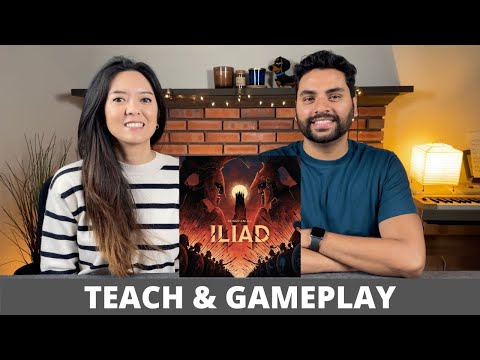








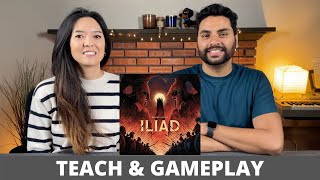


The Trojan War has begun, and both sides of the conflict pursue every advantage they can possibly gain. Two opposing heroes — Hector of the Trojans and Achilles of the Greeks — seek the favor of the gods to lend them support and tip the scales of fate. Only one side will emerge victorious, its hero becoming the legend of the Iliad.
Iliad is a tile-placement strategy game for two-players by Reiner Knizia. On your turn, select one of two tiles from your hand and place it onto the board adjacent to an opponent's tile. Both players have symmetrical pools of tiles, with their strength ranging from 1-5, along with the Dolos tile that mimics your opponent's adjacent tiles. The key to victory lies behind the relentless tension of where and when to commit your tiles. When placing a tile, you may also activate the tile's ability, which can serve to turn the tide of war.
When a row or column is filled, the player with the highest total strength in that line earns the right to select one of the two success tokens at the ends of that row or column; the other token goes to their opponent. Success tokens can earn you the favor of the Gods, and they can earn (or cost you) points. At the end of the game, the winner is the player who has earned the favor of all five Gods. If both players — or neither of them — meet this qualification, then the player who has earned the most points wins. Thus, players will face tough tactical trade-offs as they must decide whether to compete for exclusive favor of the Gods or for the most points — then influence the outcome of the game toward their intended advantage.
Iliad is the first game in the Mythos Collection, a line of two-player titles by Bitewing Games featuring strategy and mythology.
—description from the publisher
- Tactical, evolving decisions that feel unique per game
- Short playtime (~30 minutes)
- High replay potential due to varying token layouts and win conditions
- Clear core goals once the win conditions are understood
- Initial complexity and potential overwhelm when learning
- Tracking multiple win conditions can be challenging for new players
- token control and strategic placement to maximize row/column power
- mythology-inspired context with gods and sacred tokens
- abstract, decision-driven
- Toy Battle
- Icar
Mechanics (from transcript analysis)
- Compound Scoring — The goal is to have the highest strength value in a completed row or column.
- dynamic trade-offs — Each game layout creates new decisions and trade-offs, changing your priorities on the fly.
- row/column scoring — The goal is to have the highest strength value in a completed row or column.
- tile placement — Players place identical tile sets into color spots on a cloth board; spots are adjacent to opponents.
- tile/token placement — Players place identical tile sets into color spots on a cloth board; spots are adjacent to opponents.
- token swapping — There are limited opportunities to swap out problematic tokens with available options.
- win-condition tokens — To be eligible to win, players must collect five gods (or four) and both wedding band tokens.
Video topics + discussion points
Quotes (from this video)
- Iliad's one of those games.
- these are the kind of decisions you're making constantly in Iliad
- it's a 30-minute game
- There are trade-offs everywhere
- the overwhelm for me dissipated really quickly
- Patterns is the more strategical game.
- Patterns is the one that makes me feel like I want to play another game immediately and consistently gives me those feelings.
- Ultimately I am keeping Patterns
References (from this video)
- tight tactical decision space
- clear swing points via tokens and row/column scoring
- potential for deep, turn-to-turn planning
- cloth board can crease and be fiddly
- initial turns can feel unclear due to many small decisions
- tokens/board setup can be a bit fiddly
- tactical positioning and god-favored scoring
- Trojan War; gods and politics on a cloth board
- abstract, tactical competition with god-themed scoring
- Toy Battle
- Lost Cities
- Seven Wonders Duel
- Reeneer
Mechanics (from transcript analysis)
- Compound Scoring — when a row or column fills, players total tile strength in that line
- dos tile — a special tile that copies adjacent values
- scoring by lines — when a row or column fills, players total tile strength in that line
- success tokens — collect tokens representing gods (or wedding bands) to become eligible to win
- tile manipulation — tiles have abilities to move, flip, or alter other tiles on the board
- tile placement — on a turn, place one of two tiles onto the board adjacent to an opponent's pre-existing tile
- Tile/Map Shifting — tiles have abilities to move, flip, or alter other tiles on the board
Video topics + discussion points
Quotes (from this video)
- it's a dig in for me
- the tactical decision space is really interesting
- this is going to be one of my go-to filler games
- the tipping point for every row and column is the funnest thing
- the dice are great
- this is a behemoth
References (from this video)
- Very slick two-player experience
- Elegant token system with mixed positive/negative scoring
- Strong strategic depth for an abstract game
- High thinking intensity for a two-player only title
- mythology-inspired abstract strategy
- Two-player grid-based puzzle with number tiles and gods tokens.
- strategic, token-driven
- Other two-player abstract strategy games
Mechanics (from transcript analysis)
- gods token mechanic — Collect tokens representing divine favor to win eligibility.
- grid-based tiling — Red and blue tiles placed to create rows/columns with strengths.
- Pattern Building — Complete rows/columns to score tokens with varying values.
- pattern completion — Complete rows/columns to score tokens with varying values.
Video topics + discussion points
Quotes (from this video)
- Flip Tunes is a game that I thought looked really cool.
- For a 20-minute game, there's a lot packed into it, which I really appreciate.
- There's so much clever card play in here.
- Iliad is such a good two-player only game.
- Toy Battle is so, so good.
References (from this video)
- Smooth, elegant design with deep tactical depth and constant micro-decisions
- Floating balance that remains satisfying across a huge variety of starting layouts
- Outstanding production values; upgraded components and clear symbolography that reinforce gameplay
- Not a light game; complexity and symbol interpretation can intimidate new players
- Learning curve around the five god tiles and marriage tile interactions may require a dedicated teach or play-through
- mythology and god-like power dynamics in a tight two-player abstract framework
- Greek-modern myth-inspired abstract duel on a checkerboard with tile placement
- abstract puzzle-like play with a mythic flavor; tech-tinged euro abstraction wrapped in mythic theming
- Atlanton
- Rift Force
Mechanics (from transcript analysis)
- row/column control for first pick — Winning control of a row or column grants first choice on tiles that cap that line, driving aggressive local control.
- scoring with god/marriage tiles — To be eligible to win, a player must have at least one of each of the five god tiles or four god tiles plus two marriage tiles; tie-break is based on the highest value in each color and subtracting other scoring tiles.
- set collection — Colors collected across the board contribute to scoring and enable clustering of positive points while avoiding negative tiles.
- tile placement — Each turn you place one tile of your color in a square; decisions are dense because tile power and color placement determine future access to tiles that cap lines.
- tile power variety — Tiles carry varying power levels and abilities; the power on a tile affects not only its own score but interacts with opponents’ tiles and line control.
Video topics + discussion points
Quotes (from this video)
- incredibly balanced, just a joy to play, and wickedly addictive.
- the insane amount of possible starting layouts and combinations
- these are two of the best two-player only games that I've ever played
- you're going to be hungry to come up with strategies for each of them
- The production is incredible; the upgraded components feel essential when you start to play a lot
References (from this video)
- tight tile play and strategic depth
- strong designer pedigree behind Bitewing Games
- meaner player interaction may not suit all groups
- combat and strategy with mythic flavor
- ancient myth inspired by Greek epic traditions
- dense, competitive ambient storytelling
- Icor
Mechanics (from transcript analysis)
- engine building — upgrade paths and improving capabilities over time
- engine-building — upgrade paths and improving capabilities over time
- take that — clever inter-player interference and responses
- take-that interactions — clever inter-player interference and responses
- tile placement — tight tile play and spatial planning
Video topics + discussion points
Quotes (from this video)
- Origins Game Fair is right around the corner and I am pumped
- legacy games, I love a great legacy experience
- The ancient Greek theme is right up my alley
- it's kind of like Crokinol meets engine building
- I love beigeos. It's what I live for
- the central track that drives your action, and it combos with other stuff on the board
- these expansions are number one on my list
References (from this video)
- tight tactical decisions
- very small board creates intense pressure
- fast and highly tactical
- abstract nature may not appeal to everyone
- divine influence and scoring through tiles
- Ancient Greece
- abstract two-player strategy
Mechanics (from transcript analysis)
- area influence and tile scoring — row/column influence determines who gets first dibs on scoring tiles
- Compound Scoring — scoring tiles can carry gods and both positive and negative points
- tile/deduction-like scoring — scoring tiles can carry gods and both positive and negative points
Video topics + discussion points
Quotes (from this video)
- It's one of those lovely puzzle games and I always find myself coming back to it.
- The board is so small, you feel an intense pressure come on top of you and it's on straight away.
- I'm the biggest Teenage Mutant Ninja Turtles fanboy of all time.
- Turtle Power.
- Easily the best co-op game of the year for me.
- The amount of replayability from the start is insane.
References (from this video)
- tight two-player dueling with strong theme
- short plays with depth
- scales less well with more players
- mythic epic with Greek-inspired storytelling
- two-player trick-taking with mythic/epic theme
- epic, tight, tense
- Caesar's Empire titles
- Toy Battle duels
Mechanics (from transcript analysis)
- two-player trick-taking with chapter progression — each chapter advances narrative and scoring while you manage hands.
Video topics + discussion points
Quotes (from this video)
- This one's very quick. It's very quick to play and to teach.
- There are player interactions, but it doesn't feel mean.
- The narrative is so well written. The actual boss battling part is gripping.
- Above and Below Haunted gave it a little more oomph. Ghosts add consequence.
- It feels like a video game in board game form; very smooth and substantial.
References (from this video)
- tight, tactical decision-space
- clear and elegant mechanics that feel thematic within an abstract frame
- highly abstract; thematic flavor can be subtle
- two-player focus may limit audience
- mythology and divine influence on battles
- Trojan War, mythic Greece
- abstract strategy with mythic framing
Mechanics (from transcript analysis)
- area/abstract strategy — Checkerboard-like interaction where rows/columns determine deity advantage and victory points.
Video topics + discussion points
Quotes (from this video)
- this is our top 10 board games of 2025
- it's a trick-taking style game where you predict exactly how many tricks you will win
- the Mindbugs can take control of that creature twice during the game
- it's a semi co-op element in Kidfire Council
- it's a cat-and-mouse hidden movement game
- it's an efficiency engine through and through that has a nice nature-based theme
- this is based off of the Pandemic system
- Speak Easy is by far the heaviest
References (from this video)
- Cerebral, thinky, and highly refined abstract design.
- Dual-front scoring (vertical and horizontal) creates rich strategic depth.
- Appealing array of powers and gods/monsters with meaningful decisions.
- Very math-heavy; dense calculation can be overwhelming at a glance.
- Shifts in tile powers and placement can feel messy and add cognitive load.
- Production quality (cloth mats) and art variety could be improved.
- mythic warfare and strategic grid control
- mythology-driven grid-based abstract confrontation (gods vs titans)
- two-player abstract strategy with tactical depth
- On Tama
- New War Chest
Mechanics (from transcript analysis)
- best_tile_by_line — highest-valued piece in a completed line earns the best tile; second place earns the next.
- grid_based_placement — players place tiles to complete rows/columns to score tiles on the edges.
- limited_hand — each player holds two tiles at any time for placement.
- set_collection_victory — collect a full set of gods to win immediately if the opponent cannot counter.
- tile_powers — tiles have powers that influence play; powers vary by tile strength and are used sparingly.
- Unique player powers — tiles have powers that influence play; powers vary by tile strength and are used sparingly.
Video topics + discussion points
Quotes (from this video)
- the tile placement itself is very easy.
- you can only build the colored buildings that are on the edges or the extremities of those particular columns.
- some of the tiles that you can claim are way more powerful than others.
- I'd rather play Carcassonne over this one.
- it's a full-blown game where it's going to take an hour and a half or so to play
- the game really embraces the feeling of kind of Vegas
- I enjoyed it and I can certainly see why people love this one.
- it's a very cerebral game. ... the best player will win.
- Yes, it's pretty much purely random.
References (from this video)
- Deep two-player head-to-head puzzle
- Tactical, variable scoring potential
- Thematic flavor through Greek mythic design
- Heavy for a two-player title; long learning curve
- Grid-based combat and hero interactions
- Ancient Greek mythic warfare
- Tactical, high-consequence decisions
Mechanics (from transcript analysis)
- grid-based placement — Tiles with numbers determine control and scoring on a grid.
- pattern/area scoring — Scores derived from rows and columns with special tokens.
- Token Collection — Gains tokens based on row/column strength and relative performance.
Video topics + discussion points
Quotes (from this video)
- This is a roll and right or flipping right game.
- Energy bars let you duplicate actions.
- It's Christmas. This is Christmas.
- Chop chop till you drop.
- Undersea theme. Isn't it just calming?
- Orbit is a new Riner Knizia game.
- Azul Duel is a really engaging version of Azul.
- Tag Team is almost like an auto battler, but you program the order.