


























Imperial Steam Deep Dive
What the Community Thinks About Imperial Steam
Imperial Steam stands out in the economic euro landscape as a deliberately punishing, tightly designed experience that rewards careful planning and ruthless decision-making. Reviewers like Board Game Critique and Getting Games emphasize that this 2021 design from Alexander Huemer demands players bring their best: fall behind on worker acquisition or income generation, and you may spend rounds clawing back to competitiveness. For players who embrace tight economies and high interactivity, Imperial Steam delivers a deeply satisfying strategic puzzle. For those seeking forgiving gameplay or shared incentives, it presents a formidable wall.
Core Mechanics That Define Imperial Steam
Railway Network Building with Worker-Driven Effort
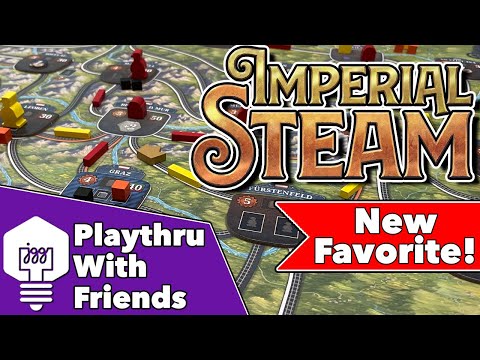
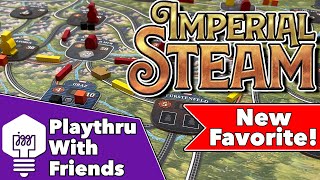
At its heart, Imperial Steam is a route-building game where players construct railways from Vienna toward Trieste across the Austrian empire. Track building requires three resource types (wood, stone, iron) but also demands effort spent from trained workers. The elegance lies in this constraint: you cannot simply buy your way to expansion. You must balance worker recruitment, training advancement, and resource acquisition. Multiple workers acting in concert generate the effort needed to complete routes, creating a genuine puzzle around worker placement and sequencing.
Factories, Training, and Resource Production
Workers occupy training and working areas across experience levels. When you place a worker at a factory, that worker generates resources, with the amount depending on training level. Workers left in the training area improve over time, but once used they must cycle back through training before gaining experience again. This creates tension: do you use your trained workers now, delaying their further improvement, or preserve them for future turns? Factories themselves are limited and highly contested, forcing races to prime locations on the board.
The Imperial Steam Experience
A Brutally Tight Economy
Money is victory points in Imperial Steam, and money is perpetually scarce. Starting capital evaporates quickly when workers cost money, factories cost money, track requires resources that may demand purchasing from an expensive market, and trains must be built or upgraded. Income trickles in from deliveries to hub cities and from passenger service, but ramping these up takes rounds of investment. Reviewers consistently note that the early game feels desperate, with cash flow becoming the central tension.
Deliveries as Pivotal Income Events
The moment a player connects track to a hub city and delivers goods, receiving a large payout in a single action, the game opens up noticeably. This is not an accident of balance; it reflects the economy by design. Reaching those hubs quickly is so valuable that players race to build track, establish factories aligned to each hub's demands, and execute deliveries before competitors. Each hub city can only absorb a limited number of deliveries before its demand is satisfied.
What Makes Imperial Steam Stand Out
The Reputation Track as Hiring Gateway
A novel element is the influence track, which gates access to worker markets. To hire workers from a given city, your influence token must meet or exceed that city's current value. Early bidding for starting influence is therefore critical: bid too low and you may lock yourself out of cheap labor once those workers become expensive. The track also determines turn order, making it a multifaceted decision point. Players can spend money to bump influence up a space, but doing so late when desperate wastes precious cash.
Contracts with Conditional End-Game Scoring
Contracts reward completing specific factory combinations, but here is the catch: contracts only score, positively or negatively, if any player connects to Trieste. If no one reaches Trieste by the final round, contracts are ignored. This creates extraordinary late-game tension. If another player is close to Trieste and you have uncompleted contracts, you must rush to finish them or accept the penalty. If someone else is nearing Trieste with better contracts than you, you might strategically avoid finishing the race to deny them the scoring window. This mechanic alone elevates Imperial Steam beyond standard economic games.
Potential Drawbacks
A Steep Learning Curve with Procedural Complexity
Imperial Steam layers multiple phases per round, many distinct actions, several resource types, a worker system with experience levels, an influence track, contract management, and share mechanics on top of one another. The rulebook is dense, and first-game setup takes time. Teaching requires patience, and many reviewers recommend a practice round before playing for score. Early mistakes such as poor worker hiring, weak influence bids, or misaligned factory builds compound into rounds of struggle with no quick path to recovery.
Punishing Gameplay and Social Friction
Imperial Steam does not reward players who help one another. When you build track, others pay you a small fee to build on the same route, which benefits you but costs them. There are no meaningful cooperative opportunities, only competition and taxation. Players who fall behind early due to a bad bid, unfortunate turn order, or a suboptimal action can spend a long stretch of a multi-hour game watching others pull ahead with little recourse. For groups seeking gentler, more forgiving play, Imperial Steam can feel oppressive rather than satisfying.
If You Enjoy Imperial Steam
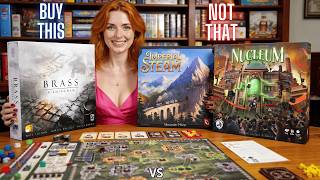
Explore Brass: Birmingham, which combines network building with shared resource incentives and a dramatic two-era structure. Try Age of Steam for a different take on rail networks and auction-driven economics. Indonesia offers similarly tight, punishing gameplay where early mistakes echo throughout. For more heavy economic puzzles in the same vein, Lignum and Carnegie reward the same kind of rigorous planning.
What Reviewers Are Saying
"Imperial Steam is the most overtly punishing. Fees to opponents for routes, escalating hiring costs, the pressure of the Trieste race, the influence penalties for repeating actions, and that endgame dividend haircut all combine into a game where every mistake just hurts more. It's brilliant, but it absolutely is not forgiving."
— Board Game Critique
"Once you've made a couple deliveries, suddenly you are flush with cash and you can actually start getting things going. Those first few rounds always feel tight, like I'm not really doing anything, and then suddenly you can start to do quite a bit of stuff."
— Getting Games
"Money's hard to come by in this game. You have to balance whether you need the goods to go to the towns that generate income, but you also need those resources to come into your area so you can produce more track. You've really got to balance it all out."
— Rolling Dice & Taking Names