























Imperium: Horizons Deep Dive
What the Community Thinks About Imperium: Horizons
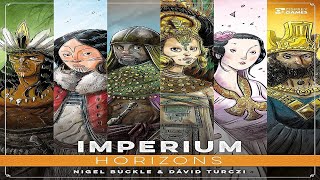
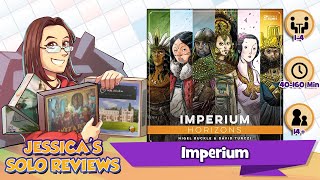
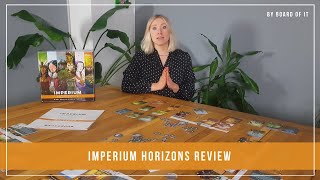
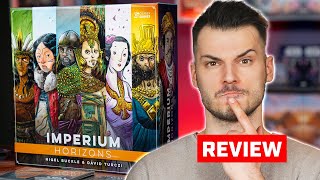
Imperium: Horizons stands as a crowning entry in the Imperium series, a deck-building civilization game that captivates players seeking both thematic depth and mechanical innovation. Designed by Nigel Buckle and David Turczi and published by Osprey Games, it lets each unique faction tell its own story of rising from obscurity to dominance. OFG Voices celebrates its faction variety, Board of It dissects its demanding solo focus, and BoardGameGeek ranks it among the best civilization games for the sheer depth of content. The community admires its scope and replayability while warning that it rewards deep, patient engagement.
Core Mechanics That Define Imperium: Horizons
Asymmetric Deck Building at Its Heart
Imperium: Horizons is fundamentally a deck-building game where every faction begins with a unique starting deck and evolves it differently. Rather than buying from a single shared pool, players acquire cards that align with their civilization's identity, producing wildly different experiences from seat to seat. Reviewers note that you cycle through your deck while optimizing each turn, supplementing it with cards that feed faction-specific combos. A development deck grows more powerful as the game progresses, representing your civilization's evolution from unrest toward a flourishing empire.
Hand Management and Tableau Building
Each turn imposes a critical constraint: you cannot play every card you hold, forcing constant decisions about which to play and which to keep. This selective play combines with tableau building, where acquired cards slot into rows that combo with one another. The interplay between cycling weaker early cards out of your hand and assembling a coherent engine of later-era cards forms the central puzzle players spend the whole game solving, a puzzle that deepens as new nations enter the field.
The Imperium: Horizons Experience
A Deeply Thematic Civilization Journey
What separates Imperium: Horizons from abstract deck builders is its commitment to theme. You are not merely tuning a card engine; you are shepherding a civilization through its ages. Each faction interprets its history differently, with one emphasizing regional expansion, another leaning into aggressive military advancement, and a third focused on pure engine building. Reviewers consistently highlight the alignment between a faction's identity and its mechanical tools, creating the sense that you are guiding a distinct people toward glory.
Staggering Replayability and Faction Diversity
With a large roster of playable factions across the Imperium games, each presents its own puzzle to solve. Horizons greatly expands the civilization count and introduces fresh factions alongside historical ones, so reviewers express enthusiasm that you could play for years without repeating a setup. Each civilization feels distinct to pilot, rewarding familiarity while constantly offering new strategic challenges, which is a major reason the game sustains so many plays.
What Makes Imperium: Horizons Stand Out
A Masterclass in Solo Game Design
David Turczi, who has engineered solo modes for a long list of board games, poured that expertise into Imperium: Horizons. The game plays excellently solo, offering an intellectually demanding puzzle where you optimize your civilization's growth against self-generated challenges. Reviewers describe the solo experience as extraordinarily rich, with enough faction variety that solo players will never exhaust the content, and OFG Voices ranks it among the very best solo games to play.
Evolved Design from a Proven Foundation
Horizons is not a simple reprint; it represents the culmination of lessons from the earlier Imperium games. The rulebook was rewritten for clarity after feedback on the originals, and the larger civilization count plus optional modules for player interaction demonstrate iterative design. The game takes the proven heavy deck-builder and tableau-builder hybrid and expands it with confidence, adding depth rather than bloat.
Potential Drawbacks
A Solitary Experience Not Built for Groups
Here lies the critical caveat: Imperium: Horizons can feel like one of the most solitaire multiplayer games around. While the box lists up to four players, reviewers strongly favor solo or two-player play. Direct interaction is minimal, with the main conflict point being a card someone takes from the market that you wanted. Your focus stays inward on your own civilization, and turns grow longer as you calculate combinations and synergies.
Substantial Downtime and Cognitive Load
A single turn can become very long, especially with complex factions where tracking card synergies demands intense concentration. Even at two players, reviewers report one player drifting away to do chores while the other takes a turn. The game does not facilitate table talk because of the mental load each player's individual puzzle imposes, which makes it a poor fit for social gaming and an excellent fit for those seeking a solo puzzle that happens to wear a multiplayer coat.
If You Enjoy Imperium: Horizons
If Imperium: Horizons resonates with you, explore the earlier Imperium: Classics and Imperium: Legends, which offer the same system with different faction rosters. For solo-friendly deck builders with strong civilization themes, Empires of the North features unique faction decks and quicker play, while Terraforming Mars shares the engine-building puzzle and a celebrated solo mode. Those craving deeper asymmetry with meaningful interaction that Horizons deliberately sidesteps will find it in Spirit Island or Gaia Project.
What Reviewers Are Saying
"You have a ton of factions and it's so enjoyable. It's a hard game, you know, but when you get it down it's fun to play. I love it, it is fun to play."
— OFG Voices
"This is a game that can already be quite long, especially depending on the complexity of the civilization, but when you add in three or four players it gets kind of staggering, the amount of play time. And the game doesn't facilitate table talk either, because you're so involved in what you're doing, and your turn can be quite complex and, as we said, long."
— Board of It
"There's just so much to explore. It's a really good solo game experience as well. This game can be big and long, and there's not always a ton of direct interaction with other players, so this is a great game to just dig into as a solo puzzle, and there's just literally so much content to explore."
— BoardGameGeek