
























Irish Gauge Deep Dive
What the Community Thinks About Irish Gauge
Irish Gauge stands as a proof point that train games can be genuinely fun brain games. This lightweight economic stock game condenses everything engaging about 18XX-style gaming into a single hour, stripping away complexity while preserving strategic depth. Reviewers consistently praise it as an excellent entry point for players intimidated by heavier train games, yet sophisticated enough to reward thoughtful play from experienced gamers. The game bridges a meaningful gap between the gateway charm of Ticket to Ride and the demanding rulebooks of traditional cube rail systems.
Core Mechanics That Define Irish Gauge
Stock Auctions and Portfolio Management
The auction system forms the nervous system of Irish Gauge. Players begin by bidding on initial shares at minimum printed values, then subsequently claim shares at prices they set, creating fascinating tension. Once you win a share, you become that company's primary stakeholder, though other players will inevitably invest alongside you. The catch is elegant: when you call an auction to acquire more shares of a company you already own, you're forcing other players to either invest heavily alongside you or capitulate, watching your portfolio grow while theirs stagnates. This creates a delicious psychological game beneath the mechanical simplicity. Money only flows into your account through dividends your shares generate, making share selection a matter of life and death in your economic survival.
Cube Drawing and Dividend Mechanics
The dividend resolution system is where Irish Gauge's controlled chaos lives. Rather than managing specific track connections, players draw colored cubes from a bag to determine which cities pay dividends that round. A company generates income only if its tracks connect at least one paying city to any town, or if they link two paying cities to each other. Income is calculated simply: each town contributes two pounds, each city contributes four pounds, regardless of how many were connected. This amount divides by the number of shares issued, rounding up. The randomness of cube drawing keeps the game dynamic and prevents analysis paralysis, yet players exercise meaningful control by strategically placing cubes to upgrade towns into cities, subtly shaping future dividend outcomes without guaranteeing them.
The Irish Gauge Experience
Playful Tension and Table Laughter
Irish Gauge creates memorable moments through its freewheeling, rollercoaster atmosphere. The game thrives on unexpected player decisions that astound the table. Reviewers describe moments where a player's sudden choice to upgrade a town or call dividends at an inopportune moment sends ripples around the group, disrupting carefully laid plans. This unpredictability isn't frustrating; it's energizing. The game generates genuine humor when someone realizes they just paid too much for a share, or when a cube draw fundamentally reshapes the economic landscape. Everything players do is simultaneously annoying because it messes with your plans, yet admirable because you can appreciate the other players' ingenuity.
Strategic Intensity Beneath Simple Rules
Despite its two-page rulebook, Irish Gauge demands constant tactical vigilance. Every auction forces you to ask whether you should lock in control of a company or allow rivals cheaper entry. Upgrading a town means sacrificing a cube from the remaining pool, reducing the odds that specific colors activate. Placing track means you're obligated to own at least one share in that company, so your infrastructure development is inextricably linked to your shareholdings. The game's simplicity serves as a mask for underlying complexity, creating situations where decisions matter profoundly but can be explained in seconds. Players describe feeling uncertain mid-game about their position, then seeing dividends suddenly shift the balance, creating drama through elegant mechanics rather than fiddly subsystems.
What Makes Irish Gauge Stand Out
Elegantly Stripped-Down Design
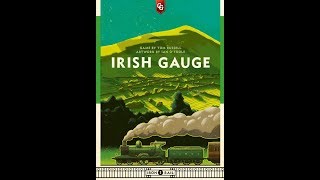
Irish Gauge accomplishes in one hour what many train games stretch across half a day. The rules fit on a single double-sided sheet that a new player can understand in under five minutes. The board itself is beautiful but functional, featuring Ian O'Toole's signature understated aesthetic that blends the simplicity necessary for readability with gorgeous, understated greens that bring Ireland to life. No track cubes ever need to be removed and replaced. No complicated income tables require lookups. Every mechanic serves a purpose and every rule decision simplifies rather than complicates. The result is a game that feels like it couldn't possibly work, yet plays with surprising smoothness and strategic richness.
The Sweet Spot Between Genres
Irish Gauge occupies crucial middle ground in the board game landscape. For players who found 18XX games intimidating but Ticket to Ride too light, this game provides an ideal landing zone. It captures the stock market mind games, the infrastructure racing, and the financial optimization that make train games compelling, but removes the fiddliness of pickup-and-delivery, the excessive calculation, and the brutal table-time commitments. Multiple reviewers note that this is the train game they've been missing, the one that lets you engage with stocks and building without dedicating your entire evening. It's thematic without being thematic, mechanically efficient without feeling streamlined into meaninglessness.
Potential Drawbacks
Economic Dominance and Runaway Leader Problems
Irish Gauge can create situations where a player secures an early economic advantage and leverages it inexorably throughout the game. If you accumulate capital while opponents lag, you can dominate auctions, flooding companies with investments while rivals lack the funds to compete. Watching someone park themselves in the driver's seat and hoard the wheel isn't always fun for the caboose riders. This doesn't happen in every game, particularly with experienced players who understand when to bid and when to pass, but the potential exists for one player to run away with the lead through superior financial management and lucky cube draws at the right moments.
Theme Abstraction and Cube Randomness Disconnection
Some players find the disconnect between thematic expectation and mechanical reality unsettling. You're building railway networks, yet the actual profitability depends entirely on randomly drawn cubes rather than the quality of your infrastructure. A beautifully positioned network might generate zero income if the wrong colors never appear, while a haphazardly placed one could explode in value. Additionally, while the theme is present, it's minimal; you're really just managing a spreadsheet of stocks and cube values rather than building a living, breathing railway business. For players who want deep thematic immersion, Irish Gauge delivers mechanics first, theme second.
If You Enjoy Irish Gauge
Explore other entries in the Iron Rail series, particularly Iberian Gauge, which uses a similar stock system with more deterministic mechanics and no random cube draws. For heavier economic stock games, investigate the broader 18XX family, starting with approachable titles like 1830 or 1846. Players who appreciate auctions and bidding should explore games like Cyclades or Framework. Those drawn to the racing-to-build-connections element might enjoy Sagani, Ride the Rails, or even the classic Ticket to Ride series. For pure stock trading depth, consider City of the Big Shoulders or the economic-first design of Iberian Gauge.
What Reviewers Are Saying
"Irish Gauge is a game that stands on a pedestal and that pedestal is called proof that train games can be fun brain games. What if I told you that instead of getting hypothermia you might play a board game that condenses all of the fun of trying games, removes all of the clutter and slog, plays in under one hour, and all of the rules can fit on this double-sided A4 sheet of paper?"
— No Pun Included
"This is the level of train game that I think I've been missing. I love railways of the world, I love the pickup and deliver, I love the stocks. Irish Gauge seems like the sweet spot where you've got the stocks, you've got building the track, and you don't have the fiddliness of pickup and deliver."
— Rolling Dice and Taking Names
"This is an interesting game of like chicken almost where I'm going to put a little thing out here and see if you start playing stuff over there. The game flows very well and mechanically it's very streamlined."
— Getting Games