/pic1951594.jpg)
In Isle of Trains, players are train operators, building trains with the right mix of freight cars needed to complete delivery contracts before your opponents.
Cards are used in multiple ways: they can be built as train cars or buildings supporting your train line, used as currency to pay the cost of building those new train cars and buildings, or used as cargo to load on available train cars.
When loading cargo on an opponent’s train, players receive an immediate benefit or action, but they are also giving their opponent the cargo they just might need to be able to complete a delivery contract and score big!
Balancing the need to upgrade your train, take advantage of benefits from loading other players' trains, and complete delivery contracts first is the key to being the most successful train operator on the Isle of Trains!


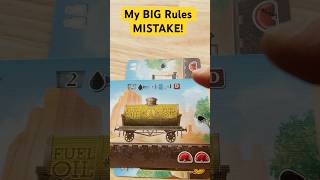
- Playing with a house rule where you can load your own trains and trigger actions was an amazingly fun time.
Mechanics (from transcript analysis)
- Action Triggering — Loading cargo into opponent's trains triggers its effect, incentivizing the use of others' trains and engines to expand one's own train and fulfill contracts.
- Variant Play — The host acknowledges that playing with a house rule where loading one's own trains triggers actions can also be fun.
Video topics + discussion points
Quotes (from this video)
- When you're learning a lot of board games you can often oversee some of the simplest rules and to let you in on a secret I made a really big rules blunder yesterday
- It was a very honest mistake and I'm so sorry about it
- And that's the beauty of board games playing different variants check it out
References (from this video)
- Great little engine builder.
- Fast gameplay.
- Interesting conundrum of what cards to give up to play other cards.
- Might end too quickly before players get going.
Mechanics (from transcript analysis)
- Engine Building — A great little engine builder.
- Multi-Use Cards — Cards are used to build other cards and also serve as goods.
- Pick-Up and Deliver — Increasing train capacity to load goods and using them to complete contract tracks.
Video topics + discussion points
Quotes (from this video)
- this is the London box but I've got the Paris map in there and I think that's my favorite version of the game now
- a brilliant Paulo Mory tug-of War Style game all about Chess and this game was so so interesting
- the more I'm playing this the more I'm understanding how to really exploit that hand of cards and know when to throw games that you can afford to throw in order to boost up your longevity by keeping your mental strength as high as possible to make sure you have more cards in your hand as well as more pawns to boost your strength
- this one might be one of the quickest climbers through my rankings
- the more I'm playing it the more the the depth of the game is starting to reveal itself
- this is a brilliant abstract game and I don't use that word lightly it is truly an excellent piece of design and it's definitely flown right into my top 100 now for the first time
- playing new games that I've really liked such as ter pyramides has been an absolute Joy
References (from this video)
- damn good one for a casual two-player game
Mechanics (from transcript analysis)
Video topics + discussion points
Quotes (from this video)
- It takes elements of The Mind and those sort of games where you have to you can't communicate and you've got to figure stuff out.
- But the game uses Texas Holden Poker to do it.
- So flip seven.
- It's literally just the equivalent of an Uno card game of push your luck.
- I found Slay the Spire to be boring as a computer game.
- The rinse repeat nature of a rogike game is just not fun to me because you just rinse and repeat the same thing.
- Let's Go to Japan actually did a pretty good job of doing the theme well with that.
- Let's Go to Japan is mostly about the scoring phase.
- SETI search for extraterrestrial intelligence one win it wins it over
- But, Seti, yeah, I'm I'm happy with this one.
- war game. To be honest, I'm not interested in war games. Arcs is I mean, that is basically what Arcs is.
- I don't find what you do in the game that interesting, period.
- the card system has a major problem.
- the ambitions as well, this is one thing I really do not like.
- So, my scoring objectives are based on random chance.
- How is that a good aspect of design?
- the defenses I was getting from some people were really bad.
- It's only a game.
References (from this video)

- Trains and railroads
Mechanics (from transcript analysis)
Video topics + discussion points
Quotes (from this video)
- The reason I highlighted Planet Unknown is that this is a game that is purely about building a planet.
- But I love the idea that instead of having a universe of planets that you can go and discover, instead you have one specific planet with a unique hook, a unique layout, beautiful art.
- So, in Hot Streak, it is a racing game for mascots.
- Delightful game. I think the the theatic and the uh mechanical twist make this game really stand out.
- Trading in the Mediterranean. Concordia is the game that I think has really broken through in this genre.
- They typically don't enjoy trading in the Mediterranean, but they really really enjoy Concordia.
- But if you're not into the Viking theme of I I guess exploring and pillaging, if you're not really into that, I think a game that stands out that's mentioned here is the game A Feast for Odin.
- But I think this game is just a really really good Eurothemed game that give players a lot of choices.
- So, Creature Caravan doesn't even really present itself as a zombie themed game, but it is.
- But I love that Ryan Locket put his own spin on zombie themed games by just having them be these lumbering creatures that that just follow you around.
- I say that because our game origin story, we have a different take on the the superhero theme in our collection now.
References (from this video)
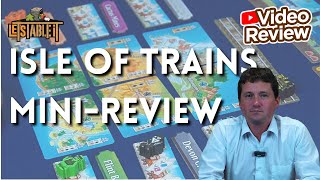
- Compact footprint with deep strategy
- Multi-use cards and card synergy
- High production quality of components (passenger minis)
- Multiple scoring avenues
- Engaging interaction with opponents' trains
- Some luck of the draw can affect outcomes
- Endgame can feel abrupt after heavy setup
- Cycles of draw and discard while hunting for key cards
- Array
- island
- Conversational, enthusiastic
Mechanics (from transcript analysis)
- Card Drafting — On a turn, players choose two actions by selecting from face-up market options or the deck.
- Card Upgrades — Upgrade an existing train car or engine by replacing with a higher-cost version and paying the difference in cost in cars.
- Contract / Location Fulfillment — Fulfill contracts on location cards to score rewards; some contracts are secondary and must be fulfilled first.
- Contracts — Fulfill contracts on location cards to score rewards; some contracts are secondary and must be fulfilled first.
- Deck Building — Draw cards from the deck to take a passenger or to build/load components.
- Deck Building / Card Acquisition — Draw cards from the deck to take a passenger or to build/load components.
- End Game Bonuses — Game ends after a final turn; the player with the most points wins.
- Endgame Scoring / End Condition — Game ends after a final turn; the player with the most points wins.
- Pick-Up and Deliver — Load passengers or goods into train cars and deliver them to locations for rewards.
- Resource Loading / Movement — Load passengers or goods into train cars and deliver them to locations for rewards.
Video topics + discussion points
Quotes (from this video)
- I enjoy how much strategy is packed in this little box.
- There are a lot of ways to score in the aisle of trains.
- This little box hits hard with clever strategy, multi-use cards and plenty of ways to score.
- There’s quite a bit of luck of the draw in this one.
- The art style is great and the production quality on the passenger minis is topnotch.
References (from this video)

- Solid use of multi-use cards
- Accessible and straightforward
- Rule interpretation and delivery mechanics can be tricky on some digital implementations
- Trains, cars, and deliveries
- Rail-network themed card drafting
- Multi-use cards providing actions and goods
- Village Rails
Mechanics (from transcript analysis)
- Delivery optimization — Deliver goods to destinations for points
- market drafting — Draft from a deck/market to acquire trains and goods
- Multi-Use Cards — Cards used to build trains and generate goods
- Pick-Up and Deliver — Deliver goods to destinations for points
Video topics + discussion points
Quotes (from this video)
- The Mundus cards really only affected the new wonders and diluted the base game.
- I think a 7.0 is a very appropriate score for this game.
- This is a lightweight game that has a puzzle aspect to it.
References (from this video)

- Accessible for families
- Appealing, quirky components (top-hat figure on the side)
- Not as engaging as other train-themed games
- Trains and networks
- Railway logistics and route planning
- Light, family-friendly
- Baron Park
- Planet Unknown
Mechanics (from transcript analysis)
- Tile/track building with thematic twist — Collectively manage trains and routes using a simple, accessible mechanic.
Video topics + discussion points
Quotes (from this video)
- it's an everlasting series Ending Story need to incorporate it into our daily life of gaming
- double keep because double keep me all the way across the sky
- there's nothing wrong with the game it was actually really fun
- we borrowed it because we didn't back the kickstarter
- this is a break for my brain in a very delightful way
- if you're going to spiel you can come and meet us
References (from this video)
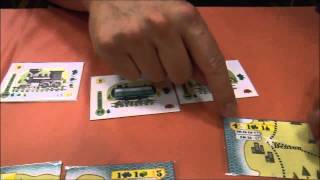
- Clear integration of theme and mechanics (train building, loading, and delivering).
- Dual-use cards create efficient decisions and momentum.
- Player interaction through loading on others' trains adds strategic depth and tempo.
- Contracts with back-side upgrades encourage planning and risk management.
- Straightforward end condition that scales with player count.
- Complexity can be a hurdle for newcomers despite approachable core rules.
- Managing engine weight vs. power requires careful tracking; potential parity issues in player counts.
- Endgame can be influenced by the luck of draw and contract assortment.
- Logistics, trade, and route optimization with multi-use cards.
- Railway operation on a shared network where players build trains and deliver goods to contracts.
- procedural, process-focused with emphasis on engine-building and contract fulfillment.
Mechanics (from transcript analysis)
- action selection — On your turn you choose two actions (build, take, load, deliver) to advance your network.
- Card use as dual-purpose components — Cards serve as both train cars and goods; loading uses the card as the handled good.
- Contract and end-game mechanics — Contracts are placed in the middle; delivering goods fulfills contracts and unlocks secondary contracts on the back; only one front contract can be active; end triggers when a number of middle contract cards are depleted.
- Contracts — Contracts are placed in the middle; delivering goods fulfills contracts and unlocks secondary contracts on the back; only one front contract can be active; end triggers when a number of middle contract cards are depleted.
- Deck management and draw — Take top card from the draw deck; use cards to build or fulfill contracts.
- Deck Manipulation — Take top card from the draw deck; use cards to build or fulfill contracts.
- end condition and final turns — When middle contracts for players are exhausted, everyone gets a final turn.
- Engine Building — Engines have power and weight; adding train cars increases weight and reduces available capacity.
- Engine-building and capacity management — Engines have power and weight; adding train cars increases weight and reduces available capacity.
- Load and mutual benefit — Loading goods on another player's train grants you benefits (cards) while contributing to their progress.
- Multi-Use Cards — Cards serve as both train cars and goods; loading uses the card as the handled good.
Video topics + discussion points
Quotes (from this video)
- "this is of trains and in this game each player is working as a train operator uh trying to build the best train and uh deliver goods uh to uh claim contracts."
- "the engine um has a certain amount of power, uh certain amount of victory points and cost."
- "it's actually beneficial, like I said, to load on somebody else's train because you get the action."
- "the number of players plus two um delivery contract cards are gone from the middle... everybody gets a final turn."