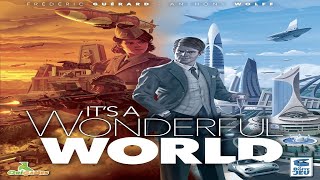
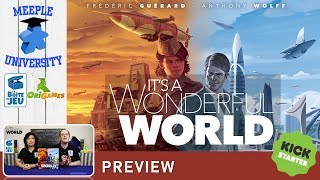
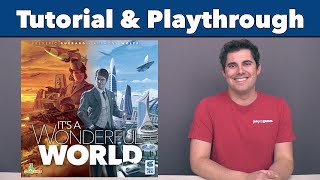
In It’s a Wonderful World, you are an expanding Empire and must choose your path to your future. You must develop faster and better than your competitors. You’ll carefully plan your expansion to develop your production power and rule over this new world.
It’s a Wonderful World is a cards drafting and engine building game from 1 to 5 players. Each round, players will draft 7 cards and then choose which ones will be recycled to immediately acquire Resources, and which ones will be kept for construction to produce Resources each round and/or gain victory points.
When a card is fully built, it’s added to the player’s Empire to increase the player’s production capacity for each round. The mechanical twist being that the production phase works in a specific order. You'll have to plan your constructions carefully!
For a deeper insight of the gameplay, please follow this link : It's a Wonderful World - First steps
In addition to the base game, players can also enjoy expansions boxes introducing an innovative Campaign mode. Each Campaign offers a storyline to follow and many gameplay twists. At the end of each campaign, players will open a reward booster to unlock new cards, enhance their base game and keep a memory of what happened during the campaign. All the campaigns can be replayed and don’t imply game components destruction.
More info on the Campaign mode : It's a Wonderful World - Campaign Mode
—description from the publisher
- Solid solo mode exists
- Engaging engine-building with accessible rules
- Good fit as a mid-weight family/medium-weight title
- Complexity may be a barrier for very casual players
- Theme and art may be less appealing to some players
Mechanics (from transcript analysis)
- card drafting — Players draft cards that provide resources, buildings, and benefits to advance their engine.
- card-drafting — Players draft cards that provide resources, buildings, and benefits to advance their engine.
- engine building — Players construct a production engine by drafting and selecting actions to acquire resources and develop their tableau.
- engine-building — Players construct a production engine by drafting and selecting actions to acquire resources and develop their tableau.
Video topics + discussion points
Quotes (from this video)
- I'm going to be playing this probably non-stop.
- It's a Wonderful World more. So who knows if I'll get that plate this month.
- It's so easy. It's not even funny. And I love that.
- I'm over the moon.
References (from this video)
- Array
- Array
- card drafting and tableau-building
- Array
- dystopian world of bankers vs. warlords
- Array
- Array
- Array
- positive
Mechanics (from transcript analysis)
Video topics + discussion points
Quotes (from this video)
- it's just like a super easy to teach but super mean game that you can play with your family
- I love games where you're involved on everyone's turn
- the expansions have added a lot to it
- the production value of the aliens those miniatures
- this is basically alien the board game
References (from this video)
- deep engine-building
- short rounds and accessible feel
- engine-building via card drafting
- industrial empire building
Mechanics (from transcript analysis)
- card drafting — Draft cards to create efficient engine combos; 'hate drafting' can occur to block opponents.
- card drafting to build an engine — Draft cards to create efficient engine combos; 'hate drafting' can occur to block opponents.
Video topics + discussion points
Quotes (from this video)
- i recommend this with ignorance is bliss
- star wars is my number one favorite anything i'm just obsessed with star wars
- this is a table hog of a two-player game
- no one owns it
- you can play this with new gamers because you can explain it very quickly
References (from this video)
- engaging solo engine-building with a clear production loop
- intuitive setup that converts Seven Wonders-like drafting into a solo-friendly variant
- strong synergy between building choices and end-game scoring
- ramped production that scales with card placement and recycling decisions
- decisions feel meaningful each sequence and round
- solo variant can feel dense or punishing for new players
- some card options may seem underpowered without the right combination
- score maximization can require careful planning and a fair bit of math
- industrialization, engine-building, resource management
- Sci-fi corporate empire, interstellar production
- engine-building progression with evolving card interactions
- Seven Wonders
Mechanics (from transcript analysis)
- construction and resource placement — Players place cards into a construction area to build empire structures, then allocate resources (materials, energy, gold, etc.) to meet construction costs.
- drafting (solo adaptation) — The usual closed drafting from a hand is replaced in solo mode with eight piles of five cards each, where you select from piles and indirectly simulate drafting by choosing or discarding cards to optimize your build.
- end-game scoring via card types — Scoring is derived from a combination of green science buildings, black cards, financiers, and other card-dependent bonuses accumulated across rounds.
- Production Phase — Each round progresses through production, delivering resources (materials, energy, gold, science, etc.) to power up built cards and trigger bonuses.
- recycling — Discarding a card can yield a resource or benefit, often enabling stronger production or card draw possibilities.
- supremacy bonuses — If a resource production hits certain thresholds, players may gain tokens or bonuses that influence end-game scoring and card effects.
- Variable Phase Order — Each round progresses through production, delivering resources (materials, energy, gold, science, etc.) to power up built cards and trigger bonuses.
Video topics + discussion points
Quotes (from this video)
- not going to lie I'm a bit concerned about our lack of points
- we absolutely nailed it there at the end
- time travel is now done
- get to the parallel Dimension we're producing one blue it goes here that's the parallel Dimension
- we've finished our second sequence so we're done with that planning phase
- emperor level generations of subjects will cower at your name for centuries to come
References (from this video)
- Satisfying engine-building with production synergy
- Strong density of card interactions and scoring options
- engine-building with closed drafting
- industrial-age advancement and production
- strategic, production-focused
Mechanics (from transcript analysis)
- closed drafting — Draft card-building actions and then recycle or construct for production and points
- engine building — Construct buildings to produce cubes and resources, then optimize production lines
- engine-building / tableau building — Construct buildings to produce cubes and resources, then optimize production lines
Video topics + discussion points
Quotes (from this video)
- Remember, you are somebody's reason to smile.
- I absolutely love this game. It is in my top 100 games of all time.
References (from this video)
- strong engine-building feel
- engaging production optimization decisions
- can become a bit solitaire if players don’t interact enough
- board setup can be fiddly
- production growth and card-driven engine expansion
- Retro-futuristic empire-building
- engine-building with scalable production
- Terraforming Mars
- Gaia Project
Mechanics (from transcript analysis)
- card drafting — players select cards to optimize production and growth
- Deck building — cards power production engines and expansion options
- deck-building — cards power production engines and expansion options
- Resource management / engine-building — players optimize production to outpace rivals
Video topics + discussion points
Quotes (from this video)
- I've been Chaz Marlar from Pair of Dice Paradise.
- This expansion funded in 20 minutes and raised 23 times the amount of its funding goal.
- the King's dilemma by a horrible guilt in this interactive narrative and legacy experience
- gaining a hundred and thirty-six spots to crown this month's biggest climber
References (from this video)
- closed drafting format balances luck and strategy
- solo variant reimagines drafting into an eight-pile structure for eight rounds
- replayability through diverse card interactions
- solo variant changes core drafting dynamic
- may feel different from multiplayer experience
- creative resource management and expansion
- civilization-building drafting
- calculated drafting with strategic timing
Mechanics (from transcript analysis)
- closed drafting — Each player holds a hand of cards and drafts from a common pool, mitigating luck from draft order.
- Deck building — Drafted cards provide different build options; players read opponents to time benefits.
- deck construction-esque drafting — Drafted cards provide different build options; players read opponents to time benefits.
Video topics + discussion points
Quotes (from this video)
- Voidfall is one of my favorite games of all time.
- I love that he brought completely new mechanisms to solitare voidfall that aren't used in the competitive multiplayer mode.
- Ultimately, Voidfall shows that even highly interactive games can make for great solo experiences as long as you have a designer dedicated to the art form.
- Solo tricktaking. Actually, is tricktaking one word? Maybe I only need two words.
- Heat not only exposes how ridiculous that opinion is, but I think it shows how much the genre has suffered by not including solo play.
References (from this video)
- Engaging drafting with meaningful engine growth
- Complex for new players
- Card drafting and engine-building
- Futuristic/resource-management world
- Competitive, multi-path tableau development
Mechanics (from transcript analysis)
- card drafting — Draft cards to build engines and pipelines.
- engine building — Cards and combinations generate resources and actions.
Video topics + discussion points
Quotes (from this video)
- Scout is a fantastic trick-taking game.
- It's a Wonderful World is a fantastic card drafting engine building game.
- I really enjoy Flamecraft if people have the patience for it.
- Near and Far is one of my favorite games from Red Raven Games.
- Stardew Valley the board game feels so much like the video game.
- Parade is very fun and I really enjoyed it.
- Downforce is a fun betting racing game.
- I definitely recommend getting Tuscany if you enjoy Viticulture.
References (from this video)
- Similar feel to Seven Wonders with a different flavor
- Good for medium-large groups
- Fast reading and approachable engine-building
- Theme may be abstract for some
- Scalability can vary with player count
- Resource management and strategic engine-building
- A bustling world of progress and industry
- Abstract, competitive project optimization
- Seven Wonders
Mechanics (from transcript analysis)
- card drafting — players draft cards to build their own industrial engine
- Resource management — cards generate resources used for future actions
- Resource Production — cards generate resources used for future actions
Video topics + discussion points
Quotes (from this video)
- Gen Con is the biggest convention in the US
- I would love to hang out with you guys there and play some games
- I'm just so so excited to do it
References (from this video)
- Strong solo play reputation
- Engaging gameplay
- World-building / business
Mechanics (from transcript analysis)
- card drafting
- solo mode optional
Video topics + discussion points
Quotes (from this video)
- I'm intimidated to get started with it.
- You're building outposts and in order to increase your trade routes.
- the artwork here is quite lovely
- I'm not super into Political themes.
- it's a dexterity game where you are building up power towers on the island of nikima
- Arctic scavengers I picked this up because I know nothing about it
References (from this video)
- Elegant card drafting that drives civilization-building themes
- Clear, accessible production cycle with satisfying card completion
- Beautiful or appealing card art and thematic flavor
- Abstracted theme may feel distant to some players
- Indirect interaction can lead to feel-bad moments if drafting blocks occur
- civilization development through technology, events, and production chains
- Drafting civilization-related cards spanning various time periods and themes.
- card-drafting with production and recycling discipline; abstracted civ progression
Mechanics (from transcript analysis)
- card drafting — Players draft civilization-related cards each round to plan future actions.
- construction and recycling — Cards can be constructed or recycled to gain resources and activate effects.
- production sequencing — Resources are produced in a defined phase order and then applied to cards.
- Resource management — Resources are allocated to cards to complete builds and trigger effects.
Video topics + discussion points
Quotes (from this video)
- We absolutely adore this game. It's super super fun.
- the big Mayan calendar in the middle
- you can place a worker on the symbol that matches the god card.
- This is a big deck building game where you are going to have a different nation.
- Every game I feel like is a little bit different because the board map will change.
- Civolution is very good.
References (from this video)
- beautiful components, accessible, elegant drafting
- rules can be dense for new players
- engine-building through card drafting and resource accumulation
- civilization-building via card drafting
- clear, strategic, modular
Mechanics (from transcript analysis)
- card drafting — draft cards to build an engine of resources
- engine-building — combine cards for larger effects and points
Video topics + discussion points
Quotes (from this video)
- our Kickstarter's coming
- we're gonna need your support
- we love playing them
References (from this video)
- Compact, fast play time that still supports rich engine-building decisions
- Relatively easy to teach and pick up, making it accessible to beginners
- High degree of variety and depth due to a large card pool and interactions between cards
- Distinctive, memorable theme that contributes to strong thematic flavor
- Strong emphasis on decision density, providing meaningful choices on nearly every turn
- Drafting speed and flow can be highly dependent on group dynamics; a slow drafter can stall play
- Quirky theme may not resonate with all players, and the balance between theme and mechanics can feel uneven for some groups
- State-building with a quirky, surreal flavor
- Near-future city-state building and development
- Playful, slightly batshit whimsical, high-concept flavor
- 7 Wonders
- Terraforming Mars
Mechanics (from transcript analysis)
- drafting — Each round begins with a 7-card draft where players select one card to keep and pass the rest to the next player. The direction of passing alternates each round (left on rounds 1 and 3; right on rounds 2 and 4), creating changing interaction patterns and strategic tension as players attempt to assemble strong engine-building combinations.
- engine building — Players gradually construct a personal engine by building buildings and systems on their city/faction board. The cards interact to generate resources, unlock production, and enable point-generation pathways, creating a dense, scalable engine as play progresses.
- Engine building / card construction — Players gradually construct a personal engine by building buildings and systems on their city/faction board. The cards interact to generate resources, unlock production, and enable point-generation pathways, creating a dense, scalable engine as play progresses.
- Production phases — There are five sequential production steps, typically moving from grey to blue resources, with certain buildings (e.g., nuclear plant) unlocking higher-yield production. Timing and ordering of production are crucial for maximizing output in a given round.
- Resource management — Resources are produced and spent across multiple phases. Players place resources on their faction sheets or directly onto cards to develop their board, balance immediate needs with long-term plan viability, and manage production timing.
- set collection — Victory points are primarily earned through collecting diverse sets of cards and resources, incentivizing careful selection and planning to maximize points across multiple categories.
- Variable Phase Order — There are five sequential production steps, typically moving from grey to blue resources, with certain buildings (e.g., nuclear plant) unlocking higher-yield production. Timing and ordering of production are crucial for maximizing output in a given round.
- Wild/resource amplification — Rare red cubes function as wild resources that can be used on various buildings, adding flexibility and late-game amplification to engine-building decisions. They serve as occasional rewards for building cards and add variability to resource planning.
Video topics + discussion points
Quotes (from this video)
- It’s a wonderful world crams a lot of decision making into its rather short play time.
- And it is a game for people who want to play an engine builder, but who don’t want to spend hours doing it.
- The theme is a little bit batshit weird. Building aircraft carriers to find the fountain of youth is both bizarre, yet strangely memorable.
- The best thing about this game is how densely packed it is with good decisions.
- However, drafting is a very group dependent game system, and with some groups this fast paced game can be brought to a standstill by one slow drafter.
- It shares a lot in common with the popular 7 Wonders
- And for a longer more complex engine builder, try Terraforming Mars
- It’s a wonderful world - it's a wonderful game a Gold medal game.
References (from this video)
- flow and joy of engine-building
- fun conversions
- score tracking can be a thread at times
- engine-building with card drafting
- fantasy industrial empire-building
- positive, light-hearted
Mechanics (from transcript analysis)
- card drafting — draft cards to build your engine
- Compound Scoring — scoring depends on objectives and conversions
- variable scoring — scoring depends on objectives and conversions
Video topics + discussion points
Quotes (from this video)
- Folklore is such a great classic Gothic horror kind of Dungeon Crawl.
- Snowdonia is still on here baby going strong.
- Pavlov's house should be in the top 100 because Pavlov's house is a solo game and it's not really multiplayer.
- it's the joy of It's a Wonderful World... the journey.
- pandemic Legacy season one is above it, I don't know maybe people play it solo
References (from this video)
- Solid, accessible engine-building
- Generally quick and engaging
- Good for a varied game night
- Card draw variance can matter
- Crunchy decision space may overwhelm casual players
- industrial development and resource management
- world-building economy
Mechanics (from transcript analysis)
- deck-building — Draft and play cards to generate resources and victory points.
- Engine-building / resource optimization — Assemble and sequence actions to optimize production and scoring.
- Set collection / combination — Strategic card drafting to maximize synergy and points.
Video topics + discussion points
Quotes (from this video)
- it's a wonderful world again
- they are simple they are quick and still very very fun
- Happy City, which is a decent drafting game
References (from this video)
- accessible for players new to euros
- strong solo experience and good with groups
- engaging production rhythm and decision-making
- theme may feel a bit abstract to some players
- engine-building and production throughput
- Fictional production world with resource optimization
- focused on mechanics and efficiency
Mechanics (from transcript analysis)
- card drafting — draft cards to develop your engine and capabilities
- engine-building / cube management — place and manage resource cubes to generate output and scoring
Video topics + discussion points
Quotes (from this video)
- not only is it just a delight in general but it's a game that's good solo and it's fun to teach people
- it's rare to find a game that just everybody likes so much
- what a good game it's so tense every time I get really excited
- we really really fight it out all the way to the end
- it's interesting I'm not sure it's the best solo game but I still can't quit playing it solo and I absolutely love with other people
- it's a wonderful world
- the third game on the list is one that I wasn't sure I was going to like mainly because there are aspects of its historical presentation that I have issues with, but I just cannot get enough of Hadrian's Wall I absolutely love that game
- haplo remastered and victorum both made it to my apartment
References (from this video)
- Blends best elements of Seven Wonders and Terraforming Mars
- Multiple scenarios to try
- Extended eight-round format
- Great for drafting and engine building fans
- Weird and wacky pseudo-futuristic theme
- Futuristic world building
- Engine building
- Seven Wonders
- Terraforming Mars
Mechanics (from transcript analysis)
- Beat Your Score — Different scenarios with various challenges
- drafting — Draft cards to build your civilization
- engine building — Build gnarlier engines across eight rounds instead of four
Video topics + discussion points
Quotes (from this video)
- I've played about 300 solo games so this represents the top of all the solo games I've played
- These are entirely my opinions based on my personal play experience
- I think this is one of the cleverest solo modes on the market
- When you win a game of Robinson Crusoe there are very few things in solo board gaming more satisfying
- The closest experience in board gaming to being the captain on a bridge in a sci-fi movie where everything is going to shit
- I'm probably a solo board gaming masochist
- I just love Thunderbirds as a solo game
- It feels like Legendary Encounters was built for the Alien theme and was built as an upgrade to the original Legendary system
- Probably the best AI opponent in all of board gaming
- Few games have that genuine sense of exploration
References (from this video)
- fast-paced drafting with engine-building payoff
- interesting interaction through drafted card choices
- resource balancing can be tight
- engineering and drafting
- empire-building flavor
- card drafting and engine-building
Mechanics (from transcript analysis)
- card drafting — draft cards to build engines and manage resources
- card_drafting — draft cards to build engines and manage resources
- engine building — activate combinations of cards to produce resources and points
- engine_building — activate combinations of cards to produce resources and points
Video topics + discussion points
Quotes (from this video)
- This game is all about balance and efficiencies with a good dose of theme.
- The race to get your stars out is kind of what's driving this game.
- The two main reasons why this game is on my list. First is the tech trees.
- This game offers me the perfect balance of euro mechanisms and card play combined with randomness of events.
- That patching mechanism is just so fun and engaging that patch history is my number 75 on my list.
- The production wheel. These wheels have rotating spokes that split the wheel into two sections.
- Kickback actions are one of the reasons why I love this game.
- The theme in this one is, well, to be fair, not exactly sure beyond being an empire looking to expand.
- What sets this one apart is you only draft once during the game at the very beginning.
References (from this video)
- Highly addictive engine-building
- Abstract feel may not appeal to all
- World-building economy with chain productions
- Abstract, production-line optimization through card play
- Hadrian's Wall
- Underwater Cities
Mechanics (from transcript analysis)
- Card-driven engine-building — Players assemble orders and production chains to maximize output.
- engine building — Players assemble orders and production chains to maximize output.
Video topics + discussion points
Quotes (from this video)
- Spirit Island is just so engaging and interesting.
- Words cannot express how dominant this is.
- My true love is still Mage Knight… but Spirit Island ate and left no crumbs.
- The solo gaming community is the best gaming community.
- Thank you so much to the solo Community; you guys do a great job.
References (from this video)
- simple rules with near-terraforming-esque depth
- minimal components, accessible to new players
- theme is considered by some as flat or non-immersive
- civilization building
Mechanics (from transcript analysis)
- engine-building — simple rules; minimal components; civilization card drafting
Video topics + discussion points
Quotes (from this video)
- it's one of the most beloved solo board games out there
- this is a wonderful engine builder
- a game that you can take anywhere
- the rule book was perfect in my opinion
- one hell of a title by chip theory games
References (from this video)
- Strategic despite short play time
- High decision density
- Synergy-driven gameplay
- Resource generation is key
- Shorter game duration
- Steep learning curve for card selection on first play
- World building
Mechanics (from transcript analysis)
Video topics + discussion points
Quotes (from this video)
- It's getting hot in here - be safe family
- I can't play green then I will play purple
- Go get the expansion and put the green in there
- Five Tribes is my number one analysis paralysis game
- I taught chat GPT to teach me board games and now I won't ever go back
- Netflix now has announced Bridgerton the board game
- Those games are not really solid games they don't have the right mechanics
- Everything Western - you've got it
- The hype is real
- You're eliminating, eliminate yes
- Simple rules but hard to master
- Watch the playthrough all the way to the end
- Don't cut it off family don't you cut it off
- She cannot handle it and I love it
References (from this video)
- Smooth drafting with a clear production ramp and fast play.
- Engaging production chain from drafted cards to production row.
- Can involve fiddly optimization with resource ordering for new players.
- production ramp and drafting
- civilization-building with resource production
- drafting to build a production tableau
Mechanics (from transcript analysis)
- drafting — Draft seven cards per round, choosing one and passing the rest to the left or right.
- production sequencing — Allocate resources produced by cards to activate further production and final scoring.
Video topics + discussion points
Quotes (from this video)
- This is one of those games that kind of was an evangelism game for us for a while because it kind of came out and then like seemingly no one ever talked about it.
- It's the epitome of like an elegant game. This game, like we said, has a lot going on, many different mechanics, many different kind of like things going on, but it just works.
- The ramp up effect that you kind of hope to see in these tableau builders where things kind of chain together, and power up each action.
- Ark Nova is obviously a very popular game on Board Game Geek in particular.
- It's just a simple, smooth tableau builder drafting game. It's absolutely outstanding.
References (from this video)
Mechanics (from transcript analysis)
Video topics + discussion points
Quotes (from this video)
- Deep down it's because it brings out all the qualities that makes you feel like a kid again
- Life with cats is so much better