/pic7049926.jpg)
Joraku is an ancient Japanese word commonly used before the Edo period which means “Going to Kyoto”.
Specifically, during the Sengoku period, Joraku refers to the act of local warlords, the Daimyo, marching their armies toward Kyoto to "protect the Shogun and Emperor from other rogue lords" and ultimately rule in their place.
Onward to Kyoto! Take command of your army, and defeat every Daimyo blocking the way! March on! To victory! March on! Kachidoki!
Joraku is a trick-taking area control game. Outwit your opponents with tactical card play, use your loyal Samurais to bid control of areas and build prestige. Only the Daimyo with the highest reputation and the biggest stick can rule Japan!
Round Overview
Recruit Phase
Draw new hand of 5(6) skirmish cards in a 4(3) player game.
Pass 2 cards to the left simultaneously.
Skirmish Phase
Each player plays 1 card and resolves it.
Check who wins this skirmish.
Pass the Kachidoki card to winner. All players rank influence where the winner's Daimyo token is to gain RP.
Repeat 1~3 until all cards in hand are played.
Prestige Phase:
Rank influence of players in each area, earn Reputation Points based on the score charts on the map.
The game lasts for 3 rounds, and the player with the highest RP wins.
The points given in each area will be different for every round.
Your Samurai cubes will stay on the map between rounds, so plan for the future when you place them.


- Peaceful theme
- Simple turns with strategic depth
- Visually appealing components (acrylic tiles)
- Two versions available (acrylic vs cardboard), requiring attention to which edition is desired.
- Peaceful pond building
- Koi pond
Mechanics (from transcript analysis)
- Drafting — Players draft both a koi fish and a feature improvement tile each turn.
- Pattern Building — Points are scored by surrounding flowers with matching colored koi, placing frogs next to specific tiles, and ensuring baby koi have safe places.
- Tile Placement — Players place koi fish and feature improvement tiles into their personal koi pond.
Video topics + discussion points
Quotes (from this video)
- players are trapped on a supernatural ghost train rolling dice and battling bosses
- this game immediately caught my attention i mean there's so much here that intrigues me story driven horror themed cooperative and ghosts what's not to love about these bone-chilling adventures
- players assume the role of dungeon fighters a motley band of screw-ups and desperate vagrants forced into the dungeon delving lifestyle by misfortune or bizarre ambition
- how to take the perfect photograph of a group of 14 persnickety people especially when each person has their own requirements for where they need to be positioned
- just like twitter
- the game kabuto sumo these brazen beetles battle for supremacy in the world insect wrestling championship
- instead of flicking pieces you're pushing them around and sometimes things don't interact the way you think they're going to
- grandpa can't look at the items or grab them their palm has to stay flat then based on how the item was placed in their hand they'll try to guess which memory card it corresponds with
- if i had my own small island paradise i'd absolutely use it to grow fruit on as opposed to like exotic motorsports with foreign oil barons
- the result is a combination of dexterity strategy and luck
- the pattern players lay their tiles in is what will score them points and that's where things get tricky
- this episode was also made possible by the legendary expansion annihilation from upper deck
- players go on adventures to gather the three pieces of a magic key then hop through a portal to defeat the demon king harold van crandall buckle once and for all
- systematic corporate monetary dissection the democratic election system oh boy family fun for boys and girls
- the enticing offer that it quote will only take 15 minutes of your time
- burn through too much money and you'll find yourself having to sublease half your island paradise tax on mobile headquarters
- adrenaline a first-person shooter on your gaming table grab some ammo grab a weapon and start blasting rivals derivates
- actions are quick and the different weapons you can pick up make for interesting decisions to be made based on location movement and line of sight
- the upcoming abstract murder mystery game that time you killed me in which two players compete as rival time travelers trying to erase each other from history
- an abstract narrative game of time and murder
References (from this video)
- Interesting blend of trick-taking with area control and battlefield mechanics
- Tightly themed, strategic, with tactical cube placement
- Complex to teach; requires steady group to reach full potential
- samurai, ninjas, and regional control
- feudal Japan/Kyoto-themed campaign of armies on a map
- battle- and region-control with card-driven abilities
Mechanics (from transcript analysis)
- end-of-round area majority scoring — points awarded for regional control; end of three rounds determines winner
- ninja cards and region combat — ninja-type cards allow placement and movement; other cards provide movement points
- Trick-Taking — players play cards to activate region effects and place Samurai cubes on the board
- trick-taking with card-driven region control — players play cards to activate region effects and place Samurai cubes on the board
Video topics + discussion points
Quotes (from this video)
- it's pretty with nice components and interesting gameplay
- it's a good trick taking game if you've got your own crew
- the reason why I don't own any trick taking games I'm an idiot
- I need a drink
- Chronicle is his take on a trick taking game where players play a card and follow suit if possible
References (from this video)

- Elegant design
- Faultless integration of mechanics
- Clever
- Unique
- Beautifully designed
- Best use of trick-taking mechanism seen
- Much gameplay in a short time
- Area control with trick-taking elements
- Feudal Japan
Mechanics (from transcript analysis)
- Area Control — Players compete to control different regions on the board.
- Hand Management — Players manage cards in their hand.
- Trick-Taking — Players play cards in rounds, with the highest card winning the 'trick'.
Video topics + discussion points
Quotes (from this video)
- So, these are games that I played for the first time in 2024 that were not 2024 releases.
- Um I love the simple winning system here where you know, instead of trying to checkmate your opponent, you're simply trying to get two of your pawns behind your enemies' lines.
- It is just a perfect example of a two-player abstract strategy game that with a modern twist in terms of its scoring conditions.
- It's almost like a perfect design in the way that everything is is put together here.
References (from this video)

- Brilliant hybrid trick-taking and area control.
- Extremely high debut on the list.
- Nuanced gameplay, carefully managing hand of cards.
- Scoring shifts across the board, making action points important later.
- Every play session reveals new wrinkles.
- Almost perfect, can't criticize it.
- Criminally underrated and not widely revered.
- Hybrid trick-taking and area control.
- Feudal Japan (implied by 'damio' and 'region scoring')
Mechanics (from transcript analysis)
- Action Points — Players take action points based on the number of the card played, used to kill opponent's troops or move troops.
- Area Control — Wherever the damio figure is on the linear board, that region will score. Players deploy new troops into regions matching the card played.
- Trick-Taking — Playing cards in turn order, having to follow suit if possible, and whoever played the highest card wins the round.
Video topics + discussion points
Quotes (from this video)
- one of my favorite engine building game
- such satisfying combos you can build up uh with these cards you're collecting through this worker placement system where you have Columns of cards and basically the the higher up the columns these cards sit means the stronger worker you need to get that card
- the strength of your workers is determined by a random roll of a D6 and that might sound pretty um you know pretty cheesy but it's actually not because those dice are going to determine the colors of those workers for all of the players
- loads of different strategies you can go for here like do you want to build up your Green Engine or your or your Yellow Engine and where you are activating a certain spot on the board and those cards you collected are spitting out and churning out resources at really high high rates or are you going to collect you know blue cards to give you just pure scoring or purple ones that will give you discounts and things
- not enough time to do everything which is one of the things that keeps me coming back to Lorenzo IL magnifico
- it also has a fantas fantastic expansion where you can start with unique abilities and even bid for the ones that you really want
- this is kind of the big box version of you know Russian railroads American railroads German railroads and I think there's even another one in there
- this is such a fun worker placement game that just is super satisfying because each round your generating huge amounts of points by climbing up these tracks
- the turn Ang or the worker placement in my opinion is super high in this game and for me that is kind of one of the essentials that you need in a good worker placement game there needs to be that kind of uh turna when it's not your turn and someone's grabbed the spot that you want um there's got to be that frustration there's got to be that that again that real sense of urgency to get the spots that you want and for me um ultimate railroads really has that
- I love the variability on the different ways you can play game um especially love the ones where you can update or upgrade your personal player board to get some unique track on there so when you reach certain check points you'll get some abilities that only you can get and nobody else can
- this is just such a rewarding and fun game that every time just feels amazing
- the only nitpick I'd have with this game is that if somebody does start running away with things earlier in the um in the phases then it's quite hard to make up that lost ground because know generally speaking it's a game where you constantly picking up momentum rather than falling behind again so again if you fall behind too early it can be difficult to create to bridge that Gap
- it scales extremely well actually I actually really like this game at two players um but it also works every other player count too
- it's just such a well um polished and well iron out design that is Ultimate railroads
References (from this video)

- Recommended by a fan
- Works well as a hybrid of area control and trick-taking
- Hates trick-taking but likes this game
Mechanics (from transcript analysis)
- Area Control — It's like a card driven area control game... A great little um, hybrid between area control and trick-taking game.
- card-driven — It's like a card driven area control game.
- Trick-Taking — that feels a little bit like trick-taking... A great little um, hybrid between area control and trick-taking game.
Video topics + discussion points
Quotes (from this video)
References (from this video)

Mechanics (from transcript analysis)
Video topics + discussion points
Quotes (from this video)
- Send help, please.
- My shelf of opportunity. There are a few games on here that I want to bring.
- This bag is already full and I haven't even gone out to the board game room.
References (from this video)
Mechanics (from transcript analysis)
Video topics + discussion points
Quotes (from this video)
- Send help, please.
- My shelf of opportunity. There are a few games on here that I want to bring.
- This bag is already full and I haven't even gone out to the board game room.
References (from this video)
- Pure and beautiful area control
- Subtle and clever
- Fantastic pacing
- True work of art in game design
- Host had no idea this game was out there
- Assuming quite a few viewers don't know it either
- Area control with card-driven actions
Mechanics (from transcript analysis)
- Action Points — Using the number on cards as action points to move or eliminate troops.
- Area Control — Players deploy troops into regions numbered one to six.
- Card Drafting — Players play cards with a color and number.
- Trick-taking (adjacent) — Other players follow the color, using the number for troop deployment or action points.
Video topics + discussion points
Quotes (from this video)
- So, I believe it or not out of all the board games out there, there aren't actually that many that sit at that hour time frame mark.
- So, it's a bit of a sweet spot that I personally like. I I really do like those games that you can kind of get done in about an hour's time because it kind of feels meaty enough to sink your teeth into, but it's not necessarily got to be the kind of main event um of your gaming night.
- So, if you do want a a catalog of hour-long games, then this could be a good place to start.
- And it's just a very nice, well-put-together game.
- So, kind of kind of like an economic uh tile placement game, Foundations of Metropolis is a great place to start.
- And I love that kind of being so confined and restricted in a game like this.
- So, if you like these card driven mechanically sound games that's a little bit subtle but clever then I would really recommend giving Arigato a try.
- So, fantastic game, but maybe at the lower player counts or if you're more familiar with the game, you can get it into that hour mark.
- And it's just so engaging and it just keeps you on your toes from start to finish.
- So, for me, it takes all the best parts of all the uh the best deduction games.
- So, I'd definitely try that one out. And again, I think so many people could enjoy this one.
- So this is one of the purest, most beautiful area control games uh that you will ever play and that unlike a lot of other area control games it's it's quite subtle and it is card driven through this kind of trick taker adjacent mechanism and I wouldn't let that put you off because you know I I hate trick taking games. This one does have some similarities and but it's fantastic.
- So this is such a cerebral, beautifully balanced clever you know intelligent sophisticated game in my opinion
- And for me, that is just fantastic. And I'm always excited to see what he comes out with next.
References (from this video)
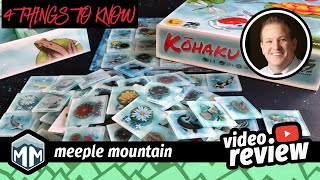
- Beautiful koi pond art with acrylic tile finish that adds depth
- Very easy to teach with simple rules
- Great for families and light strategy players
- Flexible pond-building that allows varied pond shapes
- Limited depth for heavy strategy players
- Some tiles offer similar scoring potential, requiring careful tile choices
- Calm nature and koi-pond aesthetics guiding light abstract scoring
- Koi pond concept in a tranquil water garden
- abstract puzzle framed by pond-building visuals
- Spralopolis
- Circle the Wagons
- Harvest Dice
- Topiary
Mechanics (from transcript analysis)
- board_replenishment_and_middle_shift — After each turn, the board updates by moving middle tiles to the edges and introducing new tiles in the middle, keeping the play area dynamic.
- feature_tile_scoring — Score via feature tiles that trigger point patterns based on adjacent koi tiles and color matching.
- tile_drafting_and_adjacent_placement — On a turn, players take two tiles from the board and place them in their pond; tiles must be adjacent to existing tiles.
- tile_placement — Players place two orthogonally adjacent tiles per turn to extend their own pond.
Video topics + discussion points
Quotes (from this video)
- the game is a tile lane game
- this game is a lightweight family game about building your own koi pond
- it's pretty cool to see your koi pond with more of a 3d type look to it
- the game has such simple rules that it makes it extremely easy to teach
- this is a great light strategy tile lane abstract game
References (from this video)

- Innovative integration of card play with board actions
- Appealing art and thematic feel
- Complexity can be intimidating for newcomers
- Rules clarity needed for first plays
- area control through card play
- board-driven trick-taking with action placement
- mixed euro/ameritrash feel
- Libertalia
- area-control trick-takers
Mechanics (from transcript analysis)
- Area Control — Played cards influence board control and movement, affecting scoring.
- area control / modifier actions — Played cards influence board control and movement, affecting scoring.
- Trick-Taking — Cards feed actions on a board (e.g., moving warriors) in addition to tricks.
- trick-taking with board actions — Cards feed actions on a board (e.g., moving warriors) in addition to tricks.
Video topics + discussion points
Quotes (from this video)
- Everything Ever is the party game that you've been preparing for your entire life.
- Time Chase is a really interesting take on a trick taking game.
- Gap is easy to play so easy to learn; plays up to six.
References (from this video)

- Brand new title with potential for tight drafting and scoring decisions
- Two-to-four player suitability aligns with the host's plan
- Designer/year details unclear from transcript
- Drafting and set collection
- Euro-style abstract realm with drafting and tallying
- Eurogame flavor with direct drafting interaction
Mechanics (from transcript analysis)
- Drafting — Players select cards from a common pool to build their strategy.
- Tallying / Set collection — Scoring is derived from assembling and counting sets or combinations.
Video topics + discussion points
Quotes (from this video)
- it's been difficult it's been a difficult week
- we're tired retired and we appreciate all of our allies
- we're hoping and we're not going to run this too far we're just hoping
- diversity and inclusion and we want to use our platform to help the board game hobby
- we're vaccinated we armored up we armed up but we still wear our masks
- seven and seven yes we're gonna fulfill these games seven seven seven baby seven seven
References (from this video)

- Deep, multi-layered design with lots of nuance
- Rich strategic depth and elegant systems
- Underrated by many; may be challenging for newcomers
- influence and damio pieces in a shifting board
- area control with six to seven regions
- deeply strategic, layered systems
Mechanics (from transcript analysis)
- Action point management and timing — Choose actions and move troops; scoring peaks shift across the board.
- Action Points — Choose actions and move troops; scoring peaks shift across the board.
- Area control with trick-taking elements — Compete for regions; higher cards influence scoring and positioning.
Video topics + discussion points
Quotes (from this video)
- I think out of all of these videos that I've done this is probably the highest quality list that I've done in terms of game recommendations
- gorgeous production I mean the pieces here are absolutely lovely on the table
- one of my favorite deduction games of all time if not my favorite game
- I like how pure and simple it is
- it's criminally underrated
- this one is an absolute absolute belter
- I could not recommend it enough
References (from this video)

- beautiful acrylic tiles with koi, turtles, and frogs
- easy to learn and quick to play
- accessible solo and with a partner
- light in depth; may not satisfy heavy gamers
- Japanese garden aesthetic with koi imagery
- Japanese koi pond / koi fish motif
- pattern-building tile drafting
- Five Tribes
Mechanics (from transcript analysis)
- central pool drafting — tiles are drafted from a shared center and placed into a personal pattern.
- Pattern Building — players try to assemble patterns from placed tiles to optimize points.
- tile laying — tiles are taken from a central pool and placed into a personal koi pond.
Video topics + discussion points
Quotes (from this video)
- it's just beautiful
- it's a comfort game
- it's quick to learn
- it's not for everyone
- it's very cute
- the pagoda rotation mechanic is integral to gameplay
- it's a puzzle-thinking game
- fantastical asian style theme that's the one i'm going for
References (from this video)
- unique twist on trick-taking with multi-use cards
- compact and portable with surprisingly deep decision space
- engaging theme and component aesthetics
- not a big-budget or widely known title; edge-cases may require careful teaching
- multi-theme with traditional Japanese motifs
- feudal Japan; samurai/ninja/monk imagery
- theming framed around trick-taking and area control
- Fox and Forest Duet
- The Crew
Mechanics (from transcript analysis)
- area control / influence — placing workers/daimyo tokens to gain territorial influence.
- Multi-Use Cards — each card can be used for bidding or taking a different action.
- sequential action/round design — two cards are played per turn; bidding determines turn order; top card is played.
- Trick-Taking — no trump; highest number wins the trick; strategic timing matters.
Video topics + discussion points
Quotes (from this video)
- it's just beautiful
- it's a comfort game
- it's quick to learn
- it's not for everyone
- it's very cute
- the pagoda rotation mechanic is integral to gameplay
- it's a puzzle-thinking game
- fantastical asian style theme that's the one i'm going for
References (from this video)
- beautiful artwork
- calming gameplay
- compact player count (2-4)
- can be fiddly or blocking for some players
- Artful pond-building and tile placement
- Japanese-inspired theme with koi pond imagery
- Calming, zen
Mechanics (from transcript analysis)
- tile drafting — draft tiles to place in a koi pond grid
- tile placement / pattern building — place tiles to create patterns and ponds
Video topics + discussion points
Quotes (from this video)
- it's a filler card game
- it's a fun game
- you cannot cut corners publishers
- this is big news
- unbox now is gonna feature digital guides and tutorials
- it's a really cool set collection game
- overshadowed by Splendor
- the money and the product are the same card
- we wore out the cards
- it's a unique sphere game
- it's calming
- check out the little paintbrush components
References (from this video)

- Very relaxing and aesthetically pleasing
- Two-player mode is well-paced with tight drafting
- Can become tight on board for some color strategies
- Calm, serene, nature-inspired pond-building
- Koi pond garden with decorative tiles and natural motifs
- Relaxing, zen-like
- Orleans (expansions and drafting vibe)
Mechanics (from transcript analysis)
- tile drafting and placement — Players draft tiles and place them to optimize their pond with color-matching dynamics.
Video topics + discussion points
Quotes (from this video)
- Two-player head-to-head pitcher.
- This is Star Wars in a box.
- It's the most thematic experience in a board game you will ever play.
- Get out and play some games.
- This is like forcing a book lover to choose their favorite book.
- Orleans with Trade and Intrigue changes it in such a way that it's necessary.