



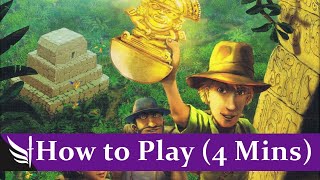
















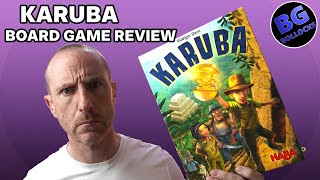



This is a tile-laying race game with players starting with boards that are identical, and one player drawing tiles that they all will use. They race to get their explorers to temples first and earn points. Along the way they can collect additional points by collecting items off the paths they create. The game ends when one player gets all of their explorers to their corresponding temples or whenever the last tile is drawn and placed. Most points wins.
Description from the English Ruleset:
Many moons have come and gone since your boats departed on the journey to Karuba. Once you arrive on the island, each player will lead an expedition team of four adventurers. Now you just have to navigate your way through the dense jungle to make it to the temples. „Just“ may be something of an understatement; the ancient jungle trails have to be found and uncovered first! Hurry up and be the first to reach the temples to collect the most valuable treasures. Many paths have dead ends and you need to be patient to find the right/best way (through the jungle). Look! A gold nugget! You can pick it up and collect it, same applies to the shiny crystals along the paths.
- Recognized as part of the mega-game lineup, suggesting broad appeal
- Path-building and tile-placement puzzle
- Jungle treasure exploration and temple-building
- Abstract, puzzle-driven with light adventure flavor
Mechanics (from transcript analysis)
Video topics + discussion points
Quotes (from this video)
- Open gaming is the core focus of the convention; as Jess puts it, this is what Aircon is built around and what attendees primarily do.
- This is 90% of what you're going to be doing at Aircon: open gaming and exploring the library with staff and other players.
- The gaming library is, in many attendees' opinions, the best stocked library of any convention the speakers have attended.
- If you see us, please ask us to play a game with you—that's what the whole thing is about.
- We are setting up a Patreon to grow the channel and to fund new kinds of content and bonuses for supporters.
- The demo team is terrific and the staff and volunteers are all very friendly; that community warmth is part of what makes Aircon special.
References (from this video)
- strong family game
- scales to eight players by combining two copies
- rewards may need modification for eight players
- treasure hunting and route building
- jungle temple exploration
- adventure, family-friendly
- Sagrada
- Calico
Mechanics (from transcript analysis)
- discard to advance — If a tile can't be placed, it can be discarded to move an explorer forward.
- tile placement — Each turn reveals a tile that all players place on their own grid to form routes.
Video topics + discussion points
Quotes (from this video)
- the game is called raising robots
- it's Wingspan if Wingspan was played with everyone taking their turns simultaneously
- every round you get to perform the two actions that you selected as well as any actions that other players selected
- Earth is another Tableau Builder game where players are building an island
- there's a lot of engine building in here because on one person's turn they are selecting an action and triggering every card that matches the color of that action
- every other player is doing that too
- it's possible to buy two copies of this game and combine them so that you can play up to eight players
- it requires a few modifications to the rewards
- Rainforest City players are building an ecosystem and attracting animals into their rainforest City
- each round four pairs of cards are dealt to the center of the table and one player chooses the pair of cards that they're going to add to their own City but their choice dictates how the other three pairs of cards get given to their opponents
- the objective of the game is to place animals in ecosystems in such a way that their food chain is supplied
- the big difference if you're familiar with pandemic then you know that it's everyone taking one turn at a time and because everyone's taking one turn at a time it kind of lends itself to that Alpha player problem
- everyone has a hand of cards and everyone is playing their cards simultaneously
- they can take as many actions as they want until they choose to stop but while everyone is playing simultaneously there can be taable talk
References (from this video)
- quick to teach and play
- icon-based and language independent
- solid 30-minute play time with meaningful decisions
- scythe token mechanic adds strategic moments
- board progression and unlocks add depth and uniqueness
- card values and costs are not always balanced, which can feel punishing
- wild salt cards can disrupt expectations and require careful planning
- some turn optimization tension between gaining runes and playing cards
- potion crafting and rune-based resource management
- fantasy alchemical world (Carnuta) with sun/moon rune dynamics
- abstract, icon-driven, puzzle-like scoring
Mechanics (from transcript analysis)
- Compound Scoring — cards display one or two icons representing ingredients; scoring comes from matching and combinations.
- deck manipulation — scythe tokens let players refresh a row of cards to draw fresh options, introducing strategic tempo control.
- deck/row manipulation — scythe tokens let players refresh a row of cards to draw fresh options, introducing strategic tempo control.
- end-game trigger and extended scoring — the game ends when a player has at least 11 cards in tableau; all players then score from their ingredients.
- hand management — on each turn a player may take two actions from four options, with a three-card hand limit.
- icon-based scoring — cards display one or two icons representing ingredients; scoring comes from matching and combinations.
- Multi-use cards — salt cards act as wild icons with varying costs and effects, influencing card value and play order.
- Resource management — sun and moon runes are gained from a center reserve, and runes are flipped to align with played cards.
- rune resource management — sun and moon runes are gained from a center reserve, and runes are flipped to align with played cards.
- set collection — players collect ingredient icons to score points by matching components across their potions.
- upgradable player boards and tokens — progression on your board unlocks more rune slots and limited tokens that grant future benefits.
- variable card costs and wilds — salt cards act as wild icons with varying costs and effects, influencing card value and play order.
Video topics + discussion points
Quotes (from this video)
- Carnuta is a set collection game for two to four players.
- The end of the game is triggered when a player has at least 11 cards in their tableau.
- This game is all about the scoring.
- It's language independent. So you don't need to be able to read anything.
References (from this video)
- Tactile, visually appealing components and artwork
- Sun/moon resource mechanic enables satisfying, cascading combos
- Engaging drafting/fulfillment loop that rewards planning and timing
- Prototype/pre-production status; production quality is not fully known
- Managing two games and their components can introduce cognitive load and potential confusion
- Some players may view the stone/tile components as a potential risk if production is not finalized
- Desert/territory-themed with resource-driven scoring
- Map-based area control with a focus on icon collection and camp building
- Icon-based scoring cascades with flip mechanics for resources
- Splendor
- Castle Combo
- Far Away
Mechanics (from transcript analysis)
- area placement / camp building — Place camps to fulfill card/icon requirements on a large map with hex-like regions.
- card fulfillment and icon scoring — Cards provide icons; completing cards yields scoring and allows achievement of other goals.
- resource flip and management — Two resources suns and moons flip or are discarded to enable card plays and scoring combos.
Video topics + discussion points
Quotes (from this video)
- it's the perfect style of game that you'd want to play on BGA
- these are the kind of games that appeal to me
- it's very simple to play
- you could get some really satisfying combos where you're like, I take the moons now
- it's not often that you see games hitting the hotness and they're not even necessarily out yet
- join our Discord
References (from this video)
- Beautiful components and eye-catching, compact packaging
- Relaxing, easy to learn and play with light strategic tension
- Great for guests and as an after-dinner filler
- Potential repetitiveness after multiple plays
- Rulebook can mislead about depth; theme is light and may not be memorable
- Front sleeve design lacks a visible title, which some players dislike
- Set-collection and resource-management around magical ingredients and combos
- Fantasy magical world where players collect and combine ingredients (berries, clovers, dragon eggs) to score points
- Whimsical, light-hearted, component-driven
- Splendor
- Century Spice Road
- No Thanks
Mechanics (from transcript analysis)
- card drafting — On your turn you either draw a card or play a card from your hand, with play requiring meeting costs shown on the card.
- card drafting / hand management — On your turn you either draw a card or play a card from your hand, with play requiring meeting costs shown on the card.
- end-game trigger and scoring — Game ends when a player reaches 11 cards; scoring occurs across all players' piles and tokens.
- Resource management — Players collect sun and moon tokens to pay for card costs and to advance toward scoring opportunities.
- Resource management (sun/moon tokens) — Players collect sun and moon tokens to pay for card costs and to advance toward scoring opportunities.
- Row refresh mechanic — A token-based mechanism to refresh a row of available cards, adding variability.
- set collection — Played cards create stacks; scoring is based on combinations of types like berries, clovers, and dragon eggs.
- set collection / stacking — Played cards create stacks; scoring is based on combinations of types like berries, clovers, and dragon eggs.
- Token flipping / clearing rows — Tokens can be flipped to align directions; a row can be refreshed by spending a token to replace cards.
- Wild/variant tokens (salt) — Salt acts as a wild that can be assigned to any existing stack to boost scoring.
Video topics + discussion points
Quotes (from this video)
- This is a very pretty game as you can see.
- There's something very like soothing about this game.
- It's like an after-dinner mint of a game.
- I would strongly consider keeping this for guests.
References (from this video)
- strong simultaneous play aspect
- replayable due to shared decision visibility
- Cooperative/competitive tile-placement with simultaneous action
- Jungle adventure with temple-building and treasure
- Tile-drafting and simultaneous placement
- Tiny Towns
Mechanics (from transcript analysis)
- draw and place — players draw tiles and place them on their personal boards
- Simultaneous Actions — all players act at the same time, often by drawing/placing identical resources
- simultaneous gameplay — all players act at the same time, often by drawing/placing identical resources
Video topics + discussion points
Quotes (from this video)
- my five favorite board game mechanics
- cards have multiple uses regardless of what your hand draw is
- I love games that engage you when it's not even your turn
- every player gets to do something at the same time
- not only when you pull your workers you get something but every other player also has the option of pulling their workers back at the same time
- stock buying mechanic ... the objective is to have the most money at the end of the game and the way you get the most money is by buying stock in the players
References (from this video)
- Accessible for snooker enthusiasts
- Luxurious wooden build with two finish options
- Two size choices allow tailoring to players and space
- Expensive relative to other micro-games
- Rules of snooker adaptation can be mystifying for newcomers
- Snooker meets circular-board dexterity
- Circular board on a lazy susan for home play
- Descriptive, enthusiastic
- croquet / crokinole
- air hockey
Mechanics (from transcript analysis)
- Circular board flicking — Players flick pucks on a circular board, with rules inspired by snooker and aim-based play
- Flicking — Players flick pucks on a circular board, with rules inspired by snooker and aim-based play
- Snooker-like scoring rules — Scoring and play flow borrow from snooker traditions, adapted to a circular layout
- Two size options — Two sizes (plus a tournament variant) to tailor play to players and space
Video topics + discussion points
Quotes (from this video)
- it's an incredibly skillful game
- it's the smallest game in our compendium
- class smashes every single category to perfection
- i can't believe that that is an actual point
References (from this video)
- Brilliant simultaneous play
- Elegant balance of luck and strategy
- Easy to teach and replayable
- Limited depth for heavy gamers
- treasure hunt and pathfinding
- jungle temple exploration
- light thematic exploration
- San Juan
Mechanics (from transcript analysis)
- Simultaneous action selection — players act in parallel using tiles and explorer tokens to assemble routes
- Simultaneous Actions — players act in parallel using tiles and explorer tokens to assemble routes
- tile placement — placing tiles to create routes and guide explorers to treasures
- tile placement / route building — placing tiles to create routes and guide explorers to treasures
Video topics + discussion points
Quotes (from this video)
- five board games with a perfect mechanic score
- the four factors to consider so let's describe what each of them means
- I personally really enjoy simultaneous action selection and I dis like Press Your Luck but that's just me
References (from this video)
- Fresh twist on area control via Sudoku-like constraints
- Short playtime (~20 minutes) with depth
- Accessible rules with meaningful strategic choices
- Late-game restrictions can feel tight
- Relatively obscure title; limited widespread familiarity
- Sudoku-inspired constraints merged with area control
- Gardens where color tokens are placed to maximize coverage
- Abstract puzzle with spatial planning
Mechanics (from transcript analysis)
- blocking and strategic placement — Use placement to block opponents and optimize your own scoring opportunities
- dice placement — Use placement to block opponents and optimize your own scoring opportunities
- row/column/garden restrictions — Cannot have the same number token in the same row, column, or garden as any other player
- tile placement — Deploy stones in gardens to maximize your control area
- tile/stone placement in gardens — Deploy stones in gardens to maximize your control area
Video topics + discussion points
Quotes (from this video)
- it's a lightweight family-style game that takes around 20 minutes to play
- the randomness and swingy nature of it has you know diminished my enjoyment slightly
- it's such a clean game as you're placing these tiles
- this is such a great game I love this one
- a new Twist on the area control genre
References (from this video)
- go-to game for mixed groups
- balanced decisions with easy teachability
- short playtime and strong player fit
- not highly interactive against opponents
- bingo-esque path placement and exploration
- adventurers navigating roads on a tile grid toward temples
- light, accessible puzzle
- Scrabble
Mechanics (from transcript analysis)
- Bingo — choose routes based on efficient pathing and color themes
- bingo-style selection — choose routes based on efficient pathing and color themes
- simultaneous play / tile reveal — tiles are built and placed in rounds with simultaneous action
- Simultaneous reveal — tiles are built and placed in rounds with simultaneous action
- tile placement — placing tiles to form paths for adventurers
- tile placement / route-building — placing tiles to form paths for adventurers
Video topics + discussion points
Quotes (from this video)
- it's breezy and quite relaxing to be honest
- it's so easy to teach
- it's never really let me down with whoever i brought this out
- it's inviting being easy to play but still having the interest there
- it's a hidden gem in terms of being a gateway game
- I really do just sit back and enjoy the process of a game like this
- the best deduction game i've ever played
- it's a 30 to 45 minute game that can be tailor-made to how you want to play it
- it's almost like a step up from a game like Scrabble
- it's a puzzle style game with pirate theme
- the layout of these tiles is extremely interesting
- this game has a unique twist that adds a lot of interest
References (from this video)
- family-friendly and quick
- clear decisions with visible consequences
- may feel lightweight for hobbyists
- randomized tile draw can affect consistency
- tile placement and path-building
- jungle temple treasure hunt
- family-friendly puzzle
- Kingdomino
- Sushi Go Party!
Mechanics (from transcript analysis)
- Tile placement / path building — place path tiles to connect temples and collect points
Video topics + discussion points
Quotes (from this video)
- this is the a to z board game challenge
- we love to challenge ourselves and each other
- there's no timer this isn't speed round because there's going to be some where it's going to be harder
- you should definitely do this at home it was super fun
- that is not easy that is so much harder than you would think
References (from this video)
- Accessible, family-friendly puzzle
- Varied explorer paths create different experiences
- Downtime between tile draws for some players
- Exploration and temple-building
- Tropical jungle expedition to locate temples
- Competitive tile-placement puzzle
- Gingopolis
- Acropolis
Mechanics (from transcript analysis)
- Simultaneous path planning — All players draft and place tiles to maximize temple routes for points.
- tile placement — Players place temple and path tiles to form routes for their explorers.
Video topics + discussion points
Quotes (from this video)
- This video has been sponsored by munchpak so thank you to munchpak.
- Tapestry is a game that has just continued to increase on my list; I've always liked it a lot.
- Rhino Hero Super Battle... this game is so much fun.
References (from this video)
- Extremely easy to learn and teach
- Fast, simultaneous play keeps everyone engaged
- Short game length makes it ideal for family gaming
- Kid-friendly entry point with approachable decisions
- Limited depth and strategic buildup compared to heavier title
- Some players may crave more tension or long-term planning
- Not as satisfying for seasoned gamers seeking a pure strategic challenge
- Treasure hunting and exploration through a temple-filled jungle
- Jungle temple expedition
- Light, procedural path-building with simultaneous play
- Azul
Mechanics (from transcript analysis)
- Compound Scoring — Temple values determine final scores, augmented by crystals and nuggets collected throughout the run.
- end_conditions — The game ends when every tile has been played or when a player has reached all four temples.
- house_rule_expand — A suggested modification to allow combining multiple boxes for more than four players, requiring a rebalancing of treasure values.
- leader_role — One player acts as expedition leader; their pieces are face-down and mixed, and they call out numbers to drive tile placement and draw flow.
- Movement — Discard a tile to move an adventurer; movement points equal to the number of paths on the tile; cannot split movement or pass through occupied spaces; must finish on a tile containing the desired treasure.
- Movement points — Discard a tile to move an adventurer; movement points equal to the number of paths on the tile; cannot split movement or pass through occupied spaces; must finish on a tile containing the desired treasure.
- Resource management — Nuggets and crystals are collected when an adventurer lands on a tile with treasure; crystals are worth 1 point, nuggets 2 points at game end.
- resource_collection — Nuggets and crystals are collected when an adventurer lands on a tile with treasure; crystals are worth 1 point, nuggets 2 points at game end.
- scoring — Temple values determine final scores, augmented by crystals and nuggets collected throughout the run.
- Simultaneous Actions — All players act in lockstep by drawing and playing the same tile; turns are faster because no waiting for others.
- simultaneous_play — All players act in lockstep by drawing and playing the same tile; turns are faster because no waiting for others.
- tile placement — Place tiles anywhere on your personal board, keeping the top-left number; no required sequence or adjacency; you can create dead ends.
Video topics + discussion points
Quotes (from this video)
- it's so easy to play
- it's just very fast moving you don't waste any time waiting for your turn
- two reasons why we really like koruba
References (from this video)
- Impressive build quality
- High tactical depth for a dexterity game
- Expensive and storage-heavy
- Can be challenging to master
- Dexterity-driven precision and competition
- A cross between carom and snooker with a rotating table
- physical skill game with table-top sport feel
Mechanics (from transcript analysis)
- Flicking — Players flick discs to pot balls in a specific order.
- flicking discs — Players flick discs to pot balls in a specific order.
- pull variants — Alternative rules that emulate snooker-like play.
- rotating table — A rotating surface adds spatial challenges and shot options.
Video topics + discussion points
Quotes (from this video)
- the Minis for the first edition of this game were really really terrible they were absolute dog
- we just put up with the ship Miniatures and we just good afternoon our own ball sack
- this for us is the best solo game ever created in major night
- Mage Knight never ever gets old there's always something new to discover in this game
- it's number four on this list
- it's the greatest party game ever made hands down
- the theme dead on and the action selection mechanism
- the possibilities are literally endless in Pitch car
- you could teleport directly into someone's backyard give them a good old spanking
References (from this video)
- Family-weight, easy to pick up and play
- Engaging route-building with a satisfying bingo-like feel
- Players mostly focus on their own board; interaction is light
Mechanics (from transcript analysis)
- race/relocation — There is a race element to reach colored temples and scoring via routes
- tile placement — Players place tiles to form paths on their own grid, racing to connect adventurers to temples
Video topics + discussion points
Quotes (from this video)
- top 10 chilled board games now for me
- it's such a relaxing game in my opinion
- the production really does help it because it's a lovely lavish Deluxe feeling game
- think Wordle but the Twist on this game
- cooperative game ... very relaxing
References (from this video)
- cool twist where unchosen cards affect ship damage
- solid core flip-and-write Euro feel
- not highly differentiated from other heavy flip-and-write titles
- not particularly exciting within the month’s lineup
- Dinosaurs in a sci-fi research/expedition context
- Space exploration with ship management and dinosaur research
- Risk/reward flavor with endgame multipliers
- Demeter
Mechanics (from transcript analysis)
- card drafting — choose cards to increase capabilities while unselected cards can impact other factors
- Card drafting / selection — choose cards to increase capabilities while unselected cards can impact other factors
- damage tracking / endgame risk — taking damage can cost points or end the game early
- flip-and-write — players flip cards to unlock abilities and influence endgame scoring
- Flip/Roll and Write — players flip cards to unlock abilities and influence endgame scoring
- Limited Points — taking damage can cost points or end the game early
Video topics + discussion points
Quotes (from this video)
- the coolest thing about this game was that sometimes when you choose a card the cards that you didn't select would end up impacting damage on your ship which would end up costing you negative points
- grossly underrated I can't even believe this game isn't talked about is so well put together
- Woodcraft is my favorite game of the month
References (from this video)
- Innovative, highly tactile gameplay
- Excellent table presence and build quality
- Expensive and niche appeal
- Dexterity-driven flicking game on a rotating board
Mechanics (from transcript analysis)
- dexterity flicking — Disc flicking to pop color targets on a rotating board.
- Flicking — Disc flicking to pop color targets on a rotating board.
- tabletop strategy — Strategic placement and color targeting through flicking.
Video topics + discussion points
Quotes (from this video)
- Twilight Imperium Fourth Edition is an absolute Masterpiece
- Vindication offers some shocking replayability value
- Memoir 44 is probably my favorite war game of all time
- Station 4 is probably the greatest achievement in board game design in the last 10 years
- Monikers is absolutely hilarious
- The cycles edition is about to drop in January
References (from this video)
- strong family-friendly puzzle
- good pacing for mixed-age groups
- table presence on table
- may feel light for experienced euro players
- adventure, exploration, route-building
- tropical jungle exploration and temple treasure
- familial, adventurous
- Miyabi
- Azul
Mechanics (from transcript analysis)
- set collection / resource allocation — collect path tiles to earn points and complete temple routes.
- tile placement — players draft and place jungle tiles to build routes and explore temples.
Video topics + discussion points
Quotes (from this video)
- Habba actually has child psychologists on staff, which informs our game development and age ratings.
- The difference in the amount of fun that you have as an experienced gamer and engaging something even like my First Orchard.
- Miyabi is very simple to get up and start learning and to play but then there's a lot of strategic depth and potential in that game.
- Color It works super well over Zoom or Skype and coloring sheets are available online.
References (from this video)
- Fantastic two-player experience
- Innovative variant within the dexterity genre
- Limited to two players (as discussed, not a party game)
- competitive dexterity and precision
- abstract two-player dexterity on a Crokinole-like board
- Crokinole
- Crokinol (Crokinole variant)
- Zombicide
Mechanics (from transcript analysis)
- board_control — Control of scoring zones and sequences through disc placement and flicking.
- dexterity — Players flick discs to score on a central board, competing for zones.
Video topics + discussion points
Quotes (from this video)
- Kuruka is absolutely fantastic.
- Barcelona is being added. I really enjoyed it and want more plays.
- Leaders is replacing Pillars of Fate. Pillars of Fate is my favorite from the Fate series, but Leaders offers a different two-player experience.
- Recall is subject to more plays. The review still hasn't gone up.
- Galactic Cruise is great, but I feel a little guided by what the game asks you to do.
References (from this video)
- Innovative integration of rotation with classic dexterity concepts
- Accessible and fast-paced for larger groups
- Feels like a natural replacement for other dexterity staples (e.g., Crocodile, Carom, Snooker)
- Abstract, skill-based dexterity with sport/rec room flavor
- Circular table with a rotating platform; billiards/snooker-inspired play on a dexterity platform
- Pure gameplay focus, no campaign or story arc
- Crocodile
- Carom
- Snooker
Mechanics (from transcript analysis)
- Color/ball-set targeting — Discs come in billiards/snooker-like colors, guiding target selection and strategy.
- dexterity flicking — Players flick discs on a rotating board to influence position, knock discs, or score targets.
- Flicking — Players flick discs on a rotating board to influence position, knock discs, or score targets.
- Roll/Spin to Move — The round table rotates akin to a lazy Susan, changing angles and angles of attack.
- rotation mechanic — The round table rotates akin to a lazy Susan, changing angles and angles of attack.
Video topics + discussion points
Quotes (from this video)
- this is an absolutely astonishing achievement the bloku designers came up with the idea himself
- it's replaced crocodile for us
- you really should get hold of this one
- the greatest real-time game ever made and made even better by the new iteration
- Seven Wonders is one of the greatest board games card games ever made
- Obsession is without doubt one of the finest board games that we've played for a very, very long time
- Cyclades is the complete package
References (from this video)
- clean, approachable gateway game
- nice interplay between building the grid and scoring
- mechanics can feel light for players who want deeper engine-building
- temple-building through tile drafting
- Jungle temple exploration
Mechanics (from transcript analysis)
- tile_laying — players place numbered tiles to construct a grid and route explorers
- tile_matching_and_placement — align colored temples and matching resources to score
Video topics + discussion points
Quotes (from this video)
- Nar is a Viking themed whole thing, but the whole timing, the sequencing when you get to fire off those banners, when you're actually making that, it's one of those games that is a small footprint, but I think it builds really well.
- With the expansion, I think it's fantastic. And they integrated some of that stuff in the new version, Sakura Slam.
- I love Clask so much.