/pic7976828.jpg)
































Kavango Deep Dive
What the Community Thinks About Kavango
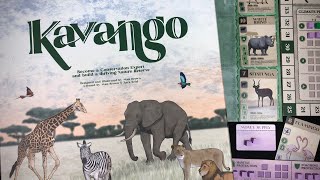
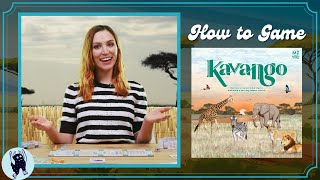
Across the videos that cover Kavango, the strongest point of agreement is that its conservation theme feels earned rather than pasted on. Grant Lyon spent time explaining that the designers worked in real conservation efforts in Botswana before creating the game, and pointed to details like the conservation experts being modeled on people they met in the field. Rahdo Runs Through made a similar point from a different angle, noting that one of the designers illustrated the game personally, using sketches made while living in the region.
Where reviewers split is on weight and audience. Rahdo Runs Through described the base game as sitting at a ticket-to-ride level of complexity that different experience levels could sit at together, and said they would reach for it over more familiar gateway games when introducing new players. Board Game Critique reached a different conclusion after testing the Lodges expansion: the positional puzzle it adds turns Kavango into something heavier, and they would not encourage a novice to play it with lodges out of the gate. Their review landed at a 7.5 out of 10, calling Kavango strong and thoughtful but not for everyone. The Board Game Garden's Jenna also came away positive after playing it at a convention, singling out its pick-and-pass drafting as exactly the kind of game Jenna gravitates toward.
Core Mechanics That Define Kavango
Card Drafting Into a Growing Tableau
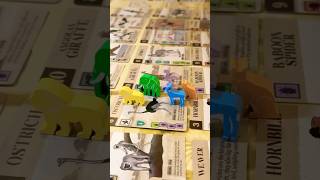
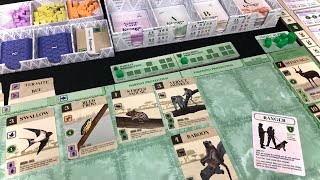
Kavango is built around drafting cards from a shared hand that gets passed around the table each round. Cards come in tiers: producers like plants, insects, and fish at the bottom of the food chain, grazers above them, and apex predators that need habitat, poaching, and climate protection to support. Box of Delights walked through this structure while showing that higher-tier animals depend on players already having lower-tier producers in their reserve, so early picks shape which apex species become reachable later. Players are also working through hidden goal cards and conservation awards that pay out at game end for hitting species diversity, habitat and poaching protection, and climate research thresholds.
The Lodges Expansion's Positional Puzzle
Board Game Critique's review centered on the Lodges expansion, which asks players to draft six lodge cards, each a two-by-two animal pattern, and try to complete that pattern on their personal board before locking it in with a lodge token for points and immediate cash. They described using the same animal to count toward two different lodges as legal and satisfying, and just as often described the sting of locking a pattern too early and trapping a high-value animal away from a research goal. A second module has players pay to clear community protection markers blocking spaces on their board, or flip them into solar tokens for a cash injection that permanently removes that space from their reserve, and a third module adds public golden lodge patterns that race every player toward the same animals.
The Kavango Experience
Fast, Simultaneous Rounds With Real Tradeoffs
Grant Lyon described Kavango as a bunch of fast-paced simultaneous turns, with every player drafting, passing, and playing cards into their reserve at the same time rather than waiting through a long turn order. Board Game Critique's playthroughs bore that out with specific moments of tension: in one game they had to decide whether to spend scarce funds clearing a community protection marker to place a needed animal, only to end up too broke to fund climate research and miss a ten-point reward. They also described a golden lodge race that came down to a two-point miscount between players, calling that shared-goal sprint the closest thing to direct interaction in the game.
A Personal, Educational Theme
Several reviewers pointed to how directly the game's mechanics tie back to real conservation work. Rahdo Runs Through called out the rulebook's built-in handicap system, where beginner and experienced players start with different amounts of money so mixed groups can play together, as evidence the designers wanted the game accessible at the table. Grant Lyon added that the conservation experts represented in the game are inspired by real people the designers met while working in Africa, and treated that detail as central to why the theme lands.
What Makes Kavango Stand Out
Hundreds of Animals and High Replayability
Board Game Critique pointed to the game's scale as the source of its replay value: 160 unique animals, rotating research goals each round, asymmetric conservation experts, and 45 lodge cards from which only six appear in any given game. They described one playthrough built entirely around grassland megafauna and another where they pivoted to birds mid-game to complete a research chain, and rated the range of viable strategies as tense and varied rather than repetitive.
Sustainable, Story-Driven Production
Rahdo Runs Through highlighted the production choices as unusual for the category, noting the game uses no plastic at all and calling it one of the best examples of green production methodology in a board game. Box of Delights focused on the art itself, noting that the game's illustrator worked on it personally and calling the presentation, while still a prototype, wonderful and a fantastic showcase of that artwork.
Potential Drawbacks
No Turn Tracker Invites Analysis Paralysis
Board Game Critique's biggest complaint was structural: each round runs ten simultaneous turns with no built-in tracker, so their group resorted to a ten-sided die as a workaround and still lost track of a turn in a four-player session. They also flagged analysis paralysis as a real risk once the Lodges expansion raises the stakes of card placement, describing a player who froze for roughly a minute deciding where to place a single elephant.
An End-Game Money Rule That Feels Unbalanced
Rahdo Runs Through's one real critique was about leftover cash: money that goes unspent by the end of the game scores nothing and is not even used as a tiebreaker, which they said can feel punishing for a newer player unsure what else to do with excess funds. Board Game Critique raised a related concern about the base game on its own, saying that without the Lodges expansion, Kavango can feel hollow and that they would not choose to play the base game alone again.
If You Enjoy Kavango
Board Game Critique summarized Kavango as a blend of familiar favorites, describing it as an Ark Nova style engine wrapped around Seven Wonders drafting and Wingspan's appeal for animal lovers. They pointed Wingspan fans toward the game's spatial puzzle and Seven Wonders drafters toward its tension, while cautioning that players hunting for Ark Nova's heavier board-blocking and market fights should look elsewhere once Lodges raises the weight. Rahdo Runs Through made a similar weight comparison after playing with Lodges, saying the expansion makes Kavango heavier than Seven Wonders ever was, though they still preferred reaching for Kavango over Ticket to Ride when introducing new players to the hobby.
What Reviewers Are Saying
"Without the expansion, base Kavango feels hollow now. I wouldn't play base alone again."
— Board Game Critique
"It's lovely. It's wonderful. It tells such a great story. The gameplay works for all kinds of levels of gamers."
— Rahdo Runs Through
"It's looking wonderful, it's pretty much final. It really does showcase Matt's artwork. He's done a fantastic job with this game."
— Box of Delights