/pic217481.jpg)
Key Harvest is the fifth game in the key series of games published by R&D Games.
The object of the game is to score the most points. Players score points by placing tiles on their own country board. One point is scored for each field tile in the player's largest group of connected field tiles and two points for each tile in their second largest connected group.
Points are also scored for the worker tiles a player places on their country board. The number of points scored for each worker is equal to the number on the worker tile. Worker tiles do not count as connecting tiles when calculating the largest group of tiles. When played, a worker enables a player to take a special action. Each player has their own team of six workers, known as farmhands. There are also six townsfolk who can be acquired by any player.
There are usually six field tiles available at any time from the registry. On their turn a player may bid for up to two tiles using crop counters. The field tile being bid for and the bid in crop counters are placed in the player's store. On their turn the other players may match the store owner's bid in both the number and type of crop counters. If they choose to do so, then they place the field tile on their country board and pay the crop counters to the store owner. If no other player has matched the store owner's bid, then on their next turn the store owner may place the field tile(s) from their store onto their country board and pay their bid in crop counters to the general stock.
When deciding how much to bid for a field tile, players will need to consider how important the field tile is to them and whether other players are likely to bid for the tile. It is usually beneficial for a player to place field tiles into their store as that player will either obtain the field tile or receive additional crop counters.
When played, a worker tile must be adjacent to at least the number of field tiles as the number on the worker tile. A worker tile cannot be adjacent to another worker tile. If a player obtains a field tile for a space where they have already placed a worker tile, they must remove the worker tile. However, if the worker tile can be replaced immediately (next to the required number of field tiles), then the player can benefit from the worker's ability again. Getting these extra benefits is one of the keys to doing well in the game.
Players have two actions per turn. There are four possible actions. Each action can only be performed once per turn. As described above, the actions include placing field tiles from the stores onto their country board - action (c), placing field tiles from the registry into their store - action (d), and placing a worker tile onto their country board - action (b). Action (c) cannot be performed after action (d). A player may also harvest crops by turning over some unharvested field tiles on their country board - action (a).
Field tiles taken from the registry are replaced immediately with field tiles from the bag. The bag also contains a number of event tiles. The event tiles, when drawn, affect all of the players, not just the player who drew the event tile. When the tenth event tile is drawn, the game ends after two further rounds have been played.
One point is also awarded to the players who have the most of each of the types of crop counters at the end of the game. No points are awarded for ties. Points are tallied using the scoring track on the town board. The player with the most points is the winner.
Nr. 4 in the QWG Master Print Edition series, as Demetra

Mechanics (from transcript analysis)
Video topics + discussion points
Quotes (from this video)
- it's kind of the cheaper alternative to contrast paints from games workshops
- I painted 152 miniatures it took me about two weeks
- it's almost entirely speed paints with some metallics kind of splashed in there
- this was like the main culprit to me and I used I think just about every color in here
- water actually worked pretty well as a mixer whereas with contrast the water to me didn't really work quite as well
- these were a little bit more opaque than the contrast
- the mixing of colors there's a couple other models I'll show you where I did a lot of mixing that works 100 better than the contrast
- if I were to try a technique which is what I've been doing of laying contrast paints down and then I usually just let it dry and I go back in with like an oil washer thinned down oil paint in certain areas and then rub that off that contrast paint's not going to come off but in the case of the army painters speed paints that's definitely going to come off
- my favorite models the fellowship of the ring by far my least favorite models to paint it has nothing to do with the paints just I don't like those models
- this paint is going to reactivate if you hit it with anything wet
- I really enjoyed these
References (from this video)
- Was a pretty cool game
Mechanics (from transcript analysis)
Video topics + discussion points
Quotes (from this video)
- Nintendo fans, here it is. My number two favorite system of all time is the Nintendo Gamecube.
- Oh my god. God, the Gamecube is so good.
- Eternal Darkness, the best Lovecraftian horror game ever made.
- Zelda, Legend of Zelda: Wind Waker. By far my favorite Zelda game.
- Metroid Prime, my favorite Metroid game. So good. love that game. The atmosphere is great.
- I love the Gamecube. I wish Nintendo would have followed down that path, but I have a feeling if they would have, they probably wouldn't be around anymore.
- And finally, my number one system of all time, and that is the original Sony PlayStation.
- And uh that game reignited my passion for or that console reignited my passion for video games. And it's been ignited ever since.
- And the best thing about the Sony PlayStation 1 era was like this was a time before we had so much news coverage online about video games.
- And so I could go to a video game store and we had quite a few where I was from in Fresno, California, a local kind of chain called BR and then we had Software etc.
- you could go into a video game store and just look at the shelves and the shelves of the stores were huge and they had so many shelves and there were so many games for the PS1 and you could stumble upon games that you had no idea what they were because they weren't getting covered.
- These totally bizarre almost non games.
- They had refund and exchange policies at their store, so you could go in and buy a game with a full guarantee that you would like it.
- And it just it gave us the chance to try things out at home and, you know, decide whether or not we like the game.
- And so that, you know, kind of gave me the freedom to experiment with a whole bunch of different kinds of games.
- And I think that's a I think that's a huge uh miss. I think not allowing gamers to exchange games and not allowing for, you know, that's why I like Steam so much because you can buy a game, you can play it for a couple hours, and if you don't like it, you can refund it.
References (from this video)
- Engaging auction system that rewards thoughtful pricing and anticipation of others’ moves.
- Two large clusters scoring incentivizes balance and planning ahead.
- Rich interaction with other players via stores and auctions; high puzzle density is rewarding.
- High cognitive load; some players may find the decision space overwhelming.
- Rulebook criticized as being difficult; production/component issues may detract from experience.
- Potential pacing concerns at certain player counts due to the multi-turn planning required.
- Resource management, auction dynamics, and tile placement in a farm-like setting.
- Agricultural field development and rural economy with tile-based scoring.
- Puzzly, abstract economic planning with emphasis on cluster scoring.
- Keyflower
Mechanics (from transcript analysis)
- Auction / Bidding — Players price field tiles in their stores; prices influence what others will pay, driving strategic pricing and timing.
- auction/bidding — Players price field tiles in their stores; prices influence what others will pay, driving strategic pricing and timing.
- event tiles — Event tiles are drawn periodically to disrupt the board state and affect planning.
- Resource Management — Players manage resources behind their screens to price tiles and pay for acquisitions.
- Storefront/hidden information — Each player has a store with hidden ownership and costs; auctions determine who gets which tiles and at what price.
- Tile Placement — Players place field tiles onto their country boards, respecting constraints to form clusters.
Video topics + discussion points
Quotes (from this video)
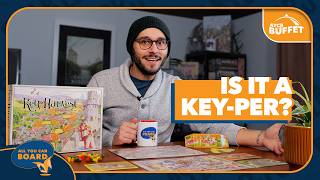
- This is Key Harvest, and this is a game from 2007. It was designed by Richard Breeze.
- I really enjoyed this game, and it did not disappoint.
- It's a very puzzly game; you're constantly having to plan ahead and consider multiple turns.
References (from this video)

- Accessible entry point that still offers depth through economy-based decisions.
- Promotes patient, long-horizon planning and careful bidding.
- Encourages social interaction and mutual observation of table state.
- Market fluctuations can be influenced heavily by indirect player choices.
- End-game scoring may feel opaque if players miss key sale opportunities.
- agriculture, markets, and exchange; the game emphasizes the social aspect of resource exchange and cooperative-competitive play.
- A farmer’s market of tiles; players harvest fields and cultivate crops with a flexible, shared economy that rewards bid-and-sell decisions as much as cultivation.
- gentle, reflective, almost pastoral; the game invites patience and slow discovery rather than frantic action.
Mechanics (from transcript analysis)
- Auction / Bidding — Tiles can be put up for sale, and players bid to acquire desirable resources; timing and price dynamics shape the end-game scoring.
- auction /bid for tiles — Tiles can be put up for sale, and players bid to acquire desirable resources; timing and price dynamics shape the end-game scoring.
- cooperative-yet-competitive resource flow — Players’ actions can help or hinder others; circulating resources and selling tiles creates interdependence and strategic tension.
- Tile Placement — Tiles are placed to form fields and market areas, creating opportunities for harvest and sale on future turns.
- tile placement / grid management — Tiles are placed to form fields and market areas, creating opportunities for harvest and sale on future turns.
Video topics + discussion points
Quotes (from this video)
- In many ways, board games have never been as popular as they are today.
- We're not just building a board together. We're having a conversation.
- Patience isn't complacency, patience is living.
- Two phases.
- You choose what matters. Because you build the board. You splay the cards. You choose what you let go of. You choose what you keep.
- Sometimes you just need to wait for the right thing to say.
References (from this video)

- favorite Uwe Rosenberg game
- small decisions have huge consequences
- good player wins by big margin
- can't luck your way to victory
- engine building
- agricultural
- engine_building
Mechanics (from transcript analysis)
- Engine Building — engine builder's engine builder
Video topics + discussion points
Quotes (from this video)
- this is my list the video says the top 100 board games of all time but it really is just my top 100 board games of all time
- three minute board games is an independent channel we dont take money from publishers and we do not do any form of paid content
- Mosaic has the ambitious goal of being a civilization game that can be played in two to three hours and it very much succeeds at this goal
- a game that does not need to be played with a traitor because the inherent selfish goals in this game created enough internal conflict
- I love space racing games and space corp is the game that is most racy as far as space racers go
- the term I use instead of gateway game is foundation game
- Sentinels could easily be a forever game the kind of game you just play over and over and over and over again endlessly
- Modern Art is a simple and brilliant and beautiful game and easily the best pure auction game Ive ever played
- Black Orchestra models some very clever things about how conspiracy is run
- when I asked the question hey what game should I play with my non-gamer friend who's interested in gaming but hasn't done much gaming I almost always answer Sentient Golem Edition
- Arkham Horror is the game that really made board gaming my number one hobby
- there are a few things more fun and rewarding in board gaming than organizing a fight in the arena
- Twilight Struggle is one of the best head-to-head games out there
- Santorini is the definition of an elegant design
- Arkham Horror the card game absolutely should be for you it's a hundred percent for me and it is my number one game of 2023