/pic3690708.jpg)
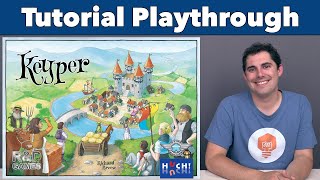
Keyper is a game with high player interaction for two to four players played over four rounds. Each round represents a season: spring, summer, autumn, and finally winter.
Each player starts the game with their own village board, a mini keyp board, 12 village tiles, a keyper (waving meeple) in their player color, and a team of eight multi-colored keyples, including two white keyples. Each differently colored keyple is a specialist in one activity: the brown keyper is a woodsman, the black keyple is a miner, the orange keyple a clay worker, etc. The white keyples are generalists who can represent any other color.
Keyper is a worker placement game. (Keyper is the eighth new title in the medieval Key series of games, with Keydom, the second in the series being widely recognized as the first of the worker placement genre of games.) What makes Keyper special is that when one player places a keyple on a country board, another player can join them with a matching colored keyple on the first player's turn to the benefit of both players. In this way, some players are likely to have played all their keyples before others. All keyples have the potential to work twice. If a player has played all of their keyples, but another player still has some, then on their turn, the player with no remaining keyples can lay down one or more keyples on the country board they have claimed or in their village board to secure additional resources or actions. It can therefore be doubly beneficial to co-operate with your fellow players, although Keyper is not a co-operative game in the usual sense of the term.
The country boards are also noteworthy, in that they can be manipulated and folded at the beginning of summer, autumn, and winter to show one of four different permutations of fields for that season. A player will chose the one to suit their strategy, often hoping that another player will complement their choice. Certain fields on the country boards are available only in certain seasons, e.g., raw materials can be upgraded to finished goods only in spring and summer, after which you can only convert using tiles in your own village. Gem mining occurs only in autumn and winter.
A player's strategy is likely to be influenced by which (seeded) spring country tiles they acquire and by the particular colored keyples they have available in the later seasons. Different combinations will encourage a player to develop their farm or village, help with their shipping or mining activities, and prepare for the seasonal fairs. Players constantly need to evaluate whether or not to join other players, when to claim a country board, whether to play on their own or another player's country board, when to use their own village, and whether to create a large or small team of keyples for the following season. The winner is the player to gain the most points, usually through pursuing at least a couple of the different strategies.
In addition to the theme and mechanisms, Keyper has similar traits to the earlier Key games: Game actions are positive and constructive, not destructive; player interaction is through the game mechanisms not direct, and like Keyflower, the previous game in the series, there is a lot of player interaction.
A special English-language Kickstarter edition of Keyper with "character" keyples and keypers will also be released.

Keyper Tutorial & Playthrough - JonGetsGames

- pleasant surprise
- interesting board interaction
Mechanics (from transcript analysis)
- board claiming / area control mechanics — players claim boards to lock in actions for the next round
- worker placement in modular boards — workers placed to activate actions; boards form the core action set and can be claimed
Video topics + discussion points
Quotes (from this video)
- this game is amazing
- it completely blew me away
- Gaia Project... I enjoyed it more than Terra Mystica
- Masters Trials did a good job of combating the number one issue of cooperative games
- it's a really good card game version of a previous game
References (from this video)
Mechanics (from transcript analysis)
Video topics + discussion points
Quotes (from this video)
- The approach to that is so completely different from the approach that I take when I'm creating a script for a video it you know in some ways it's worlds apart but in other ways there's a lot of connections.
- It's okay to look at the rulebook okay yeah so I am the main demo person for check games edition and when I go to Gen Con and origins and things like that I demo all of the check games to and somebody will come up and they'll say I want to play dungeon pets well I know dungeon pets I know dungeon vet really well Do I remember exactly what the three player rule is about the green square no is it so so for that point I will look in the rule book now there is a train of thought that says wait a minute you're the official demo person for this game and you're having to look in a rule book and some people might think that's you know wrong but looking in the rule book for something that's you know a very small detail about all the setup instructions how much money does everybody start with oh yeah it's four five five six right okay yeah just little things like that don't be afraid to look in the rule book if you if you need to it's much better to look in the rule book then you know think oh yeah I think I know what the rule is so I'll tell them and then you end up getting it wrong so yeah that would be one thing I would say definitely keep the rule book handy.
- The problem is by being distracted during the rules explanation you will you will miss certain things yeah so yeah and the other thing as well about people is that they will be constantly asking questions some people you know especially if you've kind of scripted the teach so the teach that I'm gonna do of key market tonight I am planning today to script it not word for word but I am going to have a series of bullet points and I am going to have different parts of right whereabouts am I going to explain this bit and where am I going to explain that of it and then you get somebody interrupting like two minutes in saying what does this icon do here or what does this mean here and you're like yeah I'll get to that later on um and and and this is a thing you've got to be careful that some people don't like that okay so some people if they say what does this icon do here yeah if you don't tell them right then what the icon does they think you're a terrible teacher because they've asked a question and you're not answering it yeah so some people think that but when you know you know you've spent a whole day planning how you're going to teach this game and that icon means absolutely nothing right now and it makes me even if you explain it right now it makes no sense whatsoever yeah it's the way that you would if you say that icon is relevant in the winter phase I'll explain it more in the winter days if I forget remind me so you know basically don't pamper to everybody's needs and desires if they want to know exactly what a specific thing means at that specific time because it can disrupt the flow and it can also end up messing up your flow of information so I believe that there is a there's a right flow of information and if you start focusing on a specific thing specific thing that's going to happen in a specific area of the game and you start Corina just at the start it it kind of messes up and that will disrupt it disrupts that the teach basically.
- The objective of this exercise for the next three or four hours by the end of it you will have learned how to play forget being competitive right we're all going to try and win obviously but forget being competitive forget all of them my new details just play the game learn the game and learn how all of the bits interconnect and move around yeah because then the game goes a lot quicker if you were to say right we're all going to be super competitive from game one I'm going to read out all of the rules everybody's going to sit there and analyze all of those rules yeah very few people can actually then turn those rules into a workable strategy without actually seeing how the game plays out first.
- So I had to lick that clip so that it was nice and nice. we're yeah I would then insert it in not on my belt but actually between my trousers and my skin so that it was touching my skin okay yeah and the static went away now Wow what I was doing is I was obviously providing some kind of earth but what I had to it was quite funny I had literally licket and sticky down my pants and a static went away now I have told this story how time to professional sound people yeah and they they didn't believe me and I'm like look it happened and they said well I've never heard of that but it was a combination of fluorescent lights powered lapel mic yeah an unshielded cable yeah and it was all of those things combined but yeah I accidentally fixed it because what I did is I had some headphones in the camera and I was listening back to occurred here this static and there's suddenly the static would go I'm out it's gone oh and then he's come back yeah well he's gone and he's come back and I'm like what's happening and he was when I was holding the clip every time I touch the metal clip it static when so I thought well I can't hold this on camera because I'm so I'll have to lick it and put it down me challenges and I did I did loads of videos like that
- The mechanics of the game aren't that hard but if you don't know what's coming and what's going to get you most of your points then you're not in a competitive position
References (from this video)
- Key to the City London
Mechanics (from transcript analysis)
Video topics + discussion points
Quotes (from this video)
- i was blown away by how much i loved that game
- i was blown away by the innovation that was in this game
- i was blown away at how much fun i had actually playing this one
- this game is so tense and so tight with such an elegant simple rule set
- i don't think i actually enjoyed that play
- i absolutely loved the experience
- i was completely blown away by this game
- i hated this game what a surprise
- it's a top 10 game
- so unfortunately my biggest surprise game overall is on the negative
References (from this video)
- not many people talk about it for years
- considered underrated among two-player games
Mechanics (from transcript analysis)
Video topics + discussion points
Quotes (from this video)
- it's 12 years old and i was just i remember uh playing this game feeling like how are more people not talking about this game this game is so neat
- i decided to play it again and i really enjoyed it
- i can't give you a good answer on that because like most games that i make videos for i never really actually played it
- i'm a big champion for pioneers i think that game is really cutthroat and lovely
- abstract recommendation is home world it's a fantastic game with a mix of tactics and strategy
References (from this video)

- Striking art style
- Clear, accessible deck-building core
- Compact 60-minute experience appears well-suited to many groups
- Length/structure details unclear from the segment
- space adventure, urban-colony vibe
- Space exploration with a decently stylized aesthetic
- deck-building with thematic storytelling cues
Mechanics (from transcript analysis)
- Deck Building — build a deck of abilities to influence actions and progression
- deck-building — build a deck of abilities to influence actions and progression
- meeple-based play — utilizes meeples rather than miniature figures
Video topics + discussion points
Quotes (from this video)
- I hope you survive.
- There’s the exploration, there’s the story, and then there is the boss fight.
- I like the art on it.
- This is a story-driven cooperative game where you are going into the unknown and fight against a giant creature.
- I think this hits me in everything I’m interested in.
References (from this video)

- strong reception in the community
- enjoyable and accessible
- not deeply described in playthrough here
- community-recognized game of the year era
- Birth
- Mighty Boards catalog
Mechanics (from transcript analysis)
- Compound Scoring — recognized by community for overall excellence
- scoring-driven — recognized by community for overall excellence
Video topics + discussion points
Quotes (from this video)
- Harmony is pushing toward the middle, maybe the top end of our beginner category
- it's a fabulous game
- Barbarian Kingdom is a mosH pit of a game of area control
- Ironwood such an amazing game
- Rebirth is absolutely fantastic
- Lord of the Rings DW is a great pick
- Joy Ride Survival of the Fastest is an amazingly striking game
References (from this video)
- Strong coupling of theme with mechanics (seasonal cycling, shipping, and upgrading).
- Engaging and educational tutorial playthrough that teaches core systems while playing.
- Deluxe components in the video (silkscreened workers) are highlighted as a quality touch.
- Board flipping and market dynamics add variety and replayability.
- Color-coded borders and visuals aid accessibility and quick comprehension.
- Rule complexity is high; beginners may feel overwhelmed by the number of interacting systems.
- High information density could slow early-game learning and setup.
- Lengthy playthroughs may test patience for some audiences.
- Resource management, building, and seasonal production with a strong emphasis on planning and upgrading.
- Seasonal agrarian world with country boards, villages, ships, and animals.
- Procedural flavor with explicit seasonal phases and evolving board layouts; narrative is thematic but abstract.
Mechanics (from transcript analysis)
- Building construction and upgrading — Players construct village and farm buildings; upgrades flip to grant ongoing benefits and points.
- Color matching and borders — Actions often require color matching; borders and icons assist color coding and accessibility.
- End-game scoring and adjacency — Points come from buildings, ships, adjacent village tiles, and seasonal/tile-based bonuses; some tiles score diagonally or in rows/columns.
- Festival/fairs scoring — Festival tiles require combinations of resources/animals to secure end-game points.
- Infinitely flip-able country boards — Country boards can flip to reveal a wide array of options, changing strategy across seasons.
- Keeper placement and lay-downs — Keepers are placed on country boards; lay-downs can activate multiple times with helpers and may mirror across turns.
- Market tile drafting — Tiles representing buildings and plots are drafted from a market and refreshed periodically.
- Resource conversion (raw to refined, and gems) — Raw and refined resources can be transformed; gems and special tiles provide advanced scoring and options.
- Resource storage and animal housing — Farm tiles store animals; limited storage creates strategic decisions about hoarding and conversion.
- seasonal round structure — The game progresses through Spring, Summer, Fall, and Winter, with season-specific effects and board changes.
- Shipping and ports — Shipping actions dock ships and convert resources into shipping points; keeps a persistent shipping track.
- Worker Placement — Players place keepers or workers to trigger actions; helpers from opponents can boost actions.
Video topics + discussion points
Quotes (from this video)
- What’s going on in this game is each player is going to be playing through for overall seasons and they have a variety of workers that come in different colors.
- the boards will flip into a variety of different orientations
- Spring symbol on all three country boards and we are in the Spring season
- we both get to take two of these building tiles but in this case we get to choose one of these the blue player will get to choose two and then we will choose our second one after
- Shipping action and we dock ships into empty ports
- the end of the season you will take all of the peoples that are over here on your board and those will get added into your supply for the next season
- the rules also say that if you forget to do this when you put your keeper out you can also lay this down to take that bonus at the end of the season
References (from this video)
Mechanics (from transcript analysis)
Video topics + discussion points
Quotes (from this video)
- Black history is American history.
- We are rating games we played in 2022.
- OMPG endorsed.