/pic8660175.jpg)






























Kingdom Crossing Deep Dive
What the Community Thinks About Kingdom Crossing
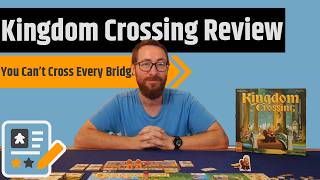
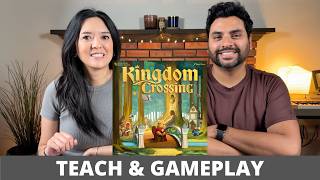
Kingdom Crossing has surprised reviewers with its depth beneath a whimsical exterior. While the cover art and animal theme initially suggest a lighter experience, players quickly discover a thoughtfully designed midweight Euro that rewards careful planning and clever optimization. Reviewers consistently praise the game for delivering satisfying engine-building moments and engaging puzzles without becoming overwhelming.
Core Mechanics That Define Kingdom Crossing
Bridge Crossing and Route Optimization
The heart of Kingdom Crossing lies in its elegant central constraint: you can never use the same bridge twice in the same day. Inspired by the mathematical Seven Bridges of Konigsberg problem, this mechanic creates a cascading puzzle of spatial planning. On your turn, you select one of your action tiles, each numbered to let you cross a specific number of bridges, and place footprints on those bridges to mark them as used. As the round progresses, islands become increasingly isolated until you're forced to use the hot air balloon (at a cost) to reach disconnected areas. This restriction creates genuine tension without feeling arbitrary, as islands naturally get cut off from the rest of the kingdom through the game's organic flow.
Engine Building Through Guild Cards
Kingdom Crossing's second pillar is its engine-building system. You acquire character cards representing different guilds (fox, owl, bear, wild boar, and deer), tucking them under your player board to build columns of paired sets. At the end of each round, you gain income from these columns: fox pairs grant points, owl pairs let you invest in your economy, bear pairs activate structures, wild boar pairs upgrade your action tiles, and deer pairs give you resources. This income engine grows throughout the game as you carefully build which guilds to specialize in. The puzzle becomes deciding which cards to pursue and in what order, as your choices about guild focus cascade into your economic strength and flexibility for future turns.
The Kingdom Crossing Experience
Satisfying Tightness and Decision-Making
Money is scarce in Kingdom Crossing, creating a perpetual tension that keeps the game engaging. You never feel flush, yet rarely completely stuck. Most turns offer a few clear options worth considering, which reviewers note keeps the game from becoming analysis paralysis. The decision space feels restricted in a good way, where your options are meaningful without being overwhelming. Each round of four actions forces you to balance immediate needs (money, resources) against longer-term goals (completing goal tiles, upgrading your action tiles, advancing resource tracks). The economy's tightness makes every coin matter and every resource trade-off meaningful.
Multiple Paths to Victory
No two games of Kingdom Crossing play the same because you're pursuing different combinations of objectives. Six double-sided bridge goal tiles create races that shift from game to game. Your personal end-game goals (drawn at random and expanded through play) vary widely. Resource tracks don't just contribute to scoring; they're intertwined with your guild card colors, letting you build wildly different scoring engines. You're also trying to place all three of your houses on the board (one per distinct guild), which opens up additional income and endgame bonuses. The result is a game where you're not trying to do everything, forcing strategic choices about which scoring paths to invest in.
What Makes Kingdom Crossing Stand Out
Whimsical Theme with Serious Mechanics
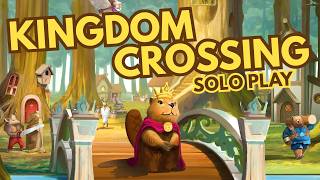
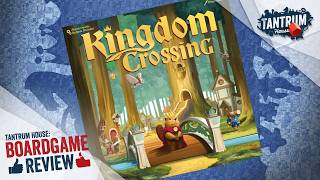
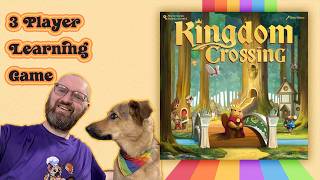
Kingdom Crossing wears its fantasy animal theme proudly, yet this never trivializes the game's mechanical depth. The cutesy beavers, foxes, owls, and birds might suggest a gateway game at first glance, but once play begins, the puzzle reveals itself as quite sophisticated. Reviewers note the pleasant surprise of this mismatch: the game looks approachable but plays with intelligence and interesting constraints. The animal characters provide flavor without getting in the way of clean, strategic decision-making. The double-layer player boards and chunky wooden components underscore the production quality, with everything fitting neatly and silk-screened clearly.
The Hot Air Balloon as Safety Valve
While the bridge restriction can cut off islands entirely, the hot air balloon prevents complete frustration. You can always use it to reach unreachable regions, but it costs coins (three if it's in your region, ten if you must call it to you). This forces a spatial puzzle on top of the economic puzzle: do you position yourself where the balloon is to access it cheaply, or do you make your optimal movement and pay the premium? Some of the highest-value cards and regions lie on islands that become unreachable through normal movement, making the balloon a legitimate strategic consideration rather than a get-out-of-jail card.
Potential Drawbacks
Limited In-Game Goal Variety
The game includes only six bridge goal tiles, double-sided for slightly easier and harder variants. This is the main limiting factor for replayability at higher player counts. With just six objectives in play per game, the competitive landscape can feel familiar across plays. Reviewers expressed a wish for more in-game goal variety, expecting future expansions to address this. The goals drive critical decisions (like managing your money track to hit specific numbers), so having more would freshen the puzzle each play.
Resource Track Optimization Ceiling
The resource tracks contribute to endgame scoring through a satisfying but somewhat unintuitive calculation: you multiply your resource track position (past certain starred thresholds) by the number of cards you have in the matching guild color. The tracks offer one major bonus (an endgame goal for reaching the end), but reviewers noted that this bonus is extremely difficult to hit and felt underutilized. With only that single mid-track milestone, the resource tracks become a steady background element rather than a focal point of dynamic decision-making, and some players felt they could have been integrated more richly into the turn-by-turn puzzle.
If You Enjoy Kingdom Crossing
Players drawn to Kingdom Crossing tend to appreciate tight Euro economies where every resource matters, route-planning puzzles, and games that reward engine-building. The mathematical restriction of the Seven Bridges of Konigsberg gives the game a distinctive constraint that fans of spatial puzzle games will appreciate. If you enjoy Everdell's set collection, Azul's tight spaces, or games like Arknova with genuine economic pressure, Kingdom Crossing offers that same combination of elegance and depth. The game shines with two to four players, scales smoothly across player counts, and begs for replays once you understand the baseline systems.
What Reviewers Are Saying
"This one's got some really interesting decisions and it's got a lot of replayability because there's tons of different ways to play. You're not going to be able to do everything in a game. It's an awesome midweight Euro game that has been brushed under the rug because unfortunately there's just too many good games."
— Board With Steve
"It feels really good and very satisfying. Yeah, this is a very good game. This is in the light to midweight Euro engine building type of genre, but it has some nice timing to it that keeps the game really live until the end."
— Meeple University
"This is a smart game with big decisions and it's got like interesting restrictions in it as well. There is just something about it that looks a little bit kiddish, but do not be fooled by that. This is a a smart game with big decisions."
— Allies or Enemies