/pic2031777.jpg)
/pic3051552.png)
/pic6620505.jpg)
/pic7055560.jpg)
/pic2031777.jpg)























La Granja Deep Dive
What the Community Thinks About La Granja
La Granja stands as a farming and economic game that has earned sustained appreciation from serious board gamers. The game generates genuine enthusiasm among reviewers who value resource management depth, rewarding deck building mechanisms, and innovative card systems. Though some find its theme less visceral than purely agricultural games, those who engage with its mechanics consistently return to it, recognizing it as a classic that deserves more attention than it receives. The game strikes a balance between elegance and strategic complexity that appeals to gamers seeking something beyond typical agricultural simulations.
Core Mechanics That Define La Granja
Multi-Use Cards as Design Foundation
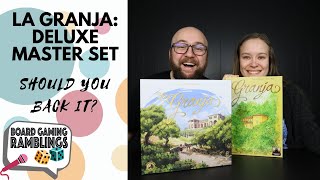
La Granja is probably best known for its use of multi-use cards, one of the most sophisticated implementations of this mechanic in board gaming. Each card can be used in four different ways by physically tucking it under one of the four sides of your player board. This simple physical interaction creates surprisingly rich decision-making throughout every game. Players might choose to improve their farm or create a new field of wheat, olives, or grapes, or use the card for its delivery contract on top, or play it as a special ability at the bottom. The sheer number of cards in the deck means every game presents distinct strategic avenues, making each playthrough feel genuinely different from the last.
Dice Drafting and Resource Allocation
The game features a fascinating dice drafting phase where players select dice from a shared pool to power their actions. This mechanic combines luck with tactical decision-making. Alongside area control elements and contract fulfillment systems, the dice drafting phase creates a free-flowing feel where many core actions function as free actions. This pacing system allows players to enjoy genuine choice without excessive downtime between turns. The interplay between what dice are available and how players choose to use their cards creates a satisfying puzzle that rewards both careful planning and tactical flexibility.
The La Granja Experience
Elegant Complexity and Satisfying Puzzle Solving
Players praise La Granja for how it makes complex systems feel approachable. The game throws a bunch of familiar mechanics into a pot to create an intriguing stew, yet barely squeaks into the medium-heavy complexity category through its quirky rules and intuitive card-tucking system. What makes the experience compelling is the satisfying puzzle of managing your farm: you want to produce goods like wine and meat through your fields and livestock, then deliver these to market to earn victory points and money. The combination of card play and the foundational dice you draft creates a genuinely fascinating combination that players love to explore.
A Farming Theme That Resonates
The farming theme feels grounded and functional rather than superfluous. You are genuinely managing a farm by planting crops, building infrastructure, breeding livestock, and trading goods. The economic simulation works naturally through its mechanics, creating meaningful decisions where each choice moves you toward establishing your farm's production engine. Players describe the sensation of building up their operation over time, watching their farm grow from scattered resources into an integrated trading system. This thematic cohesion between the mechanical and narrative aspects creates what players describe as a comfort-game quality, something they return to without fatigue.
What Makes La Granja Stand Out
Innovative Card Manipulation System
Few games implement multi-use cards with the sophistication and elegance of La Granja. The physical act of tucking cards under different sides of your player board is both satisfying and intuitive. What sets this apart from other multi-use card systems is the sheer range of meaningful options available for each card. You never feel like you are forced into one obvious choice because the game genuinely rewards multiple distinct strategies. Players consistently highlight this as one of their favorite mechanisms in all of board gaming, praising how the deck's size ensures endless card combinations and paths to victory across different games.
Multiple Routes to Victory
La Granja refuses to push players down a single optimal path. You can succeed through various strategies, whether you focus on livestock breeding, crop cultivation and wine production, building delivery contracts, or leveraging special abilities from your cards. This openness means that the game rewards different player styles and priorities. Some games reward only the player who optimizes a single narrow strategy most efficiently, but La Granja genuinely feels different every time you play because the viable winning approaches shift with the cards that appear and the dice that are drafted. This design creates replayability that many players found remarkable even after repeated plays.
Potential Drawbacks
Thematic Distance for Some Players
While the farming theme works well mechanically, some players find it less evocative than purely thematic games. The game is fundamentally about economic optimization and resource conversion rather than immersive farm management storytelling. For gamers seeking deeper thematic integration where the theme drives the narrative experience, La Granja may feel like a well-designed economic puzzle dressed in farming clothes rather than a true simulation. The theme serves the mechanics rather than the reverse, which some find refreshing and others find somewhat hollow.
Rules Complexity and Setup Overhead
Despite its elegant central mechanism, La Granja carries moderate complexity through its layered systems. Players must manage dice drafting, card placement, contract fulfillment, area majority, and resource conversion all simultaneously. While experienced gamers find this satisfying, newer players can feel overwhelmed by the sheer number of systems working together. The original version offered a simple solo mode that kept overhead low, allowing players to focus on card manipulation without complex AI opposition, though the newer Deluxe Master Set introduced more elaborate solo variants that add significant complexity.
If You Enjoy La Granja
Gamers drawn to La Granja typically love mid-weight economic games with innovative card systems and strong tableau-building elements. If you appreciate games like Viticulture, Agricola, or Ginkopolis, La Granja shares similar DNA in how it combines resource management with strategic card play. You should also seek out games featuring area majority mechanics combined with contract fulfillment, or other Stefan Feld designs known for elegant decision spaces. The appeal of La Granja extends to anyone who loves multi-use card games where the same card can fill radically different roles depending on your strategy, as well as players seeking farming-themed games that prioritize engaging mechanics over thematic narrative.
What Reviewers Are Saying
"The combination of card play and choosing what dice you want is a really fascinating combination that I really do love. The multi-use cards are some of the most multi-use cards in all of board gaming, every card you can play in four different ways."
— Totally Tabled
"La Granja is a classic medium-weight Euro that I adore because it uses multi-use cards. This game is getting a deluxe reprint, and hopefully it'll be widely available again and back in the gamer consciousness because I consider this one a classic."
— Totally Tabled
"La Granja is a 2014 game that is ranked 239 overall and is one of my favorite non-Rosenberg farming games. Tableau management mediated by individualized multi-use cards and contract fulfillment makes this game very fun every time I've played it."
— The Board Gaming Doctor