/pic8265939.png)
In Havana you acquire victory points by constructing buildings, available as tiles displayed on the table. To take a building you must pay its requirements - some combination of money, workers and building materials. More difficult combinations yield more victory points.
Furthermore, not all of the available buildings on the table are ripe for the taking, as only the ones on the right and left hand border of the 2 rows of buildings are available for selection.
The game's core mechanic revolves around identical decks of 13 cards for each player, of which only 2 are played per round. But in addition to the card's function, the numerical combination of cards played is important (e.g. a card with a value of 3 and 4, result in the value 34) as the player with the lowest combined number acts first.
So not only is the start player constantly changing, but it is also possible that a planned action cannot be taken, as another player has already used the same role. Not all roles are exclusive, so the turn order will also determine whether your "half of all pesos in the middle" is half of eight, or half of four (if a player before you played the same card). Some roles allow you to tax others or steal from them, and some cards defend against this, so it's not all just collecting pieces in a solitary manner. Some combinations require the presence of an architect, so you must choose whether to use one of your two card spots for him. Other cards add different twists. What and when to choose, who to hurt, and what you're aiming for, make up the game's main decisions.
These different ideas make Havana its own game even if some of it is familiar. It's shorter and lighter than many similar games, as well.


How to Play La Habana
Images


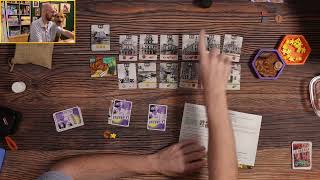
- Interesting resource management with rubble, pesos, and workers.
- Strategic card play affecting initiative and actions.
- Satisfying building progression.
- The 'Mama' card is noted as powerful.
- The rules can appear confusing.
- Some actions are limited to one player per round.
- Tiebreakers can be numerous.
- Building out Havana
- 25th century Havana
Mechanics (from transcript analysis)
- Area Control — Players build structures in Havana, with some progression rules related to rows.
- Hand Management — Players play two cards from their hand, then discard one, and draw new cards to replenish their hand.
- Resource gathering — Players gather pesos, rubble, and workers to fuel their actions and building.
- Set Collection — Players collect various types of bricks and rubble to exchange for buildings.
- Turn Order — Initiative is determined by the sum of played cards, with tiebreakers like youngest player going first.
- Worker Placement — Workers are a resource needed to build certain buildings.
Video topics + discussion points
Quotes (from this video)
- So all of these actions just take a nap, right? This is just to give you a zero so that you can try and um fudge turn order.
- And of course, Mama's the most powerful. Mama, she's the leader of the game.
- Boom. Pharaoh wins.
References (from this video)
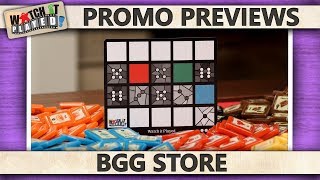
- Large upgrade with extended goods set
- premium production quality
Mechanics (from transcript analysis)
- Resource Management — Upgrade set replaces standard goods with enhanced representations (goods like cattle, meat, grain, bread).
- resource_representation_upgrade — Upgrade set replaces standard goods with enhanced representations (goods like cattle, meat, grain, bread).
Video topics + discussion points
Quotes (from this video)
- this is the watch it played promo for Sakurada
- this set could quite literally last a lifetime several lifetimes I would think it could be heirloom passed down through generations
- none of the pieces you see in this video use stickers this is a heat transfer system that fuses the image to the plastic
- the box is finally empty and you can find everything I showed you here
- 11 time tokens to replace the ones in the game and includes the two blue ones that are used for the easy mode
- you dec build but you actually customized the cards themselves as you play
- Relax play games
- any purchase you make after that point will help the channel here
References (from this video)

- Good component and production quality
- Interesting way initiative changes
- Plays quickly
Mechanics (from transcript analysis)
- Card Play — Players play two cards from their hand, with one staying for subsequent turns, forming a number based on the played cards to determine initiative.
- initiative — Whoever plays lower gets to have initiative and go first, with the start player changing every round based on cards played.
- Set Collection — Players try to build the cards they need, which involves acquiring various resources.
Video topics + discussion points
Quotes (from this video)
- One of the nice things is it feels a little less punishing than the original game.
- Monopoly Deal, I think, is a much more fun version of Monopoly.
- This game feels bigger than it is, and I mean that as a compliment.
- And so, you know, it's just full of those kind of mind games.
- Silver Frost is maybe the most punishing of the games in the series because you are doing worker placement out with your meles, gaining resources, using those resources to build cards.
- The game is actively trying to screw you over, and you have to manage it as well as the other players out there.
- I love Love Letter. Uh and uh it's one of my most played games of all time also cuz you can just throw it in a pocket and bring it anywhere with you.
- And it's inside of a fun Stitch plushy.
References (from this video)
- Stands the test of time
- Colorblind friendly component design
- Cool and interesting system
- Pretty balanced gameplay
Mechanics (from transcript analysis)
- Card Drafting — Players select cards from a central display. They can only take from the outer edges of two rows of six cards.
- Hand Management — Players have their entire deck available at the start and must manage their hand, playing two cards for initiative and then discarding one for the next turn, cycling through cards.
- initiative bidding — Players reveal two cards, sum their values for initiative, and determine turn order based on the total.
- Set Collection — Players collect resources like bricks and money to build structures that provide victory points.
- Worker Placement — Workers are sent out to gather resources or perform actions.
Video topics + discussion points
Quotes (from this video)
- two hits and a miss with some 25th century games
- It's really good and it does stand the test of time.
- Operation Barlay. Wanted to like it, but just didn't have as much fun as I wanted to.
- Mechco Syndicate blew me away.
- By the end of the game, your brain is so fried. You have so many things juggling.
- The artwork is dynamite.
References (from this video)
- tight, tactical city-building with focused two-player-to-four-player playtime (30-45 minutes).
- delightfully unpredictable central supply bag adds tension and planning depth.
- flexible end-game scoring with clear, decisive finish.
- distinct action-cards drive varied strategies and planning ahead.
- memory-driven planning gives opponents opportunity to anticipate intent.
- complex for newcomers due to many action-altering cards and phase rules.
- scaling and simultaneous planning can feel dense at lower player counts.
- board setup and card management may slow down play for casual groups.
- city-building, resource management, action-card driven engine
- Havana, Cuba; historic/urban development theme
- competitive, planning-forward with simultaneous actions
Mechanics (from transcript analysis)
- central supply bag and resource randomness — A bag holds bricks and other resources; draws add unpredictability to the central supply.
- end of round planning and memory — Single card is kept; the other is discarded; all players reveal their new two cards simultaneously.
- end-row structure layout and refresh — Two rows of six structure cards with end cards; when two left, draw four and replace ends.
- five-for-one resource conversion — Exchange five vessels or five bricks for a replacement of a worker or material.
- hand and resource management — Players manage pesos, bricks, construction materials, and workers to acquire and build structures.
- phase-based play and initiative order — The round unfolds in four phases: initiative, structures and actions, central supply, replacement.
- scoring and end-game conditions — Game ends when a player reaches target prestige (25/20/15 depending on player count) or all structures are built.
- Special action cards — Action cards grant unique abilities (Siesta, Wardas Palas, Mendigo, Recycle, Ruina, etc.), shaping round strategy.
- structure-building with end costs — Pay costs listed on structure cards and immediately gain prestige; can build from either end row with constraints.
- two-card action drafting and initiative — Players secretly select two action cards each round and reveal; turn order is determined by the smallest two-digit number formed by the two card values.
- Variable Phase Order — The round unfolds in four phases: initiative, structures and actions, central supply, replacement.
Video topics + discussion points
Quotes (from this video)
- To begin laying the foundation of your growing city
- This bag is your city supply chain, and it is delightfully unpredictable.
- Havana is flexible, but not that flexible.
- No questions, no negotiations.
- After revealing your new action card, if you now only have two action cards left in your hand, you immediately take all cards from your discard pile back into your hand.
- You can never turn a worker into five pesos or a material into five rubble.