/pic6795274.jpg)
















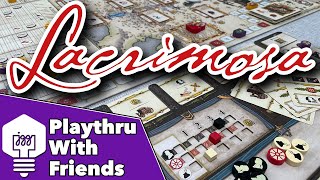
















Lacrimosa Deep Dive
What the Community Thinks About Lacrimosa
Lacrimosa has captured the attention of board game reviewers with its elegant blend of historical theme and intricate mechanics. Players praise it as a well-crafted Euro game that brings classical music to the tabletop in a meaningful way. While some reviewers find it falls slightly short of excellence, others consider it one of the standout games of 2022. The consensus centers on its beautiful production, smooth gameplay flow, and the satisfaction of managing tight resource systems.
Core Mechanics That Define Lacrimosa
The Dual Card System
At the heart of Lacrimosa lies an innovative mechanism where each card serves two distinct purposes. Players slot cards into their personal boards with the top action providing immediate gameplay effects and the bottom section generating resources for the following round. This multi-use card design creates meaningful decision-making around resource planning, forcing players to balance immediate actions against future positioning. The system rewards careful planning, as committing resources now determines what you can accomplish in later rounds.
Deck Construction and Upgrading
Rather than traditional deck building where cards flow through discard piles, Lacrimosa uses a fixed nine-card deck that evolves throughout the game. When purchasing new cards, players must retire existing ones, creating a thoughtful optimization puzzle. Cards improve over time, offering multiple actions instead of basic abilities, which provides satisfying progression as your engine grows more powerful. This constant tension between maintaining action diversity and upgrading critical cards keeps strategic options open.
The Lacrimosa Experience
Mozart as Your Creative Partner
The game establishes an intimate narrative where you act as a patron funding Mozart's final works. A communal Mozart figurine moves across a European map, creating a subtle element of spatial interaction as you compete for valuable location bonuses. This thematic integration feels natural rather than pasted on, anchoring your economic decisions within the historical setting of 18th-century musical patronage.
The Requiem as Collective Achievement
Contributing to Mozart's Requiem creates a shared scoring track alongside personal objectives. Players invest resources to place instruments in different sections of the score, positioning themselves to benefit from composer majorities. This mechanism blends personal ambition with shared progress, though some reviewers note that one player often establishes dominance early, with others following rather than directly competing for control.
What Makes Lacrimosa Stand Out
Thematic Authenticity in a Niche Setting
Board games rarely explore classical music with any depth. Lacrimosa brings genuine thematic resonance by focusing on Mozart's Requiem, commissioning various composers, and tracking historical figures from his life. The game teaches subtle lessons about musical history while making every mechanical choice feel connected to its subject matter. This fresh setting distinguishes it from the countless European economic games occupying hobby shelves.
Elegant Complexity in Smooth Execution
For its strategic depth, Lacrimosa flows remarkably well. The turn structure is intuitive, action resolution feels natural, and there are no fiddly subsystems or memory challenges. Players understand their options quickly, and the game accelerates after the first few rounds as everyone internalizes the action icons. This accessibility makes it welcoming to experienced gamers and newcomers alike.
Potential Drawbacks
The Requiem Lacks True Area Majority Drama
While thematically compelling, the composer majority mechanic plays conservatively. Players tend to piggyback onto whoever established dominance earliest rather than mount competitive challenges for control. The limited opportunities to invest in composers and increasingly expensive additions create barriers to shifting the balance, meaning the first mover often runs away with Requiem points. Reviewers respect the limitation but found this portion less exciting than the card and travel systems.
A Solid Game That Rarely Inspires Passion
Lacrimosa executes its design flawlessly, yet some experienced gamers feel it lacks the dramatic peaks and valleys that elevate games into their top tier. The game presents multiple paths to victory and interesting decisions throughout, but lacks a signature moment that generates excitement or table talk. For collectors comparing it against similar titles like Rococo or Newton, Lacrimosa holds back slightly, offering refined polish over transformative gameplay.
If You Enjoy Lacrimosa
Fans of Rococo and Newton will find familiar design sensibilities here, though with fresh mechanics and setting. Those drawn to Clank, Dune Imperium, and Lost Ruins of Arnak appreciate the multi-use card systems that Lacrimosa shares. Players who loved Concordia for its elegant hand configuration will recognize the thoughtful card management. If you seek games with strong historical themes combined with economic gameplay, investigate Alamithin and other Devir releases. For those craving more Mozart and musical themes, the rare appearance of such settings in the hobby makes Lacrimosa uniquely valuable regardless of other comparisons.
What Reviewers Are Saying
"The balancing of the currency management in this game was very well done. At the end of the round if you don't spend these currencies they reset back to zero, so it's a matter of using it or losing it."
— Chairman of the Board
"I love the idea of the multi-use card system where the top portion of the cards are the actions and the bottom portion is going to be resources that you gain for the next round. It's a really cool unique way of playing a game that I haven't seen in any other game."
— The Board Game Garden
"The theme is a little bit tough to wrap your mind around at first, but what really sold me on this game is the theme integration and the mechanics, because the mechanics in this game for a fairly complex game flows so smoothly and is so easy to understand once you're into it."
— kovray