
Part puzzle, part game. Play as either Land or Sea (or the Cartographer in a 3 player game). Each player plays with 2 double-sided hex tiles containing a mix of land and sea shapes. They take turns placing a tile each to make a map together. Land places tiles trying to complete land areas, and Sea places tiles trying to complete sea areas. Completed areas score a point per tile; land areas for Land, sea areas for Sea. Some tiles score bonus points for whoever completes the area they are in. So players may decide to strategically complete rival’s areas to gain their bonus points. Other tiles allow players to play their second tile, or steal a player’s tile - but not their last one!
Using 2 double-sided tiles (one side always revealed and the other always hidden until played) means there is partial information to plan around, and some surprises too. Players replenish back up to 2 tiles from a choice of 2 face-up tile stacks.
The strategy of the game involves careful tile placement to score from as many land or sea areas as possible, while minimising your rivals’ opportunities to score from the tiles you play. Watch your rivals’ possible plays, and control tempo strategically with Play Again and Steal tiles. Look out for opportunities to score valuable bonus points in your and your rivals’ areas. Carefully select tiles as you replenish your hand to prepare for your next turn.
The game ends once the last tile is placed. The player or team with the most points wins.
The basic Land vs Sea game is simple enough for light / family gamers. After you have played the basic game, you can unlock more scoring options on the tiles to add surprising depth:
1. Mountain & Coral scoring - score for cumulative chains of connected Mountain (Land) / Coral (Sea) sections.
2. Caravan & Ship scoring - score for Caravans & Ships added to Trade Routes on the map, and score each Trade Route you have majority in (more Caravans scores the Trade Route for Land, more Ships for Sea) at the end of the game.
3. Waypoints - bonus points you can place on the map to entice cooperation, or score for yourself.
2, 3 & 4 player modes:
You can play head to head with 2 players, or with 4 players in teams using the basic rules and any of the additional scoring options. 4 player games use Waypoints to prevent alpha players directly instructing their partner.
The challenging 3 player mode uses all of the additional scoring options in a more asymmetric game. The Cartographer scores by connecting Mountain and Coral sections, and all players compete for bonus points and Trade Route scoring.
-description from publisher


Land vs Sea - How To Play

Land vs Sea - Playthrough

Images


- Simple to teach but offers limitless possibilities.
- Impactful tile placement.
- Advanced mode provides strategic depth.
- Beautiful double-sided tile design.
- Slightly deceptive, the optimal strategy might not be obvious.
- Base rules can be simpler, but advanced rules are recommended for more depth.
- Dividing territory between land and ocean
- Carcassonne
Mechanics (from transcript analysis)
- area enclosure — you want to kind of close off your type of terrain to score points.
- map expansion — when you place them out you're expanding the map.
- Modular Board — each tile is double-sided.
- Tile Placement — every tile you place in this game feels a lot more impactful.
Video topics + discussion points
Quotes (from this video)
- the idea that you're working together but you're solving this puzzle in this way that's ever shifting and changing
- this next game encapsulates that that all into one box and what I really love about this game is it's kind of like one of those games where you have half of the answer and the other players the other half of the answer and with your communicative skills combined um this is a game I just love watching couples play with each other because some of the moments that come through this game are absolutely brilliant
- it's a game about decorating your house and it's called decorum it's a game of passive aggressive cohabitation that kind of sums it up really well
- what's really deceptively hard about this game is trying to work out ooh Why did my partner say they didn't like that Blue Lamp I really want a blue room but I don't want that Blue Lamp and that conversation and inferred meaning comes right through
- um and it was super fun because you're solving puzzles together where the puzzles feel Innovative fresh different allow to think outside the box sometimes literally
- yeah the exit games are super fun because they're quick to play they can be played in one session you have that collaboration but also those aha moments when you solve a puzzle together and this series is probably my favorite out of all of the Escape rooms
- but I cannot get over how ingenious this game is the idea that you're placing a tile out every single turn or you can move one of your insects using their abilities on your turn and the whole aim of the game is to basically surround your opponent's queen bee it's sounds simple but you're constantly analyzing all the potential moves
- this game is super Dynamic it has insect abilities Dynamic board tough decisions I've never ended this game in a draw there's always been a winner
- this is a game that has some beautiful components and you could literally play this by the pool if you wanted to or even on the beach it is my go-to game whenever we travel and it is one that I think will stay as my number one two-player board game of all time
References (from this video)

- More complex and thinky than Carcassonne.
- Double-sided tiles add a game-changer element with private knowledge.
- Dynamic scoring with chaining and combo potential.
- Hexagonal tiles add a new dimension and puzzle element.
- Smaller and more portable.
- Rules are more elevated and offer more choices per turn.
- Primarily plays best at two players; doesn't like sharing roles in variants.
- Lacks a coherent storyline compared to Carcassonne's theme.
- One player fights for the land and the other the sea.
- More of a visual aesthetic where you're seeing patterns of sea and land connect, but no coherent storyline.
- Carcassonne
Mechanics (from transcript analysis)
- Area Enclosure Scoring — Land player scores for closed land areas, Sea player scores for enclosed sea areas, points equal to the number of tiles used.
- bonus actions — Play again tile (place second tile) and steel tile (take a tile from another player) are available bonus actions.
- Chaining/Rescoring — Mountains and corals score when placed adjacent to others; entire chains re-score each time a new piece is added.
- double-sided tiles — Land tiles are double-sided, with one side public knowledge and the other private knowledge, offering four choices per turn.
- hexagonal tile laying — Uses hexagonal tiles instead of square ones, adding complexity and reshaping the game's geometry.
- Hole filling (Whirlpool/Volcano tile) — A special tile can fill hexagonal holes in the game board, allowing players to score complete regions.
- Trade Routes — Connecting ships (Sea player) and caravans (Land player) creates trade routes. The player with the most in a route scores it at the end.
- Waypoint tokens — Tokens on open terrains entice players to complete regions. A waypoint token surrounded by six tiles also earns a point.
Video topics + discussion points
Quotes (from this video)
- Carcassonne is the candy wrapper that advertises the delicious chocolate of modern board gaming encased inside.
- Land vers sea is like casson's muscular younger brother fitter stronger and possibly more attractive in every way.
- The tile is literally a masterpiece in whole filling.
References (from this video)
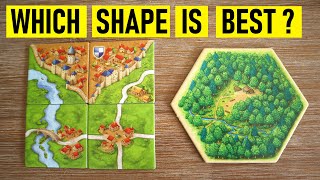
- Hexagons open up more expansion opportunities
- Hexagons tessellate well for easy connections
- More opportunity to play with terrain on edges
- Double-sided tiles add design elements
- building regions of land and ocean
Mechanics (from transcript analysis)
- Hexagonal tile placement — Players place hexagonal tiles to build regions of land and enclosed regions of ocean. Tiles offer up to five extra spaces for future placement and allow for easy adjacency connections. Edges can feature different terrains, and tiles are double-sided.
Video topics + discussion points
Quotes (from this video)
- When it comes to board game packaging most board games are square shaped so that they can be catalogued stacked and displayed easily on your shelf
- When it comes to designing a game and translating it into a fully fledged board game the shape of a game is the first thing that designers often think about
- Squares are really good because they can be easily joined together with other squares to make rectangles
- The idea that moving one space diagonally is not the same distance as moving one space orthogonally is an interesting dilemma that game designers have to contend with
- The hexagon is a very common shape used in many modern board games in fact it's a shape that tessellates extremely well
- When it comes to emulating the geography and topography of the true natural features of a map in a board game using a hex grid based system is actually particularly effective
- I'm always truly fascinated when it comes to tile laying games and the sorts of shapes that game designers use in their games to create a fun experience
- Just because a game uses a square shaped tile in its design doesn't actually mean that that game is any less complex
- Just when you think that the square has finally relished in its glory in terms of one-upping a hexagon in terms of its design shape well the game gods love dinosaurs takes domino's to a whole new level
- Polyhexes have an interesting shape to them and when you attach a polyhex to an established map they provide players with up to 10 different options of different ways they can be connected together
- Henceforth you could even rotate the tile so that it fits in spaces like this one here
- What this has consistently shown so far is that hexagons always provide that extra flexibility the extra level of option that squares don't often provide
- I personally gravitate towards the hexagon just because the shapes feel more organic when it comes to map building
- When games can kind of marry the shape of the game to the mechanisms and their theme and they can do it well then that says to me that it doesn't really matter what shape the game is the game is going to be fun regardless
References (from this video)
- Great for two players
- Simple yet addictive replayability
- Puzzly nature appeals to puzzle lovers
- Evokes building a beautiful map
- Tactical tile placement
- Hidden information adds surprise
- Multiple modes and variants
- Tug of war between land and sea.
Mechanics (from transcript analysis)
- Area Control — Players score points by closing regions (land or sea).
- bonus actions — Some tiles allow players to steal a tile or play a second one.
- Set Collection — Chaining mountains and coral together, and establishing trade routes.
- Tile Placement — Players place double-sided tiles to build a map.
- Variable player powers — One player fights for land, the other for sea.
Video topics + discussion points
Quotes (from this video)
- Hey everybody Merry Christmas and Seasons greetings if you're watching this video at any other time of the year then hello friends welcome to board game sanctuary.
- I remember the immense joy that I felt when I discovered modern board gaming for the first time it was like being a kid on Christmas morning ripping open that Christmas wrapping and seeing a brand new board game inside and unlocking its secrets mechanics strategy stories and themes and realizing there's a whole new world of games out there.
- Ultimately it is a game that will have you singing a Christmas tree whilst you watch your victory points grow.
- The red cathedral is probably one of my most favorite euro small box games and it's definitely on my top recommendation list for you to get this Christmas especially if you want to satisfy the inner euro gamer in you.
- It is a game dripping with theme that has every elf envious of the adventure ahead.
- Sleeping Gods is probably one of the best board games I've played this year.
- Dune Imperium has plays dipping their toes in the really hot sand and if you're a long time follower of board game sanctuary you'll know that I'm a really huge fan of euros and worker placement board games and this game combines elements of worker placement deck building resource gathering as well as an interesting combat system.
- Land vs a game that is definitely travel worthy with its simple design and addictive replayability.
- Every time I set up a game of parks I always feel like I'm unwrapping a beautiful Christmas present.
- So what did you think of this year's gift guide? I hope this video gave you some suggestions or even some starting points of some board games for particular people in your family or friendship group.
References (from this video)
- Carcassonne
Mechanics (from transcript analysis)
Video topics + discussion points
Quotes (from this video)
- I was absolutely Blown Away by just how much tabl topping stuff is actually there
- I went with an expectation of a 7 out of 10 in terms of a tabletop experience and leaving the convention with like a 12 out of 10
- the vibe was so positive I could see people off coming off trams and just flooding into to the Melbourne convention center and it just had such a positive uplifting feeling
- literally it felt like they brought a piece of Essen to this table topping convention in little old Melbourne
- it was just such a cool interesting deduction experience
- I love games that just really engage that kind of conversational thinking
- just seeing how much you know some of this content and his designs have kind of connected us together
- Phil Walker Harding is probably one of my favorite Australian designers just because a lot of these games are really simple to teach but they have a lot of lays and depth to them
- I just loved um some of the questions that the audience asked about you know what was some of their games that they thought would do really well but they didn't do really well that kind of like honesty to see in like an Australian context was amazing
- the fact that tabl topping hobby was so Niche when he first started that it was just like you know something you would do in a local community Hall to now being able to play at packs and to travel to Europe and actually try and Pitch your games there just showed me A New Perspective and appreciation for some of these games
- the fact that you know you really like what you see on this channel just absolutely made my day
- we are this really great community
- it's the people that you meet along the way and the journey that we take that just absolutely I just can't believe that you know 6 years ago I turned on a camera uploaded a couple of videos and now you know seeing people at a convention just uh I just can't comprehend it
- the thing that I realized about board game conventions is that they're just not a place to play games or to you know buy new copies of games that have just been released but they're a place to make lifelong friendships a place to continue to uh meet people discover people who just love this Hobby
References (from this video)
- Good game
- Cartography, building islands and waterways
- Semi-whimsical
Mechanics (from transcript analysis)
- tile laying — Players are building out their islands and waterways through tile placement.
Video topics + discussion points
Quotes (from this video)
- Brian Boru High King of Ireland as soon as you put that on the on the table and as soon as I saw trick taking I was like uh oh I'm all in I I pushed all the chips in I was fully engaged in this game
- Clash of cultures Monumental Edition I'd like to commend the design development and Publishing team behind K C it's varied in strategy epic in scale and thankfully foot powder free
- man it's one of those games for me that just created an experience every time I played and I've played with four player I've played with three player I've played with two player and every single time I enjoyed what that game brought to the table
References (from this video)

- map building competition
- land vs sea; cartographer asymmetric variant
Mechanics (from transcript analysis)
- asymmetric roles — One player is the cartographer determining how to score best for sea or land
- tile placement on hex grid — Place hex tiles to score, with asymmetric cartographer role
Video topics + discussion points
Quotes (from this video)
- the roman republic is coming to an end but not before a power struggle between caesar and pompeii
- this expansion has several modules and scenarios
- this is a cooperative deck construction dice rolling game
- this is going to be their big essence spiel release later on in the game
- Sleeping Gods is the latest game from Red Raven Games
- Terra Futura is an engine building card game in which you build your land of tomorrow
- the big thing ... if you connect a port early you increase the stock value
References (from this video)
- fast setup
- easy to learn
- modular with expanding rules
- beautiful components
- engaging spatial puzzle and decision making
- scaling complexity may increase with added rules
- not ideal for non-spatial players
- durability of components could be better for outdoor use
- territorial conquest and map-building
- medieval island-building with land and sea territories
- procedural, demonstration-focused
Mechanics (from transcript analysis)
- Compound Scoring — score for closing off areas; land closes islands, sea (C) closes seas
- Hand Management — draw and replenish tiles each turn; some tiles grant extra draws or actions
- hand_management — draw and replenish tiles each turn; some tiles grant extra draws or actions
- navigator_variant — in 3-player games, a navigator tile adjusts scoring and rules
- path_and_closed_area_scoring — score for closing off areas; land closes islands, sea (C) closes seas
- Set Collection — use stacks of island and sea tiles; the box doubles as the victory point tracker
- set_collection — use stacks of island and sea tiles; the box doubles as the victory point tracker
- special_tiles — whirlpool and volcano tiles grant bonus points when a space is closed
- steal_action — a steel action lets a player steal a tile from an opponent, reducing their options
- Tile Placement — place tiles to connect land and sea to form closed areas; scoring occurs when islands or seas are enclosed
- tile_laying — place tiles to connect land and sea to form closed areas; scoring occurs when islands or seas are enclosed
- waypoints_and_additional_bonuses — waypoints, caravans, mountains, and coral reefs provide additional scoring bonuses
Video topics + discussion points
Quotes (from this video)
- land versus c a super fun puzzly game
- it's quick to learn and quick to set up
- the pieces are beautiful the components are great the box is excellent
- we immediately wanted to play again and again
References (from this video)

- simple base rules but with depth via variants
- multi-player flexibility (2-4, teams, modular variants)
- visually appealing with good table presence
- some variants may add complexity that detracts for beginners
- tile-lane game with land and sea tiles
Mechanics (from transcript analysis)
- area closure scoring — closing off land or sea areas scores points for your team
- Modular variants — variants adding caravans, ships, mountains to increase complexity
- multiplayer variants — 4-player team mode (land vs sea) and 3-player asymmetric cartographer role
- tile-laying with hex tiles — players place land/sea tiles to shape the map
Video topics + discussion points
Quotes (from this video)
- it's probably my biggest surprise so far of 2021
- it's a two player card battler we're big fans of card battling games
- under 30 dollars and it plays quickly
- it's a beautiful looking game on the table
- the most laughs we've ever had is when the cards flip over
- it's basically an excuse to laugh
- this is one of the meanest games that we own
- a game of pretty gardens and petty grudges
- it's a roll and write version of Biblios but it retains a lot of what makes Biblios such a great game
References (from this video)

- beautiful aesthetic
- strong tile-laying feel
- tile laying and exploration
- map-building and exploration
- table presence with drafting
- Cartographers
Mechanics (from transcript analysis)
- tile laying with drafting — Six tracks; draft cards; place between two cards; reverse drafting.
Video topics + discussion points
Quotes (from this video)
- it's a beautiful mess of a game
- criminally underrated
- it's a long game
- I adore Guild Master
- this is a very clever game
- it's a fun crazy wacky game
References (from this video)
- Adds more toys to play with to a game the host already likes.
- The artwork and components are beautiful and hilarious.
- The game is adaptable to different table sizes.
- The new starting tiles make the start of the game faster.
- The 'menhirs' are a fun and clever scoring mechanism.
- The cities double scoring for seas and trade routes, making them valuable.
- Bandits and pirates offer a quick point opportunity.
- The expansion fixes the score tracker issue of the original game.
- It's an excellent expansion that improves the original game.
- Increases the length of the game by about six or seven turns.
- Bandits and pirates are the least interesting new additions.
- Bandits and pirates can sometimes be unused if the board state doesn't favor them.
- Making patterns of islands and seas
Mechanics (from transcript analysis)
- area scoring — Normally, this would score one, two, three, four, five. And then whoever placed the final tile would get these two points here. So I would get seven points for that sea normally.
- line scoring — when you place them [menhirs] on the board, you do your normal scoring... and then nothing happens until there is a second one in a straight line away from it. So, so for example like this right here... and then we look at the line in between the two and we count up all of the x's.
- multiplier scoring — with the city being connected to this sea, all of the X's become doubled. So now this is worth 1 2 3 4 5 6 7 8 nine points. The other thing the cities do is when you get to the end of the game, they double the scoring for all of the trade routes that are out there.
- Pattern Building — you are making patterns of islands and seas.
- placement scoring — the bandits and the pirates. And the way those work, it's very simple. They score when they are placed next to the caravan or the trade routes. So if I were to place these bandits right here, I would score one point for being next to this caravan here.
- Scoring Layers — there's a variety of different scoring layers that you can add. From the basic, you just get points for creating the islands or the seas all the way up to another five different layers you can add.
- tile laying — This is a tile laying game where you are making patterns of islands and seas.
Video topics + discussion points
Quotes (from this video)
- This is one of the prettiest games I've ever seen.
- It's beautiful on the board. It is adaptable to the size table you have.
- I love having those new starting tiles. It starts you out with a lot more places to go. Re, I don't think I'll ever play without those again.
- This expansion does nothing but improve it.
- This is immediately in the running for expansion of the year for me because it's just that good as an expansion.
References (from this video)
- Compact board that doubles as a score track, reducing setup complexity.
- High replayability due to modular expansions and multiple scoring avenues.
- Strong two-player head-to-head experience with clear tension between land and sea strategies.
- Immediate feedback on scoring keeps players engaged and reduces end-of-game counting fatigue.
- Clear iconography and accessible rule interpretation improve onboarding.
- Asymmetric two-player focus may deter players seeking larger player counts.
- Learning curve emerges as players explore multiple scoring options and potential tile interactions.
- Some tile arrangements can create open ends that are difficult to close if misplayed.
- Territory control and route-based scoring across land and sea, plus dynamic scoring via terrain features.
- Two-player asymmetric tile-laying contest framed as competing land and sea empires, with modular expansion options and explicit scoring tracks on the board.
- instructional and enthusiastic; focuses on how to play and why it works as a head-to-head puzzle.
Mechanics (from transcript analysis)
- Caravans and ships as scoring motifs — Land tiles can feature caravans and sea tiles ships, which create potential scoring routes and immediate scoring through placement choices.
- Closed Drafting — On each turn players draft a two-tile hand; what is on the back of a tile remains hidden until the tile is chosen, adding bluff and deduction elements.
- Double-sided starting tile — The initial setup features one starting tile that designates either land or sea, establishing asymmetric goals from the start.
- Modular expansions and variable scoring — Expansion options add new scoring methods (bandits, prairies, cities, menes, etc.) and allow players to mix and match to tailor the game experience.
- Public front-facing tile information — Only the fronts of tiles are visible during play; backs remain hidden until tile is drafted, affecting planning and bluffing.
- Score track integrated into board — The board itself functions as the score track, providing immediate visibility into progress without separate counting.
- Steal and extra-turn options — Certain tiles grant the ability to steal a tile from an opponent or grant an extra turn, increasing interaction and tension.
- Tile drafting with hidden backs — On each turn players draft a two-tile hand; what is on the back of a tile remains hidden until the tile is chosen, adding bluff and deduction elements.
- Tile-based bonus scoring (X symbols) — X symbols on certain tiles grant bonus points for completing a land or sea area, adding a strategic reward layer independent of basic area completion.
- Two-player head-to-head emphasis — Base game supports 2-4 players but the reviewer notes it shines as a direct land-vs-sea duel, creating a tight competitive dynamic.
- Variable Set-Up: Player — The initial setup features one starting tile that designates either land or sea, establishing asymmetric goals from the start.
Video topics + discussion points
Quotes (from this video)
- This is a fantastic puzzly thinky game.
- Two to four players, but really I feel like this is a two-player game.
- Everything's compact. And then two, it even shows you right here what some of the symbols mean.
- The board doubles as the score track.
- It's modular in that way that you can add what you want at a time.
- Everything fits in one box, which I so appreciate because I'm at a premium.
References (from this video)

Mechanics (from transcript analysis)
Video topics + discussion points
Quotes (from this video)
References (from this video)
Mechanics (from transcript analysis)
Video topics + discussion points
Quotes (from this video)
- "tiles are double-sided"
- "the board is used as a scoring track"
- "art in these towels is unbelievable"
- "it's easy to teach"
- "land versus sea" discussion highlights a dual nature of the game
References (from this video)
- easy to teach and set up
- strong two-player duel dynamic
- beautiful tile art and production
- board/box scoring track integration
- multiple scoring variants add depth
- supports 3- and 4-player variants with team play
- scoring variants can feel messy and overly complex
- setup can be fairly involved with many moving parts
- conflict at the table may not appeal to all players
- can be lengthy; not a short game
- tile drafting can become repetitive
Mechanics (from transcript analysis)
- cartographer/team play — three-player cartographer is added; four-player games can be teams with hidden tile sides
- Compound Scoring — mountains, corals, caravans, and ships introduce extra scoring rules
- edge-matching placement — on your turn place a tile so that each connected edge matches
- Enclosure scoring — enclosing a complete area scores points, with additional bonuses for finishing spaces
- special terrain scoring — mountains, corals, caravans, and ships introduce extra scoring rules
- tile actions — tiles may grant actions such as playing another tile or stealing one from an opponent
- tile drafting — players draft from two piles until each has two tiles
- two/three/four player variants — game supports 2, 3, or 4 players with different dynamics
- waypoints scoring — waypoints allow additional scoring and can influence play
Video topics + discussion points
Quotes (from this video)
- "tiles are double-sided"
- "the board is used as a scoring track"
- "art in these towels is unbelievable"
- "it's easy to teach"
- "land versus sea" discussion highlights a dual nature of the game
References (from this video)

- There are lots of fun drawings and elements on the various tiles
- territory expansion and area control across land and water features
- a growing map of land and water on the table as tiles are placed
- tile-driven spatial puzzle with scoring for completed areas and special actions
Mechanics (from transcript analysis)
- edge-matching placement — tiles must be placed adjacent to the map so that touching edges match land/sea
- end-of-game scoring — game ends after last tile is played and scores are tallied; highest score wins with ties shared
- mountain/coral and caravan/ship scoring options — advanced scoring variants add points for mountain/coral edges or ships/caravans across routes
- play again and steal actions — some tiles have play again or steel symbols; play again lets you place an extra tile; steel lets you steal an opponent's tile under certain conditions
- Reclaim as Action — some tiles have play again or steel symbols; play again lets you place an extra tile; steel lets you steal an opponent's tile under certain conditions
- scoring completed areas — score points for completed land/sea areas; additional points for crosses inside the completed area; scoring token movement
- tile drafting from top of stacks — on your turn you may pick the top tile from one of two stacks; you can peek at its other side after taking it
- tile replenishment — after your turn you draw tiles until you have two in front of you
- volcano whirlpool tile — if a hole is created and the volcano whirlpool tile fits, the final tile triggers scoring and a special placement with a bonus
- waypoint tokens (optional rule) — each player has a waypoint; can place it on a matching feature and scores a bonus if that area completes or the tile becomes surrounded
Video topics + discussion points
Quotes (from this video)
- it's a race to see who can dominate as you create one of the most unique maps to spread across your game table
- that's how you play the basic game
- you can use either the mountain and coral scoring or caravan and ship scoring or both together
- otherwise that's everything you need to know to play land versus c
References (from this video)
- Compact two-player puzzle with clear objectives.
- Double-sided tiles provide more decision points per turn.
- Box-integrated score tracker is a clever design touch.
- Modular scoring variants add variety and replayability.
- Strong visual art with charming thematic Easter eggs.
- Base game can feel underwhelming or leave little lasting impression.
- Close-enforcement of areas can be time-consuming and tense.
- May not have a strong memory impulse after play for some players.
- territory control and area closure between opposing forces
- Two-sided hex-tiled map where land and sea players compete to create larger connected land or sea areas
- procedural puzzle with modular scoring and hidden tile orientation
Mechanics (from transcript analysis)
- area_completion_scoring — Points are earned when land or sea areas are completed or 'closed' by enclosing spaces.
- Compound Scoring — Optional modules add mountains, coral, caravans, and ships for ongoing and end-game scoring.
- end_game_condition — The game ends when all tiles are placed; then final scores are totaled.
- scoring_variants — Optional modules add mountains, coral, caravans, and ships for ongoing and end-game scoring.
- special_tiles — Certain symbols grant additional actions such as stealing a tile from another player or taking an extra turn.
- tile_drafting — At the start of a turn, players draft from the top of two stacks; the other side of tiles is hidden until drawn.
- tile_laying — Players place hexagonal tiles to extend land or sea areas, aiming to connect and enclose regions.
Video topics + discussion points
Quotes (from this video)
- Two-player game at its core.
- Tile-lane game you're using these hexagonal tiles and you are trying to make either islands of land or lakes of sea.
- the bigger the areas of land or more tiles you use the more points you're going to get
- the land player closes off some land they're going to get these extra points in addition to whatever their island is going to be worth
- if the sea player closes that off they're the ones who are going to get those X's for the land
- the box score tracker is like super cool cuz it's just in the box
- I really like how the graphic design and the art for this game too
- it's really cool at the end of the game I think they did a really great job of like as far as the graphic design and the art for this game too
- this is a really fine two-player tile-lane game
- it was pretty challenging to close off your sections
References (from this video)

- Familiar weight with approachable rules
- Unclear to what extent it innovates on the genre
- carcassonne replacement
- Carcassonne-like tile-laying with a maritime/settlement motif
- tile-laying strategy
- Carcassonne
Mechanics (from transcript analysis)
- Tile-laying / drafting — Build a landscape with tiles to claim territory
Video topics + discussion points
Quotes (from this video)
- it's not too late to pick up a badge
- I'm really looking forward to grubbing and gaming at the same time
- this stuff that really gets me going
- I can't wait for Tantrum Con 2022
- let's get into it
- this has been a minor suggested game production and I'm Alex, your board game sommelier, signing off
References (from this video)

- Simple to learn
- Great two-player experience
- Limited player count may limit variety
- Territory development and area control
- Two-player tile-laying map conquest
- Abstract/Minimalistic
Mechanics (from transcript analysis)
- Area Control — Score by surrounding or connecting territory
- Tile Placement — You place tiles to expand land or sea territories
Video topics + discussion points
Quotes (from this video)
- it's a deck of cards that's all it is
- it's a mean trick taking game that is a bit unique
- it's very easy to set up
- open the box that's your arena
- it's so easy to travel with
References (from this video)

- two-player abstract strategy
- tight, strategic decisions
- quick to teach and play
- abstract feel may limit thematic appeal
Mechanics (from transcript analysis)
- Tile Placement — players place tiles to block the opponent and shape the play area
Video topics + discussion points
Quotes (from this video)
- this is being put to the top of the list it is anyways
- if somebody asked what my favorite game of the con was it was going to be this
- this is my new favorite game
- this is the best moment of my life basically
- they probably gave it to the right people because i'm gonna pump the heck out of this game
- we got to demo a new game that's coming out in January from Plaid Hat Games called Familiar Tales
References (from this video)
- Expansion coming soon
Mechanics (from transcript analysis)
Video topics + discussion points
Quotes (from this video)
- Shelf 16 is kind of a an odd mix here
- This shelf has twice as many games as most shelves
- one of my favorite two-player games, but it's very difficult to learn and play
- Fantastic abstract strategy game
- Such a classic game and I like it a lot
- I don't know why I like it so much, but I do
- one of the most beautiful dexterity/party games there are
- There are so many games on the shelf
References (from this video)
Mechanics (from transcript analysis)
Video topics + discussion points
Quotes (from this video)
- we are going to be using these tiles to build out a large map
- the two types of terrain there's c which is blue and then there's land
- on your turn all you're going to do is you're going to place it adjacent to one of the tiles existing on the table
- the play again symbol lets you place your second tile
- steal a tile from an opponent
- score points by completing land areas or c areas
- mountains and corals
- caravans and ships
- waypoint tokens
References (from this video)
- Engaging head-to-head interaction with blocking and closing off terrain
- Rich end-game scoring with mountains, corals, caravans and ships adds depth
- Clear teach-through with concrete example play and explicit rule explanations
- Large potential map size can become unwieldy if players chase sprawling terrain
- End-game scoring with multiple modifiers may be complex for new players
- territory control and area scoring with thematic terrain features (land, sea, mountains, corals, caravans, ships)
- a tile-laying map-building contest split between land and sea factions, played on a modular map
Mechanics (from transcript analysis)
- area completion scoring — points are awarded for completed land or sea areas; larger completed areas yield more points
- end-game scoring modifiers — advanced scoring adds mountains, corals, caravans and ships, plus waypoint tokens that influence end-game scoring
- Hand Management — start with two tiles in hand; pick one to place, then draw up to two tiles to replenish your hand
- special actions on tiles — some tiles grant play again (allowing a second tile placement) or steal (take an opponent's tile, with rules about last tile constraints)
- Tile Placement — each turn you place one of two tiles adjacent to existing tiles; tiles must match land vs sea terrain when connected
Video topics + discussion points
Quotes (from this video)
- we are going to be using these tiles to build out a large map
- the two types of terrain there's c which is blue and then there's land
- on your turn all you're going to do is you're going to place it adjacent to one of the tiles existing on the table
- the play again symbol lets you place your second tile
- steal a tile from an opponent
- score points by completing land areas or c areas
- mountains and corals
- caravans and ships
- waypoint tokens
References (from this video)

- Clean, elegant scoring with interesting tension between land and sea
- Accessible tile-laying with meaningful decisions
- Good depth without heavy downtime
- Can feel punishing for beginners if you miss optimal land/sea closures
- Some players may want more thematic flavor
- territorial development with dual scoring for land and sea
- A tile-laying map where land and sea compete for control
- abstract strategy framed as territorial contest
- Cascadia
- Carcassonne
Mechanics (from transcript analysis)
- dual-scoring — Points awarded for completing lands or enclosing seas (lakes) depending on who completes them
- End-game scoring — Game ends after a fixed number of rounds; highest score wins
- hidden-back tiles — Tiles have imagery on both sides, creating hidden information and planning dynamics
- Tile-laying — Players place tiles to form land masses or seas and reveal scoring opportunities
Video topics + discussion points
Quotes (from this video)
- the art and graphic design of the card are so good they're so playful
- it's all about the spice
- there can be only one
- this is a team based game that plays from four to eleven players
- after your turn all the monsters have to activate
- the ring master