/pic6554779.png)
Lanzerath Ridge is a solitaire wargame that takes places on the first day of the Battle of the Bulge, during the Second World War. In the game, you take control of a small group of American soldiers. Under your command, the Americans must fend off the relentless attacks from German paratroopers and fusiliers. Your goal is to recreate the incredible historic accomplishment of the American soldiers by defending the town of Lanzerath, Belgium and delaying the advance of an entire SS Panzer Division.
Lanzerath Ridge is the next design in the Valiant Defense series, following the critically acclaimed Pavlov's House (2018), Castle Itter (2019), and Soldiers in Postmen's Uniforms (2021). The Valiant Defense series allows you to play amazing stories of courage, with small forces holding the line against unimaginable odds. Games in the series focus on the individual defenders and are deeply rooted in history, while providing a quick play experience with a light complexity rule set.
Lanzerath Ridge is divided into four attack periods, each of which is represented by a deck of enemy cards. Each attack period is divided into a number of turns, and each turn consists of two phases:
The game ends immediately if the defenders’ morale drops to 0 or if a German attacker takes over an American defensive position. Otherwise, the game ends after the last attack. Your level of success is based on the Americans’ morale, intelligence gained during the defense, and any objectives you accomplish.


- Immediate appeal to WWII history buffs
- Connects to more complicated war game mechanics
- Fantastic, easy to learn
- Plays fun
- Visually appealing
- Meets all criteria for best beginner games
- Fantastic experience with historical connections
- American soldiers fighting German attackers
- Battle of the Bulge
Mechanics (from transcript analysis)
Video topics + discussion points
Quotes (from this video)
- Access and Allies. So, uh, this is this game doesn't really need any introduction, but I've heard so many good things about it. I think it does meet a lot of the qualifications and criteria that we established as a war game and as an introductory war game for this list. Just haven't had time and made time to play it yet. I think it could have a very high spot on the list.
- David Thompson has been on the list a lot. He makes fantastically accessible war games. So, anything that he creates, I think is a candidate for this list.
- John Butterfield is a fantastic designer and this is a area control.
- John Butterfield designed some just amazing stuff.
- This is a game that might not fit into the classic war game category, but I've heard a number of war gamers say that it's definitely a war game with a lot of war game aspects and it fits probably in that subgenre of games, get the pun, where you are playing the role of a plane or a tank or a submarine or a ship and going over a campaign.
- War at Sea, if you're not familiar with it, it's an area based naval game that dates back to the 1970s, maybe 1980s.
- This is a game set in World War II where you take charge of female Russian pilots. This is based in actual history that run various aircraft missions over the German lines during World War II.
- Worthington does a great job with their production values with games.
- What games did I miss? What games on the list do you like and agree with?
References (from this video)

- Really enjoyed it
- Good production value and clear rulebook
- Engaging use of named historical figures
- Interesting strategic arc balancing immediate needs with long-term goals
- Tactics cards add welcomed spice and difficulty
- Offers different scenarios and ways to adjust difficulty
- Marries theme with mechanics well
- First few rounds can feel too easy if not playing with advanced rules
- Might be overwhelming for a first game without Tactics cards
- The beginnings of the Battle of the Bulge
- Battle of the Bulge during World War II
- States of Siege
- Phantom Leader
- Undaunted series
- B17
- The Enemy Within
Mechanics (from transcript analysis)
- Action Point Allowance — Players have a limited number of action markers (cubes) to perform actions each turn.
- Ambidexterity (variant) — Optional rules like Tactics cards add layers of complexity and replayability.
- Card-driven actions — Enemy actions are driven by flipping cards from decks representing different rounds, dictating their behavior.
- Combat modification — Machine guns can fire multiple shots, with subsequent shots in the same action becoming more difficult but potentially hitting multiple targets.
- Dice Rolling — Combat and other actions often involve rolling dice (D6, D8, D10, D12) to determine success.
- Intelligence tracking — Intelligence can be gathered and radioed back, contributing to the final score.
- Morale tracking — Player morale is a key track that, if it reaches zero, results in losing the game.
- Objective Completion — Optional objectives are present in later rounds that can provide bonus points if completed.
- Overheating weapons — Firing too many shots with a machine gun can lead to it overheating and being removed from the game.
- Resource Management — Players need to manage resources like machine gun ammunition and conserve them for critical moments.
- Solitaire — The game is primarily designed as a solitaire experience, with rules for two players also included.
- states of siege — The game is compared to States of Siege games, but with additional nuances that differentiate it.
- tower defense — The game shares similarities with tower defense mechanics, where players defend a location against incoming enemy waves.
- Variable player powers — Named characters have different stats (e.g., D8 for shooting) and abilities, with leaders and commanders providing inspiration or reactivation.
Video topics + discussion points
Quotes (from this video)
- And what it is is a solitire game. Although in this one there are rules for two-player. I'd not tried it. I've just played solitaire.
- The rule book is great. I think it's a good production. nice illustrations, very clear, all that stuff.
- So, you're going to flip three cards, take five actions, flip three cards, take five actions.
- So, you've really got to start to watch how, you know, these sort of u different attack sort of styles, if you will, uh work through the game, and you you'll kind of learn that as you go.
- So, I really really enjoyed it.
- To me, that adds a little bit of that spice to it and it makes those earlier rounds a little bit more dangerous and a little bit more interesting in that way.
- And I really like that part of this where it's not just like, you know, artillery guy X and Private Zero and all these different things. You've got these guys and so you kind of get to know like, oh, this guy's really good at the machine gun. You know, Jenkins is is a dead eyee with the machine gun and so and so it's like he's very very inspirational and that kind of thing. So it just in theme-wise, it really kind of pulls you in.
References (from this video)
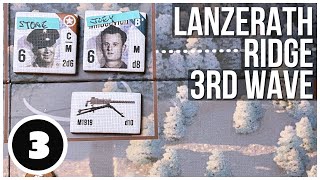
- Rich tactical decision space with multiple layers of defense (inspiration, machine gun placement, artillery), creating dynamic, cinematic firefights.
- Exciting moment-to-moment action sequences with decisive machine gun and sniper-like firefights that showcase planning and execution.
- Clear cause-and-effect feedback from dice results, ammunition/energy tracking, and token management that rewards strategic planning.
- Narrative and campaign feel, with progression through attack waves and evolving defense considerations.
- Mortars/forward observer mechanics add tension and require careful judgment and risk management.
- Significant randomness from dice and card draws can feel swingy at times and may frustrate players expecting more deterministic outcomes.
- Rule complexity and occasional card-shuffle ambiguity can create player confusion without careful rule references or play aids.
- Long session length and round-by-round micromanagement may be challenging for newcomers or casual players.
- Small American unit defense against German assault
- Battle of the Bulge, Western Front, 1944
- campaign-style playthrough with live strategic planning and commentary
Mechanics (from transcript analysis)
- artillery_calling — Artillery support is requested via radio tokens; acquiring artillery can be risky and relies on dice or token availability.
- bandaging_and_damage_management — Wounded characters require bandages or medical attention; sustaining wounds affects actions and morale.
- booby_trap — Booby traps can randomly remove attackers, adding a defensive hazard that punishes aggressive advances.
- deployment_and_outflank_strategy — Defenders can shift forces between flanks and center to counter attacker wave distributions; positioning is key to maximizing firepower and morale.
- dice_resolution — Combat and actions are resolved with various dice (D8, D10, D12, etc.), with success chances driven by target numbers and dice pools.
- inspiration_and_reinforcement — Leaders can Inspire to grant extra actions or improve outcomes, and squads can be reinvigorated through command actions.
- machine_gun_nests_and_overheating — Machine gun positions provide heavy fire but exhaust ammunition and can be reset or repositioned; overheating drains resources.
- observer_and_mortar_mechanics — Forward observers and mortars shape mortar accuracy; revealing observers can alter mortar effectiveness and requires discarding/adjusting tokens.
Video topics + discussion points
Quotes (from this video)
- Royce opens fire
- Lyle picks up three kills and wipes out that entire Central attack column
- the dice Gods shining on us
- I think we win this game
- the booby trap saved us
- we win this battle
References (from this video)
- great gateway for deeper war gaming
- heavy emphasis on historical immersion
- rules can be slightly challenging for absolute beginners
- defense against waves of enemy assault
- World War II Battle of the Bulge scenario at the Bastogne/Lanzarath Ridge context
- visual history immersion with tactile components
Mechanics (from transcript analysis)
- hex encounters and map aesthetics — engaging map design with counters reinforcing the historical vibe
- Line of Sight — mechanics elegantly capture fire dynamics and positioning
- range/line of sight and weapon behavior — mechanics elegantly capture fire dynamics and positioning
Video topics + discussion points
Quotes (from this video)
- this is one of the finest introductory war games I've encountered
- solitaire games are great to play as introductory war games if you play them cooperatively with somebody else
- it's easy to learn, it's got great balance, it's fun to play, the design is elegant, the map is beautiful
- this game is 5th Century BCE; the Persian Empire is trying to take over the Greek city-states
- it's very beginner friendly, you can learn it really fast
- the range and the way the Machine Gun Works and lines of sight and things like that are handled very elegantly
References (from this video)

- tight, tense tactical gameplay
- machine gun system is especially interesting
- variety of scenarios is less than some other war games
- not as many variants as larger campaigns
- tactical, tense combat across historical scenarios
- solo-focused WWII-era war game in the Valiant Defender series
- tight, scenario-driven mission-based play
- Valiant Defender series
- Castle Itter
Mechanics (from transcript analysis)
- tactical dice-based combat — machine gun systems and historical scenarios drive the tactical decisions
Video topics + discussion points
Quotes (from this video)
- there's basically like a little tactical game you have these varied factions that like hugely vary the game
- the solo mode is very complicated I'm super impressed
- this is an amazing one in a small package for a small price
- the story grabbed me and would not let go
- the racing is the smoothest solo racer I've ever played by far
- it's an emotional ending—the most emotional game experience I've had this year
References (from this video)
- high tension and dramatic pacing
- diverse terrain/design with multiple lanes
- beautiful art by Niels Johansson and an aesthetically improved board
- clear sense of narrative and historical context
- larger strategic space with resource manipulation (intelligence, tokens)
- still demands careful, heavy management; not as accessible to absolute beginners
- some actions pay off only later, which can feel punishing
- reliance on dice for overheating introduces luck elements
- valiant defense under pressure, strategic improvisation, narrative of resilience
- Battle of Windsor-Ethridge, first day of the Battle of the Bulge, Western Europe WWII winter frontline
- historic, campaign-driven, tense
- Pavlov's House
- Castle Itter
- Soldiers and Postman's Uniforms
Mechanics (from transcript analysis)
- artillery and radio calls — Minor actions add tokens to artillery or radio vehicles; major actions can remove attacker cards and raise intelligence.
- attacker deck — Germans resolve three attack cards per turn, advancing forces with four rounds of escalating difficulty.
- board lanes and grenades — The board presents multiple lanes; grenades influence assault timing and defense pressure.
- Combat: Deck/Hand — Germans resolve three attack cards per turn, advancing forces with four rounds of escalating difficulty.
- exhaustion and command — Exhausted units must be unexhausted by a commander, creating careful sequencing.
- grenades and reprieve — Grenades arrive as assaults progress, offering a temporary reprieve before pressure mounts.
- Line of Sight — Long-range shots are possible with line-of-sight considerations and terrain.
- line of sight and long-range — Long-range shots are possible with line-of-sight considerations and terrain.
- major vs minor actions — Defenders perform up to five actions per turn; minor actions don’t exhaust, major actions exhaust the acting unit.
- Morale tracking — Morale decreases with disruptions and casualties; running out ends the game.
- Player Elimination — Morale decreases with disruptions and casualties; running out ends the game.
- weapons and overheating — Powerful weapons can overheat based on rounds fired, potentially removing the weapon from play.
- win condition framing — Win by surviving four attacker rounds; loss by German reach into defender spaces or morale collapse.
Video topics + discussion points
Quotes (from this video)
- this is a game that is very tense where things can turn very quickly
- it's the fourth value defense game
- it's a very different landscape and it feels like a new flavor
- the aesthetically pleasing board does enhance the experience
- you really are going to have to fight it out to stay alive until the end of the game
- Lanzareth Ridge does freshen up the system and adds a new flavor within the Valiant Defense series
- on the anniversary of the Battle of the Bulge this game really lives up to its promise of being tense but fun
- I think it's actually the best one yet in the series
- if you already like these games then you'll still like Lanzareth Ridge because it's got different variations on the theme
References (from this video)

- expands on the Valiant Defense line
- exciting co-design collaboration
- not enough detail here
- Valiant Defense series
- World War II, Battle of the Bulge era
- miniatures-influenced tactical combat
Mechanics (from transcript analysis)
- miniatures feel — thematic but not exact miniature rules
- new mechanics — co-design with another partner
Video topics + discussion points
Quotes (from this video)
- the cards in your deck each card represents the sort of the health or the efficacy of a unit on the board
- it's a mashup of deck building and a skirmish game
- the core idea was to model a US rifle platoon
- we wanted to make it very different yet still feel like undaunted
- 62 different ways to play undaunted solo mode
- we're not interested in designing something unless it's different