







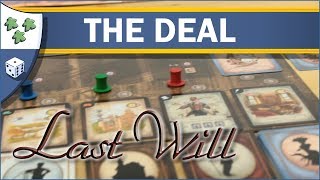


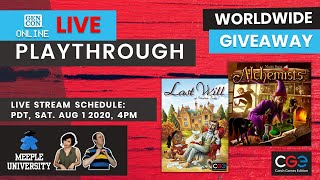
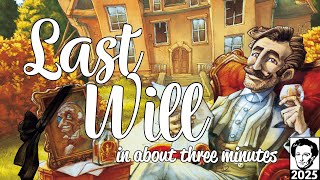




In his last will, your rich uncle stated that all of his millions will go to the nephew who can enjoy money the most. How to find out which nephew should be rich? You will each be given a large amount of money and whoever can spend it first will be the rightful heir. Visit the most exclusive theatres or eat in the most expensive restaurants. Buy old properties for the price of new ones and sell them as ruins. Host a huge party in your mansion or on your private boat. Spend like your life would depend on it. Spend to become rich! If you're the first to run through the money on hand, you'll receive the rest of his inheritance – oh, and win the game.
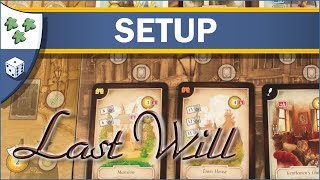
In Last Will, each player starts with a certain amount of money, an individual player board, two errand boys and two cards in some combination of properties and helpers. At the start of each round, lay out cards from the appropriate decks on the offering boards; the four regular decks are properties, companions, events, helpers and expenses, with special cards forming a deck of their own. The particular mix of cards varies by round and by the number of players.
Each player then chooses a plan for the round, with each plan indicating the number of cards the player draws (drawn immediately from the four regular decks in any combination), how many errand boys he can use later (one or two), the number of actions available to him that round, and his spot in the playing order that round. In the playing order for that round, players then take turns choosing an action with their errand boy(s), with those actions being:
Take a card on display and add it to your hand.
Draw a card from any regular deck – This can be chosen only once by each player.
Visit the opera and spend $2.
Adjust the value modifiers in the property market.
Take a player board extension, thereby giving you room to play more cards.
Players then take actions in the playing order for that round, with each player having as many actions as indicated on his plan. Actions let you play one-time events (which have a cost, possibly variable); helpers and recurring expenses (which are placed on your individual player board); and properties (which cost money and may depreciate over time). You can often play companions with events or recurring expenses – of course you should bring a date to the opera or a horse on your yacht! – to increase their cost. You can also use actions to activate cards on your player board, possibly with one or more companions and always with the goal of spending money. Helpers and special cards can provide you with unique powers to further boost your profligacy.
At the end of each round, you must discard down to two cards in hand, and properties that can depreciate do so; this is good as a player cannot go bankrupt if he owns properties, and the only way to get rid of properties is to sell them, which regretably puts money back in your hands unless the depreciation was intense or you manipulate the market.
If a player has no money and no properties, he declares bankruptcy and the game ends at the conclusion of that round; otherwise the game ends after seven rounds. The player who has the least money (or even who is most in debt) wins.
Last will in about 3 minutes
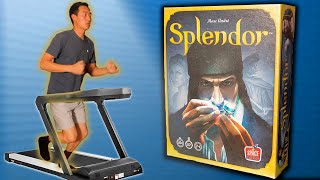
Board Gaming on a Treadmill
- accessible for all ages
- fast-paced and highly engaging
- works well with families and mixed groups
- Array
- Party word game
- rapid-fire competitive wordplay
Mechanics (from transcript analysis)
- timed rounds — rounds are driven by a timer for quick execution
- Word Association / Word Building — players produce words to match a category and a starting letter
- Word building — players produce words to match a category and a starting letter
Video topics + discussion points
Quotes (from this video)
- Chaos just has this fun balancing act of each demon trying to do what's right for them but also keeping an eye on the other demons to make sure they don't get too strong in what they want to do
- the human skin board just gets increasingly tighter
- the score at the end of the game is the number of points in your weakest category
- this is such a cool game and look at this box art
References (from this video)
- fast-paced and energetic
- great for audience engagement
- high replayability with different prompts
- can be mentally exhausting under pressure
- potential for misinterpretation of clues
- vocabulary, quick thinking under time pressure
- rapid-fire party word game
- group party game with built-in scoring and rounds
- Coup
- Splendor
Mechanics (from transcript analysis)
- Compound Scoring — Points awarded based on correct guesses; prompts vary per round.
- per-round scoring — Points awarded based on correct guesses; prompts vary per round.
- rapid-fire guessing — Teams guess words under time pressure from a rotating clue giver.
- word association — Players try to prompt answers using clues without repeating or revealing the target word.
- Word Deciphering — Players try to prompt answers using clues without repeating or revealing the target word.
Video topics + discussion points
Quotes (from this video)
- weirdest game of Splendor I've ever played, it's an experience
- I burned 155 calories
- this is probably one of the dumbest ideas I've had
- I can't think of a single word right now
- that's five letters I'm tired I'm running
References (from this video)
- Multiple viable strategies
- Engaging action-selection system
- Interesting engine built from cards and actions
- The property market is simple yet volatile
- Accessible for a Euro audience and fans of engine-building
- Unusual pacing and learning curve
- Limited direct player interaction
- Rarely rewards replays due to unusual victory conditions
- Spending inherited wealth quickly to win a grand prize
- Wealth inheritance race in a modern, satirical setting
- satirical, humorous
- High Society
- Underwater Cities
Mechanics (from transcript analysis)
- action selection — Choose from turn order, cards, workers, or actions; leftmost goes first
- card management — Draw and manage different card types (helper, property) to build an engine
- Property market and upkeep — Buy, maintain, and manage properties with market-driven values and upkeep costs
- worker placement — Place two workers on the board to gain benefits and take actions
Video topics + discussion points
Quotes (from this video)
- The best thing about this game is its property market. It's wonderfully simple, but shows a volatile housing market.
- There's lots of viable strategies.
- I really like the action selection system.
- For a lighter game with a similar vibe, try High Society.
- For another game by the same designer, try Underwater Cities.
- Last Will, I'm going to Disneyland.
- classic Richard Prior film, Brewster's Millions, where he gets 30 million and has to spend it to inherit 300 million.
References (from this video)
- unique premise of spending to become the wealthiest broke player
- engaging endgame and auctions
- availability/price may be a factor
- spending and manipulating wealth to become the most broke
- estate/money management and inheritance
- Chinatown
Mechanics (from transcript analysis)
- Auction / Bidding — decisions around spending and selling estates to manipulate wealth
- hand management — card-based actions to spend money and manage estates
Video topics + discussion points
Quotes (from this video)
- I really want to be able to hop into a live stream and know exactly what I'm doing.
- Less but better quality is something I'm embracing going into 2024.
- Septima is my number one game of the month.
References (from this video)
- Humorous, unique theme
- interesting take on wealth/poverty as strategy
- Thematic tone may not appeal to everyone
- lose money / become the poorest to gain uncle's fortune
- humorous take on inheritance and wealth
- satirical, lighthearted
- Rococo
- Nippon
Mechanics (from transcript analysis)
- hand management — manage actions and resources to minimize wealth and reputation loss
- hand management / action points — manage actions and resources to minimize wealth and reputation loss
- hidden victory points — points represent fortunes that you try to shed
- victory points as a resource — points represent fortunes that you try to shed
Video topics + discussion points
Quotes (from this video)
- these are games from you know 1990 something all the way up to I think the most recent one is 2013
- I really want to try Agricola because Francis and I have played Caverna we absolutely love Caverna
- the fisherman theme that's why we tried News Fjord as well because we loved that theme
- Onirim ... a solo game where you shuffle through your dreams and open doors
- Robinson Crusoe ... you are trying to survive on an island cooperatively
- Hanamikoji is absolutely beautiful and I would love to try it
- CV is one that I would love to try the art is absolutely adorable
References (from this video)
- tight, accessible entry point into worker/engine-building
- varied setups can alter duration; some setups longer
- blow money to outpace rivals
- work replacement / money-siphoning theme
- clever, set-up driven engine-building
Mechanics (from transcript analysis)
- work replacement / tableau building — build your tableau and manage money to reach goals
Video topics + discussion points
Quotes (from this video)
- rock solid martin wallace game and i'm really enjoying it
- it's got one of the weirdest pacings of the game
- I like it but I just don't love it and i don't think this is going to be sticking around much longer
- Six Nimpt by Wolfgand Kramer, a borderline essential game, a great little filler that everybody should play at least once
- it's just pure simple family weight fun
References (from this video)
- humorous premise generates entertaining personal narratives
- thematic engagement with money and dating adds flavor to play
- some may find the humor dated or awkward
- rules and setup can be opaque without context
- Humorous commentary on wealth, social life, and the absurdity of opulence.
- A satirical economic race where players expend wealth through extravagant dates and purchases to lose money before the end.
- emergent storytelling through personal choices
Mechanics (from transcript analysis)
- auction_or_bidding_like_planning — Strategic planning around allocation of funds to slots and dates.
- economic_management — Players must spend money to avoid keeping wealth, with value determined by date choices and purchases.
Video topics + discussion points
Quotes (from this video)
- there's an emergent story that comes from the characters
- the emergent storytelling that you can see in Z is amazing because it's so sandbox
- we make decisions based on what our character would do rather than what's the best choice
- it's fun to make up stories as you're spending lots of money
References (from this video)
- innovative and fresh theme
- solid, enjoyable engine and interaction
- Brewster's Millions-style money management and waste
- inheriting money and spending it extravagantly
- humorous, light and breezy
Mechanics (from transcript analysis)
- action point bidding — players bid on how many actions to take based on drawn cards
- building-price manipulation — recruit helpers and manipulate the price of assets
- Deck-building engine — build a powerful engine to manipulate money and opportunities
Video topics + discussion points
Quotes (from this video)
- this is very much a back and forth take that style of game as you are infecting each other with these different viruses and diseases
- it's a random take that fest
- this game goes on way longer than the box says
- this is quite a cool quirky little game at least in terms of the visual appeal
- the economic part of this game is very tight
- it's really solid and a lot of fun
References (from this video)
- estate/legacy planning
- Early 20th-century family/business planning
- strategic card/board game
Mechanics (from transcript analysis)
Video topics + discussion points
Quotes (from this video)
- we're going to make a board game Advent calendar
- randomly assign them to different envelopes without knowing what's in
- this would be super fun if anybody wanted to do it at home
- we will play all 24 of these games before Christmas
- join me for this fun little craft project
- we leave December 4th until the 10th so packs unplugged happens
References (from this video)
- economic
- legacy
Mechanics (from transcript analysis)
Video topics + discussion points
Quotes (from this video)
- everybody game your abc's start with a and end with z
- arkham horror that's a fright
- b is for battle or there's monsters to fight
- cosmic encounter that's right
- fury of dracula he turns into mist she is gone
- shown clever you'll feel so smart
- hogwarts battle defend against the dark arts
- jabberwocky you can't play it alone
- in that runner they don't make it anymore
- on mars get a galactic high score
- paladins for the kingdom
- quellenberg proportions the best
- space space if you like your sci-fi
- viticulture watch those wine grapes get smashed
- welcome to build a neighborhood
References (from this video)
- money, investments, corporate intrigue
Mechanics (from transcript analysis)
Video topics + discussion points
Quotes (from this video)
- you start rich and you're trying to blow as much money as you can as quickly as possible by making bad investments
- this one however has a quite a different feel to a lot of the other rolling rights
- it's strictly two player puzzly abstract style game
- this is the newest printing of the bunk
- this one actually uses the between two cities mechanism where you're working with the people to your left and right except on this one
- it's a game that's fascinated me
- the idea of puzzle this stuff around get the ideal family photo
- gamers bingo
References (from this video)
- Cool thematic concept and narrative alignment
- Too light in the face of market saturation in worker placement
- Lacked depth to justify continued play
- Invest, hire, buy, and sell to burn through money quickly
- Capitalist economy / early modern enterprise
- Economic satire with thematic ties
Mechanics (from transcript analysis)
- economic engine / money management — Money is the resource you burn through with poor investments to score.
- thematic tie-in drives decisions — Ties between theme and mechanics influence what feels intuitive.
- Worker placement / action economy — Take actions to invest and manage assets in an economic engine.
Video topics + discussion points
Quotes (from this video)
- the twist on this game was that these are animals not only do they move in different ways when you landed on them on the board which means you could plan turns ahead
- Meadow is kind of this little Tableau building game as you're playing cards out in front of you
- no rules overhead in this one
- this was almost enough for me to keep this one around
- there was no real interesting decisions to be made and it became quite frustrating at times
- less is more
References (from this video)
- Unique theme around spending wealth quickly
- Strong mechanical satisfaction
- Theme may feel grim or dark to some players
- spending wealth efficiently, life after death
- life-focused, where you manage ancestral fortune
- darkly humorous exploration of legacy and finances
- Life
- CV
Mechanics (from transcript analysis)
- hand management / optimization — Optimize actions to spend wealth efficiently while maximizing points.
- resource management / spending — Spend resources (wealth) to achieve end-game goals as fast as possible.
- tableau/sequence of actions — Arrange actions to maximize end-game scoring.
Video topics + discussion points
Quotes (from this video)
- it's literally just about the journey that you're on.
- you are simply moving along a track.
- you craft a story.
- This is a story of your villagers of how they're going to go around collecting the things you need as you try to find the various ways to find victory points.
- you are telling your story, but you're doing so with dice rolls and cards
- it's incredibly accessible
- you are going to lend itself to full fantasy over here
- you are trying to set up all these marriages to try to get these various people into your family