
The Portuguese canning industry developed throughout the 20th century, going through periods of great splendor and of extraordinary importance in the social fabric of communities close to fishing centers. After the huge growth due to the immense supply of troops in Europe that World War II brought, the industry went through a period of stability with the consolidation of the quality of the products and the establishment of markets abroad.
Lata ("tin can" in English) is the name of the raw material for the containers in which the fish is packed, and it also turned out to be a popular designation for the product. In this game, players manage local canning companies in the 1950s and produce and sell the famous canned sardines or canned mackerel, the two main canned fish in the first decades of the industry, before the appearance of the very popular tuna.
The game takes place over six rounds. In each round, players buy a batch of fish, tomato or olive oil, which they then can use in their factory. These preserves will then be sold to markets. This operation will result in money that will be used to buy scorecards and increase the factory's production capacity.
The order in which each batch of raw materials is chosen is given by an auction of action points that players secretly make by sliding their disk to the left on the action track of their individual board. Whoever gives up more opportunities for action chooses the best lot, but it is clear that having more possibilities for action is vital to produce more and reach the best markets!
The player with the most victory points (VP), which are awarded at the end of the game by the scorecards, wins.
Lata is the second game in the "Quinas Collection", following the success of Café, the first game in the line.
—description from the designer


Images


- Great game at a great price point.
Mechanics (from transcript analysis)
Video topics + discussion points
Quotes (from this video)
- it's like, falling into a warm comfortable bed. It's just all nice and cozy and you know what to expect
- I enjoy train games don't know why but I enjoy a train game
- for an old-school euro game I really enjoyed this too it didn't have a lot of flash or dazzle or anything unique it's an older game reprinted
- the person who wants to be first has to pay full price person who wants to be second it's got to pay full price then the next people have to pay half price and the last person doesn't underpass it's that half-price and zero price
- if you don't have enough money to pay your expenses you're in a world of hurt
- there's not a lot of flash to it mm-hmm solid mechanics solid concepts concepts that I enjoy
- theme doesn't draw me in but theme turns me off maybe we are sitting there looking at what's flashy too
- portability I can't argue with that that is the selling point of that console right now
- Oh okay I should not have dismissed this game strictly on theme because it's a solid no little euro game
References (from this video)
- Clear winning condition based on value.
- Structured turn and round phases.
- Paying interest on loans.
- Feeding phase requires food or francs, with loans as a last resort.
- becoming the most successful business person
- port town of Lahav
Mechanics (from transcript analysis)
- city building — Players can buy buildings and place them in town or their own stacks.
- End game scoring — The game ends after a specified number of rounds, and players count their money, buildings, ships, and subtract loan penalties.
- Loan System — Players can take loans for francs but have to pay more back, with penalties at the end of the game and during interest supply actions.
- Resource Management — Players collect and manage various resource tokens like Frank, cattle, grain, iron, clay, wood, fish, coal, and hide.
- Set Collection — Players aim to collect resources and buildings to increase their overall value.
- Worker Placement — Players place their ship on supply locations and their person disc on buildings to take actions.
Video topics + discussion points
Quotes (from this video)
- The first is the supply action so you're gonna place your ship on the next round supply location
- this is where you can either take all the goods from one particular offer location or move your person disc to an unoccupied building
References (from this video)

Mechanics (from transcript analysis)
Video topics + discussion points
Quotes (from this video)
- there were 1.2 million views on this channel last year
- the next goal is at fifteen hundred dollars a month
- it's a really neat very simple game
References (from this video)

- Reactive decisions, rich combinatorics
- Heavy for two players; table-wide planning required
- Economic engine-building with port emphasis
- Ports and trade networks
- heavy, thinky, euro-style
- Agricola
- Le Havre
Mechanics (from transcript analysis)
- Combo building / supply chains — Use produced resources to unlock stronger outputs and profits.
- Engine Building — Use produced resources to unlock stronger outputs and profits.
- Worker Placement — Sequentially gain and use resources to build and sell.
- worker placement / resource collection — Sequentially gain and use resources to build and sell.
Video topics + discussion points
Quotes (from this video)
- and this is how we're doing it
- these are just at this current period of time
- it's not the top 100 games that are out there these are just the 100 games that we're enjoying playing right now
- feel free to share your list as we go through we would love to see it
- it's almost guaranteed to fail like your ship gets torn apart
- it's mean but no one gets their feelings here because it's so obviously mean and it's so like fun mean
References (from this video)

- Harbor
Mechanics (from transcript analysis)
Video topics + discussion points
Quotes (from this video)
- when you get to harvest you have to feed all the members of your family and if you don't feed all the members of your family you have to take a begging card
- and that i think is where all the pressure is because like you think man everything's gonna go okay as long as i can just get that read space as long as i can put my family member on there i just get all i need is one read and then it's fine i'll be able to feed my family because of this and that and the other and then some dinkus at the table takes read and it's just like it you just you want to flip the table at that point
- the reason i mentioned uve rosenberg month was i was i said i was going to try to stick some stuff on the calendar what you can count on i'll let you know just verbally what you can look forward to
- i have eyesight problems today i have to confess to you haven't put up my glasses because i wear them so seldom that whenever in the rare cases where i do need to wear them i get headaches from them so i thought i'll just i'll just try to survive but now i'm reading that you have to put put the new family member in your butt
- the problem with agricola is that family member is costing you food right that they're eating food and you have to keep them thriving and surviving they are worth points though at the end of the game
- the campaign in agricola holy crap but beats poppy 17. i'm just gonna say i'm not i'm not saying i'm a better player than bobby but i'm just saying to get 29 points at a gracola
- the trough sounded awesome when it looked like you were going to manage livestock and not cook them all well sure i still want to see a justification for that grocer
- i paid five food for this guy when it should have only been four food for this guy
- and I need to get up to a stone house so that I can do that on these two rounds plow plow you see what I'm saying so so that solves it I need to it's stone house time and I don't have the stone Oh shoot but I'm going to be one stone short if I take it now
References (from this video)

- Simple to learn and easy for non-hardcore players
- Good family/party game
- Reception can be lukewarm in some gaming groups
- Uno-like card game where llama cards can reset the progression
- Caesar
Mechanics (from transcript analysis)
- Passing decision — Passing is the biggest strategic decision that can shape the round
- token scoring — White tokens worth 1 point; black tokens worth 10; tokens can be discarded to adjust score
- Turn options — On your turn you can play a card, draw a card, or pass
Video topics + discussion points
Quotes (from this video)
References (from this video)
- Super easy to learn
- So fun
- Fast
- Better than Uno
- Uno
Mechanics (from transcript analysis)
- Card game — A little card game.
Video topics + discussion points
Quotes (from this video)
- i feel like i am slightly embarrassed sometimes of my hobby of the board game hobby that's not something i'm proud of but it is something that's i think is true because ball games i feel have still a bad rap they have a bad connotation a lot of the time in the public zeitgeist
- board games can be such a wonderful effective hobbies especially if you're willing to go different places to buy board games the secondhand market we've spoke about this on matthew answers the internet many times ebay facebook groups thrift stores
- i do not believe ball games are a luxury hobby i think collecting games is a luxury hobby i think kickstarter is a luxury hobby i think backing 150 dungeon crawlers deluxe euros yes board games can be a luxury hobby but i think it's also probably the best value for money activity a family can possibly get into
- given the option between playing chess and playing nightmare chess i'm playing nightmare chess i mean just a hundred percent of the time every single time it's one of my favorite abstract games of all time
- sometimes the unbalanced part is the fun part the challenge the wackiness of it
References (from this video)

- Unique game in Rosenberg's ilk
- Feels very different every time
- Complex
- One of the most complex to teach and play
- Agricola
- At the Gates of Loyang
- Leipzig
Mechanics (from transcript analysis)
- Building activation — Activating own or opponent's buildings.
- Resource gathering — Gathering resources is a primary action.
- Variable buildings — Special buildings vary from game to game.
- worker movement — Uses a single worker (boat) for actions.
Video topics + discussion points
Quotes (from this video)
- this game for how quick it can play for like a medium to medium heavy weighted Euro game is just really unique and or at least feels unique to me and feels varied and enough that I love coming back to it time and time again
- it doesn't surprise me that this game has been so well received by the community as a whole as it is the number one game played on board game arena
- Glass Road is one of the most unique games I've ever played when it comes to I guess Euro games
- it creates a very interactive game as a socially interactive game in a euro game which is very to me unheard of
- this game is one of the most deeply played games I think it's one of the most competitive games and lifestyle games amongst board games of all time
- the ability to create something out of very little and to become good at this game has been the most rewarding thing that I have one of the most rewarding things that I have done in board gaming
References (from this video)

Mechanics (from transcript analysis)
Video topics + discussion points
Quotes (from this video)
- we will link the BGG preview list down below so you can also explore and read about all the different games
- you have to come in with an open mind
- we're excited and do a lot give us that pra to a lot of games
References (from this video)
- Very light and fast
- Interesting tableau building
- Clever design
- Host was intrigued
- Only played once
- Lower on the list due to limited play time
- Canning sardines
- Cafe
Mechanics (from transcript analysis)
- Blind bidding — It's a little bit of a blind bidding thing that you're doing because you have nine actions.
- Tableau Building — And it's this kind of interesting little tableau building thing you're doing where as you get your cards out around your board, any card that is in an early slot, you can spin an action to activate that card and it can use anything that follows it.
Video topics + discussion points
Quotes (from this video)
- if you took Sudoku and made it a board game with a little bit of adventure in it.
- This is an intensely clever game.
- It's super clever.
- Small game, quick filler, It's right up there with Mouse, Cheesecat, Cucumber for me.
- This is a bidding game where each of your different skyscrapers on this flying island has a different number on the bottom
- And the thing with this game is it's easy to teach. It's quick to play. And it is beautiful. Just beautiful.
- But it is exceptional.
- this is a crisis management game that has a little bit of RPG leveling up, a whole bunch of worker placement, and as I said, crisis management, and you're chucking some dice to do some fighting and all those kinds of things.
- This is to me my handsdown favorite deck builder out there. Period. I adore it.
- It's a dice placement game and I I loved it.
- It's just super asymmetric, which has that moment of, you know, some people don't know what you're doing, so maybe they don't know if you're cheating or breaking the rules or whatever it is.
- This is based on Dante's Inferno. The game's called Inferno, which is a very cool theme to me.
- And just it's a heavy game.
- In fact, I think this is the absolute top limit of how heavy a Euro game can be and I still would be interested in playing it regularly.
References (from this video)
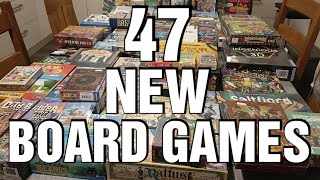
- Only had half of the components in.
Mechanics (from transcript analysis)
Video topics + discussion points
Quotes (from this video)
- I just got back from the UK Games Expo. I had a great time as always and I just wanted to make a quick video talking about all of the games that I acquired during the expo.
- The brig and buy was was great, but it was very chaotic and long long cues and longer than we've had before.
- So, definitely um was at capacity. Yeah, the brig and buy was was great, but it was very chaotic and long long cues and longer than we've had before.
- So, I definitely recommend going at least once if you have the faintest bit of interest.
- But for everybody else, I'll see you next time on Chairman of the Board. Bye-bye.
References (from this video)
- Has 198 thumbs.
- It's only $10.
- The reviewer has no interest in it.
- It is described as a 'bad game'.
- Llama
Mechanics (from transcript analysis)
Video topics + discussion points
Quotes (from this video)
- All right. Good night everybody.
References (from this video)

- Absolutely loved it.
- Looking forward to playing more of it.
- Don't own it.
- Traditional Uwe game with a twist
Mechanics (from transcript analysis)
- action selection — Moving up a harbor track to take actions.
- building — Using resources to build buildings.
- Resource Management — Taking resources to add to your pool.
- Set Collection — Shipping off goods for money (victory points).
Video topics + discussion points
Quotes (from this video)
- So, if you love Marvel, it's excellent. If you love Da Run, it's excellent. And it plays so well solo.
- And it was probably the pinnacle of my gaming experience. I don't think I'll ever hit that threshold again. It was amazing.
- Pax Penning is probably one of the most interesting games I've ever played.
- It is this cascade. It's so unique and so fun.
- For a game that comes in like the standard salt and pepper size box, it's so much game.
- It's fine at two.
- But it's not memorable, too.
References (from this video)

Mechanics (from transcript analysis)
Video topics + discussion points
Quotes (from this video)
- nobody, including us, need this many games.
- This is Divan. Mhm. I don't know anything about this game. I bought it because it looks beautiful.
- This could have easily been a Reiner Knizia game I feel like.
- And I love a reason to play Lost Ruins of Arnak Lost Ruins of Arnak because I think it's a great game.
- We have to empty our unplayed game shelf from everything that's not 2025 releases and then we'll put it in there and the rest go on the floor until we manage to play them.
- And it's based on the problem called what is called again it's based on the seven bridges of somewhere.
- I feel kind of like bad about bringing a hundred games back home.
- I I usually they go in, they go out. And that's also the thing like if I haven't played a game in a month, I will not remember the rules most of the time.
- The longest line I saw was for coffee. In the morning before the whole office.
- What's more important for you for the channel? Playing the popular ones or the less known niche ones?
- My favorite animal beside the monkey which is my favorite animal. The capybara.
- We are basically very lucky because we share a lot of hobbies.
- The building thing Ah, it was too much building. I didn't like that too much.
- It's been super fun. It's so many people. It's been so long since we did a live.
- Thank you so much for watching. Like it. We wouldn't have done this if it wasn't for you.
References (from this video)

- Tactically ducking out of a round can be rewarding.
- The catch-up mechanism with score tokens is nice.
- Simultaneous play means downtime is minimal.
- Very thin decision space.
- Not a game the host would lean towards.
- card shedding
Mechanics (from transcript analysis)
- card shedding — A mass appeal card shedding game where players try to get rid of cards.
- Push Your Luck — Deciding whether to back out of a round or draw more cards.
- Set Collection — Players gain points based on the cards left in their hand if others shed their cards.
Video topics + discussion points
Quotes (from this video)
- Were they good? Were they bad? And should you give them a play?
- Creature Caravan. This one is a game I've had my eye on for some time, and luckily a friend of mine picked this one up.
- The cards kind of feel like they're playing themselves and the decisions are fairly obvious in my opinion.
- So, all very simple, you know, straightforward set collection stuff. Um, but it's all about the maneuverability and taking opportunities
- this adds this really nice tension to the game where I want this tile, but I don't want it until two runs till till two turns time
- Tag Team getting a bit of buzz at the moment. And this is actually the first auto battler game uh that I've played.
- It just has this night nice light fluffy kind of just fun factor to it.
- I've not played a game like this before.
References (from this video)

Mechanics (from transcript analysis)
Video topics + discussion points
Quotes (from this video)
- Undaunted 2200 which is a very good game. Tactics II, very very good.
- I've got all the Killforths.
- Nemo's War, great game.
- Defenders of the Realm, love that game. Love it.
- I got some BattleTech on painting. Going to start painting again.
- Ogre, great game.
- We're going to be back in business, folks. We're going to be back in business.
- We're going to be back to full strength again. Just like the old days.
- People that want to work with me, great. People that don't want to work with me, great. Don't care.
- Getting hacked, man. It was very It took a lot of wind out of my sails.
- I'll get us there. All right, we got the other cable coming within the next month or so. Uh, they're going to be running that up here, so we're going to have fiber.
- I got 10 videos I got to get done. I got more stuff coming.
- We're turning the old game around.
- I don't think I've ever been this busy. And I'm pretty happy about it.
- We'll come back and uh, next week we'll start we'll start doing nice little short live play. Maybe we'll do uh, Val Petra.
- Everything feels better. You know, everything feels good.
- It is your old pal Earl.
- This has been a long time coming and it's showing the subscriptions have gone up.
- It's been a rough 2 days. But don't worry about it. I'll shake it off. I'll come back stronger than ever.
References (from this video)
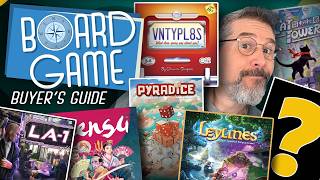
- Cases can be played individually or as part of a campaign.
- Cases can be played more than once.
- Perpetually dark underbelly of LA.
- Cyberpunk noir detective game focused on solving crimes
- Post-apocalyptic city that was once LA
- Story-driven, cooperative, with cases that can be played individually or as part of a campaign.
Mechanics (from transcript analysis)
- cooperative play — Players work together as detectives.
- Deduction — Investigators scour streets for evidence and interrogate suspects.
- Storytelling — A story-driven game where cases must be solved.
Video topics + discussion points
Quotes (from this video)
- Recall is our penultimate pick, because this is a deep strategy game from the designers of 2022's massively popular network building game Revive.
- Recall focuses on engine building and exploration as various tribes explore the lands and discover traces of ancient civilizations.
- Then, at three different points during the game, players must choose one of two paths, with the chosen path providing an immediate bonus as well as boosting one of the end-game scoring options.
- just like those players, we have reached our end game with this month's bestest bet, which is the super puzzly two-player maze deduction game Layers.
- Layers is full of both dungeon building and simultaneous dungeon exploration.
- It's a game that tests players to build a dungeon dangerous enough to confuse their competitor, while deftly defying a dungeon of their own.
- If you'd like to find even more great games to discover, well, then continue on to our latest episodes of our High Rollers or Hot Picks and Cool Recommendations videos.
- There are a lots more games that are ready for you to enjoy as your next game night pick.
References (from this video)

- Nice easy card game
- Nice casual one to play
Mechanics (from transcript analysis)
- Hand Management — Players try to get rid of all their cards.
- Push Your Luck — The decision to draw a card or fold and keep points.
Video topics + discussion points
Quotes (from this video)
- We are talking about a six-year-old that has played more board games than days he's been alive.
- Chess. It's chess.
- So, what what are you liking about Llama? I'm liking like um getting chips.
- So the the guessers have to keep eliminating options and you win the game if you can get down to only having the answer right after they've continued.
- And then in those 3 seconds, you panic and then by the time it closes, you realize you remember nothing.
- So, you know, people who are, you know, coming over to play just maybe have played it before, want to play different games and stuff like that. But man, you know, I I can't remember if we included this one on like best board games to like start a collection, but this is just a such a good versatile, you know, card drafting at boiled down to kind of its simplest form.
- Can't have too many cats.
- It's a luck game.
- Literally the game is everybody in their hand puts these five objects.
- So, it's pretty good.
- I like pushing the tiles in and trying to like figure out the best way to do it.
- I like um getting two T-rexes.
References (from this video)
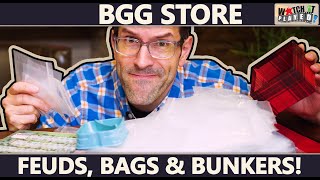
- art on both sides showing basic vs upgraded goods
- nice touch in design
- includes extra units beyond standard set
- aesthetic cohesion with game theme
Mechanics (from transcript analysis)
- none — No gameplay mechanics discussed for this item; focus is on physical components and presentation.
Video topics + discussion points
Quotes (from this video)
- this is a classic uve rosenberg game that i'm never a hundred percent sure that i'm pronouncing correctly
- what the bgg team does with these geek bit sets is really impressive because they retain the aesthetics of the game that these go with
- i have no idea what any of these symbols mean so i can't tell you what they do
- this looks like a pretty cool expansion
- this booster pack which is meant to give you eight more of each of the resources to ensure you have enough to replace the cardboard ones that come in the european expansion
References (from this video)

- Beautiful artwork and cover
- High replayability due to different cases and random elements
- Interesting and unique mechanics
- Good component quality (thick tokens, well-designed index)
- Versatile play (single game or campaign)
- Never truly out of the game when a character dies
- Miniatures add to the visual appeal
- Miniature poses do not perfectly match character art
- Thin card stock for some cards
- Solving mysteries and cases
- Post-apocalyptic LA
Mechanics (from transcript analysis)
- Card Play — The game involves drawing and playing various types of cards, including fate cards, skill cards, and mystery cards.
- Case solving — Players are 'going around, trying to find clues, trying to solve mysteries and whatnot' and 'solve cases and whatnot'.
- cooperative play — Described as a 'one to four player cooperative game' and a 'story-driven cooperative adventure'.
- Deck Building — Players draw from skill decks which can be depleted and reshuffled, with consequences.
- Modular Board — The game features a large map that is comprised of sections, and case setups can modify the game state.
- Push Your Luck — Mentioned in relation to drawing damage cards, where drawing too many leads to elimination, and also in drawing fate cards.
- Set Collection — Implied through the acquisition of different items and skill cards for characters.
Video topics + discussion points
Quotes (from this video)
- Trick or Treat Studios, you guys are geniuses, man. Thank you very much.
- I do love that cover. Absolutely love that cover.
- This is basically a um it's not a deduction game, but just a story-driven cooperative adventure where you're trying to go around, trying to solve cases and whatnot.
- But, this is what we're going to get.
- man, this game looks so good.
References (from this video)

- very story driven game with strong stories
- has an open world feel, reminiscent of video games like Red Dead Redemption
- hilarious and tense combination
- Arkham Horror DNA
- challenging race against time
- conversational storytelling where other players read cards and make decisions
- easy to start chasing leveling up and lose sight of the main goal of solving the case
- cyberpunk detective
- neo Los Angeles
- Arkham Horror
- Red Dead Redemption
- Catan Starfarers
- Dead of Winter
- Blade Runner
- Altered Carbon
Mechanics (from transcript analysis)
- Card drawing — every turn at the beginning of a turn, you're going to draw a card from the darkness deck... And the fate deck may help you. It may give you bonuses and allow you to draw more cards.
- Case resolution — you will have other cards that come out that are kind of smaller cases you're working on and you put that kind of in an active case area. Well, usually, you're going to resolve these by putting clue tokens on them and you do that by advancing the case. If you advance the case, you spend clue tokens to solve some of these minor cases and gain whatever the reward is.
- cooperative play — If the darkness token gets all the way to the end of the darkness track, then you have failed. You and your friends lose the game. But, if you are able to solve the case, crack the case, then you and your friends win.
- Deck Building — Everybody has their own deck of cards, and they have kind of their starter cards. You'll be able to get more cards as the game goes, but you are going to be able to play these cards for various effects.
- Movement — You can move from one location to another.
- Resource Management — You have credits. This is essentially the money of the game. You can spend uh credits in order to purchase uh one of these uh tiles... Another currency you have in the game is karma tokens.
- Skill checks — what this card will call for is a certain number of certain skills... you go ahead, you actually play those skill cards and then you actually have to draw a card from the fate deck
Video topics + discussion points
Quotes (from this video)
- I was always under the impression that the phrases I'm sorry and I apologize meant the same thing. Apparently not at a funeral.
- This is a cyberpunk game from Richard Launius.
- It really feels like it's got Arkham Horror DNA here.
- On the Cody scale, I'm going to go ahead, I'm going to give LA 1 Lawan a 7.5 out of 10.
- I once knew a cannibal private detective. He loved grilling people.
References (from this video)

- simple mechanics with meaningful decisions
- fast-paced and easy to learn
- versatile for different groups, including kids
- good for meetups
- scoring can feel punishing if you accumulate non-duplicates
- round-based stakes may not appeal to everyone
- Uno
- Backgammon
Mechanics (from transcript analysis)
- card values — Deck uses numbers 1-6 and a llama; llama is higher than six.
- Compound Scoring — If you did not get rid of all your cards, you score points equal to the number of non-duplicate cards in your hand.
- draw option — If you can't play, you may draw one card.
- End condition — The game goes on until a player reaches 40 points.
- Limited Points — The game goes on until a player reaches 40 points.
- Multi-Use Cards — Deck uses numbers 1-6 and a llama; llama is higher than six.
- play card that matches or is one higher — On your turn you play a card that matches the previous or is one higher; 'llama' is higher than six.
- quit for the round — Instead of playing a card, you can quit for the round and be out.
- round resolution — At the end of a round you may return a counter to adjust points.
- round structure — The round continues until everyone has quit or someone has played all their cards.
- scoring — If you did not get rid of all your cards, you score points equal to the number of non-duplicate cards in your hand.
Video topics + discussion points
Quotes (from this video)
- it's about playing not about winning
- it's fast and furious
- it's extremely simple
References (from this video)
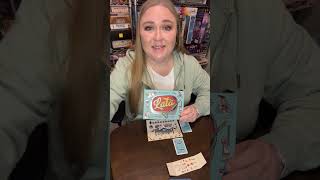
- Solo modes are fabulous
- Engaging combination of bidding, resource management, and engine-building decisions
- Clear thematic tie to the sardine/canning industry
- cafe
- Oliva
Mechanics (from transcript analysis)
- Action Points — Players have nine action points per round to spend in a variety of ways, creating tension over how to allocate actions within six rounds.
- action_points — Players have nine action points per round to spend in a variety of ways, creating tension over how to allocate actions within six rounds.
- bidding_for_turn_order — At the start of each round, players bid points to determine the turn order for subsequent rounds; ties are resolved by a specified rule.
- card_placement_and_covering — Placed cards become part of your factory; you may cover existing cards later by spending action points or money to improve your setup.
- Compound Scoring — Goods are taken to market to score points based on visible conditions; players can pay coins to reveal or acquire scoring conditions.
- hidden_information — A shield acts as a player aid that also hides certain information from opponents during play.
- market_and_scoring — Goods are taken to market to score points based on visible conditions; players can pay coins to reveal or acquire scoring conditions.
- round_structure — Six rounds per game with a fixed action-points pool each round; no cross-round saving of actions.
- tinning_goods — Goods (sardines and mackerel) can be tinned in tomato or olive oil, and placement on cards determines benefits and costs.
- Turn Order: Auction — At the start of each round, players bid points to determine the turn order for subsequent rounds; ties are resolved by a specified rule.
Video topics + discussion points
Quotes (from this video)
- This game is great.
- I really love this one.
- But like I said, I really want to try the newest one, Oliva or Oliva. I'm not quite sure how you pronounce it, but that is Lada.
- If you have played it, let me know. Give me a like and a follow, and I'll keep bringing you more board game content.
References (from this video)
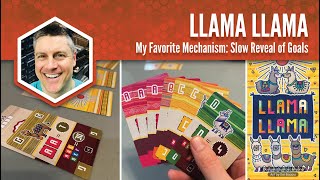
- Innovative slow-reveal goal mechanic that enriches the drafting experience
- Information asymmetry is used to dynamic effect without overcomplicating play
- Accessible, light-hearted theme that appeals to casual and family players
- Clear, tangible feedback from drafting decisions through round scoring
- Workable playtime with a refreshing twist on standard drafting
- Some players may prefer full information upfront and feel constrained by partial knowledge
- If players want heavier weight, the lightweight mechanics may feel thin to them
- The success of strategies depends on reach of goals and card distribution, which can feel variable
- Hidden scoring objectives revealed progressively, emphasizing deduction and drafting strategy over heavy abstraction.
- A light, whimsical drafting game where players pass cards and secretly vie to meet hidden scoring goals across four rounds.
- Abstract/puzzle-like, with emphasis on scoring puzzles rather than a narrative arc.
Mechanics (from transcript analysis)
- Card Drafting — Players receive a hand, select one card to keep for later use, and pass others to neighboring players in a structured sequence (4 left, 4 right, 3, 2, 1).
- Drafting / Card Passing — Players receive a hand, select one card to keep for later use, and pass others to neighboring players in a structured sequence (4 left, 4 right, 3, 2, 1).
- End-of-Round Scoring Based on Revealed Goals — After all passes and reveals in a round, players score based on how their hand matches the revealed goals, with progression across rounds influencing total score.
- hidden scoring cards — Each player secretly selects a scoring card for a round and places it face-down on a round track; these choices drive strategic drafting and risk assessment.
- Pattern & Set-Collection Scoring — Points are earned for specific card combinations (e.g., pairs or complete sets like A through G) and for meeting particular conditions on revealed goals.
- Sequential Goal Revelation — Goals are revealed one by one after each pass rather than at game start, gradually informing players' strategy across the round.
- Set Collection — Points are earned for specific card combinations (e.g., pairs or complete sets like A through G) and for meeting particular conditions on revealed goals.
- Simultaneous Reveal — Goals are revealed one by one after each pass rather than at game start, gradually informing players' strategy across the round.
- Whimsical Theme with Lightweight Rules — The tone, components, and scoring are designed to be approachable and family-friendly, keeping playtime brisk while offering meaningful choice.
Video topics + discussion points
Quotes (from this video)
- I think is my favorite mechanism in this game.
- the slow reveal of the goals instead of all the goals being up front.
- Having that slightly limited information actually makes the draft really dynamic and fun.
- So, that is my favorite reveal.
- I'd love to hear your thoughts if you've played a game like this and if there's another game that you can think of that has a slow reveal of goals instead of giving players all the goals up front at the beginning of the game.
References (from this video)
- high replayability
- great with mixed-age groups
- some setups can be fiddly
- card shedding with bluffing elements
- quirky animal-themed setting
- fun, lighthearted
Mechanics (from transcript analysis)
- Betting and Bluffing — Players interact to influence what others can safely discard
- bluffing / interaction — Players interact to influence what others can safely discard
- card shedding — Discard cards to get rid of high cards while avoiding penalties
Video topics + discussion points
Quotes (from this video)
- Uno is the McDonald's of games.
- There are 101 games that are better than Uno.
- In the description, I've grouped all of these games by publisher so you can easily find them and check them out.
- play board games like an animal.
References (from this video)

- extremely light and accessible
- easy to teach, making it beginner-friendly
- high energy with larger player counts
- interactive table dynamics around the shared discard pile
- tension and moments of big swings that make the end of a hand exciting
- replayability due to random card order
- high luck factor can dominate in some rounds
- some rounds may feel like autopilot with limited meaningful decisions
- depth may be too light for heavier gamers
- as a very lightweight title, it may not satisfy players seeking strategic complexity
- lighthearted, push-your-luck, hand-management
- Abstract, no specific setting; llama theme used as flavor in a generic card game
- abstract/game-mechanics-driven with a playful tone
- Uno
- Lum
Mechanics (from transcript analysis)
- Compound Scoring — Points are tracked with chips (1-point and 10-point denominations); going out can return a chip to the supply for a swing
- discard-value looping — The discard pile value loops around (e.g., connecting sixes back to ones), dynamically influencing decision making
- Hand Management — Players manage a starting hand of six cards per player, aiming to drop cards while minimizing total points
- point-chip scoring — Points are tracked with chips (1-point and 10-point denominations); going out can return a chip to the supply for a swing
- Push Your Luck — On each turn, players decide to stay in the round or fold, balancing risk and potential payoff as the pile value shifts
Video topics + discussion points
Quotes (from this video)
- Llama is a race to get rid of your cards each round as you try to accumulate as few points as possible.
- the tension between quitting and pushing your luck that drives the gameplay.
- it's a really light card game.
- you could actually try to shoot the Moon by drawing cards to fill in gaps in your hand.
- the final player unloads a huge sequence of cards turning what looked like a terrible hand into a win.
- there's surprising amount of interesting decisions that emerge out of such simple gameplay.
- setup is a breeze, just deal everyone six cards and start; there isn't much setup variability here.
- shuffle deck will have each hand playing out differently, keeping gameplay fresh.
- the pile can loop between your turns, and as the table shrinks, the pacing changes in a meaningful way.
- going out allows you to return a chip to the supply, creating dramatic swings and comeback moments.
- end-of-round moments are where the game's energy shines and invites a lot of social interaction.
References (from this video)
Mechanics (from transcript analysis)
Video topics + discussion points
Quotes (from this video)
- Cascadia which is always a joy to play
- Top 10 which is becoming one of my most favorite party games at the moment
References (from this video)

- tightly themed
- lots of decisions
- food/production tension can be harsh
- resource / worker placement
- port in France; maritime trade
- economic simulation
Mechanics (from transcript analysis)
- feed / upkeep — must feed workers, creating tension
- Resource Management — build buildings and use resources to progress
- Worker Placement — send workers to collect resources
Video topics + discussion points
Quotes (from this video)
- no matter what, gloomhaven remains top-rated board game
- please subscribe don't go stay with the best heavy solo game
- it's just epically big
References (from this video)
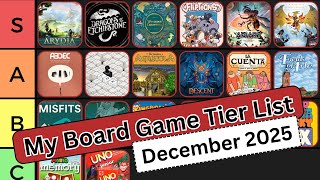
Mechanics (from transcript analysis)
Video topics + discussion points
Quotes (from this video)
- I am a little bit sad that I did not play this game before I made my top lists last year in December because this game is absolutely amazing.
- I'm not trying to farm views here. I'm just trying to be honest and transparent.
- If you lean into the theme like trying to dodge the bill, it is amazing.
- Stay safe and cheers.
- This was a great month for gaming and I really enjoyed a lot of games in December.
References (from this video)
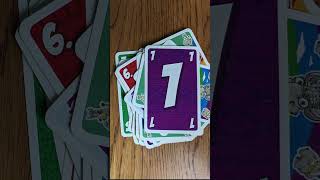
- Light and accessible
- Keeps everyone involved and engaged
- More depth than it first appears, allowing for interesting decisions
- Strong potential for exciting moments and dramatic comebacks
- Well-suited for casual game nights and social play
- Reliance on luck can be a turn-off for some players
- May feel overly familiar or derivative to those who want deeper mechanisms
- Casual party-style card play with a mild emphasis on risk and comeback potential.
- A light, social card game environment focused on quick rounds and social interaction, without a heavy thematic backdrop.
- Array
- Uno
Mechanics (from transcript analysis)
- Card play with simple set matching — A lightweight, color/number-based play pattern reminiscent of Uno, designed for quick, accessible rounds.
- Hand Management — Players optimize a small hand to maximize opportunities and timing of plays, aiming for favorable turns.
- Push Your Luck — Players decide whether to push their luck by taking riskier actions or stop, risking losing progress or points.
Video topics + discussion points
Quotes (from this video)
- Llama has consistently done a great job of filling that niche.
- a light and accessible card game that keeps everyone involved that is easy to teach while having a little more depth than what meets the eye
- potential for exciting moments and comebacks
References (from this video)
- deep Feld engine puzzle with clear card-driven progression
- dynamic timing as you upgrade your engine
- might be too dense for casual players
- fewer players may not enjoy the triple-info card mechanic
- exploration and token collection
- engine-building with commodity speculation on a map
Mechanics (from transcript analysis)
- 3-piece card information structure — each drawn card provides three bits of data: ongoing power, resource types, and token/value enhancements
- Engine Building — cards grant ongoing powers that change over time as you deploy explorers and tokens
- engine-building with evolving powers — cards grant ongoing powers that change over time as you deploy explorers and tokens
- Multi-Use Cards — each drawn card provides three bits of data: ongoing power, resource types, and token/value enhancements
- resource collection and token management — tokens represent resources used to place explorers and develop engine
- Resource Management — tokens represent resources used to place explorers and develop engine
Video topics + discussion points
Quotes (from this video)
- there's this real tradeoff of how much do I want to invest in building my engine which cards do I want to hold back to actually reap the benefits from that engine
- the tempo of the game is dictated by the players
- you can use the cards as money, to unlock more actions, or to push your engine—it's all about balancing short-term gains with long-term setup
References (from this video)
- Popular, approachable social deduction vibes
Mechanics (from transcript analysis)
- shedding / simultaneous action — participants announce actions while shedding cards; social interaction and hand management drive the pace
Video topics + discussion points
Quotes (from this video)
- i absolutely love cockroach poker
- the big moments and the big swings are quite satisfying
- i find these games hilarious
- i really like the game huh or hein
- watching the value of things change
- the moment when that tower collapses it's exciting
References (from this video)

- Light, accessible, and cheeky
- Solid family weight with subtle depth for adults
- Feels derivative of Uno in theme, though with clever twists
- Simple, so veterans may desire more complexity
- llama-themed escalation and turn-taking
- Uno-like card shedding with animal theme
- light, family-friendly
- Uno
- Sushi Go
Mechanics (from transcript analysis)
- card shedding / matching or higher card play — play a card that must beat or match the previous; special llama rules can alter flow
- end-game optimization — manage cards and tokens to minimize penalties and maximize final scores
- token scoring and negative points on passing — when you pass, you lay down cards with negative point values; tokens offer catch-up potential
Video topics + discussion points
Quotes (from this video)
- it's a crazy system but it works really well
- really chaotic it's really fun and funny
- Peanut Club really highly recommended
- you can just see it in action and you know what you're supposed to do
- King Domino lovely little filler looks like a children's game but actually there's enough substance here
References (from this video)

- easy to learn, fast rounds
- great for casual groups
- versatile for different group sizes
- some players may find it too lightweight
- balance hinges on luck and timing
- light card play with competitive edge
- color-dense, quick card game in the Uno-like family
- party/light
Mechanics (from transcript analysis)
- simple hand-management with payoff timing — Players discard and play cards while racing to minimize penalties and maximize points.
- timing and come-from-behind play — Strategic discard choices and counting influence scoring in rounds.
Video topics + discussion points
Quotes (from this video)
- these are going to be the 10 games in our collection that have the lowest average rating on Board Game Geek
- it's a very unique Cooperative game and you can't talk during the game
- the end of the round you hear someone shout I got a golden ticket
- the memories are not about the scoring but about the laughs around the table
- simultaneous play is a game changer in Seoa; it's fast and tense
- the best part is the laughing, not the scoring, in many party games