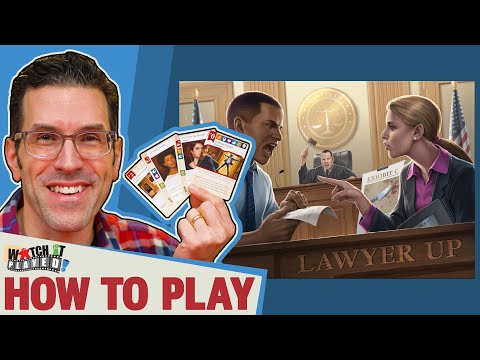






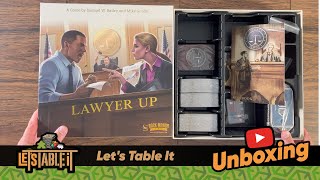







Lawyer Up box art

Lawyer Up

Game ID: GID0187378
Collection Status
Description

In Lawyer Up, a two-player asymmetrical card game, players take on the roles of attorneys facing off against each other in a courtroom case. One player takes on the role of the prosecution and the other takes on the role of defense. Each case has its own unique mechanisms and story from Murder to Racketeering.

Lawyer Up is a game of arguments, influence and strategies. Players start with Discovery, where they will go through all the evidence of the case and draft what they think is important for them to win. Then Players will take turns calling and questioning witnesses - building arguments by chaining together cards with the same symbols and earning influence. Attorneys then spend their influence to sway the biases of the jury to their side of the argument.

—description from the designer

Year Published
2021
Transcript Analysis
Browse transcript mentions, sentiments, pros/cons, mechanics, topics, quotes, and references.
Total mentions: 6
This page: 6
Sentiment: pos 3 · mix 1 · neu 0 · neg 2
Mentions per page
Top
Showing 1–6 of 6
Video JasMPDRaoM0 Let's Table It game_review at 0:16 sentiment: positive
video_pk 61987 · mention_pk 154609
Let's Table It - Lawyer Up video thumbnail
Click to watch at 0:16 · YouTube ↗
Overall sentiment (raw)
positive
Pros
  • Strong thematic integration; the courtroom/legality theme is vividly reflected in both card text and decision points.
  • Tight two-player design with meaningful choices on every turn, avoiding filler actions.
  • Excellent replayability due to multiple cases and variable card distribution each game.
  • A helpful reference card and structured flow keep the game approachable during play.
  • Thematic tension and the back-and-forth of sway and witness outcomes create satisfying climaxes.
Cons
  • Session length can feel long for a two-player match as players read and evaluate many cards during play.
  • Initial setup and rule-reading can be dense for newcomers; a teach-through may be helpful.
  • Some players who prefer heavier analysis or a longer narrative may find the pacing brisk but lack depth for extended play.
Thematic elements
  • Legal strategy, courtroom persuasion, witness interrogation, and argument construction under pressure.
  • A courtroom drama setting where two players assume opposing legal sides (prosecution vs defense) across multiple distinct cases, with jurors, witnesses, and evidence shaping the outcome.
  • Array
Comparison games
none
Mechanics (from transcript analysis)
  • Bias symbol matching and chaining — Cards contain bias icons; the first card must align with a bias on the witness, and subsequent cards must match the previous bias to chain effects.
  • Case-based replayability — Season 1 includes four cases (two base, two expansions, per the host), ensuring different witnesses, cards, and victory conditions each playthrough.
  • Drafting and hand management — Each round you select a card for yourself, give one to the opponent, and bury one; the distribution of these cards determines your immediate options and long-term planning.
  • Influence and witness resolution — You accumulate influence on your dial tied to witness interactions; the goal is to outperform your opponent when resolving a witness and sway the jury.
  • Influence Points — You accumulate influence on your dial tied to witness interactions; the goal is to outperform your opponent when resolving a witness and sway the jury.
  • Legacy game — Season 1 includes four cases (two base, two expansions, per the host), ensuring different witnesses, cards, and victory conditions each playthrough.
  • Procedural cards and judge's favor — Procedural cards can be activated later for special effects; judge's favor tokens influence when actions can be resolved.
  • Sidebar and objections — A sidebar system lets players gain extra resources; objection tokens provide one-time disruption options to discard an opponent card.
Video topics + discussion points
No key topics recorded for this video.
Quotes (from this video)
  • two-player only card game where one player will play as the prosecutor and the other will play as the defense
  • art forgery case a murder case a Godfather case and a witch trial case
  • four cases in all
  • the game feels tight and feels like it can go either way
  • the design does a great job connecting the mechanics with a theme
  • this is lawyer up season 1 with season 2 already out
References (from this video)
No references stored for this video.
Video V6FTb5tNEP0 Unknown rules teach at 0:16 sentiment: positive
video_pk 61994 · mention_pk 154616
Unknown - Lawyer Up video thumbnail
Click to watch at 0:16 · YouTube ↗
Overall sentiment (raw)
positive
Pros
  • Engaging courtroom-themed gameplay
  • Two-player asymmetric duel with clear roles
  • Flavorful cards with art and flavor text
  • Feels like being in the courtroom
Cons
  • Complex rules for new players
  • Possible ambiguity around objection rules
Thematic elements
  • law, bias, evidence, and courtroom strategy
  • courtroom drama between prosecution and defense
  • procedural, argument-driven
Comparison games
none
Mechanics (from transcript analysis)
  • Bias/Jury influence — 12 jury members with different skepticism values; you move a marker toward your side by influencing the jurors with bias tokens
  • Case selection and judge influence — choose one of four cases and a judge who will begin favoring the prosecution
  • Discovery — draft vital evidence to support your case and bury evidence that might help your opponent; decide which cards to keep, give, or bury
  • Objections — three objections per entire trial; using them can discard a witness or disrupt the flow
  • Trial and Witness questioning — call witnesses and present powerful arguments along with the drafted evidence
Video topics + discussion points
No key topics recorded for this video.
Quotes (from this video)
  • you will definitely feel like you're in the courtroom with this game
  • three objections for the entire trial
References (from this video)
No references stored for this video.
Video vJwdlkZz_FY Unknown Channel game_review at 0:00 sentiment: mixed
video_pk 32515 · mention_pk 96206
Unknown Channel - Lawyer Up video thumbnail
Click to watch at 0:00 · YouTube ↗
Overall sentiment (raw)
mixed
Pros
  • Strong thematic fit for a two-player tug-of-war card game
  • Engaging back-and-forth dynamics with solid tactical depth
  • High replayability due to multiple cases and modular expansion potential
  • Flavorful art and humorous flavor text that enhances the experience
Cons
  • Rulebook described as bare-bones and hard to fully grasp
  • Notable randomness can lead to swingy outcomes and feelings of luck rather than skill
  • Core deck remains similar across sides, reducing long-term variability
  • Buried evidence mechanic may dilute novelty and complicate balance
Thematic elements
  • Legal maneuvering and courtroom strategy presented with humorous flavor and vivid card art
  • Courtroom drama with case variants (art forgery, murder) and thematic twists (Salem witch trials, 1920s gangster motif)
  • episodic trial narratives driven by witness calls and evolving evidence
Comparison games
none
Mechanics (from transcript analysis)
  • Action Interruption — Tokens enable interrupting, drawing, or triggering card actions for strategic advantage
  • card drafting — Players draft from a central pool to build their core decks, with case-specific cards added to the mix
  • Case-specific cards and buried evidence — Each case introduces unique cards and a buried evidence deck that adds variability across games
  • Core deck symmetry with case variation — Both sides share an identical core deck; only case-specific cards vary, adding variety through caseloads
  • Deck management and reshuffle rules — The deck does not automatically reshuffle when depleted; a special rule card allows shuffling the discard into the deck
  • deck manipulation — The deck does not automatically reshuffle when depleted; a special rule card allows shuffling the discard into the deck
  • Influence and jury sway — Witness wins grant influence to sway jurors; majority jurors determine the winner unless a variant shifts the goal
  • Modular board — The modular system supports adding new cases and mechanics via expansions
  • Modular expansions and new cases — The modular system supports adding new cases and mechanics via expansions
  • Objection, sidebar, and procedure tokens — Tokens enable interrupting, drawing, or triggering card actions for strategic advantage
  • Symbol matching puzzle — Card play hinges on matching symbols to the previous card or to the witness, creating a planning-heavy sequence
  • Turn-based back-and-forth with action timing — Players alternate playing action cards; timing and sequencing are crucial for optimal play
  • Witness call and value-based resolution — A round's witness is called; the player with the higher value wins the witness and gains influence
Video topics + discussion points
No key topics recorded for this video.
Quotes (from this video)
  • the theme fits really well with much beloved two-player head-to-head tug-of-war card playing game kind of genre
  • it's a really nice head-to-head experience
  • one of the things here is that in a lot of other similar games usually you're forced to pick between the number and the action and here you're not
  • lawyer up has an absolutely terrific theme
  • it's not a must-have but they're certainly fun to be had
References (from this video)
No references stored for this video.
Video FbkgW5w12EA game_review sentiment: negative
video_pk 10436 · mention_pk 30740
Overall sentiment (raw)
negative
Pros
  • Original theme
  • Unique game concept
Cons
  • Lackluster solo mode
  • Inconsistent point generation
  • Lack of strategic depth
  • Immersion-breaking random evidence
Thematic elements
  • Legal trial simulation
  • Courtroom
  • Witness-based case building
Comparison games
  • Liar Liar
Mechanics (from transcript analysis)
  • Card Play — Playing evidence and argument cards to sway jurors
  • Point accumulation — Gaining points through strategic card plays
Video topics + discussion points
No key topics recorded for this video.
Quotes (from this video)
  • hopefully Series 2 addresses my concerns and brings some fresh life to this mediocre game
References (from this video)
No references stored for this video.
Video A4KfrQ0G6r0 Chairman of the Board top_10_list at 4:41 sentiment: negative
video_pk 3014 · mention_pk 8777
Chairman of the Board - Lawyer Up video thumbnail
Click to watch at 4:41 · YouTube ↗
Overall sentiment (raw)
negative
Pros
  • strong thematic flavor (legal drama)
Cons
  • time-wasting turns
  • back-and-forth feel
  • frustrating mechanics
Thematic elements
  • legal strategy with jury influence
  • courtroom drama; defense vs prosecution
  • tug-of-war jury persuasion through card play
Comparison games
none
Mechanics (from transcript analysis)
  • card play / jury interaction — cards influence jurors through a tug-of-war mechanic
  • long-term planning — early turns can feel useless until near the end
  • Tug of war — turn order and impact swing as jurors align
  • Tug-of-war scoring — turn order and impact swing as jurors align
Video topics + discussion points
No key topics recorded for this video.
Quotes (from this video)
  • there's no super Superfluous rules there's no fiddliness so it's quite nice and pure
  • this one stays true to what hidden role or hidden movement game should be
  • I think this one is still my favorite one as one person takes the role of Jack the Ripper
  • I absolutely hated this game I did not like anything about it apart from the visuals very stylish and I'm deluxified looking game
  • the colorblind-friendly at all and me and my brother are both quite badly colorblind
  • not colorblind friendly at all and me and my brother are both quite badly colorblind
  • the ketchup mechanism in this game
  • one of the nearest misses I've ever played
  • therefore it's just not subtle
References (from this video)
No references stored for this video.
Video 77kzgxcpksk Unknown Channel playthrough at 0:00 sentiment: positive
video_pk 1742 · mention_pk 5033
Unknown Channel - Lawyer Up video thumbnail
Click to watch at 0:00 · YouTube ↗
Overall sentiment (raw)
positive
Pros
  • Rich, thematic courtroom mechanics that mirror real trial dynamics
  • Clear dichotomy between prosecution and defense strategies with meaningful choices
  • Discovery phase adds strategic depth before courtroom play
  • Multiple witnesses and scenarios encourage replayability
Cons
  • Complex symbol system and numerous edge cases may be daunting for new players
  • Prototype components described in the video; final production may vary
Thematic elements
  • Legal strategy, evidence manipulation, juror bias
  • Courtroom trial with prosecution vs defense
  • Procedural, instructional
Comparison games
none
Mechanics (from transcript analysis)
  • Buried evidence — Some cards go to buried evidence face-down and are not immediately usable, offering ways to pull them out later or deny them to the opponent.
  • Deck building — Players construct a deck of evidence and arguments during a discovery phase, selecting which cards go into their own deck, which go to the opponent, and which are buried.
  • Deck-building / discovery — Players construct a deck of evidence and arguments during a discovery phase, selecting which cards go into their own deck, which go to the opponent, and which are buried.
  • Influence economy and endgame scoring — Influence is earned during examinations and used to sway jurors; the endgame is resolved by comparing influence and locking all jurors or by closing arguments after nine witnesses.
  • Influence Points — Influence is earned during examinations and used to sway jurors; the endgame is resolved by comparing influence and locking all jurors or by closing arguments after nine witnesses.
  • Juror manipulation: lock/unlock — There are 12 jurors with individual biases; the prosecution aims to lock them to win, while the defense can unlock with specific actions.
  • Procedures and sidebar actions — Procedures are special cards with on-card symbols that can be played for immediate or future effects, including refreshes of objections and sidebar actions.
  • Witness examinations and bias matching — During the courtroom phase, players play cards with bias icons that must align with the previously played card to chain arguments and influence jurors.
Video topics + discussion points
No key topics recorded for this video.
Quotes (from this video)
  • the game will end immediately
  • we are going to lock all 12 jurors
  • you can't lock or unlock one bias on a specific juror
  • this is the defendant's personal diary
  • we shuffle all evidence in your discard back into your deck
References (from this video)
No references stored for this video.
Transcript Navigation
Top
Showing 1–6 of 6
View on BoardGameGeek