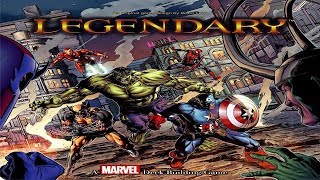
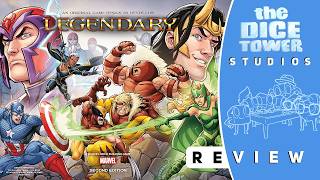
Legendary: A Marvel Deck Building Game is set in the Marvel Comics universe. To set up the game, players choose a mastermind villain (Magneto, Loki, Dr. Doom, Red Skull in the base game), stack that particular villain's attack cards underneath it, then modify the villain deck as needed based on that villain's particular scheme. Players then choose a number of hero decks – Spider-Man, Hulk, Wolverine, etc. – and shuffle them together; since players use only a handful of hero decks out of the fifteen included, the hero deck can vary widely in terms of what's available.
Over the course of the game, players will recruit powerful hero cards to add to their deck in order to build a stronger and more resourceful deck. Players need to build both their recruitment powers (to enlist more heroes) and their fighting ability (to combat the villains who keep popping up to cause trouble). Players recruit heroes from an array of five cards, with empty slots refilled as needed. At the start of a player's turn, he reveals a villain and adds it to the row of villains. This row has a limited number of spaces, and if it fills up, the earliest villain to arrive escapes, possibly punishing the heroes in some way. Some villains also take an action when showing up for the first time, such as kidnapping an innocent bystander. The villain deck also contains "master strike" cards, and whenever one of these shows up, the mastermind villain (controlled by the game) takes a bonus action.
As players fight and defeat villains, they collect those cards, which will be worth points at game's end. Players can also fight the mastermind; if a player has enough fighting power, he claims one of the attack cards beneath the mastermind, which has a particular effect on the game. If all of these cards are claimed, the game ends and players tally their points to see who wins. If the mastermind completes his scheme, however – having a certain number of villains escape, for example, or imposing a certain number of wounds on the heroes – then the players all lose.
Hero decks in the base game: Gambit, Black Widow, Hawkeye, Emma Frost, Thor, Spider-Man, Iron Man, Storm, Captain America, Nick Fury, Rogue, Cyclops, Hulk, Wolverine, Deadpool
- Accessibly thematic with familiar IP
- expansion bundles add depth
- Expansion bloat is real; rules can become unwieldy
- setup can be lengthy with multiple boxes
- deck-building with superhero powers and encounters
- fighting through iconic Marvel adventures
- cooperative/competitive superhero ensemble
Mechanics (from transcript analysis)
- Cooperative Game — work with other players to defeat villains and complete objectives.
- cooperative play — work with other players to defeat villains and complete objectives.
- Deck building — acquire cards to improve your hero and abilities.
- deck-building — acquire cards to improve your hero and abilities.
Video topics + discussion points
Quotes (from this video)
- It's not engagement. It's everyone doing their own puzzle in the same room.
- Gorgeous production quality, but multiple simultaneous subsystems that can feel complex initially for new players.
- Turn order determines a lot in this game's economy.
- One wrong move with how the link network system works, and you've completely invalidated your entire strategy.
- The clue giver walks a razor line between clever and intuitive that new players haven't calibrated.
- Eight-hour day commitment, full group attendance, full mental energy required throughout.
References (from this video)
- Unique Mastermind mechanic with a persistent scheme that can cause the game to end as a loss or a win for all players depending on the wind conditions.
- Familiar deck-building core with a Marvel character lineup (Wolverine, Forge, Colossus) that ties into the theme and IP.
- Clear recruitment and combat economy that encourages planning and gadget-like deck optimization.
- Thematic and cinematic feel through the scheme and boss-battle structure, which aligns well with comic-book storytelling.
- Inherent complexity with multiple card types (Heroes, bystanders, wounds, villains) can be daunting for newcomers.
- As a cooperative game driven by a Mastermind, some players may feel the difficulty is high or opaque without guidance.
- The flow can be lengthy as players chase optimal deck builds and the Mastermind’s scheme escalates over time.
- heroic team-up, world-saving, mastermind schemes against a group of heroes.
- Marvel Universe in a present-day, comic-book-inspired scenario where heroes band together to stop a Mastermind villain.
- comic-book tone with a scheme-driven, episodic boss-battle structure; the scheme sets the wind/lose conditions and tone.
Mechanics (from transcript analysis)
- Attack points — A separate currency from recruit points used to attack villains; attack values allow players to defeat villains and push them into the victory pile.
- Bystanders and wounds — Bystanders are civilians to rescue and wounds clog or slow players; various card effects interact with these elements.
- Deck building — Players start with a small shared starting deck (e.g., Shield agents and Shield officers); they acquire new Heroes and cards to add to their deck, which reshuffles into their hand on subsequent turns.
- deck-building — Players start with a small shared starting deck (e.g., Shield agents and Shield officers); they acquire new Heroes and cards to add to their deck, which reshuffles into their hand on subsequent turns.
- hand management — Players manage a hand of cards each turn, using recruit and attack points to acquire Heroes and defeat villains while maintaining a build strategy.
- hidden victory points — Each defeated villain carries victory points; after the Mastermind is defeated four times, players tally points to determine the winner.
- Mastermind and scheme — The opposing Mastermind acts as the primary villain; a scheme card sets wind/lose conditions and governs when the Mastermind or board forces a loss occurs.
- Recruit points — A currency used to recruit Heroes from the HQ; costs are shown on each Hero card; players reveal and recruit as they spend points.
- Reveal and recruit flow — When recruiting, new Heroes can be revealed from the HQ to see additional options before committing to a purchase.
- Simultaneous reveal — When recruiting, new Heroes can be revealed from the HQ to see additional options before committing to a purchase.
- Turn and hand management — Players manage a hand of cards each turn, using recruit and attack points to acquire Heroes and defeat villains while maintaining a build strategy.
- Victory Points — Each defeated villain carries victory points; after the Mastermind is defeated four times, players tally points to determine the winner.
- Villains and henchmen — Villains (e.g., Mastermind’s forces) require a set amount of attack points to defeat; defeated villains go to the victory pile and contribute victory points.
Video topics + discussion points
Quotes (from this video)
- the game can actually win and defeat all the players
- defeat The Mastermind four times
- the way we actually accomplish that goal is by recruiting Heroes
- he's a badass
- that's kind of how the recruiting system works
References (from this video)
- Excellent for cooperative game enthusiasts
- Deep Marvel theme with many characters and expansions
- Solid co-op deck builder with good customization
- Low rules overhead, accessible to diverse groups
- Template for modern co-op deck building games
- Extensive replayability with variable setup
- Game can be pretty swingy with villain deck randomness
- Bad draws from villain deck can heavily impact difficulty
- Weak player identity - difficult to distinguish individual character roles
- Cooperative superhero defense against villains and masterminds
- Marvel Universe, city under attack
- Nefarious mastermind scheme vs heroes protecting the city
- Dominion
- Marvel Champions
- Sentinels of the Multiverse
- Legendary: Aliens
Mechanics (from transcript analysis)
- AI Villain System — Villains act based on drawn villain cards with randomized activation
- card management — Cards have sets and teams that can be combined for powerful effects
- cooperative play — Players work together to defeat the mastermind by hitting them four times
- Deck building — Players start with basic cards and add more powerful ones during gameplay
- Resource management — Resource cards spent to buy new cards, attack cards used to defeat villains
- set collection — Heroes are combined for synergistic effects based on symbols and teams
Video topics + discussion points
Quotes (from this video)
- if you like cooperative games, marvel and deck building this game is 100% made with you in mind
- and like dominion sometimes the first game to do something gets a lot right
- a solid co-op deck builder with good customization and low rules overhead suitable for just about any group that likes co-op play
- the best thing about this game is if you like the core gameplay you can add so many variables to it
- however the game can be pretty swingy and bad draws from the villain deck can really make the difference between an easy and hard go of it
- legendary marvel i really hope you like shuffling cards
References (from this video)
- high replayability through many heroes and masterminds
- fun IP integration with adjustable difficulty via scenarios
- easy entry for new players who know Marvel
- expansions can explode component count
- some combos may feel overpowering without balance checks
- deck-building combat against masterminds and villains
- Marvel Universe with iconic heroes and villains
- cinematic, modular
Mechanics (from transcript analysis)
- deck_building — Construct a deck from a pool of hero cards to defeat masterminds and villains.
- hand_management — Manage your hand to optimize combat and abilities.
- thematic_synergy — Characters' abilities interact with the narrative of each scenario.
Video topics + discussion points
Quotes (from this video)
- this game puts you under a bit of pressure by forcing you sometimes to bite off more than you can chew
- this game was very much at the Forefront of these kind of lightweight eurocentric games and it did introduce me to the worker placement mechanism
- it's a timeless evergreen of a design is a simple auction style game as you're bidding for these properties having a very fixed amount of cash
- I love the master builder mechanism here
- the idea of working with my friends to overcome these scenarios was a really cool novel concept to me
- mindblown... the feeling that the initial plays of the resistance Avalon had on me
- this one opened the floodgates in terms of me wanting to explore more intricate game design
References (from this video)
- Accessible gateway to deck-building with a beloved IP
- Solid two-player and multiplayer experiences
- Broad expansion ecosystem adds variety
- Expansion synergy can be tricky and messy
- Over-saturation can dilute balance if not curated
- Cooperative deck-building against villains
- Marvel Universe with iconic heroes and villains
- Episodic encounters with evolving villain schemes
- DC Deck-Building Game
- Marvel Legendary: X-Files (thematic offshoots)
Mechanics (from transcript analysis)
- Cooperative play framing with villains — Team up to meet villain schemes and thwart the plan
- deck-building — Acquire cards to build a stronger hero deck and defeat villains
- Looter-ish expansion interoperability — Mix and match expansions with care to avoid power imbalances
Video topics + discussion points
Quotes (from this video)
- it's the best game ever
- this game is a nut job
- the art is amazing the storytelling is amazing
- Nemesis is fan Fantastic so it's it's semi-cooperative I guess it depends
- it's the best alien game I've ever played that's not the alien license
- Photosynthesis is a beautiful game
- the core box is amazing
- it's so heavy but it's worth it
- awaken Realms sponsor this they’re so awesome
References (from this video)
- huge variety and theme integration with characters
- excellent card synergies between heroes
- can require lots of expansions to reach full potential
- can be table-tight with a large group
- superhero team-building, cooperative play against villains
- Marvel Universe
- comics-inspired, cinematic
Mechanics (from transcript analysis)
- deck-building — acquire hero cards to form an effective team and attack masterminds
- semi-cooperative play — play cooperatively against a villain/scenario while competing for optimal deck synergy
- variable hero/villain combos — expansions provide hundreds of variants for engines and challenges
Video topics + discussion points
Quotes (from this video)
- this is a game that really impressed me
- the strategy in this one is a lot deeper than your standard deck building game
- this is an amazing fun game probably one of the big hits of last year for me
- you can really strategize and focus on what you want all through the use of building your different decks
- the engine building in this game is fantastic
- Concordia is one of the best games out there in my opinion
- Legends is legendary, Marvel deck-building game
References (from this video)
- The Marvel IP appeal and a wide roster of heroes
- Solid base mechanic for light to moderate play sessions
- Bloated with expansions; memory and deck-building can become unwieldy
- Difficulty spikes can undercut early game experience
- Cooperative deck-building against villains and masterminds
- Marvel Universe
- theme-driven campaigns with evolving antagonist rogues
Mechanics (from transcript analysis)
- boss battler — New expansions ramp up difficulty and power levels with added villains.
- Cooperative Game — Players collaborate to defeat the mastermind and their schemes.
- cooperative play — Players collaborate to defeat the mastermind and their schemes.
- Deck building — Players purchase cards to improve their deck and capabilities.
- deck-building — Players purchase cards to improve their deck and capabilities.
- encounter/villain scaling — New expansions ramp up difficulty and power levels with added villains.
Video topics + discussion points
Quotes (from this video)
- Be wary if you're a completionist.
- The more stuff you bring out, the more the power level of a bunch of these characters goes up and the harder the game becomes to balance.
- Suburbia is a great Euro game, but the big box and all the expansions just get out of hand.
References (from this video)
- nostalgic recall of early experience with the game
- acknowledgement that the Legendary system exists and has some fans
- feels flat and lacking meaningful tension in solo play
- cooperative aspect not strong enough to resolve the tension between highest-score win condition and teamwork
- market/decision points don’t feel impactful, especially in solo mode
- expansions and extra components (e.g., Dark City) were overhyped purchases that did not improve the solo experience
- personal regret about purchasing a heavy, space-consuming box
- cooperative villain containment with hero team synergy
- Marvel Universe / superhero ensemble
- episodic comic-book feel with escalating masterminds and schemes
- Apex Theropod
- Alien Legendary
- Star Realms
- Shards of Infinity
- Matrix (Legendary system) game
Mechanics (from transcript analysis)
- Cooperative Game — Players work together to defeat the mastermind and thwart schemes, aiming for a collective victory.
- cooperative_play — Players work together to defeat the mastermind and thwart schemes, aiming for a collective victory.
- Deck building — Players acquire hero cards to add to their deck to improve offense, defense, and synergy over time.
- deck-building — Players acquire hero cards to add to their deck to improve offense, defense, and synergy over time.
- hand management — Turn-by-turn decisions about which cards to play and when to maximize team effects.
- hand-management — Turn-by-turn decisions about which cards to play and when to maximize team effects.
- hero_synergy_and_set_collection — Collecting and combining hero cards to unlock stronger combos and synergies.
- villain_mastermind_and_encounter_mechanisms — A central mastermind with a tailored scheme and a rotating encounter deck creates tension and threats.
Video topics + discussion points
Quotes (from this video)
- Marvel Legendary felt felt absolutely flat for me.
- The Cooperative element isn't that strong and I tried many things.
- I should not go all out with a system that I'm not familiar with.
- it's a big heavy box that was occupying space in my shelves.
- I strongly suggest you stay away from this if you're a mainly a solo boardgamer.
- I finally found a home for it.