
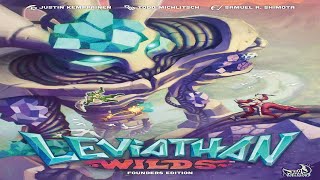












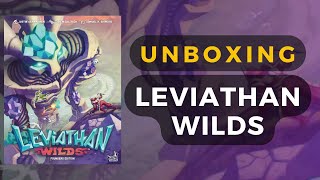
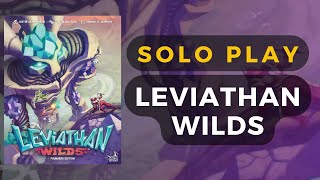







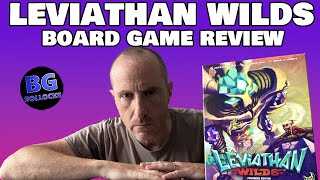

Long ago, the once-gentle leviathans lost their minds and tore the world apart. After generations of hiding and struggle, humanity discovered that the frenzied leviathans can be restored. Climbers willing to take the risk must explore the wilds and work together to remove a series of binding crystals to heal the leviathans roaming the world.
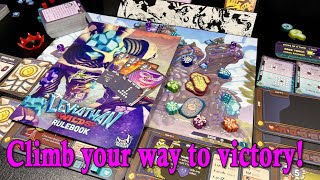
In Leviathan Wilds, 1-4 players will confront these colossal beings, with each creature being depicted across the spread of a spiral-bound storybook that makes up the game's board. The book also forms the basis of a connected campaign mode built around the game's story, with each of twenty included scenarios estimated to last around 45 minutes. Tougher difficulty levels are also available for added replayability.
Each character's deck of multi-use cards is unique, allowing them to climb, jump, and glide around the board in different ways. The number of cards left in the slim deck represents their grip on the leviathan's body; if the deck runs out, the player loses their grip and begins to fall down the board until they're able to reach a rest space, which resets their deck. Moving onto rest spaces also provides a way to regain one's grip without falling. Other spaces reduce a character's health or grip or they increase blight, a status that reduces their overall hit points.
The leviathan has its own deck of cards, which triggers various effects at the beginning of a player's turn, from targeted attacks that reduce health to effects that move players between spaces or loosen their grip. As the game progresses, the leviathan gradually gains "rage", which intensifies the effect of its event cards.
Players' characters can move around a square grid overlaid on the creature's body by spending action points — the number being determined by a card played at the start of their turn — and their remaining hand of ability cards to reach the crystals and reduce them to zero. Victory is achieved by reducing all crystals, which vary in strength, to zero.
- Beautiful production and art
- Compact, well-designed box with an excellent insert
- Excellent variety and strong theme-mechanism integration
- Rich for two players or solo play with shared deck concept
- Expansion options (Mutation Pack) add meaningful replayability
- Rulebook can be dense and occasionally conflicting due to many interacting systems
- Steep learning curve and intense decision-making can be stressful
- Color-blind accessibility concerns regarding crystal colors
- Limited retail availability post-cunding; second printing planned
- team-based ascent and purification of gigantic creatures, blending platforming/climbing with strategic combat and resource management
- Cooperative boss-battling in a world where players climb and interact with 17 leviathans whose bodies form the map; crystals corrupt the leviathans and must be destroyed.
- episodic, with each leviathan presenting its own flavor and rules; no overarching campaign progression
- Shadow of the Colossus
Mechanics (from transcript analysis)
- Character variety and synergy — Eight climbers and eight classes create numerous deck combinations; a two-player variant can combine decks.
- color accessibility considerations — Crystals use color cues that may be problematic for color-blind players; color differentiation could be improved.
- Cooperative Game — Players work together to climb leviathans, manage resources, and destroy corrupting crystals before climbers die.
- cooperative gameplay — Players work together to climb leviathans, manage resources, and destroy corrupting crystals before climbers die.
- deck-building / multi-use cards — Each climber class provides a deck; cards offer action points and special skills with multiple uses on a single card.
- difficulty scaling and rage — Seventeen leviathans with varying stats; difficulty increases with gear level and an enraged/advanced attack phase.
- expansions and injuries — Mutation expansion adds extra variety; an injuries deck introduces lasting penalties for failed encounters.
- grip / stamina system — Draw up to three cards per turn; grip depletes with actions, and if it runs out the climber falls.
- movement and terrain navigation — Climbers move across ledges, jumps, glides, anchors, and mushrooms; terrain can deal or mitigate damage.
- mushroom power-ups — Mushrooms placed on the map grant grip, health, or special abilities when harvested or consumed.
- setup and player aids — Rulebook provides setup flow and threat trackers; reviewer notes a desire for more player aids or pass-out cards.
- threat and end-of-turn resolution — Leviathan threats are revealed and resolved at the end of each turn, affecting adjacent spaces and dealing damage.
- Variable Set-up: Player — Rulebook provides setup flow and threat trackers; reviewer notes a desire for more player aids or pass-out cards.
Video topics + discussion points
Quotes (from this video)
- the production value is just I think off the charts good Everything feels really good the box is nice and small it has a great insert that holds everything perfectly
- the marriage of mechanisms and theming in this game is really strong
- I absolutely love the variety I like how you mix the various characters with the classes and you can make all kinds of different combinations and they do feel different
- the art in this game is so good I love it
- Shadow of the Colossus and that you are playing as these climbing Heroes
References (from this video)
- Slipstream Leviathan and its wing-rotation mechanic feel dynamic and fresh
- New climbers and classes expand strategic options and combos
- Warp crystals and warp deck add new strategic layers and unpredictability
- High replay potential due to varied class/crystal interactions
- Expansion enriches the cooperative puzzle-solving and risk management
- Wing-flap and orientation mechanics can be fiddly or punishing in some scenarios
- Some players may find warp crystals less exciting than other core mechanics
- Verticality of Slipstream may limit horizontal maneuverability compared to other Leviathans
- Cooperative ascent and survival atop a colossal, shifting creature with dangerous, vertigo-inducing terrain
- Aerial, high-altitude expedition aboard a living flying leviathan during the Shattered Peak event
- Expansion-driven campaign feel with evolving leviathans, classes, and new mechanics
Mechanics (from transcript analysis)
- Anchoring, climbing, and focus actions — Players anchor to ledges, climb, and focus to gain advantages and stabilize position during perilous ascents.
- Blight and environmental hazards — Certain crystals deal blighted damage; blight, slime, and other hazards raise the stakes and risk with every action.
- card crafting — Warp crystals introduce a third crystal type; warp cards provide immediate effects, teleports, or push effects that affect play area.
- Character classes with unique abilities — New climbers (Dare, Alchemist, Recoil, Geommancer) provide varied action economy and synergy opportunities.
- Cooperative Game — Players work together to navigate a perilous sky-borne environment and defeat the leviathan threats.
- cooperative play — Players work together to navigate a perilous sky-borne environment and defeat the leviathan threats.
- Crossbow tokens, reload and ranged actions — Recoil uses crossbow tokens with a reload ability and crossbow-based strikes that may push or damage players if misused.
- Falling risk and immediate defeat on certain falls — Falling off the leviathan or into dangerous zones can end a climber’s run, emphasizing careful positioning.
- Prep tokens, ingredient tokens, and brewing recipes — Alchemist collects prep/ingredient tokens to brew recipes that grant extra effects such as extra actions or movement.
- Resting on crystals to become focused — Climbers can rest on crystal spaces to become focused, enabling powerful future turns and combo possibilities.
- Unique player powers — New climbers (Dare, Alchemist, Recoil, Geommancer) provide varied action economy and synergy opportunities.
- Warp crystals and warp deck — Warp crystals introduce a third crystal type; warp cards provide immediate effects, teleports, or push effects that affect play area.
- Wing orientation and ledge mechanics — Leviathans’ wings flip orientation, rotating the map and activating or deactivating ledges; failure can mean a fall and defeat.
Video topics + discussion points
Quotes (from this video)
- Slipstream is basically a giant uh snaky dragony thing that you are riding up to the Shattered Peak.
- I love Slipstream. I think it's a really cool mechanic.
- If you already like Leviathan Wilds, I think this one is a no-brainer.
- The new Leviathans look great and I'm sure there will be a lot more.
- This expansion just makes it even better.
References (from this video)
- Movement and spatial depth are highly engaging; the map interactions invite thoughtful positioning and strategic risk-taking.
- Leviathans provide a strong variety of encounters; different monsters create memorable asymmetrical experiences and replayability.
- Character classes introduce meaningful asymmetry and interesting tempo shifts, enabling varied play styles across sessions.
- Threat cards, blight, and ledge mechanics contribute to a tense, strategic decision space that rewards careful planning and coordination.
- Card play can feel underpowered or underwhelming at times, especially for certain classes, which dampens excitement despite the overall polish.
- Three-card starting hands can constrain early-game branching and decision-making, making some turns feel straightforward rather than deeply strategic.
- Solo mode is less appealing or balanced than two-player or larger co-op configurations, limiting perceived accessibility for solo players.
- Several classes and some skill effects do not significantly alter the feel of play, which can reduce perceived depth for part of the player base.
- team-based exploration and strategic disengagement from peril; the leviathans function as dynamic playgrounds with unique boss-like behaviors.
- Cooperative fantasy-adventure where players operate on a map laid across colossal leviathans; the objective is to remove crystals while managing threats and blight as they traverse diverse terrain on the beasts.
- procedural, tactical co-op with asymmetric powers and modular boss encounters; emphasis on movement, risk management, and deck-driven decision-making.
- Spirit Island
- Defense of the Wild
Mechanics (from transcript analysis)
- Action points — In each round players spend action points to perform basic actions (climb, jump, glide) and to activate class-specific skill cards. The balance between using a high-impact skill card now or saving it for a later moment creates a marshmallow-test-like tension that guides pacing and risk management.
- Arcane tokens and gadgeteer tokens — Certain classes introduce tokens (arcane, gadgeteer) that modify the power and effect of skills. Tokens can flip or refresh, adding a layer of long-term planning where you weigh whether to deploy a strong skill now or reserve for more potent future moments.
- Blight and negative tracking — Blue crystals introduce blight that advances toward danger markers. If blight stacks or interacts in certain ways (for instance when markers overlap or pass too close), the player risk escalates toward a failing condition. This mechanic injects a harsh but measurable pressure to steadily reduce threat and complete objectives.
- boss battler — The leviathans themselves are dynamic bosses with different abilities and interactive zones. Each boss variant (e.g., Watcher, Turtle, hungry plant archetypes) reshapes the map’s hazards, rewards, and required sequencing, creating a varied strategic playground each game.
- Character asymmetry and class cards — Each player selects a class that comes with a distinct set of cards (typically eight), delivering asymmetric abilities and playstyles. The class choice influences what your three-card hand can do on a given turn, which adds layers of strategic planning and potential synergies with teammates.
- Crystals and HP depicted via dice — Crystals act as the primary removable targets; each crystal has a value tied to a dice result that effectively serves as a health measure (HP). Players must allocate actions to knock crystals off the leviathan while managing the risk of taking damage from the environment and threat cards.
- Grip and deck management — Grip represents how many cards remain in a player’s deck. When the deck runs out, a fall occurs or near-fatal consequences may ensue depending on location and other effects. Resting and drawing from the deck are core to maintaining options—balancing tempo, risk, and recovery.
- Ledges as safe havens — Ledges function as safe spaces where players can rest and recover cards. They also act as strategic anchors to plan movements and avoid spatial penalties, turning mid-map positioning into a meaningful choice rather than a simple path to the objective.
- Leviathan roster (boss variety) — The leviathans themselves are dynamic bosses with different abilities and interactive zones. Each boss variant (e.g., Watcher, Turtle, hungry plant archetypes) reshapes the map’s hazards, rewards, and required sequencing, creating a varied strategic playground each game.
- Movement and action points — Players spend action points to move across the map, jump between climberable terrains, and glide to reach distant crystals. Movement becomes the primary strategic lever, shaping positioning, reach, and timing to minimize risk and maximize opportunities to remove crystals.
- Mushrooms and one-time benefits — Mushrooms scattered on the map grant one-time benefits when collected. They provide a tactical boost or modifier that can turn a tight sequence in a favorable direction, contributing to the tactical depth without being overly game-breaking.
- Once-Per-Game Abilities — Mushrooms scattered on the map grant one-time benefits when collected. They provide a tactical boost or modifier that can turn a tight sequence in a favorable direction, contributing to the tactical depth without being overly game-breaking.
- Rest, refresh, and deck balance — Resting not only refreshes cards but also helps manage the balance between risk and reward. Wrong timing can deplete your deck too quickly, reducing options and increasing the likelihood of being overwhelmed by threat effects or gravitational hazards.
- Skill cards and action points — In each round players spend action points to perform basic actions (climb, jump, glide) and to activate class-specific skill cards. The balance between using a high-impact skill card now or saving it for a later moment creates a marshmallow-test-like tension that guides pacing and risk management.
- Threat cards — A row of threat cards is revealed prior to each player’s turn, telegraphing what will happen next. These effects introduce a strategic layer that can force players to adapt, brace for impact, or alter their planned sequence of moves. They help balance luck with informed decision-making.
Video topics + discussion points
Quotes (from this video)
- it's fine
- it's perfectly fine
- it's a good game
- the movement is absolutely excellent
- Leviathans are the highlight in this entire game
- Spirit Island is my gold standard
- Defense of the Wild is a good comparison
- the marshmallow test analogy
- I am what I am
- this game is built on a rock solid foundation of mechanics
References (from this video)
- Cooperative gameplay focus and emphasis on teamwork
- High anticipation and hype around the title prior to release
- Expressed as not grabbing the player strongly or maintaining broad engagement
- Described as 'fine' rather than 'glowing' or compelling
- Cooperative survival and collaboration against a looming, intelligent sea-beast in a high-stakes exploration scenario.
- An oceanic expedition aboard a colossal Leviathan, a fantastical mega-creature that frames the exploration and peril at sea.
- Emergent and player-driven, shaped by shared objectives and evolving game state rather than a fixed scripted arc.
Mechanics (from transcript analysis)
- Cooperative Game — Players work together to complete shared objectives, manage resources, and mitigate threats presented by the Leviathan Wilds.
- cooperative gameplay — Players work together to complete shared objectives, manage resources, and mitigate threats presented by the Leviathan Wilds.
Video topics + discussion points
Quotes (from this video)
- it's the best co-op of 2024
- arrived and I've played it probably a dozen times over the last two to three days
- Leviathan Wilds is fine doesn't quite grab you
- not glowing
- fine and good aren't going to get clicks
- not even making this video whatsoever
References (from this video)
- gnarly boss battles, streamlined system
- rules may feel light for some; replay variety depends on encounters
- Boss-battler, cooperative/solo potential
- Gloomy oceanic fantasy world
- Accessible, gnarly and gnarly-simple
- Primal
- The Dungeon
Mechanics (from transcript analysis)
- boss battle / modular encounter booklet — Character class combinations with modular monster encounters; simple to run.
Video topics + discussion points
Quotes (from this video)
- It's such a clean idea. It's so incredibly simple. But I love that you can teach this game in a minute.
- This is the game that kind of put Awaken Realms on a map.
- One surface in which you roll or flip and write. In every one of these games, everybody has their own sheet.
References (from this video)
- unique world vision and aesthetic
- variety in maps and class/character mashups provides replayability
- cooperative focus may not appeal to all players
- heroic tactical exploration with verticality as antagonist/ally
- cooperative dungeon crawl world
Mechanics (from transcript analysis)
- cooperative exploration — Players team up to explore and overcome challenges driven by map layouts.
- verticality as primary challenge — Three-dimensional positioning or multi-layered maps influence outcomes.
Video topics + discussion points
Quotes (from this video)
- "this is the completely biased unadulterated Jack's personal top 10 list of 2024"
- "it's a wonderful year to be a gamer with the partner gamer in your life"
- "Leviathan Wilds is a midweight game that doesn't take a lot to get to the table"
- "Harvest is a game that got me into gaming in the first place"
- "this year has been bonkers... I'll remember forever"
References (from this video)
- streamlined rules that keep AI overhead to five cards
- strong verticality and gravity theme that differentiates from typical dungeon crawlers
- solid foundation for expansion with room to add new mechanics and components
- community desire for more content (more climbers and more classes) indicates a need for future expansions
- Ascension and exploration within a gravity-influenced, tactically-focused dungeon crawl
- Vertical, gravity-sensitive dungeon exploration around colossal leviathans, featuring modular scenarios.
- Scenario-driven with concise cards and focused rules to keep gameplay flowing
- Deep Veil expansion
- Shattered Peaks expansion
Mechanics (from transcript analysis)
- AI via five-card deck — Enemy actions are driven by a small, reveal-one-card-per-turn deck for streamlined AI.
- climbers and classes — Playable character roles with distinct abilities that shape traversal and combat options.
- gravity-based movement — Central mechanic that affects how climbers progress and interact with the vertical board.
- scenario-based play — Scenarios are contained on cards to minimize rule bloat and keep play snappy.
Video topics + discussion points
Quotes (from this video)
- That is an instant hook for everyone.
- you shuffle build your characters. You only have the five enemy cards. I mean, that that's often my pitch is like, hey, you love all these tactical dungeon crawl games, but like, wouldn't it be nice if all of the AI overhead were just five cards, reveal one a turn, and then you react to it throughout your turn and see what is going to happen at the end.
- The no gravity one in Deep Veil was one that was teetering on the edge for a long time until we finally got to okay, this works and is simple enough to still like feel like it's part of the experience.
- Warp crystal, and when you strike it, it teleports to another location. It adds a little bit of that puzzle where instead of just, you know, like I'm going to trundle over to this crystal and hit it as hard as I can, now you got to start to plan a little bit being like, okay, this is we got a few of these that we have to deal with.
- Arctic themed expansion. Uh, as the Alaskan, I'm hoping there's going to be like a moose or a caribou or polar bear or raven or something in there, but I'm waiting to be surprised.
References (from this video)
- gorgeous artwork and modular design per Leviathan
- strong teamwork with distinctive Leviathan personalities
- gear and setup can be involved
- some scenarios may feel similar after repeated plays
- team-based monster encounter with deck-building and role assignment
- fantasy world where explorers confront giant leviathans
- shared narrative beats with boss-like battles
- Descent-style boss games
- Zombicide-like team-ups
Mechanics (from transcript analysis)
- cooperative boss encounter — teams work together to identify gem points and defeat the leviathan.
- deck-building — characters customize capabilities through a card-based progression.
- tile/board per page — each Leviathan presents a distinct board layout and fight style.
Video topics + discussion points
Quotes (from this video)
- This is incredibly impressive and players can work together to try to solve these cases.
- There are thousands of cases; it scales in complexity and replayability.
- There are so many scenarios so that every game doesn't feel the same.
- This one is back to being really unique because this is based in the entire Dungeons and Dragons world.
- Two versions of it. There's retail and the miniatures, and they both play the exact same, which is what I love.
References (from this video)
- strong cooperative feel with clear teamwork and discussion around table
- thematic integration and visuals feel like a ‘Shadow of the Colossus’ vibe translated to a board game
- teaching curve is approachable and simpler than Spirit Island
- variety across Leviathans and the potential for strong replay value
- end-of-turn effects and escalation can overwhelm new players
- administrator-like options can be confusing on first plays
- only one Leviathan was played in the session described; other Leviathans may shift balance or experience
- cooperative rescue mission; teamwork to save a colossal creature; notable thematic nods to Shadow of the Colossus.
- Giant leviathans roaming the Earth, infested with crystals; players climb and destroy crystals to aid the leviathans.
- emergent, round-table discussion-driven with player-specific abilities guiding actions.
- Spirit Island
Mechanics (from transcript analysis)
- action-point, grid-based climbing — players spend action points to climb the Leviathan on a square grid, progressing toward higher areas.
- cooperative play — all players cooperate to defeat the Leviathan and manage escalating threats.
- end-of-turn Leviathan effects — a Leviathan card is flipped at the end of each turn, potentially affecting multiple players and increasing difficulty.
- heal and risk management — health and a secondary negative status require healing and careful positioning to avoid defeat.
- personal deck construction / hand management — each player builds a starting deck from their character and a partner’s cards; no ongoing deck-building later.
- round tracker escalation — as rounds advance, Leviathan behavior shifts from easy to hard, increasing threat level.
Video topics + discussion points
Quotes (from this video)
- it's a fully Cooperative game and right off the bat if you're familiar with my tastes that might be a little surprising
- Shadow of the Colossus the board game
- the teach is way simpler than Spirit Island
- I bought the game, I pre-ordered it, and I really want to play this game more
- it's wonderful
- this game has a lot of fire off effects that you don't have control over
- it's still a comboy kind of game
- I won by a squeaker
References (from this video)
- innovative deck-building approach
- quick setup with quick play sessions
- unique theme and feel
- rules complexity can be high for some
- requires understanding of card interactions
- card-driven leviathans, exploration, and combat
- mythic oceanic frontier
- bold, strategic
- Living Forest
- Cascadia
Mechanics (from transcript analysis)
- card-drafting — cards are used to drive actions and encounters
- set collection/packing — assembling a deck to maximize efficiency against leviathans
Video topics + discussion points
Quotes (from this video)
- it's one of my favorite puzzle games in a small format
- it's a purely solo game with just 18 cards
- no two sessions are alike
- the solo mode is simple yet challenging
- this is my updated top 50 solo board games 2024 Edition
- it's a must try in my opinion
References (from this video)
- Tons of play time
- Distinct Leviathans feel unique and fun
- Heavy and pricey
- asymmetric powers and custom decks
- Cooperative boss-battler with leviathans
- epic, RPG-lite
Mechanics (from transcript analysis)
- asymmetric player powers — Each player has unique decks/powers
- asymmetric roles — Each player has unique decks/powers
- boss battler — Players combine powers to defeat a larger threat
- Cooperative boss battles — Players combine powers to defeat a larger threat
Video topics + discussion points
Quotes (from this video)
- Nobody expects the Spanish Inquisition.
- The only thing you can count on in this game is chaos.
- If you've got a rowdy and loud family, Hot Streak is going to be for you.
- Beige box belies its depth.
- This is a no-brainer for any Lord of the Rings fans.
References (from this video)
- Engaging behemoth-boss feel
- Dynamic moments and thematic setting
- Rules can be tricky and finicky
- Some players dislike card-driven engine interactions
- boss battler in a monstrous encounter setting
- Fantasy behemoths and climactic battles
- story-driven encounter
Mechanics (from transcript analysis)
- Behemoth encounter/resolution — Climb and damage sections of a giant creature to progress
- Card-driven actions — Play cards to move, attack, and trigger effects in a boss-battle flow
Video topics + discussion points
Quotes (from this video)
- This is a two-player only trick-T game that is really clever.
- It seems to be the MO—the cleanest, most straightforward way possible.
- Castle Combo is a killer design that manages to in 20-25 minutes tops give me so many fun little moments.
References (from this video)
- Adds a large set of Leviathans with varied behavior and terrain requirements
- Harvester class offers dynamic, high-variance decisions
- Edge climber adds flexibility through focus mechanics
- Integrates smoothly with the base game and expands the feel of the campaign
- Limited introduction of entirely new mechanics beyond Leviathan-specific rules
- Want more new classes and climbers for greater long-term variability
- Character variability and replay potential felt narrower than hoped
- cooperative boss battler with exploration and macro threats
- subterranean/abyss exploration featuring colossal Leviathans
- narrative-driven boss encounters with variable Leviathans
Mechanics (from transcript analysis)
- Activation economy — cards and actions with action points and delayed payoff, encouraging choice and tempo
- dual-sided card choice — on drafting, players choose between Reality Rift (high mobility/scale) or Unleash (strike-oriented)
- focus and grip system — the Edge climber uses focus tokens to boost actions; you can lose grip to gain focus once per activation
- gravity and terrain modulation — new terrain layouts and gravity variants affecting access points and crystals
- harvester die and harvest action — a die that advances on harvest; when it cycles back to one, you draft a powerful dual-sided card
- Leviathan variety — seven new Leviathan characters with distinct behaviors and terrain interactions
- new climber class — the Harvester and Edge introduce different playstyles and synergy with the base game
Video topics + discussion points
Quotes (from this video)
- Leviathans are fantastic
- I really like everything in this box
- it's going to fit in really smoothly
- I'm only going to come down to a 7.5 on it
- the Harvester class is very dynamic and engaging
References (from this video)
- Accessible and quick to play
- Less thematic depth noted in discussion
- accessible space-themed exploration
- Space exploration, exploratory campaign
- light-to-moderate narrative emphasis
Mechanics (from transcript analysis)
- Easy-to-pick-up exploration — Simple setup and approachable exploration with quick sessions.
Video topics + discussion points
Quotes (from this video)
- found families are the through line
- this is a campaign game that has this like dark medieval fantasy vibe
- Andromeda's Edge has become like one of my favorite sci-fi games
- I post once a day, every single day. And then on TikTok specifically, I post twice a day on weekdays.