/pic1005268.jpg)
Part word game, part bluffing game, part strategy game, LINQ is a team game in which you don't know who your partner is!
Each round, two players will have cards with the same word on it, while the other players will have bluffing cards. The object of the game is to find out which two players have the same card — that is, which two players LINQ — by listening to the clue words that all the players give. For example, if the LINQ word is blue, a player holding that card might say ocean. A player who is bluffing might follow by saying shell. It's not yet clear who has the LINQ, until the other player can describe blue in a different context.
After round one has been completed, players can guess who they think has the LINQ, or pass on guessing until after round two. When the LINQ is revealed, players earn 2 or 1 points for correctly guessing after, respectively, round one or round two. (The two players who are LINQed score only if they both identify one another.)
The first player to score 10 points wins. It's a unique game in which you play as an individual but must rely on your partner — if only you know who that is!

- one of the worst trick takers I've played in a while
Mechanics (from transcript analysis)
Video topics + discussion points
Quotes (from this video)
- This game rips.
- I wish my wallet was full of fat stacks like this.
- So, we're going to be playing this game hypothetically.
- My filming assignment was to capture the essence of sadness, and I did.
- Tom, I will always travel with you and not with Eric Supper.
- I don't know if that man has had a single flight not get canceled.
References (from this video)
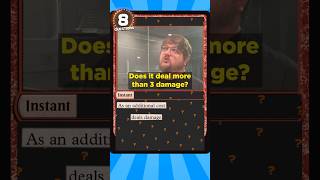
- Damage scales with sacrificed creature's power, enabling dynamic removal
- Can target any creature or player, offering versatility
- Low mana value (two or less) increases playability in aggressive decks
- Instant speed (if applicable) allows surprise plays
- Requires sacrificing a creature, which can punish a fragile board
- Lacks inherent card draw or advantage on resolution
- Damages only a single target, not multiple threats
- Effectiveness depends on having a creature to sacrifice; poor synergy without creatures
- Sacrifice to unleash damage
- Fantasy world with magical duels; typical MTG planes
- Mechanics-driven card text enabling dramatic turns
Mechanics (from transcript analysis)
- Combat: Damage Based — Damage dealt scales with the sacrificed creature's power and can be directed at any target (creature or player)
- Damage equals sacrificed creature's power to a valid target — Damage dealt scales with the sacrificed creature's power and can be directed at any target (creature or player)
- Sacrifice a creature as an additional cost to cast — You must sacrifice a creature to cast Fling, representing a cost that trades board presence for a potentially powerful direct-damage outcome
Video topics + discussion points
Quotes (from this video)
- Your card is a red instinct.
- Does it deal damage?
- It can sometimes.
- It's fling.
- You got it.