/pic1783744.jpg)
1870 – Somewhere deep in Texas, the rearing of Longhorn cattle from northern Mexico is booming. It has now become a major source of income for the Texan farmers, while at the same time attracting cattle thieves of all kinds.
In Longhorn, the players assume the roles of two particularly feared outlaws: Eagle Perkins and Jessie Artist Byrd. The aim of the game is simple: to steal cattle (and a few gold nuggets, if possible) to see who can amass the most money by the end of the game — or who can get his opponent arrested by the sheriff!
The game is set up by shuffling the 9 locations and setting them up in a 3x3 grid, selecting 9 tokens randomly and assigning one to each location (if the sheriff token is in play, it must be placed on Nugget Hill), and finally randomly distributing the coloured longhorn cattle meeples to each location, with the number required being shown on each location. The start player then chooses a location with 4 cattle and places the player piece in it.
The game ends in one of three ways:
- If a player takes the sheriff token, they lose immediately
- If a player takes all 9 cattle of any one colour, they win immediately (if they did both in the same turn, they lose)
- If no legal move can be made, the players score; gold nugget tokens are worth their face value and each colour of longhorn is worth $100 for each cow of the same colour still on the board. For example, if the Perkins player has 4 black cattle and 5 are left on the board, each of his 4 black longhorns are worth $500. If there are no black cattle (because the Byrd player has them, or through drought) then they are worth nothing. The player with the highet total wins.
On a players turn, they choose a colour of longhorn present in their location and steal all of that colour. For each longhorn stolen, the player moves the player piece that many spaces and then flips it, to signify that it is now the other player's turn.
If a location is cleared of longhorn cattle, the player who took the last longhorn must take the token present and activate it. Some are positive and some are negative. Once a space is cleared, it can not be moved to in a future turn, though it can be moved through.
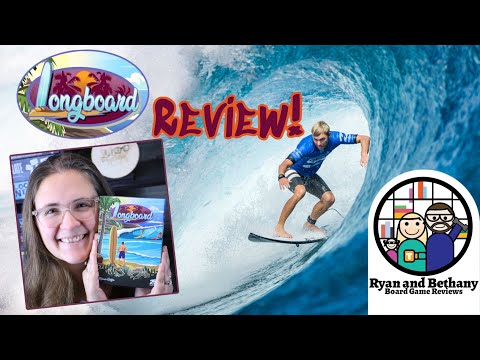
Longboard Review!
- surfboard shaping
- beach
Mechanics (from transcript analysis)
- Drafting — Players draft and trade surfboard pieces to build the tallest and stockpile the most surfboards.
- Trading — Players draft and trade surfboard pieces to build the tallest and stockpile the most surfboards.
Video topics + discussion points
Quotes (from this video)
- i've got a soft spot for the ridiculousness and stress that this game provides
- if you remember this film then boy does this hit hard in the nostalgia
- if it's a new game with kenitsia's name on it i'm probably gonna try it
- that's the news to continue your journey with us this one is all about the best ball game in awards and other burning ball game questions spoiler though they are only figuratively on fire
References (from this video)

Mechanics (from transcript analysis)
- Mancala — Described as a precursor to Five Tribes and having a Mancala mechanism.
Video topics + discussion points
Quotes (from this video)
- what mechanism isn't used enough what game mechanism what thing in the game do you really like that you think is awesome that isn't in enough games you just think why why aren't we why aren't we always doing this
- I love that mechanism there's a 167 games on Board Game Geek that list Mancala as a mechanism
- Mancala is the mechanism that is not used enough
- it's a doozy because it's one of your favorite games that you should hate one of those games that you think I love that game it's great but it does defy every part of my taste and everything about myself that I've known for the last however many years I've been on this Earth
- really really heavy Euros where it's like oh let's do this thing well you've got to trudge through a massive rule book and there's 65 million things to remember and learn
- really heavily story driven games I find it to be a lot of work you know I just have to read the whole paragraph now and I don't want to read a paragraph when I play a board game
- those surprises are very satisfying and a lot of fun to find out
- what are the games that you have to buy into to enjoy what he meant by that are what are the games that you really have to invest into what you're doing to actually enjoy the game
- when people are stood up excited want to win trying their best really invest in the game it's phenomenal Stand Out Stellar exciting fun
- those type of things really investing in the experience and that got us all riled up they'll get everyone playing excited and anxious and nervous
- I think games are better when people invest in them
References (from this video)
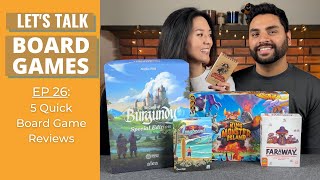
- Light and simple gameplay
- Good for conventions or quick filler
- Introduces trading mechanic
- Completed surfboards score positive points
- Not a long-term keeper for some
- Wish it was more punishing like Lost Cities
- Some decisions feel less meaningful
- Theme did not strongly resonate with one reviewer
- Surfing
- Lost Cities
Mechanics (from transcript analysis)
- action selection — Players take two actions per turn from options like adding to their supply, playing a card to build a surfboard, or trading with opponents.
- Objective Cards — Public objective cards provide additional scoring opportunities at the end of the game.
- Set Collection — Scoring is based on the number of stickers on cards within a completed surfboard.
- Tableau Building — Players build surfboards by playing cards of the same color and equal or higher value.
- Trading — Players can trade cards from their supply with opponents, who cannot deny the trade.
Video topics + discussion points
Quotes (from this video)
- we do hope to get uh going with reviews again soon
- this is the castles of burgundy special edition
- for anybody who missed the last campaign and were really interested in the special edition then it is available on game found
- it is beautiful um they they did a really really good job with the component quality
- I do appreciate something like this but I am an old timely homely kind of guy
- there are different uh communities or populations of people that are sort of at odds in terms of this sort of uh game grandios Grand yeah gr grandiosity is that a word
- the dice that we discussed are way easier to read
- it is absolutely gorgeous uh but definitely deluxified
- king of monster island
- so if you're familiar with King of Tokyo this game features a lot of the same mechanics except instead of a sort of of a competitive battler game you have a fully Cooperative game
- after turn after turn after turn it got it felt a little exhausting doing that over and over again
- this game is definitely a bump up or two in complexity as compared to King of Tokyo
- it's just not as simple as King of Tokyo which you know I enjoyed that world for its simplicity
- faraway
- technically a uh drafting Tableau building game where the game is played over the course of eight rounds
- it becomes like a like a a crunch of like do I just want to get a lot of points like in the first three rounds that I that I played out or can I actually make something work out where I can just perfectly get everything uh in synergies
- for you know for a game like this it is very simple but it's really neat I haven't played a game that has required me to think this way or plann this way yet in a 20-minute package
- longboard
- this is a card game where players are building surfboards surf theme game
- it does sort of remind me of like a more casual version of L cities I wish it was a little bit more punishing
- this one is a lot more casual than I think I would have liked
- paper app dungeon
- it's a very interesting concept actually the way that the game works is it comes with this pencil and the pencil is your writing utensil but it is also the die that you're going to be using in order to move around this dungeon
- this is more of like a travel companion or people who just enjoy an activity on the bus or like at the airport because it's very very casual
- there is no real like benchmark Mark to know how well you're doing it's more of just like a casual activity like just go explore this dungeon and try to get as much money as you can
- those are some of the games that we have been playing recently
References (from this video)

- Nice two-player game
- Good back and forth gameplay
- Moving steers
Mechanics (from transcript analysis)
- action selection — picking the right action
Video topics + discussion points
Quotes (from this video)
- I know it has its own little like um uh you know sub cult of people who enjoy it.
- I don't particularly like it because I think it has a very strong rich get richer.
- If you start winning an Outpost you were going to continue winning because if your engine gets going faster than mine there's not much I can do about it.
- But yeah this one does not This one is one I wanted to like a lot more than I did.
- it's a good back and forth two-player game.
- I like the theme of it a lot. Seems like most music games I play aren't very good.
- I I find this one amusing.
- It almost feels like you could play it randomly and have the same amount of fun, but it's a nice way to pass some time.
- It's a great little filler.
- I don't think a lot of people have played this one.
- It was replaced by Nobody is Perfect, too, because they didn't get it right the first time.
- This is what a lot of people were talking about.
- It was one of those games that I saw a little bit of buzz and I was like, "Ooh, I'll have to play that sometime." and then never heard anything else about it.
- I think that's just a really solid two-player game from Catalia.
References (from this video)

- Easy to learn and play
- Relaxing, not brain-burning
- Interactive with opportunities to disrupt opponents
- Aesthetically pleasing with thematic components
- Multiple viable strategies via objectives
- Objective cards can feel unbalanced or underwhelming
- It's possible to win without completing objectives, which can reduce tension
- Might not be ideal for larger game-night crowds looking for heavier games
- Building and shaping long surfboards to maximize points via sponsorships and objectives
- Surfing/beach setting with longboards and sponsorships
- Light, thematic flavor centered on surfing culture and competition
- Lost Cities
Mechanics (from transcript analysis)
- Card Drafting — Draw cards to supply and then use them to build surfboards; manage available cards to advance boards
- card drafting / hand management — Draw cards to supply and then use them to build surfboards; manage available cards to advance boards
- Card swapping / take from others — You can swap or steal cards by giving opponents higher-valued cards to take their card
- Compound Scoring — Public objective cards provide points; shaping boards and sponsorship stickers influence scoring
- Endgame trigger by board shaping / deck depletion — The game ends when a certain number of boards are shaped or the draw deck runs out
- Overpay to take a card — You can pay more than the value of a card to take it from another player
- Sequential placement with increasing values — When placing cards on a board, you must start with a low number and can only add cards of equal or higher value
- Sticker-based scoring and penalties — Sponsorship stickers contribute points; unshaped boards reduce points
- Variable/objective scoring — Public objective cards provide points; shaping boards and sponsorship stickers influence scoring
Video topics + discussion points
Quotes (from this video)
- longboard not short board
- Lost Cities is a super super classic
- this is a great game after work
References (from this video)
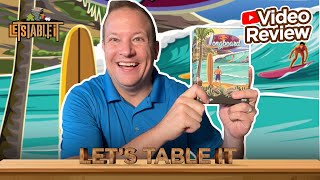
- Fast playtime (under 30 minutes)
- Multiple viable scoring paths (boards, length, stickers)
- Engaging player interaction through card stealing and counterplay
- Clear end scoring with strategic depth
- Some variability from card draws and steals
- Initial rule learning curve
- Endgame can feel abrupt depending on player count
- Building longboards by composing cards to form boards, with scoring based on boards and stickers
- Beach environment / surf shop vibe
- Rule-focused overview with strategic critique
- Lost City
Mechanics (from transcript analysis)
- Action economy — On a turn, a player takes two actions, which can be used in any combination or duplicated
- Board creation / extension — Start new boards or extend existing boards by placing cards from your supply; cards placed must be the same color
- board progression — As you build, each card must be equal to or greater than the previous card beneath it; cards overlap to show values
- Card swapping / stealing — You can swap a card from another player's supply, but you must give them cards totaling a higher value and then use the new card to start or extend a board
- Color rules / wilds — Cards placed on boards must match color; multicolored cards are wild and can be used for any board
- Compound Scoring — Scores are determined by boards, the number of stickers, the longest board, and objective cards
- Deck draw / supply management — Draw cards to increase your supply and plan builds
- Deck Manipulation — Draw cards to increase your supply and plan builds
- End Game Bonuses — End the game when a player meets end conditions based on number of shaped boards and seven-card boards, with variations by player count
- endgame conditions — End the game when a player meets end conditions based on number of shaped boards and seven-card boards, with variations by player count
- Objective Cards — Four random objective cards set end-scoring goals
- scoring — Scores are determined by boards, the number of stickers, the longest board, and objective cards
- Starting a board with constraints — When starting a new board, you cannot start with a wild; boards can be multiple of the same color
- Variable Set-Up: Board — When starting a new board, you cannot start with a wild; boards can be multiple of the same color
Video topics + discussion points
Quotes (from this video)
- now this is a great and fun strategic car game that has a definite feel of a kitzia game
- it reminds me a little bit of Lost City but this one plays up to four players instead of the two
- cards are played upwards partially overlapping the earlier cards and showing off each card's shown value
- the game is pretty good and can be played quickly lots of choices to make
References (from this video)
Mechanics (from transcript analysis)
- tile/draft-like drafting — a strategic drafting mechanic centered around constructing a layout and scoring opportunities
Video topics + discussion points
Quotes (from this video)
- I am a crazy board game gal
- we are going to Mexico for like a Christmas vacation
- I am so, so excited to play all these
- I would love to know other ones for us to pick up and try
References (from this video)
- precursor to Five Tribes; tight, strategic and compact
- cow colors, end-game scoring based on remaining cows
- cow-herding/managing cattle with a Five Tribes lineage
- abstract strategic with direct comparison to Five Tribes
- Five Tribes
- Tavern
Mechanics (from transcript analysis)
- area influence via resource collection — players move to collect cows and manage end-game scoring by cows left on board
Video topics + discussion points
Quotes (from this video)
- the twist to this game is you don't get to score your trees unless you have more of the values of those trees in your hand than your opponent
- it's basically six little miniature games that you're playing
- one of those games where you're thinking two, three, four turns ahead
- it's a better version of Ticket to Ride
- the dice work, replacement; one of my favorite Felds