/pic4007841.jpg)
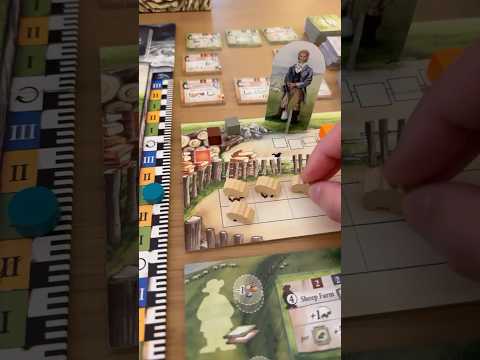










Lowlands Deep Dive
What the Community Thinks About Lowlands
Reviewers who cover Lowlands land in the same place: it is a Rosenberg-flavored farming Euro that adds one distinctive twist, the shared dyke, and that twist is what earns the game its attention. The Board Gaming Doctor frames it as gameplay that repeatedly reminds players of Agricola but with an interactivity that most medium-weight Euros lack, since every player has to keep an eye on how much they, and everyone else, are contributing to the shared flood defense. Stonemaier Games' podcast on formative game design, featuring designer Connie Vogelmann, singles out Lowlands for a different reason: the way its sheep economy works is a near-mirror of Agricola's feeding puzzle but produces the opposite emotional response at the table. Before You Play placed Lowlands at number thirty-six on a top fifty countdown, praising the balance between building a farm and propping up the community dyke.
Where the takes diverge is on staying power. The Board Gaming Doctor is enthusiastic after a handful of plays but flags that decisions started to feel straightforward and that the pool of building tiles ran thin by the third play at three players. Before You Play, by contrast, ranks the game highly enough to place it among an all-time top fifty list, suggesting the dyke tension and farm balance kept delivering for that channel over repeated sessions. Both channels agree the game is designed by Claudia and Ralph Partenheimer, and both note the strong Uwe Rosenberg fingerprints in the tile purchasing and animal husbandry, with Stonemaier Games adding that Rosenberg directly consulted on the design. Before You Play also credits the game to Z-Man Games.
Core Mechanics That Define Lowlands
Worker Placement and the Resource Card Economy
Turns are taken through worker placement and tableau building. According to The Board Gaming Doctor, placement runs on an action point system where the strength of the worker placed determines how many times a player can take that action, or what level of building they are able to construct. The game hinges on three resource types, wood, clay, and stone, which arrive as cards rather than tokens. Players draw them to hand by taking a dedicated action or by collecting them during income phases, then spend them to build fences that hold sheep, to raise buildings, or to advance the shared dyke. Before You Play describes the same system from a different angle, noting the tile laying where players purchase tiles using resources and place them on their own board, calling it very Rosenberg in feel, alongside the sheep-breeding side of the tableau.
The Dyke: A Semi-Cooperative Pressure Valve
The mechanic every reviewer returns to is the dyke. The Board Gaming Doctor explains that only one type of resource can be contributed to the dyke at a time, so a player hopes to be holding the right card when their turn comes around, since contributing advances the dyke track and earns bonuses along the way. Whoever falls behind on the track risks having sheep washed away at game end, and intermediate phases during play hand out penalties to whoever is lagging when the water is assessed. Before You Play adds a detail that makes the cooperation explicit rather than incidental: anytime a player contributes to the dyke, they must ask an opponent whether that opponent also wants to contribute, so a single action can pull other players into the shared effort. Stonemaier Games' Connie Vogelmann ties the same pressure to the sheep economy itself, since sheep breed exponentially, with every two sheep at the end of a round producing another, and a farm with no room left for a new sheep simply loses it.
The Lowlands Experience
Balancing the Farm Against the Flood
The Board Gaming Doctor's own account of a recent game captures the tension the design is built around: early turns went into working the farm and building up a personal tableau while other players focused on the dyke, and by the final couple of turns it became clear that the dyke needed help and that falling behind on that track would cost a lot of points if the sheep were washed away. That kind of late realization, and the scramble to fix it, is presented as the game's signature arc. Before You Play describes the same dynamic as a dichotomy between building up points on a personal board and protecting that board from the flood, where overcontributing to the dyke lets everyone else benefit for free, but undercontributing risks losing everything when the water comes in.
A Different Kind of Tension Than Its Influences
Connie Vogelmann frames the feel of Lowlands as the inverse of Agricola's harshest moments. Where failing to feed a family in Agricola means real point loss while everyone else sits at zero, failing to contain sheep in Lowlands means a player is stuck at zero while opponents who managed their farms are sitting on several extra sheep. Vogelmann describes the underlying math as close to the same puzzle, but says the feeling at the table is almost entirely opposite, since missing out on a bonus in Lowlands reads as a minor letdown rather than a catastrophe. The Board Gaming Doctor calls the twists and turns of a full game exhilarating, both at the finish and throughout, and says the arc it tells stuck with them well after the session ended.
What Makes Lowlands Stand Out
Interactivity That Most Medium-Weight Euros Skip
The Board Gaming Doctor's central praise is that the dyke gives Lowlands an interactive core that most games in its weight class do not attempt, since Euro games in this range have increasingly become, as the review puts it, a multiplayer solitaire experience. Because contributing to the dyke pulls other players into a decision on their turn, the review notes that outcomes and the overall journey change depending on who is at the table, which keeps individual sessions from feeling identical even when the mechanics stay the same.
A Reversed Take on a Familiar Animal Husbandry Puzzle
Connie Vogelmann highlights how Lowlands takes the animal-breeding math that Uwe Rosenberg is known for and flips its emotional weight. Vogelmann also connects the design to Aviary, noting that Aviary is a giving game where players are never forced to feed anyone but still face real consequences for playing inefficiently, and argues Lowlands lands in a similar space of consequence without harsh punishment. The Board Gaming Doctor's list of community praise adds that every game of Lowlands feels distinct because of the mix of building tiles that come out and because the players at the table shape whether the dyke gets built at all.
Potential Drawbacks
Randomness in the Resource Cards
The Board Gaming Doctor flags the resource card system as the game's clearest source of frustration. Cards are drawn randomly during income phases and pulled from a market of four during a dedicated draw action, so a player can be left without the one resource type the dyke currently needs, or without what a fence or building requires, purely on the draw. Since the dyke accepts only one resource type at a time, that randomness can directly affect endgame timing and how much a player is able to contribute when it matters most.
Straightforward Decisions and Fading Variety
The same review reports that community feedback on the design skews toward it feeling a little too straightforward, without room for the big combos some players want from their turn, and that the game became repetitive for some once the goal of building the dyke and gathering sheep became familiar. The reviewer's own experience echoed this at three players, where most of the available building tiles were seen well before the game ended, leaving less of the surprise that keeps a Rosenberg-style tile pool feeling fresh from session to session.
If You Enjoy Lowlands
The Board Gaming Doctor points players toward Agricola first, calling it the clearest influence on the theme, resource cards, worker placement, and tableau building in Lowlands. The same review also recommends Glass Road for a similar playtime and weight, and Earth for its comparable simultaneous, semi-cooperative feel where one player's action can trigger a cascade that benefits the table. Stonemaier Games' Connie Vogelmann draws a direct line to Aviary as well, describing it as a giving game that still carries real consequences for inefficient play, much like the dyke system in Lowlands.
What Reviewers Are Saying
"Each game feels different because of the different building tiles that come out, but also, as I mentioned before, the over the table element with who you play with, you know, depending on the players that you know and play with, from game to game the outcome and the journey may be different as you play and contribute to the Dyke or not, and so that element is very refreshing among Euro style games."
— The Board Gaming Doctor
"In Lowlands you have sheep and your sheep farmers, and there's this whole sort of dyke building mechanism that's a very interesting semi-co-op puzzle that's this entirely different. But the core part of the game with the sheep is that your sheep grow exponentially. Every two sheep you have at the end of every round produce another sheep."
— Stonemaier Games
"Then everybody else is just going to run wild, and you just protected everybody and now they're just going to benefit off of what you've done. But if you don't start building up your farm and everybody else just kind of lets the dam go and you haven't contributed to it, then because you are the person who contributed the least amount, your stuff is going to get wiped out and you get negative points."
— Before You Play