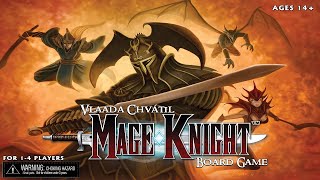
Mage Knight Board Game box art

Mage Knight Board Game

Game ID: GID0197934
Collection Status
Description

The Mage Knight board game puts you in control of one of four powerful Mage Knights as you explore (and conquer) a corner of the Mage Knight universe under the control of the Atlantean Empire. Build your army, fill your deck with powerful spells and actions, explore caves and dungeons, and eventually conquer powerful cities controlled by this once-great faction! In competitive scenarios, opposing players may be powerful allies, but only one will be able to claim the land as their own. In cooperative scenarios, the players win or lose as a group. Solo rules are also included.

Combining elements of RPGs, deck-building, and traditional board games the Mage Knight board game captures the rich history of the Mage Knight universe in a self-contained gaming experience.

Year Published
2011
Transcript Analysis
Browse transcript mentions, sentiments, pros/cons, mechanics, topics, quotes, and references.
Total mentions: 12
This page: 12
Sentiment: pos 10 · mix 1 · neu 0 · neg 0
Mentions per page
Top
Showing 1–12 of 12
Video yX5LIG4oEZM Allies or Enemies top_5_list at 3:33 sentiment: positive
video_pk 61038 · mention_pk 153447
Allies or Enemies - Mage Knight Board Game video thumbnail
Click to watch at 3:33 · YouTube ↗
Overall sentiment (raw)
positive
Pros
  • Enormous sandbox with diverse mage playstyles
  • Expansions add depth and variety
  • Rich thematic feel
Cons
  • Very steep learning curve
  • Rulebook is dense with few examples
Thematic elements
  • Open-ended, sandbox-style adventure with heavy tactical puzzle
  • Fantasy world with mages and temples
  • Array
Comparison games
  • Mage Knight: Ultimate Edition
Mechanics (from transcript analysis)
  • Card-driven actions / hand management — Players plan and execute actions via a deck that represents abilities and movement
  • Modular board — Tiles form a large, exploratory map where players navigate and develop their capabilities
  • Modular map / temple exploration — Tiles form a large, exploratory map where players navigate and develop their capabilities
Video topics + discussion points
No key topics recorded for this video.
Quotes (from this video)
  • the solo mode is so simple, but works so well.
  • It is amazing because the bot actually makes sensible decisions.
  • the puzzle in all the different puzzles because every spirit that you use is just such a different puzzle.
  • It is so much randomness. It is so much randomness. But it is surprisingly interesting and surprisingly a really like emergent narrative from a game that's really just random dice rolling.
References (from this video)
No references stored for this video.
Video m5muFUayl4Q analysis at 0:00 sentiment: positive
video_pk 60544 · mention_pk 152924
Mage Knight Board Game video thumbnail
Click to watch at 0:00 · YouTube ↗
Overall sentiment (raw)
positive
Pros
  • engaging, puzzle-driven hand management where each draw creates meaningful decisions
  • satisfying progression from zero to hero as upgrades unlock new capabilities
  • cooperative play aligns with puzzle-solving aspects and enhances group dynamic
  • varied finale options (cities or bosses) depending on play mode, providing replayability
Cons
  • notoriously complex and unforgiving; mastery requires time and dedication
  • potential for stalling if a hand dramatically lacks movement or key actions
  • heavy setup and potentially long playtime may deter casual players
  • steep learning curve around optimizing deck-building and encounter strategies
Thematic elements
  • heroic progression through deck-building and personal upgrades, culminating in a climactic finale
  • Fantasy world with cities and dungeons explored via a modular map during a single-session playthrough
  • episodic, finale-driven structure with boss encounters; heavy emphasis on cooperative puzzle-solving
Comparison games
none
Mechanics (from transcript analysis)
  • Area movement — Players move across a map to reach encounters, resources, and objectives, with freedom to choose paths
  • Character progression / leveling up — Progression between encounters or sessions unlocks new cards and powers, driving a sense of growth from zero to hero
  • combat / monster encounters / boss battles — Engagements with monsters and bosses require strategic planning and resource management to prevail
  • Cooperative Game — Two-player cooperative mode is highlighted as a preferred method, allowing players to collaborate on puzzles and plans
  • cooperative play — Two-player cooperative mode is highlighted as a preferred method, allowing players to collaborate on puzzles and plans
  • Deck building — Players draw from a personal deck and add new cards to shape actions, enabling strategic synergies and combos
  • deck-building — Players draw from a personal deck and add new cards to shape actions, enabling strategic synergies and combos
  • exploration / map movement — Players move across a map to reach encounters, resources, and objectives, with freedom to choose paths
  • hand management — Players must manage a hand of cards, balancing movement, attack, and defense while facing luck of the draw
  • hand management / action selection — Players must manage a hand of cards, balancing movement, attack, and defense while facing luck of the draw
Video topics + discussion points
No key topics recorded for this video.
Quotes (from this video)
  • And Mage Knight is a game that probably is the closest I've seen in a board game.
  • the puzzle of this game in every hand is just so interesting.
  • cooperative which I would be our favorite way to play
  • it's going to be one of the cities or what a boss depending on what play mode you're doing.
  • going off and leveling up but ultimately coming back together to try finale
References (from this video)
No references stored for this video.
Video FGrjuy0TT1M Rolls in the Family top_10_list at 51:30
video_pk 60545 · mention_pk 152932
Rolls in the Family - Mage Knight Board Game video thumbnail
Click to watch at 51:30 · YouTube ↗
Pros
none
Cons
none
Thematic elements
Comparison games
none
Mechanics (from transcript analysis)
Mechanics unknown.
Video topics + discussion points
No key topics recorded for this video.
Quotes (from this video)
  • you can be the most unlike unlikable person, but if you can just get one person to agree to play with you.
  • you get to play both roles within a session.
  • this is one of the most playable games I think on our list here in terms of just you could play this a 100 times and still be seeing situations you haven't seen before.
  • not an easy game to learn.
References (from this video)
No references stored for this video.
Video _fPcKJePTaE Pair of Dice Paradise top_10_list at 5:36 sentiment: positive
video_pk 32980 · mention_pk 97778
Pair of Dice Paradise - Mage Knight Board Game video thumbnail
Click to watch at 5:36 · YouTube ↗
Overall sentiment (raw)
positive
Pros
  • deep tactical combat and rich spells
  • great for players who want a large fantasy quest
Cons
  • heavy, long play sessions
  • older components and rule complexity
Thematic elements
  • heroic exploration, spellcasting, and tactical combat
  • Dungeon-crawling fantasy adventures
  • epic, modular scenarios with solo/coop and competitive play
Comparison games
  • Descent: Journeys in the Dark
  • Gloomhaven
Mechanics (from transcript analysis)
  • combat resolution — tactical combat with various spell and ability interactions
  • Cooperative Game — players cooperate to defeat dungeon/quest objectives
  • cooperative play / solo modes — players cooperate to defeat dungeon/quest objectives
  • Deck building — characters build customized decks for actions
  • deck-building — characters build customized decks for actions
Video topics + discussion points
No key topics recorded for this video.
Quotes (from this video)
  • I've been Chaz Marlar from Pair of Dice Paradise.
  • This expansion funded in 20 minutes and raised 23 times the amount of its funding goal.
  • the King's dilemma by a horrible guilt in this interactive narrative and legacy experience
  • gaining a hundred and thirty-six spots to crown this month's biggest climber
References (from this video)
No references stored for this video.
Video lPnnbDjhn2U Rolls in the Family top_10_list at 52:33 sentiment: positive
video_pk 31638 · mention_pk 148174
Rolls in the Family - Mage Knight Board Game video thumbnail
Click to watch at 52:33 · YouTube ↗
Overall sentiment (raw)
positive
Pros
  • deep progression, highly interactive combat, satisfying arc
Cons
  • rulebook is dense, steep learning curve
Thematic elements
  • deck-driven tactical heroism with sprawling maps
  • fantasy realm with ongoing quests and missions
  • epic, modular questing with a strong story feel
Comparison games
  • Gloomhaven
  • Descent: Journeys in the Dark
Mechanics (from transcript analysis)
  • cooperative campaign potential — primarily experienced as cooperative rather than competitive
  • deck-building with both top and bottom card actions — choose two cards and decide order to resolve actions
  • extended playtime, tactical combat — long, involved sessions with epic battles and progression
Video topics + discussion points
No key topics recorded for this video.
Quotes (from this video)
  • the narrative it does ends up being a fun experience
  • it's the story. there's almost I find when I'm playing it and horrible things are happening
  • through the ages... a grand historical journey
  • epic and full-day experience
  • you can draft up to your point level and duke it out to the end
References (from this video)
No references stored for this video.
Video 1DyJgDiOs_A Weekly Alaboom general_discussion at 1:10:48 sentiment: mixed
video_pk 28762 · mention_pk 151848
Weekly Alaboom - Mage Knight Board Game video thumbnail
Click to watch at 1:10:48 · YouTube ↗
Overall sentiment (raw)
mixed
Pros
  • deep tactical depth
  • rich system and enduring appeal for fans of fantasy combat
Cons
  • steep learning curve
  • rule clarity can be challenging for new players
Thematic elements
  • epic conquest and exploration
  • fantasy realm with wizards and knights
  • sandbox/arena-style campaign potential
Comparison games
  • Gloomhaven
  • Love Letter
Mechanics (from transcript analysis)
  • action selection — players use cards to perform a sequence of actions each turn.
  • boss battler — control multiple heroes and adversaries with distinct abilities.
  • Combat: Damage Based — combat occurs on a tactical map with movement and range.
  • Deck building — players construct and optimize decks to perform actions.
  • deck-building — players construct and optimize decks to perform actions.
  • grid-based combat — combat occurs on a tactical map with movement and range.
  • hero/monster management — control multiple heroes and adversaries with distinct abilities.
Video topics + discussion points
No key topics recorded for this video.
Quotes (from this video)
  • Voter disenfranchisement is alive and well in Texas.
  • Rules are rules.
  • The world sucks.
  • Disenfranchisement... yes.
  • It's weird to stand in lines when the system could be digital.
  • New additions of Love Letter and base Love Letter.
References (from this video)
No references stored for this video.
Video 82hSP5N2z80 Barron playthrough at 0:00 sentiment: positive
video_pk 13638 · mention_pk 144283
Barron - Mage Knight Board Game video thumbnail
Click to watch at 0:00 · YouTube ↗
Overall sentiment (raw)
positive
Pros
  • Rich, crunchy tactical decisions with deep engine interaction
  • Strong solo play loop with a reliable artificial opponent
  • Immersive thematic components and 3D terrain elements
  • Modular map and dynamic dungeon/tower encounters
  • Flexible strategy with many card synergies
Cons
  • Very high complexity and long setup time
  • Steep learning curve for newcomers
  • Rulebook dense; requires careful study to play smoothly
  • Can be lengthy in solo games, potentially challenging pacing
  • Component management can be fiddly
Thematic elements
  • Magic, conquest, territory control, and heroic mage-quests.
  • Fantasy medieval world with mage knights exploring a modular map to conquer cities and monasteries.
  • Emergent story driven by card play, AI timer, and modular tiles.
Comparison games
  • One Stop Co-Op Shop Mage Knight content
  • Other videos by Ricky Roy and Liz Davidson
Mechanics (from transcript analysis)
  • combat and siege — attack vs defense with options for range or melee; some enemies require siege to defeat.
  • dummy opponent / timer — the dummy player acts as a timed opposition, discarding cards to accelerate its turns, affecting pacing.
  • fame and influence tracks — gaining fame increases unit recruitment; influence enables recruitment and special actions.
  • hand management — players select and execute action cards, spells, and units from a hand, discarding and drawing per turn.
  • Influence Points — gaining fame increases unit recruitment; influence enables recruitment and special actions.
  • Mana and crystals — mana dice produce color-specific crystals used to power actions, spells, and movements.
  • monasteries and units — monasteries provide access to advanced units and tactics; recruitment costs depend on reputation.
  • Movement and terrain costs — movement costs vary by terrain and time of day; certain tiles restrict or favor movement.
  • Movement points — movement costs vary by terrain and time of day; certain tiles restrict or favor movement.
  • night/day phase and dungeon/monument exploration — the board shifts with day/night phases, including ancient ruins and towers with unique rewards.
Video topics + discussion points
No key topics recorded for this video.
Quotes (from this video)
  • this is regarded as one of the greatest solo experiences out there
  • this is going to be super fun
  • we're going to be doing a solo conquest
  • i'm super excited to bring this game to you
References (from this video)
No references stored for this video.
Video yQHJqZD05Ek Unknown Channel playthrough at 0:05 sentiment: positive
video_pk 12640 · mention_pk 36899
Unknown Channel - Mage Knight Board Game video thumbnail
Click to watch at 0:05 · YouTube ↗
Overall sentiment (raw)
positive
Pros
  • Deep, layered tactical decision-making that rewards long-term planning and precise resource management.
  • Rich, evocative fantasy setting with meaningful progression through upgrades, tiles, and encounters.
  • High replay potential thanks to modular maps, varied encounters, and scalable difficulty through scenario design.
Cons
  • Steep learning curve and dense rule set that can intimidate newcomers or players new to cooperative/solitaire-style planning.
  • Downtime can grow in multiplayer, especially as player turns become complex and halo effects from cards take longer to resolve.
  • Reliance on scenario setup accuracy and token placement can lead to mistakes that disrupt balance or early momentum if not careful.
Thematic elements
  • Heroic conquest and exploration within a dark, mythic world where strategic planning, resource management, and battlefield tactics determine the fate of cities and realms.
  • A sprawling fantasy realm of knights, sorcery, and ancient ruins where players explore modular tiles, recruit forces, and confront a rising peril across a contested landscape.
  • Scenario-driven campaign with branching outcomes, where each tile reveal and encounter shapes long-term progress, reputation, and power balance.
Comparison games
none
Mechanics (from transcript analysis)
  • Action selection & hand management — Players organize their turns around a hand of action cards that combine with mana management to drive movement, combat, recruitment, and exploration. Card timing and ordering are central, and mismanaging hand size or timing can slow a player's momentum.
  • Combat resolution with modifiers — Engagements hinge on attack, defense, armor, and special abilities. Ranged and melee interactions can be swapped under certain conditions, and modifiers from items, terrain, or spells tilt the balance.
  • Event-driven encounters and dummy players — Encounter decks and dummy opponents simulate pressure and balance. Choices about card draws and dealer-driven events shape the pace and difficulty of the challenge.
  • hand management — Players organize their turns around a hand of action cards that combine with mana management to drive movement, combat, recruitment, and exploration. Card timing and ordering are central, and mismanaging hand size or timing can slow a player's momentum.
  • Mana economy & dice-based effects — Mana from sources fuels actions and spell-like effects. Dice-derived outcomes influence attack power, defense, and special actions, creating a dynamic swing in fights and encounters.
  • Modular board — The board is built from variable tiles representing terrain, cities, and dungeons. Exploration reveals new options, unlocks upgrades, and introduces risk as players encounter rampaging enemies and unique threats.
  • Modular map exploration — The board is built from variable tiles representing terrain, cities, and dungeons. Exploration reveals new options, unlocks upgrades, and introduces risk as players encounter rampaging enemies and unique threats.
  • resource and token management — Various resources (mana, blue/green/red crystals, faction tokens) and terrain-specific bonuses influence turn efficiency, card drafting, and the ability to sustain upgrades over the course of a campaign.
  • Resource management — Various resources (mana, blue/green/red crystals, faction tokens) and terrain-specific bonuses influence turn efficiency, card drafting, and the ability to sustain upgrades over the course of a campaign.
  • Scenario-driven objectives and reputation — Reputation and tile-based objectives guide strategic choices. Some actions risk reputation loss, while others unlock new capabilities or access to stronger units and locations.
  • Unit recruitment and upgrade paths — Players recruit Guardsmen, peasants, and other units, collect reputation, and upgrade units with items or armor to improve survivability and capability on subsequent turns.
Video topics + discussion points
No key topics recorded for this video.
Quotes (from this video)
  • we've explored a heck of a lot of territory
  • we've found the green city I'm thinking about either pushing through to this monastery
  • but who said major Knight was supposed to be easy
  • let's hire some peasants I can always get rid of them later if I don't want them
  • okay let's concentrate promised with green mana which gives us the stronger effect plus two that's influenced six
  • this is going to provoke these rampaging enemies to attack
  • we're going to move into this woods which is going to provoke
  • we've got one with the land and lots of attack okay we've got improvisation rage and crystallized
  • there's a dungeon safe space you can end your turn here and then as an action you can delve down into the tomb
  • we're adjacent and we have a shield token their hand size is one high
References (from this video)
No references stored for this video.
Video M_UQqHsYs1Q Books the Lights playthrough at 0:00 sentiment: positive
video_pk 11113 · mention_pk 145574
Books the Lights - Mage Knight Board Game video thumbnail
Click to watch at 0:00 · YouTube ↗
Overall sentiment (raw)
positive
Pros
  • Rich thematic integration with strong tactical decision-making
  • High replayability through varying paths and rewards
  • Engaging solo play or co-op/competitive play
Cons
  • Steep learning curve and heavy rules
  • Long play sessions that can be fatiguing
  • Requires careful management of many components
Thematic elements
  • Strategic planning, resource/hand management, and tactical combat
  • Fantasy medieval world with mage towers, monasteries, dungeons, and monsters
  • In-play narration with tactical decisions
Comparison games
none
Mechanics (from transcript analysis)
  • Character upgrades and recruitment — Acquire upgrades and recruit units or familiars to strengthen your position.
  • combat resolution — Turn-based combat using attack values, special abilities, and elemental effects.
  • Dungeon Crawl — Reveal dungeon tiles and encounter monsters or events; choose routes.
  • Dungeon/tile exploration — Reveal dungeon tiles and encounter monsters or events; choose routes.
  • hand management — Players manage action cards and resources to execute actions.
  • Movement and exploration — Plan and execute movement on a map to explore terrain and reach objectives.
  • Resource management — Collect and spend mana crystals and influence tokens to recruit, upgrade, or cast abilities.
  • Resource/Crystals and mana tokens — Collect and spend mana crystals and influence tokens to recruit, upgrade, or cast abilities.
Video topics + discussion points
No key topics recorded for this video.
Quotes (from this video)
  • this is dreadful if I can take out that dragon that might be a great way to end this night
  • dragon you're out of here
  • wow what a beauty it was costly but worth it
  • that's it great job blue it's gone
  • what a beast it's horrible
References (from this video)
No references stored for this video.
Video GkmJMpRy30E unknown playthrough at 0:16 sentiment: positive
video_pk 6861 · mention_pk 20309
unknown - Mage Knight Board Game video thumbnail
Click to watch at 0:16 · YouTube ↗
Overall sentiment (raw)
positive
Pros
  • Rich, tactical combat with meaningful decisions
  • Deep dungeon exploration and loot progression
  • Strong thematic integration around fame and upgrade cycles
Cons
  • High complexity and long play sessions
  • Wound management can clog hand and slow turns
  • Steep learning curve for new players
Thematic elements
  • Fame and power through exploration and combat
  • Fantasy medieval world with exploration of tiles, monasteries, dungeons, tombs
  • Open-world, campaign-style, dungeon-crawl progression
Comparison games
none
Mechanics (from transcript analysis)
  • combat resolution — Phase-based combat: ranged attack, block, and damage; armor reduces attack strength; wounds gained on unblocked hits.
  • Combat: Damage Based — Phase-based combat: ranged attack, block, and damage; armor reduces attack strength; wounds gained on unblocked hits.
  • Deck building — Gaining artifacts and upgrades through dungeon rewards; some cards become one-time use.
  • Deck-building / loot mechanics — Gaining artifacts and upgrades through dungeon rewards; some cards become one-time use.
  • Dungeon Crawl — Entering dungeons, fighting monsters, obtaining rewards, and triggering dungeon effects.
  • Exploration / dungeon crawling — Entering dungeons, fighting monsters, obtaining rewards, and triggering dungeon effects.
  • hand management — Skill cards form the core actions; players manage a hand, discards, and wounds.
  • Movement and exploration — Mana-driven movement and tile revealing to explore the map.
  • Resource management — Mana, influence, gold, and spell-like effects to recruit, cast spells, and power actions.
Video topics + discussion points
No key topics recorded for this video.
Quotes (from this video)
  • first stage of combat is ranged attack
  • the first thing you do is reduce the attack strength by your armor
  • we've killed this werewolf
  • artifact… one time use so if you use this as kind of like an extra powerful effect it says skip the block and damage assignment
  • this is a dungeon and this is a spawning ground and like the dungeon these are places where you can go and find monsters
  • level five so we take this level token and turn it into a command token
  • we're now on Fame 25
  • the artifact I drew so all right next time I won't going to make the same mistake
References (from this video)
No references stored for this video.
Video cQ-ooH8h0X4 Be On Solitaire top_200_list at 2:50 sentiment: positive
video_pk 3375 · mention_pk 145948
Be On Solitaire - Mage Knight Board Game video thumbnail
Click to watch at 2:50 · YouTube ↗
Overall sentiment (raw)
positive
Pros
  • Iconic solo puzzle with depth
  • Strong thematic fulfillment
Cons
  • Complex rules; steep setup and upkeep
Thematic elements
  • Fantasy dungeon-crawling with heavy optimization
Comparison games
  • Spirit Island
Mechanics (from transcript analysis)
  • Deck building — Players manage powerful cards to perform actions and moves.
  • deck-building / hand management — Players manage powerful cards to perform actions and moves.
  • Solo play with deep optimization — Designed for rich solo experiences with intricate puzzle elements.
Video topics + discussion points
No key topics recorded for this video.
Quotes (from this video)
  • Spirit Island is just so engaging and interesting.
  • Words cannot express how dominant this is.
  • My true love is still Mage Knight… but Spirit Island ate and left no crumbs.
  • The solo gaming community is the best gaming community.
  • Thank you so much to the solo Community; you guys do a great job.
References (from this video)
No references stored for this video.
Video ggehI3ypkP4 Unknown Channel general_discussion at 9:24 sentiment: positive
video_pk 599 · mention_pk 140694
Unknown Channel - Mage Knight Board Game video thumbnail
Click to watch at 9:24 · YouTube ↗
Overall sentiment (raw)
positive
Pros
  • Dense, creative design with unique systems
  • Deep solo play that feels like a personal quest
  • Engaging chaos that remains controllable with planning
Cons
  • Steep learning curve
  • Some will find it overbearing
Thematic elements
  • personal challenge, mastery over chaos
  • fantasy world with exploration and dungeon-crawl elements
  • solo journey with inner dialogue and grand arc
Comparison games
  • Heroes of Might and Magic 3
Mechanics (from transcript analysis)
  • action economy and long-term planning — Plan turns across many moves, optimizing card usage
  • Deck-building and hand management — Build a powerful hand to perform actions efficiently
  • Dungeon Crawl — Face monsters and exploration with strategic decisions
  • puzzle-like combat and exploration — Face monsters and exploration with strategic decisions
Video topics + discussion points
No key topics recorded for this video.
Quotes (from this video)
  • Playing board games alone isn't a compromise. It's not some sad consolation prize. It's its own adventure where you're not just the player, but also the storyteller.
  • The journey itself was enough.
References (from this video)
No references stored for this video.
Transcript Navigation
Top
Showing 1–12 of 12
View on BoardGameGeek