/pic6348973.jpg)
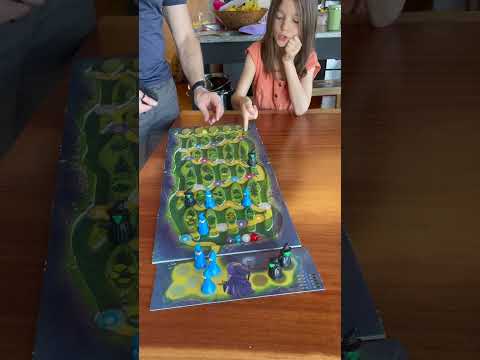
In Magic Mountain, a.k.a. Zauberberg, you want to move the sorcerers' apprentices down the mountain ahead of the witches — but you don't always know how the will-o'-the-wisps will make the figures move.
To set up, place supports on the game board to elevate the starting area, then place six sorcerers' apprentices in the back row and four witches on their designated starting spaces. Add the five colored will-o'-the-wisp marbles to the bag.
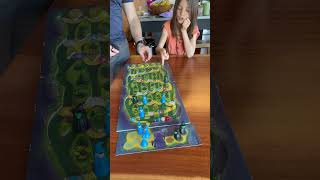
On a turn, draw a will-o'-the-wisp, then place it at the top of one of the six starting channels and let it go. If the will-o'-the-wisp hits a figure, the ball will stop. Pick up this figure and move it to the next open colored space on the winding path that matches the color of the will-o'-the-wisp. If you're moving a sorcerers' apprentice, you might want to do it quickly because if the will-o'-the-wisp hits that same figure, you can move it once again! Don't rush moving the witches, though, since you want them to move as little as possible. If a will-o'-the-wisp doesn't hit any figures, then you must move a witch of your choice to the next matching colored space. Once all five will-o'-the-wisps have been drawn, return them to the bag and start again.
If you manage to move four sorcerers' apprentices to the bottom of the mountain before three witches get there, you win! You can adjust the difficulty of the game by requiring more sorcerers' apprentices or fewer witches or both. Alternatively, you can play the game competitively, with each player or team trying to get their group of four figures down the mountain first.
[Admin note: Magic Mountain is listed for 2-6 players, whereas Zauberberg is listed for 1-4 players, but the gameplay seems identical in both releases.]

- family-friendly; adorable visuals
- kids racing with marble tracks
Mechanics (from transcript analysis)
Video topics + discussion points
Quotes (from this video)
- "this is going to be a really hard list"
- "the cover art is amazing"
- "pop-up book game"
- "it's a game but it's a pop-up book"
- "all new monsters every single one of these monsters has all new wind conditions"
References (from this video)

- will be buying for my niece because she'll love it
- cooperative marble rolling
Mechanics (from transcript analysis)
- Cooperative — a really cool looking cooperative marble rolling game.
- Marble rolling — a really cool looking cooperative marble rolling game.
Video topics + discussion points
Quotes (from this video)
- it's been a massive week of reprints reskins and new additions but it's the same old me hello i'm matthew and welcome to the board game news
- it will straight up kill you yes absolutely yes
- I'm unreasonably excited about this game
- this is what i want in my life
- frodo's cool vest or sean beans in it
- can you believe it wow
- I have no idea what that is is it cool
- all i know is that in the 90s cartoon gambit was the coolest x-man right that on the show had an absolutely banging thing june
- richard garfield's name always gives me confidence but so does reiner kenitzias
- all i can tell you is that dream factory is a brilliant game
- I'm a big fan which is what us fans of katan call ourselves okay
- the expansion looks amazing
- it certainly is contempting like tempting
- the selection process for the shbielda jairus awards is veiled in an almost secret society type mystery
- my guess was savannah park so i was big time wrong
References (from this video)
- Won the 'Spielerpreis' award.
- Mischievous witches
Mechanics (from transcript analysis)
- Marble rolling — Described as a marble rolling game.
Video topics + discussion points
Quotes (from this video)
- you know it just wouldn't be uh every other friday without some board game news
- millennials of mystery not on my watch
- so if you wanted to pick something up then now is a great time to grab a bargain
- i was very excited to see that his previously polish game was getting an english language reimplementation
References (from this video)
- Energetic theme
- Approachable for families
- Limited depth for hardcore gamers
- Not a heavyweight title
- Marble-driven path and witch-themed capture
- Fantasy-fueled family dexterity vibe
- Light, accessible family play
- Don't Llama Dice library
- Other family dexterity fillers
Mechanics (from transcript analysis)
- Dexterity/precision marble play — Family-friendly, fast rounds with simple decisions
Video topics + discussion points
Quotes (from this video)
- Gimmick games can work. A thousand% of a gimmick can carry a game. Period.
- Is this a game? We have a horrible experience with this one.
- The writing keeps it from being a one.
- Lack of FAQ in the documentation, I think, shows the true downfall of the game.
- Worst rule book dot dot dot four dots.
- This game being designed as an incredibly quote unquote inside joke is the only possible explanation I have for why this game was published under his name.
References (from this video)
- Simple rule set
- High quality components
- Engaging and accessible objective for all ages
- Family-friendly and good for teaching basic game concepts
- cooperative fantasy with a rescue mission and chain-reaction dynamics
- A magical mountain path where students are guided downhill as witches race to hinder them, creating a cooperative race against time.
- light, educational, child-friendly with gentle humor and clear objectives
Mechanics (from transcript analysis)
- Chain reactions and cascading effects — A single action can cause multiple units to move or trigger a secondary effect, increasing excitement and replayability.
- Color-coded track movement — Each character advances to the next space whose color matches the color of their current position, creating visual feedback and planning considerations.
- Cooperative Game — All players work together to move a token set down a color-coded track to rescue students and advance the storyline.
- cooperative play — All players work together to move a token set down a color-coded track to rescue students and advance the storyline.
- Engine Building: Triggered/Cascading — Releasing a Will of the Wisp or marble initiates movement or effects that can cascade into chain reactions on subsequent turns.
- Rule simplicity with quality components — Clear, concise rules paired with well-made components facilitate quick onboarding for families.
- Token release and triggering effects — Releasing a Will of the Wisp or marble initiates movement or effects that can cascade into chain reactions on subsequent turns.
- Track Advancement — Each character advances to the next space whose color matches the color of their current position, creating visual feedback and planning considerations.
Video topics + discussion points
Quotes (from this video)
- a simple rule set high quality components and engaging in understandable objective make this game enjoyable for all ages
- this is a specially great game if you want to introduce your children to board games
References (from this video)
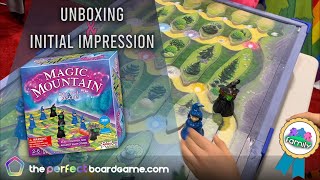
- Very accessible for families (rule set of five or fewer)
- Suitable for ages 3 and up
- Rapid play (about 15-20 minutes)
- Clear, well-designed components
- Competition among magical students on a fantastical mountain
- A whimsical magical mountain where witches and wizard students slide down a track to reach the bottom first.
- family-friendly, light narrative
Mechanics (from transcript analysis)
- color-coded movement and belts — Slots and belts influence token movement; players guide witches or wizard students along the track.
- marble-rolling path — Players roll marbles from a bag to slide them down a sloped track with colored spots, advancing pieces down the mountain.
- turn-based play with flexible player count — 2-6 players is typical; higher player counts are possible, limited mainly by waiting turns.
Video topics + discussion points
Quotes (from this video)
- this is a great game for families
- it's for ages 5 and Up and two to six players
- there really is no limit on player count except for having to wait your turn
- the game can be played in about 15 to 20 minutes
- we could play it all over again and again next time
References (from this video)
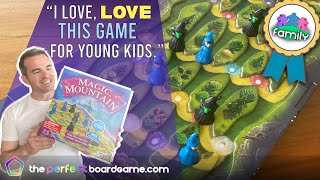
- Easy to teach and understand
- Suitable for very young children (as young as 3–5 with supervision)
- Short playtime (~10 minutes) makes it ideal for quick sessions
- Clear good-versus-evil storytelling that is easy to grasp
- Engaging with cascading marbles creates suspense and fun outcomes
- Luck can be a factor, which may frustrate players seeking consistent mastery
- Limited depth for hobbyist players seeking longer, more strategic play
- Good vs. Evil; quest to protect a magical wand; cooperation and storytelling for children.
- In the middle of a dense forest at the foot of a magical mountain, with the Will of the Wisps guiding paths and a conflict between witches and students headed to Baldwin's house.
- Fairy-tale, child-friendly narrative with simple, clear moral stakes.
Mechanics (from transcript analysis)
- Clear win/lose objective with minimal rules — The objective is to help students reach Baldwin's house before witches reach him; the game ends in a win or loss depending on the outcome.
- Marble dropping and cascading movement — Players drop a marble on a sloped board; the marble's path moves characters (students or witches) along spaces, creating potential chain reactions.
- Visual scaffolding for young players — Rule explanation is intuitive, with simple cause-and-effect visuals that help children understand outcomes without heavy instruction.
Video topics + discussion points
Quotes (from this video)
- I think it could be played with children as young as three years old
- this is a short game this is a 10 minute game
- I do highly recommend it and if you are a game Enthusiast and you would like your family to get more involved this is a great entry game for children
- I love love this game for young kids
References (from this video)
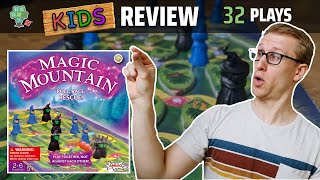
- Broad age appeal, from younger players with guidance to older kids and adults.
- Fresh, novel marble-plinko mechanic that sets it apart from typical kids' games.
- Cooperative play and approachable rules foster participation for younger players.
- Adjustable difficulty and the inclusion of a competitive variant boost replayability.
- High interaction and exciting moments as the marble approaches the bottom.
- Physical balance can drift on non-uniform surfaces, affecting perceived fairness.
- May feel repetitive for older players after many plays.
- Choking hazard: contains five standard marbles; supervision advised with younger children.
- Cooperative learning about probability and path navigation through a physical marble-dropped mechanism.
- A whimsical mountain with students and witches; marbles roll down a plinko-like board toward the bottom.
- Cooperative play with light competitive tension via witches; emphasizes observation of randomness and its consequences.
Mechanics (from transcript analysis)
- Color-matching movement — When the marble lands behind a character, that character is moved along the path to the next matching color space.
- competitive variant — A mode where one team moves witches and another moves students, adding a team-based dynamic.
- Cooperative Game — Players collaborate to guide marbles to the bottom while avoiding witches reaching the bottom first.
- cooperative play — Players collaborate to guide marbles to the bottom while avoiding witches reaching the bottom first.
- Difficulty settings — Adjusts win conditions by changing the number of required students and the number of witches.
- Dynamic obstacles — Witches also move and can pull the marble toward the bottom, impacting flow and outcomes.
- Plinko-like marble drop — A marble is dropped from one of six slots at the top and bounces down the board toward color-matched spaces.
- Probabilistic reasoning — Players weigh 50/50 outcomes and how nearby pieces affect the probability distribution along forks.
- Risk Management — Players weigh 50/50 outcomes and how nearby pieces affect the probability distribution along forks.
- Speed-driven risk — Moving quickly can trap the marble behind the same student, influencing subsequent moves.
Video topics + discussion points
Quotes (from this video)
- I'm going to be giving Magic Mountain an 8 out of 10.
- Magic Mountain's plinko-like mechanisms appeal to a wide range of Ages.
- Randomness alone won't make it interesting for adults as evidenced by many classic children's games that rely solely on luck.
- I think it is a very strong kids game.
References (from this video)

- Distinctive mechanic; teaches probability and placement
- Engaging for adults and kids together
- Requires a flat surface for fair drops
- probability, path influence, and marble physics
- Plinko-style marble mountain with witches and students
- quirky, educational
Mechanics (from transcript analysis)
- Path-based movement — Move students down the mountain toward the goal according to marble results
- random marble drop — Draw a marble color and place it into the top and watch it roll down a split path
Video topics + discussion points
Quotes (from this video)
- the work you put in really does payoff
- it's very rewarding in what board games can offer for their learning development as well as just sharing a fun experience together
- not like these games are just for three-year-olds a lot of these games do work well even with older kids
- we're trying to find as many as possible