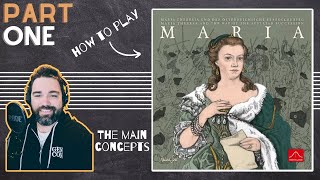








































Maria is a game based on the War of the Austrian Succession, between 1740 and 1748, where Austria was attacked by Prussia, France, Bavaria and Saxony, while only Great Britain, Hanover and the Netherlands (by forming the so-called Pragmatic Army) helped her.
Maria is primarily a 3 player game. One player is Austria, the second is France plus Bavaria, while the third player plays as Prussia (Austria's enemy) and the Pragmatic Army (Austria's ally) at the same time. This is made possible by the division of the map into two parts, the Flanders map and the Bohemia map.
Maria is derived from the award-winning Friedrich: Anniversary Edition, but has its very own character, including politics, hussars, force marches, imperial election, Saxony's betrayal and Prussia's annexation of Silesia. Subtle maneuvers, seizure of fortresses, prudent retreats, and Machiavellian politics are the keys to victory. However, players must be careful: whoever uses his Tactical Cards unwisely in battle can suddenly find himself not on the highway to glory but on the road to ruin.
Maria takes you to the era of the 18th century's ruthless struggle for power. It can be played in 2 variants: the shorter, simplified introductory game or the longer but richer advanced game, with its simultaneous campaigns in Bohemia and Flanders.
Maya - First Play Review
- Engaging core mechanic that supports deep decision-making while remaining accessible
- Clear, tension-filled scoring through temple adjacency and majority control
- Flexible tempo that rewards timing and planning; endgame can be sprung by opponents unexpectedly
- Thematic visuals and temple-building motif provide satisfying feedback
- Theme may feel generic to some players
- Pacing can be affected by how aggressively others expand temples and score
- First-time players may miss optimal timing due to multiple interacting scoring avenues
- Temple construction and area control through tile placement
- Ancient Maya-inspired temple-building and resource management
- Procedural/analytical explanation of gameplay mechanics
- Babylonia
Mechanics (from transcript analysis)
- endgame trigger — The game ends when all tiles have been placed.
- Point Salad — Points are awarded for placed tiles and adjacent matching resources; larger temples yield higher scores and majorities determine points within temples.
- Resource management and hand size — Players manage a hand of resource tiles and decide which to place and which to sacrifice for temple expansion and drawing new tiles.
- Scoring by adjacency and temple size — Points are awarded for placed tiles and adjacent matching resources; larger temples yield higher scores and majorities determine points within temples.
- Temple expansion and tile draw — To draw tiles, a player must spend one tile to expand a temple; doing so increases potential draw opportunities but reduces own tile supply.
- tile placement — Players place contiguous clusters of resource tiles adjacent to existing tiles from their hand onto the board.
Video topics + discussion points
Quotes (from this video)
- Maya, it's a big two thumbs up for me.
- I really like to play this one more.
- This game came out in 2019, and I did not hear about it until very recently.
- I think odds are pretty good that I'll be really looking into that new version with the Seagrass.
References (from this video)
- Strong fungal theme with rich art and components
- Six distinct actions per turn providing depth
- Solid area control and card drafting synergy
- High production quality (thick components, good insert, layered mats)
- Solo mode available (automa) and balanced pacing
- Good table presence and accessibility for a wide range of players
- Wind die introduces randomness which can occasionally benefit opponents
- Board can become crowded as mushrooms proliferate
- Some players may find the randomness of tile draws and market cycles disruptive
- Growth, competition for resources, life cycle from birth to decay, and spore-based expansion
- A mushroom kingdom on a modular board of triangular tiles representing different nutrients and minerals.
- Abstract strategy with a naturalistic fungal theme
- Celia
Mechanics (from transcript analysis)
- Decay — Decay a mushroom to gain its bonuses and return its token to your mat; reset its Spore counter.
- discover — Draw new mushroom cards from the market; replace chosen card with a new one from the deck.
- explore — Flip the top triangle tile from a pile and place it adjacent to the board; place an insect token if the tile has an insect symbol.
- Fruit — Spend spores to grow new mushrooms, connected to your network; mushrooms must be placed on free triangles; if you spend spores from another player's mushroom, the spores return to that player.
- Move — Move your mother mushroom token up to two spaces along a tile edge; can block others and position for Spore or scoring.
- Spore dispersal — Choose a mushroom to Spore from; place spores on the board according to wind direction determined by a wind die; spores can be owned by the mushroom's owner or the tile's owner.
Video topics + discussion points
Quotes (from this video)
- Melia is a dynamic game of tactics a competition for space and resources to create your own Mushroom Kingdom
- the game follows a life cycle of fungi a journey of creation expansion death and rebirth
- Melia is the hidden root system in mushrooms
- it's a solid game with six actions to choose from
- the game does ramp up very well
- I like the theme the art is amazing the production is very well done
- this is a game that is going to sit well with a wide range of people as the design isn't too complex
- the production is very well done
- you can play solo if that's your jam as well
References (from this video)
- beautiful artwork
- solitary play is highly engaging
- family-friendly and accessible
- thematic depth may be light for some players
- solo pace can feel repetitive for certain playstyles
- mushrooms, nature, cozy family play
- mushroom-themed family game world
- abstract, family-friendly
Mechanics (from transcript analysis)
- Deck building — build and optimize a deck to perform actions and progress toward the turn-based objective
- deck-building — build and optimize a deck to perform actions and progress toward the turn-based objective
- set collection — collect resources and patterns (e.g., Dew drops) to advance
Video topics + discussion points
Quotes (from this video)
- Calico I love Calico it's the game I've played the most ever in my life
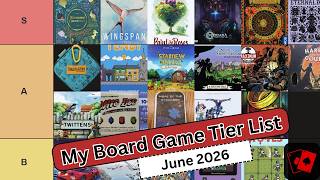
- this top 10 focuses mainly on games that are either solo only or games that I've played that I think are better solo than they are multiplayer
- I could talk on and on about board games
References (from this video)
- Educational geography learning
- Fun bluffing mechanic
- Good classroom tool
- Clear visual components
- Rule book could use work
- Geography education and bluffing/deduction
- World geography, classroom-like learning context
- Array
Mechanics (from transcript analysis)
Video topics + discussion points
Quotes (from this video)
- In Map It, players are trying to bluff their way to victory
- It's a great way to learn geography
- The rule book could use some work
- We're giving it a 7 out of 10
References (from this video)
- clever tension between safe routes and police risk
- short playtime with satisfying decisions
- strong thematic integration of the setting and mechanics
- police randomness can feel punishing
- potential analysis in setup if optimizing routes too much
- WWII resistance and city-building tension
- Resistance fighters in enemy-occupied France; worker-placement with a police mechanic
- tight, thematic tension with push-your-luck and risk management
- Northwood
- Rove
Mechanics (from transcript analysis)
- police mechanic — Police meeples are randomly placed; routes must be maintained back to the hideout.
- risk/push-your-luck — You balance leaving paths open and avoiding police capture while pursuing objectives.
- worker placement — Place resistance fighters to gain resources and trigger actions.
Video topics + discussion points
Quotes (from this video)
- AP doesn't exist in a Solo game; only a analysis paralysis isn't a problem when no one's waiting for you to finish your turn
- it's all very simple but the puzzle itself is crunchy and interesting
- the puzzle itself is brilliantly constructed but solving it leaves me a little bit cold
- No better solo only game than Final Girl; it's my number one
References (from this video)
- Solid puzzle with good solo game depth
- Strong thematic flavor
- Can be heavy for new players
- Stealth, sabotage, and mission execution
- World War II resistance
- Worker placement with mission-driven play
Mechanics (from transcript analysis)
- item/upgrade deck — gain weapons and tools to improve performance
- Pick-up and deliver — collect items and bring them to specific spots
- pickup and deliver — collect items and bring them to specific spots
- worker placement — place workers on locations to advance objectives
Video topics + discussion points
Quotes (from this video)
- new to me but proved to be a real gem
- could even fight for a solo board game of the year
References (from this video)
- Fast-paced and accessible for families, yet entertaining for adults
- Engaging push-your-luck dice mechanics that reward timing and risk assessment
- Beautiful artwork and charming components, including well-designed turtle meeples
- Innovative packaging design (box becomes the board) that reinforces the theme
- Strong social dynamics with room for large groups (4–7 players) and lively interaction
- Egg and card components are described as thin; durability could be improved
- Dice randomness can be pronounced and may frustrate players seeking greater control
- Some players may desire deeper strategic planning beyond handling the dice results
- Turtle racing and egg collection within a lighthearted island adventure
- Mahi is one of the islands in the Seashells Republic, a 92-island archipelago in the Western Indian Ocean, with Victoria as its capital.
- a modern reimagining of a classic children's game, blending nostalgia with fresh, accessible gameplay
- Kangaroo
- Pushover
- Monsterfressen
- Taxi
- Camel Up
Mechanics (from transcript analysis)
- Component transformation — The box doubles as a game board, and turtle meeples with distinctive colors contribute to a tactile, charming experience that reinforces theme and accessibility.
- Dice rolling — On a turn you roll three dice; the total determines how far you may move, but you can stop after each die and choose to roll again, introducing risk and momentum as you try to stay under seven.
- Dice rolling (three dice) with push-your-luck — On a turn you roll three dice; the total determines how far you may move, but you can stop after each die and choose to roll again, introducing risk and momentum as you try to stay under seven.
- Egg deck and scoring — Egg cards indicate points; when a turtle reaches or passes square 21, the top turtle in a stack claims the egg card’s value; the top of the deck ultimately determines scoring as eggs are tallied.
- end game bonuses — The game ends after the last Egg card is claimed; a special seven-egg space on the board provides a scoring twist for the turtle that reaches or passes square 21 late in the game.
- End-game trigger and seven-egg bonus — The game ends after the last Egg card is claimed; a special seven-egg space on the board provides a scoring twist for the turtle that reaches or passes square 21 late in the game.
- Multiplicative movement — If you use two dice and the total is seven or less, you move twice the sum; if you use all three dice and the total is seven or less, you move three times the sum.
- Roll-and-move with constrained totals — If the sum of the dice on your turn would exceed seven, the turtle returns to the raft, ending your turn and passing play to the next player.
- Stacking and Balancing — When a turtle lands on another turtle, it stacks on top; the top turtle's owner determines whether to roll the second and third dice on future turns, influencing control and risk.
- Stacking and carrying — When a turtle lands on another turtle, it stacks on top; the top turtle's owner determines whether to roll the second and third dice on future turns, influencing control and risk.
- Two- and three-player variants — In smaller player counts, players control two turtles each; egg cards can substitute for rolls in a limited way, preserving tempo and tension even with fewer participants.
Video topics + discussion points
Quotes (from this video)
- This delightful children's racing board game is surprisingly fun for adults as well.
- An incredibly delightful game that I always enjoy playing.
- Mahi is definitely worth a spot on your game shelf.
- Kangaroo is regarded as Alex Randolph's finest works and Mahi wonderfully captures the beauty and elegance of that game while introducing a fresh new version.
- The artwork in Mahi is gorgeous and I truly appreciate the overall aesthetic of the game.
References (from this video)
Mechanics (from transcript analysis)
Video topics + discussion points
Quotes (from this video)
- it's one of the most romantic games out there
- it's a cool twist on the whole victory point thing
- it's highly thematic and incredibly interactive
- it's a solid worker placement game that feels streamlined
- it's not a long game per se but with enough players it can stretch to two hours
- it's language independent
- this is a really nice streamlined euro with crunch
References (from this video)
- Good two-player puzzle
- Maximizes scoring opportunities with lucky draws
- Objective scoring and board traversal
- Two-player strategy with objective cards
- Tactical, quick scoring rounds
- Hanamikoji
Mechanics (from transcript analysis)
- set collection — Complete random objectives for points
- set collection / objectives — Complete random objectives for points
Video topics + discussion points
Quotes (from this video)
- one of the coolest initiative mechanisms that I've ever seen
- this is like an essential because it is that good
- an absolute blast playing these couple of games
- the two-player card game on the market
- Mandala is absolutely smooth as silk
References (from this video)
- deep engine and narrative flavor for a heavy euro
- strong card usefulness across different states
- very heavy; not for casual players
- goods delivery, character encounters, and quests
- Caribbean voyage and questing
Mechanics (from transcript analysis)
- branching choices and multi-use cards — cards offer multiple uses depending on context (delivery, character, quest)
- card-driven engine and quest system — cards support engines, island encounters, and quest-driven powers
- Multi-use cards — cards offer multiple uses depending on context (delivery, character, quest)
Video topics + discussion points
Quotes (from this video)
- there's this real tradeoff of how much do I want to invest in building my engine which cards do I want to hold back to actually reap the benefits from that engine
- the tempo of the game is dictated by the players
- you can use the cards as money, to unlock more actions, or to push your engine—it's all about balancing short-term gains with long-term setup
References (from this video)
- Easy to teach, with a strong brain-burning puzzle
- Sizeable depth for a small-box game
- Rule-management hiccups noted in play
- animal-themed drafting and scoring
- zoo management
- Cartographers
- Isle of Sky
Mechanics (from transcript analysis)
- drafting — players draft square tiles to place in a personal Zoo grid
- tile placement / scoring cards — round-based scoring uses public objectives with variable triggers
Video topics + discussion points
Quotes (from this video)
- an ultra streamlined deduction Style game that's definitely different to your traditional kind of logical deduction games
- I really like this one
- guaranteed some laugh out loud moments
- it's just a very charming, breezy, enjoyable game
- one of the best abstract games that I've played this year
- this game is as good as an abstract game can get in my opinion
- massive brain burner puzzle as you trying to optimally place every single card
- it's such an easy game to teach and learn
- this is one of the best simple dice games that I have
- ratings for this game have just gone up and up and up
- my favorite Uwe Rosenberg game
- The Network's become pretty big actually
- this game is almost perfect
References (from this video)
- underrated gem in the Estari line
- seems deceptively deep once learned
- not widely discussed; niche appeal
- hut placement and development triangles
- regional area-control with resource management
- abstract territory-building
Mechanics (from transcript analysis)
- Area Control — you must keep paying to maintain huts on the board
- area control with continuous maintenance — you must keep paying to maintain huts on the board
- multi-path victory through triangles and hexes — three-way planning leads to points via multiple tracks
Video topics + discussion points
Quotes (from this video)
- I absolutely adore this one
- I think it is an absolute blast
- this game is fantastic
- an evergreen to me
- it's stripped back and still a blast
References (from this video)
- Compact and travel-friendly
- Limited official information in transcript
- Card game with tactical decisions and card play
Mechanics (from transcript analysis)
- card_play — Players play cards for effects and scoring.
Video topics + discussion points
Quotes (from this video)
- The hobby business is from different sides.
- It's a wonderful experience.
- This podcast has brought me a lot of joy.
- The experience at PAX Unplugged was wonderful.
- The passion and generosity of publishers is special.