/pic7794273.png)






















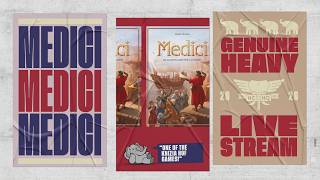







Medici Deep Dive
What the Community Thinks About Medici
Medici stands as one of Reiner Knizia's most enduring designs, a 1995 auction game that continues to captivate both newcomers and seasoned gamers. Channels like The Cardboard Herald place it firmly within Knizia's celebrated auction lineage, while reviewers Dylan and Carlo single out how distinct it feels from its siblings. The game is praised for its elegant marriage of push-your-luck card flipping with brutal opportunity-cost bidding, where every bid carries weight because money spent comes straight off your score.
Core Mechanics That Define Medici
The Push-Your-Luck Auction Structure
At the heart of Medici lies a deceptively simple but tense auction. Each round, the active player flips cards from a deck, deciding whether to hold the auction immediately or flip additional cards to sweeten the lot. The tension builds as players weigh greed against prudence. Once the lot is set, each player gets exactly one bid in turn order. This single-bid restriction forces agonizing decisions: bid too high and overpay, bid too low and lose the lot to someone willing to pay more. The uncertainty of what remains in the deck, combined with the knowledge that every coin is a point spent, makes every auction a knife-edge moment.
Money Equals Points
Medici's central design choice is its currency system. Players begin with a fixed pool of points, and every bid subtracts directly from their final score. This transforms bidding from a tactical exercise into an existential decision. When you spend points to win a lot of goods, you are accepting a deficit that only end-of-round scoring can overcome. Designed by Reiner Knizia, this system creates compound pressure: players must calculate not only the value they expect to recoup from majorities and cargo value, but also defend against being baited into overpaying by opportunistic opponents.
The Medici Experience
Ship Loading and Cargo Majorities
Players load goods, including spices, furs, grain, cloth, and dye, onto their three ships, each with capacity for exactly five goods. At round's end, majorities in each commodity are scored separately, rewarding concentration, while the player with the highest total cargo value receives a separate bonus. This multi-layered scoring creates internal conflict: pile up one color to dominate a majority, or diversify to hit the high-value threshold? The five-good ship limit ensures every lot matters and every skipped auction is a regret waiting to happen.
An Elegant Game of Reading the Table
Beneath the auctions runs a subtle information game. Players track which goods have appeared, anticipate what opponents need, and time their bids to exploit a rival's desperation or budget shortfall. It is a layer of elegance that rewards attentive play without overwhelming the core auction drama. The experience feels like authentic merchant-life risk: invest without certainty, bid against hidden intentions, and make final decisions with incomplete information, yet none of it feels arbitrary.
What Makes Medici Stand Out
A Distinct Voice Among Auction Games
Despite sharing Knizia's auction-trilogy lineage with Modern Art and Ra, Medici carves its own identity. The push-your-luck deck flipping echoes Ra's spirit, yet the economic system and scoring structure feel worlds apart. Reviewers consistently report being surprised by how different Medici plays from its spiritual siblings, suggesting that beneath surface similarities, Knizia achieved something singular. The game feels tight, purposeful, and unlike the baroque complexity of many modern economic games.
Brutal Budget Management Under Uncertainty
Few games marry economy and uncertainty as harshly as Medici. You must invest in goods without knowing future market conditions, bid against opponents whose plans are invisible, and make final scoring decisions with incomplete information. Yet none of this feels random; rather, it feels like genuine commercial risk. The game respects player judgment, rewarding those who estimate probabilities intuitively and punishing overextension.
Potential Drawbacks
Production Inconsistencies Across Editions
Medici has seen many reprints and regional editions of varying quality. Card stock, durability, and visual clarity have been uneven, with some editions suffering wear or readability issues. Prospective buyers should research which edition they are acquiring, as not all printings are equal. This remains an unfortunate historical blemish on an otherwise brilliant design.
Auction Fatigue and a Steep Judgment Curve
While the auction structure is elegant, energy can dip at the maximum player count, where turns move slowly and downtime increases. The game also rewards experienced players, whose advantage compounds across rounds. New players sometimes struggle not with the rules but with the meta-judgment required to bid effectively, leading to lopsided results until familiarity deepens.
If You Enjoy Medici
Medici sits comfortably alongside other Knizia masterworks. If you love Ra, you will appreciate Medici's distinct approach to set collection and forward planning, though its auction feels less explosive and more economically grounded. If Modern Art captured your heart, Medici offers a tighter, less chaotic experience while preserving the essence of reading opponents across the bidding table. Players drawn to High Society will find Medici similarly punishing of overpayment, with the added depth of cargo majorities. And fans of Tigris and Euphrates will recognize the distilled, minimalist brilliance that defines Knizia's best work.
What Reviewers Are Saying
"Your money in this game, your currency, is your points. Everyone starts with points on the score track, and when you're bidding, you're just taking points off of your score. So it's a really interesting decision all the time of how much do I think I'm going to be able to get back from this."
— Dylan and Carlo
"It has this majority thing where you're comparing the different colors of goods with the other players around the table. As we continue to play more of Knizia's auction games, it just blows me away that this one feels so different from the other ones."
— Dylan and Carlo
"These are titles in his auction trilogy: 1992's Modern Art, 1995's Medici, and Ra. All three games feature the designer's trademark minimalism with tense, opportunity-cost-driven gameplay, featuring only light touches of randomness."
— The Cardboard Herald