/pic5314414.jpg)
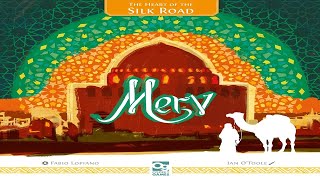
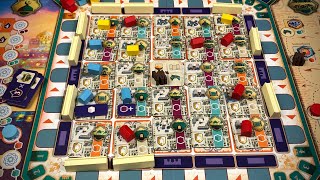
Merv: The Heart of the Silk Road is a tense economic game charting the rise and fall of the greatest city in the world.
In Merv, players are vying to amass power and wealth in the prosperous heart of the Silk Road. Through careful court intrigue, timely donations to the grand mosque, and favorable trade deals, players attempt to redirect as much of that prosperity as possible into their own pockets.
Meanwhile, beyond the city walls Mongol hordes approach. If you help construct the city walls, you give up on precious opportunities to build up your own stature, but leave it unprotected and you will burn with the city. Every decision is weighty and the consequences of each misstep are dire. Will you rise to prominence or fade into oblivion?
—description from the publisher


Merv - Tutorial Playthrough

Merv Playthrough and Review

- interesting 5x5 grid mechanic with column activation
- strong production by Osprey and Ian O'Toole artwork
- trade, power, and wealth on the Silk Road
- Silk Road era
- economic
Mechanics (from transcript analysis)
- grid-based action travel — 5x5 grid with travel along edges and activation of columns
Video topics + discussion points
Quotes (from this video)
- I love rondelle's as a mechanism in general
- wandering around an island in a hot-air balloon and the whims of the wind
- endless variability or replayability
References (from this video)
- Unique action system with worker placement.
- Engaging gameplay with many decisions.
- Visually appealing with good cover art.
- Flexible and allows for various strategies.
- Satisfying puzzle elements when figuring out optimal moves.
- Less stressful than heavier Euro games while maintaining depth.
- Camels are versatile and important components.
- Thematic integration with components like camels moving on trade routes.
- The mechanics for acquiring spices with camels can feel wonky.
- The market/trading area feels like a lot of work for little reward.
- The mosque track can feel like the easiest way to get points and might be difficult to ignore.
- The eighth breakthrough scroll effect feels less impactful than others.
- the city of Merv
- IR: The Heart of the Silk Road
- Sor: The Heart of the Silk Road
- Ember Leaf
- Petra
- Architects of the West Kingdom
- CO2
- Escape Plan
- Venice
- Lisboa
- Gallerist
- On Mars
- Sti
- Galactic Cruise
Mechanics (from transcript analysis)
- action selection — Players select actions from columns and rows on the board.
- Area Control — Players can build walls around their buildings and place soldiers on tracks.
- Engine Building — Players build up their capabilities by acquiring upgrades and expanding their presence.
- Resource Management — Players gather and spend resources to perform various actions.
- Set Collection — Players collect sets of spices.
- Tile Placement — Tiles are laid out on the board and randomized each game.
- Worker Placement — Players place workers to take actions from various locations on the board.
Video topics + discussion points
Quotes (from this video)
- This is my favorite of the three.
- The action system is very unique in this as well.
- But at the same time, this game wasn't so strict where it's like, okay, to get that one card, I have to do I have to set up three turns ahead to to then finally get this one card.
- This one just hits me the right way. Like the decisions of it.
- This is to me is right smack right where I want my euros to be.
- The camels are significantly better than the llamas in IR.
- I think Merv is a very solid one to go get.
- I'm going to give this an 8.
- I'm going to do the half step. I'm going to go 9.5 on this one.
References (from this video)

- Beautiful components and bright, thematic art
- Clear icons and a well-integrated design that remains readable with many interconnected parts
- Multiple viable paths to victory with strong, distinct mechanics
- Good balance and scalability from 1 to 4 players; 2-player variant with a simple yet clever dummy player
- Shorter, lighter than many mid-heavy euros without sacrificing depth
- Busy design style may not appeal to everyone
- Some color differentiation (white vs tan cubes) is subtle and can be challenging to distinguish
- Cubes can feel out of place aesthetically in a vibrant, energetic design
- Limited direct player interaction beyond engine-building; less conflict than some players prefer
- Rulebook access is less necessary once learned, but the complexity can still be a bit opaque for newcomers
- trade, construction, and scoring through worker placement with multiple strategic paths
- Antioch / Alexandria region along the Silk Road in antiquity
- historical theming integrated with engine-building and grid-based action selection
Mechanics (from transcript analysis)
- Card-driven AI solo mode — A small deck of cards powers a two-player bot for a solid but challenging solo experience
- Dummy player (2-player variant) — A dummy player adds buildings in 2-player games and creates a mini-game to block opponents; rules are simple
- Engine Building — Players develop engines by pursuing different tracks (mosque, library, marketplace, caravan, walls, etc.) to generate points
- Engine-building and multiple paths to victory — Players develop engines by pursuing different tracks (mosque, library, marketplace, caravan, walls, etc.) to generate points
- grid-based action selection — Choose a row or column; the space chosen determines which action you perform and what resources are required
- Resource cubes as currency — Cubes represent resources required to perform actions; collecting cubes enables trading, building, and advancing tracks
- Resource Management — Cubes represent resources required to perform actions; collecting cubes enables trading, building, and advancing tracks
- Set collection / end-game scoring — Spices and other commodities are collected via actions and scored in sets for points
- Track-based scoring and interaction — Mosque track, walls track, and other scoring mechanisms influence strategy and timing
- Worker Placement — Players place a large meeple on the city board to select a row or column and perform actions tied to building spaces
Video topics + discussion points
Quotes (from this video)
- it's a clever game that provides a great bridge between medium and heavy
- the components are one of the biggest selling points
- the colors are bright the board is beautiful and everything is clear
- it's unapologetically euro
- there is a lot of paths to victory
- the whole thing only lasts three rounds
- if you think you might enjoy merv you are probably right for fans of mid-weight euros with multiple paths to victory
References (from this video)
- Innovative grid/action-selection mechanism that drives tension and direct interaction
- Beautiful components and vibrant artwork with clear UI and readable tiles
- Effective demo bot for 2-player play and balanced pacing
- Set collection and contract/scroll system adds depth and variety
- End-of-round and end-of-game scoring feel meaningful and rewarding
- Steep learning curve for new players due to multiple interlocking systems
- Endgame can swing strongly from set collections, potentially favoring optimization over discovery
- Some early-game actions may feel less impactful until engine starts to fire
- Resource gathering, building, defense against Mongol invasions, and prestige scoring
- Ancient Merv on the Silk Road, a historical trading city under threat
- Historical-Eurogame flavor with thematic siege/defense tension
- Trajan
Mechanics (from transcript analysis)
- Action Drafting — Players place buildings on a shared grid to activate the action on that tile and influence turn order via camel-driven first/second place.
- Demo bot for 2-player — A dummy player (bot) fills the board in two-player games to simulate additional competition and pacing.
- grid-based action selection — Players place buildings on a shared grid to activate the action on that tile and influence turn order via camel-driven first/second place.
- Mongol invasion and defense — Mongol attacks threaten unprotected buildings; players defend by spending resources, walls, and soldiers to keep structures safe.
- Scrolls/contracts via library — Spend resources to buy scrolls that grant contracts and special abilities, enabling powerful synergies.
- set collection and bonuses — Acquire diverse spices/cards to form sets that score at endgame and unlock scoring bonuses along the way.
- Tile Placement — Place your buildings on a grid to generate resources and unlock row/column actions, creating a dynamic engine with blocking elements.
- Tile/Building placement — Place your buildings on a grid to generate resources and unlock row/column actions, creating a dynamic engine with blocking elements.
Video topics + discussion points
Quotes (from this video)
- this middle thing on the board is absolutely what makes this game stand out
- I love the demo player
- this is one of the most interesting takes I've seen on action selection in a long while
- the artwork here and the components looks good
- it's a very neat blocking mechanism
References (from this video)
- beautiful aesthetics and thematic immersion
- deep strategy with interlinked systems
- relatively modular in its interconnections, which can be learned progressively
- steep learning curve for beginners
- systems can feel not perfectly interlocked on first plays
- trade, resources, and cultural exchange
- Merv along the Silk Road; ancient trade nexus
- interwoven systems and historical flavor; interdependencies
- Vital Lacerda games
- Barrage
Mechanics (from transcript analysis)
- hand_management — players manage a set of actions/resources via cards or tokens
- multi-use_tiles_or_actions — actions may interact in non-linear ways, with some actions influencing others
- trade_network_and_resource_flow — players develop trade routes and utilize resources to score points
Video topics + discussion points
Quotes (from this video)
- it's going to be a look back at what we've been playing in the previous month
- the more you play this the more it opens up because you learn how it works
- we rinsed it, I've had a lot of comments on Instagram and the video that we put out there
- it's addictive little game and it's not always heavy; it's nice to have a quick round at the end of the night
- you can feel free to explore more tiles than in Maracaibo because it's not a race to the end
References (from this video)

- Multiple paths to victory and high strategic depth
- Clear eurogame pacing with an approximate hour-long playtime
- Rich visual presentation and table presence
- High replayability due to randomized tiles and spice cards
- Tension from indirect competition and clever planning
- Iconography and learning curve can be heavy for newcomers
- No direct player interaction may feel less confrontational for some players
- Random setup can impact early strategic decisions requiring adaptation
- Urban planning, trade, defense, resource management
- Medieval Silk Road city (Merv) under threat from Mongol raids
- Strategic, historically flavored eurogame with economic progression
Mechanics (from transcript analysis)
- Board actions and walls — Walls and gates defend against Mongol raids and influence scoring; walls can be bought and placed.
- Caravansary card drafting — Trade cards are acquired by spending resources; cards grant bonuses and strategic options.
- Contracts and influence track — Complete contracts by meeting influence and resource requirements; scrolls grant boons and unlock breakthroughs.
- Market/Trading routes — Place discs to establish routes; trade goods and access rare/important resources.
- Master meeple queue and camel push — Master meeples move around a queue; camels can be spent to move the queue forward, affecting turn order.
- resource management and production — Each building site produces color resources; upgrades convert to cube colors; wild white cube serves as a wild resource.
- Scoring phases via palace/mosque/scroll bonuses — End-of-round scoring uses palace slots, mosque bonuses, and scroll breakthroughs to increase points.
- Tile/City grid placement — Activating building sites in a chosen row or column to generate resources and gain actions.
Video topics + discussion points
Quotes (from this video)
- This game is a great euro game with multiple ways to victory and there is no direct player interaction but some intense indirect interaction between players.
- The game is quick to learn and understand.
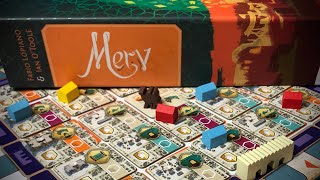
- The game allows different combos to come into effect in different games because the tiles are randomized.
- There are so many different strategies that you can focus on.
- You will only have 12 turns in the game.
- I really like the game after playing it a couple times.
- You can get through a game in an hour.
- It looks great on the table and will always keep your mind spinning as to what might be the best move.
- Huge hit.
References (from this video)
- Very high replayability due to random city layouts and multiple scoring paths
- Deep, multi-layered engine that intertwines economy, track advancement, and deck-driven actions
- Tight row-based action selection fosters strategic planning and interaction
- Solid, deterministic solo mode via a dedicated AI deck
- Strong thematic integration with the historical Silk Road setting
- Rule complexity can be daunting for new players
- Solo mode has nuanced AI behavior that may feel opaque without study
- End-game scoring requires careful tracking of many components and interfaces
- Trade, city-building, caravan economy, and defense in a historically layered urban center
- Ancient Silk Road city of Merv near Mary, Turkmenistan; late 12th century under Turkish/Mongol era
- Historical/archaeological with evolving city layers and endgame threats
Mechanics (from transcript analysis)
- action row / master meeple placement — Each round you place a master meeple on a row; only one player can activate a given row per round, and actions are amplified by existing buildings in that row.
- AI solo deck — A six-card solo AI deck (Corrupt Magistrate) drives opponent actions, blocking rows and influencing city development in solo play.
- Combat: Deck/Hand — A six-card solo AI deck (Corrupt Magistrate) drives opponent actions, blocking rows and influencing city development in solo play.
- Contract cards — Contracts convert goods and scrolls into points; higher-level contracts require earlier milestones to unlock.
- Contracts — Contracts convert goods and scrolls into points; higher-level contracts require earlier milestones to unlock.
- defense vs Mongol invasion — Mongol invasions threaten end-of-year scoring; walls, soldiers, gates, and bribes mitigate losses and protect buildings.
- influence/favor track — Gaining favor advances scoring opportunities in halls and triggers end-of-round bonuses; favors advance through the mosque and palace tracks.
- multi-layered scoring — End-of-year scoring and final caravan-based scoring create multiple routes to points, including palace, mosque progress, scrolls, goods, and contracts.
- Resource Management — Four basic resource cubes drive actions and caravan card costs; resources are earned from buildings and transformed via other locations.
- tile/board tiling — A 5x5 grid of city tiles seeded at setup, creating different layouts each playthrough and driving planning decisions.
- Worker Placement — Each round you place a master meeple on a row; only one player can activate a given row per round, and actions are amplified by existing buildings in that row.
Video topics + discussion points
Quotes (from this video)
- it's a euro with built in solo rules
- the city is made up of a 5x5 array of tiles
- it's multi-layered
- this is the delight of this game
- this is where you're going to pick up the bulk of your points
References (from this video)

- Rich, multi-layered decision space with long-term strategic planning
- Strong interactivity through shared active rows and marketplace actions
- Diverse economy with spices, upgrades, and caravan actions offering multiple paths to points
- Dynamic defense and raid mechanic that adds risk and planning around Mongol invasions
- Upgradeable components and mosque track provide meaningful long-term goals
- Steep learning curve and a lot of rules to parse for new players
- Turn-by-turn bookkeeping can feel heavy, potentially leading to analysis paralysis
- Longer playtime typical for a full session, which may deter casual players
- trade, city-building, defense against invasion
- 12th-century city of Merv on the Silk Road, facing Mongol raids
- historical simulation
Mechanics (from transcript analysis)
- caravan series / spice card row — spice cards are drafted from a central market with camel tokens affecting eligibility and bonuses
- Card/Chit Market — spice cards are drafted from a central market with camel tokens affecting eligibility and bonuses
- Increase Value of Unchosen Resources — tiles can be upgraded to modify how resources are produced or to generate wild resources that function as any color
- influence, favor and scroll tracks — tracks determine access to more spices, discounts, and breakthrough options; favors unlock scoring opportunities
- mongol raid / defense — raids threaten unprotected buildings; players defend with walls, gates, and soldiers
- palace scoring / courtiers — courtiers placed in the palace yield scoring potential across mosque, spice, and scroll-related objectives
- row/column active zone interaction — resources generated depend on which row/column is active and which colors align
- Tile Placement — activate building sites to place buildings and influence future activations
- tile placement / building sites — activate building sites to place buildings and influence future activations
- upgrades and wild resources — tiles can be upgraded to modify how resources are produced or to generate wild resources that function as any color
- Worker Placement — move master figures around the city to access different districts and rows
- worker placement / master meeples — move master figures around the city to access different districts and rows
Video topics + discussion points
Quotes (from this video)
- the mongols are planning on raiding and they will ultimately be the downfall of this city
- the caravan series and this lets players pick up spices which can be worth a significant amount of points
- you can activate sites that have buildings on them
References (from this video)
- multi-dimensional puzzle that requires planning across multiple tracks
- great solo puzzle potential and tight design
- beautiful graphic design and table presence
- can be challenging to optimize and win, especially solo
- rule interactions can be easy to misinterpret without careful play
- economic development, city-building, and network manipulation
- Ancient trade cities along the Silk Road with caravans, markets and palaces
- procedural/sandbox emphasis on puzzle-like optimization
Mechanics (from transcript analysis)
- area/track scoring — score on mosque, library, walls, caravans and influence tracks
- market/purchase chain — caravan market mechanics with camels and spice cards affecting scoring
- set collection / resource management — collecting spices and camels to form sets and trigger bonuses
- tile-placement — placing walls/buildings and tiles to shape the map and scoring opportunities
- Worker placement / action selection — taking actions by sending workers to halls and markets to activate benefits
Video topics + discussion points
Quotes (from this video)
- it's multi-dimensional puzzle of having to figure out where you could go
- really tight really neat for the soloist
- graphic design, an artwork superb design
- the visuals and components really invite you to explore
- solo mode is a brain teaser in a good way
References (from this video)

- Designer previously associated with Kalimala and Ragusa
- Gorgeous art by ENO Tools
- Economic development within a historical trading route
- Silk Road trade network
- Kalimala
- Ragusa
Mechanics (from transcript analysis)
- economic/resource management — Crunchy euro-style decisions with Silk Road theming
Video topics + discussion points
Quotes (from this video)
- "it's kind of a weird year for board game releases"
- "this is top five most anticipated essens digital releases"
- "we are going to discuss our top five"
- "there's 500 coming out this year"