/pic2470537.jpg)

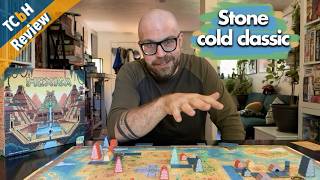


















Mexica Deep Dive
What the Community Thinks About Mexica
Mexica stands as one of the more divisive entries in Wolfgang Kramer and Michael Kiesling's Mask trilogy, earning respect from designers and strategic players while remaining somewhat less celebrated than its siblings Tikal and Cusco. Among the reviewers who have examined the game closely, there is broad agreement on its mechanical elegance and its challenging, confrontational nature. Getting Games' Jonathan appreciated the game as "a really smart game," while Chairman of the Board's assessment placed it at number 32 on his top 50 list, noting it as one of Kramer's three titles on the ranking. The game appeals to players who enjoy spatial puzzle solving and area control, though its complexity and analytical demands are not for everyone. Adam in Wales rated it as B-tier, acknowledging it as "quite a mean area control game" that demands precision and tactical awareness.
Core Mechanics That Define Mexica
Action Point Allowance
At the heart of Mexica lies a refined action point system that governs every decision players make. On each turn, players receive six action points to spend across movement, placement, and board construction. These action points become the currency of strategic conflict: moving your single worker around the island costs one point per move, laying temples varies in cost based on their power level, and establishing canals reshapes the board itself. The elegance lies in the constant calculation of opportunity cost. As Getting Games explained, players must choose between staying in one region to consolidate control or moving elsewhere to threaten new majorities, knowing that every movement and every temple placement consumes the same limited resource pool. Players can even bank up to two additional action points per turn for future use, allowing for explosive turns where careful accumulation pays off. This tight economy forces meaningful choices at every decision point.
Area Control Through Shared Board Construction
What makes Mexica distinct within the area control genre is that players collectively craft the very regions they then fight over. By placing canals and rivers on the board, players shape the landscape into distinct scoring zones. Getting Games described the dynamic: "you are frequently like moving into a region, putting a temple or two down, trying to go somewhere else to threaten another region while somebody else is doing this." The positioning of temples within each region matters enormously, since each space can hold only one temple and larger regions score more points. This creates a feedback loop where players construct opportunities and then race to exploit them before opponents can seize control. The confrontational nature emerges naturally: players can block each other by placing temples strategically, and the single worker on the board creates chokepoints where one player's position can trap another, forcing costly teleportation or defensive play.
The Mexica Experience
Analysis Paralysis and Tactical Depth
Mexica demands serious mental engagement. Getting Games' playthrough revealed the weight of decision-making: "when you have six or seven or maybe even 10 action points, you could piece together a whole bunch of things. You could also get lost with your plans." Each turn opens multiple paths forward, and the consequences of poor positioning ripple forward for the entire game. A misplaced temple blocks future placement. A worker left in an exposed position becomes vulnerable to hostile positioning. The game rewards careful planning but punishes overextension. Chairman of the Board noted that the game "can be quite analysis paralysis prone if you think about it too much," yet the action point budget itself limits how much planning is practically possible, creating natural tension between thorough calculation and decisive play.
Tense, Dynamic Majority Shifts
The scoring system, where majorities are evaluated twice during the game and again at the end, keeps the board in constant flux. Getting Games' experience exemplified this: "I think I came here like three times and I think he came here three times as we kept taking the majority away from each other." A region worth 12 points becomes the focal point of repeated raids and counter-raids. Players invest actions to build presence, only to have an opponent swoop in and flip control with well-placed temples of their own. Chairman of the Board emphasized the strategic navigation required: "it's a game about you know navigating the ball to be in the right areas at the right time so you can build things." This creates a chess-like tension where positioning, anticipation, and the ability to respond to opponents' threats drive the experience.
What Makes Mexica Stand Out
A Game of Perfect Information and Spatial Mastery
Unlike many modern strategic games, Mexica is entirely transparent. There are no hidden cards, no random draws, no fog of war. Chairman of the Board recognized this: "it's a game of perfect information. You know exactly what other players can do." This clarity makes the game a pure test of spatial reasoning and forward thinking. Every interaction on the board is visible and calculable. The map itself becomes the puzzle: knowing which regions exist, which canals connect them, where bridges allow rapid transit, and where your opponent's position threatens your plans. Reviewers praised the mental challenge this transparency creates, turning Mexica into an abstract game that merely wears a historical theme.
Brutal, Unforgiving Confrontation
Mexica embraces meanness in a way that appeals to players who enjoy high-interaction games. Getting Games described being physically blocked on the board: "He actually blocked me in...the way these temples were built, I could not leave this area." This wasn't a random penalty or house rule; it was the natural result of strategic temple placement. Being locked into a region forces either a costly teleport or capitulation to your opponent's control. Chairman of the Board reinforced this: "it's quite confrontational and quite nasty because you can block players in for doing things." This level of direct, transparent conflict means players must anticipate not just opportunities but threats, building defensive structures alongside offensive ones. The game rewards those who think several moves ahead and punishes those caught off-guard by an opponent's clever positioning.
Potential Drawbacks
Lengthy Gameplay and Downtime Considerations
Getting Games' three-player game stretched close to two hours, driven largely by the weight of decisions at each turn. With analysis paralysis a real risk and six or more action points available to consider, turns can become lengthy as players evaluate multiple possible sequences. Chairman of the Board noted the game as "quite analysis paralysis heavy...there's a lot of things to think about." This extended play time and the need for careful calculation make Mexica a commitment, particularly with experienced players who understand the deep strategic implications of temple placement and board positioning. Casual players or those seeking quick entertainment will likely find the pace frustrating.
Imbalance at Higher Player Counts
Getting Games' observation about three-player scoring suggests potential balance issues: "the two people who won were kind of beating down on the same person...maybe with four players it kind of works itself out a little bit better." When multiple players can gang up on a third without sufficient consequences, that player can fall dramatically behind. With three players in the session, one player finished roughly 30 points behind the competitive pair. The game's majority-scoring mechanism and limited region count mean that shared focus can create snowball dynamics where the leader is attacked while the second-place player benefits from the conflict.
If You Enjoy Mexica
Players drawn to Mexica's spatial puzzle and area control mechanics will find similar satisfaction in other games from the Mask trilogy. Tikal offers comparable abstract area control but with a cleaner interaction model and impressive production values that emphasize the resin temples stacked across the board. Cusco, the third game in the trilogy, builds on similar principles but adds elevation to the scoring equation, creating a three-dimensional puzzle that many reviewers prefer. Java, the original game in the trilogy, shares the action point framework and shared board construction but demands even more careful planning.
For players who appreciate perfect information strategy and confrontational area control mechanics, classic designs like El Grande offer deep majority scoring across a larger map. Alternatively, games like Power Grid emphasize economic efficiency and market timing with similarly tight resource management, though without the spatial component.
What Reviewers Are Saying
"It is worth 12 points. But what if Shiva sends his next turn on this bridge again? Maybe he does something else and then lands back on the bridge and now I'm stuck here once again. These are things that I'm thinking and I ultimately teleported away. I spent five out of my six action points to go somewhere else because I didn't want the threat of being blocked in there again."
— Getting Games
"The positioning of these temples is super important. The positioning of the canals is super important. The positioning of your people and the bridges, everything is so incredibly important. But the game is actually really straightforward. I kind of accidentally taught you essentially all of the rules to it."
— Getting Games
"It's a brilliant game about navigating the board to be in the right areas at the right time so you can build things and know or just slightly pip your opponents and controlling the different regions because the bigger the regions the more points you're going to get for controlling them."
— Chairman of the Board