/pic6336146.jpg)
/pic5542107.png)

/pic6336146.jpg)








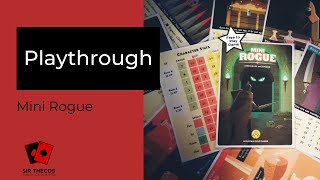
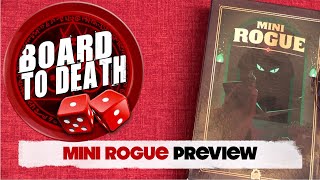
Mini Rogue Deep Dive
What the Community Thinks About Mini Rogue
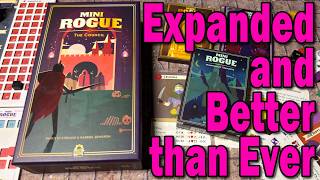
Mini Rogue has earned devoted fans across the board game community for delivering surprising depth in a compact package. Reviewers consistently praise its elegance, replayability, and respect for player time. The game sits at rank 215 on BoardGameGeek's 2025 top 200 solo games list, though some note it experienced a significant ranking drop from the previous year, leaving room for discovery among players new to minimalist dungeon crawlers. Whether played as a quick one-off or through the optional campaign mode with persistent progression, Mini Rogue satisfies both the speed-hungry gamer and those seeking lightweight narrative continuity.
Core Mechanics That Define Mini Rogue
A Dice System Built on Meaningful Pressure
The heart of Mini Rogue's gameplay revolves around rolling two different dice pools simultaneously. Your character die (white, with 5 or 6 being successes) combines with the dungeon die (black, determining difficulty or consequence). Sixes explode, letting players push for bigger damage, but rolling an X (miss) on a reroll cancels the entire attack. This creates genuine press-your-luck tension: do you push for more damage or accept what you rolled? The system rewards smart resource management. Characters accumulate additional dice as they gain experience, moving from one die to two, then three, which doubles and triples success chances. Curse and poison dice add negative variance, forcing tactical decisions about when to cleanse and how to optimize rolls.
Feats as the Primary Reroll Currency
Rather than unlimited rerolls, Mini Rogue constrains player agency through feats. Each combat turn, characters can spend either 1 experience point or 2 health to reroll a single die. This tight economy creates moment-to-moment decisions: Is this fight worth gambling health? Will I need that XP for leveling up and unlocking a second die? Free feats occasionally come from items found during exploration, adding a find-it-to-use-it satisfaction. The constraint makes every reroll decision meaningful, preventing the game from becoming a probability optimization puzzle.
The Mini Rogue Experience
Exploration as Strategic Navigation
Mini Rogue's dungeon layout enforces directional movement: players can only move right or down through a 3x3 grid of rooms. Each turn, two adjacent rooms are revealed, forcing binary choices that create natural tension. Some rooms offer clear benefits (treasures, merchants, bonfires), while others present risk (traps, monsters, shrines). The genius lies in encounter variety. Rather than every room featuring combat, rooms distribute across shrines (dice rolls with optional gold spend), tombs (potential loot), merchants (gold trading), armories (free feats), and hermits (resource exchanges). Reviewers highlight this as a distinguishing feature compared to other dungeon crawlers that frontload combat encounters. A player might clear an entire floor without fighting a single monster, or stumble into three back-to-back enemies. This unpredictability keeps drawing cards exciting even on the tenth playthrough.
Resource Tension and the Food System
Food serves as Mini Rogue's primary constraint mechanism. Each time players descend to a new floor, they must consume one food or lose health equal to the missing food amount. Characters start with 3-4 food depending on class and difficulty, meaning progression requires constant awareness of supplies. Gold buys potions (offensive fire/frost, defensive healing/holy, utility perception) and armor at merchants. Potions top out at two simultaneous pieces, forcing difficult choices about which effects to prepare for. Reviewers emphasize how this light resource management creates pacing without overwhelming new players. Veterans can optimize routing and spending; newcomers simply adapt as constraints tighten.
What Makes Mini Rogue Stand Out
Maximalist Game Design in a Minimalist Box
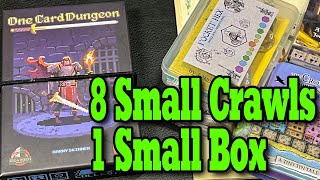
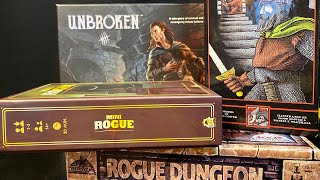
The art style mirrors the mechanical philosophy: clean, uncluttered, colorful line drawings that immediately telegraph room types and monster abilities. The entire game fits in a box smaller than many single-expansion packs, yet contains multiple playable characters (crusader, priestess, rogue, mage, witch, thief, bones, cleric), dozens of room types, unique bosses, optional lore expansion cards, and campaign progression trees. Nothing feels cut for space; instead, every component has been thoughtfully reduced to essentials. Character cards show health, armor, gold, and food on a single track. Icons represent effects consistently. This minimalism extends to setup time, the game can be shuffled, dealt, and started within three minutes. Reviewers repeatedly cite this as exceptional value: a solo game that respects both design space and table space.
Characters That Play Measurably Different
Each class begins with distinct stats and a pair of unique abilities that matter mechanically. The mage creates free potions (matching their spell-themed fantasy), the priestess can cleanse curses and sacrifice health for damage, the rogue backstabs for doubled single-die damage. These abilities flip a character card when used, preventing repeated activation per floor, a clever limitation that forces players to pick moments carefully. Starting health ranges from 10 (rogue) to 13 (priestess), gold from 0 to 3, and food from 2 to 4. Small numerical differences create surprisingly different play patterns. A character with higher starting gold plays merchant-focused; low health forces aggression or caution depending on the player's risk tolerance.
Potential Drawbacks
Icon Density and Onboarding Friction
Mini Rogue's minimalism creates a learning curve around symbols. Rooms use corner icons (shrine, merchant, trap, bonfire, tomb, etc.) that must be looked up until internalized. The included player aid omits some icons; dedicated players download enhanced references from BoardGameGeek. Reviewers note the icon system is learnable but not immediately intuitive, especially for players unfamiliar with symbol conventions in modern board games. A second edition might benefit from better iconography integration directly onto cards or in a comprehensive reference printed on the mat itself.
Randomness as Feature and Bug
While encounter variety is celebrated, dice variance creates runs where a player dies through bad luck rather than poor decisions. Early failures (multiple bad rolls in critical fights, unlucky floor generation leading to impossible monster combinations) can sour the experience for players seeking tactical mastery. The optional campaign mode mitigates this by allowing progression even after failed chapters, spendable perk points let players unlock permanent passive bonuses that apply to future runs. However, base mode offers no catch-up mechanics, which is by design but not universally appealing.
If You Enjoy Mini Rogue
Players who love Mini Rogue typically gravitate toward other minimalist roguelikes and dungeon crawlers. One Deck Dungeon offers similar press-your-luck dice stacking in an even smaller footprint. Under Falling Skies provides campaign-style progression with solo focus and increasing difficulty. Seventh Continent rewards exploration and discovery but with far higher time commitment. Gloom of Kilforth combines card-driven exploration with a living world. Arkham Horror: The Card Game appeals to the same audience seeking narrative continuity across plays. For those seeking something lighter than dungeon crawls, Everdell shares the minimalist production philosophy while leaning into puzzle solving over combat.
What Reviewers Are Saying
"Because of the minimalist nature of this game, a small addition adds a lot."
— The Dungeon Dive
"I love the variety in this game. I wish more games adopted this kind of design philosophy when designing dungeon crawls."
— The Dungeon Dive
"It packs a whole heck of a lot of game into a small box."
— The Dungeon Dive