/pic8469504.jpg)

















Money! Deep Dive
What the Community Thinks About Money!
Money! has earned genuine enthusiasm from reviewers who prize elegant, fast auction design. Jamie of Tabletoptiktok calls it fantastic and quick to click once you play a round or two, Board Game Animal praises it as one of the cleanest and strictest auction games around, and Stonemire Games go further, naming it a possible favorite auction game ever. This 1999 Reiner Knizia design distills auction mechanics into something remarkably quick yet full of meaningful decisions, and reviewers note that recent printings refresh its currency sets without disturbing the tight core.
Core Mechanics That Define Money!
The Dual-Purpose Card System
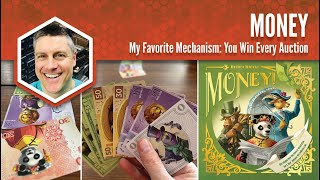
Money!'s most elegant feature is that the cards in your hand serve two roles at once. The very currency you bid with is the currency you score with at the end, so every card you spend to win an auction is a card removed from your final tally. Designed by Reiner Knizia, the game turns each round into a tug-of-war between short-term auction success and long-term scoring position. Players must decide which notes to offer as their bid, knowing that an aggressive bid to grab a valuable set quietly weakens their endgame, which Board Game Animal highlight as the constant, nuanced tension at the heart of the design.
Simultaneous Bidding and Guaranteed Wins
The auction resolves through simultaneous reveal, with all players laying bid cards face-down and flipping together. What sets Money! apart is that every participant wins something: there is no scenario where you bid and walk away empty-handed. The highest bidder picks first from the available piles, including other players' bids, and lower bidders take what remains. Stonemire Games single this out as the most satisfying aspect, since unlike many auction games where you can lose what you spent and gain nothing, here every auction yields at least one pile, making each decision feel rewarding rather than punishing.
The Money! Experience
Fast-Paced Tension and Bluffing
Money! plays in well under half an hour at any count, yet the brevity never feels rushed. The simultaneous bidding invites bluffing, since you can pad a bid with a low-value card to look stronger than you are, or bid minimally to conserve currency while appearing invested. Reading how opponents construct their bids reveals which sets they chase, letting you bid for a competing color to disrupt them or pivot your own plan. Reviewers consistently praise how the quick rounds and high agency make each decision feel pivotal, even though the whole game concludes before anyone tires.
Adaptive Strategy and In-the-Moment Pivots
While some overall planning helps, Money! rewards players who adjust on the fly. The market shifts every round, and the bids laid in front of you open unexpected opportunities. Board Game Animal note that although planning ahead matters, each auction and each decision tends to be an in-the-moment one, made by reading what opponents reveal and what the market offers. That blend of structure and spontaneity keeps the game engaging even for veterans who might otherwise find set-collection predictable.
What Makes Money! Stand Out
A Masterclass in Auction Design
Reviewers frequently invoke Knizia's wider catalog when discussing Money! Stonemire Games describe falling down the rabbit hole of his auction games, noting how distinct each feels despite sharing a core. Money! distills the auction to its purest form, where what you bid with directly becomes what you score, representing Knizia at his most economical. The result is strategic depth without baroque rules, memorable decisions without analysis paralysis, and real tension inside a short window.
Accessibility and Clean Presentation
Modern printings bring clear, color-coded currency sets that make identifying a set instant, along with player aids that demystify the slightly counterintuitive scoring. Jamie notes that the rules sound a little strange at first but click into place after a round or two, leaving a super-fast, genuinely fun game. The threshold-based scoring takes a moment to internalize, but once it does, the experience feels natural and quick to teach, which makes Money! easy to bring to almost any table.
Potential Drawbacks
Best at Higher Player Counts
While Money! supports a range of counts, reviewers lean toward three to five players, with particular enthusiasm for the fuller table. More bidders mean more bid piles to choose from, more bluffing, and richer dynamics each auction. At the lowest counts the strategic landscape narrows and some of the game's dynamic flavor fades, so groups seeking its best version should aim for a crowd.
Scoring That Reads Oddly at First
The threshold-based scoring can seem counterintuitive on a first read, since a set worth a middling amount may score far less than its face value suggests. Jamie and others acknowledge this brief hurdle but stress that it evaporates after a round, once players internalize how the thresholds work. New groups should expect a short teaching moment, after which the scoring reveals itself as a finely tuned balance between bidding and collecting.
If You Enjoy Money!
Fans of Ra, another Knizia auction classic, will recognize the same philosophical approach to bidding, though Money! compresses it into far fewer minutes. High Society and Medici, both cited by reviewers, deliver Knizia's sharp auction tension in different wrappers. And for quick, bluff-laden set collection more broadly, For Sale offers a similarly elegant two-phase auction that rewards reading the table, making it a natural companion to Money!
What Reviewers Are Saying
"I think this game is fantastic. It sounds a little weird at first, but once you play one or two rounds, you're like, oh, got it, good to go. Super fast game, really fun."
— Jamie, Tabletoptiktok
"Money is possibly one of the cleanest and strictest of that ilk. The hook here too is that, while overarching planning ahead is key, with each auction and each decision you make it's going to likely be an in-the-moment one."
— Board Game Animal
"Money is a classic auction game, and it might be my favorite auction game ever. Money is a lot of fun; I was really impressed by how much is packed into it, because every time you do an auction you are going to win something."
— Jimmy, Stonemire Games