














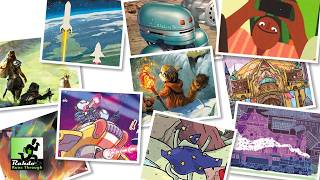

















Cities on the moon! This will be humanity's crowning achievement. At last, no longer bound to the Earth — the moon, a stepping stone to the stars. The rockets are loaded with supplies and colonists; the robots are programmed and ready. Everything has been planned down to the tiniest detail, and there is no chance whatsoever of failure. To the moon!
Moon Colony Bloodbath is an engine-building, engine-losing tableau game, with a shared deck the players build that makes things happen, many of them bad things that kill people in your moon colony, but some positive, and some that let you build up.
More specifically, each turn one card is revealed from the shared deck, which starts with four work cards, two trouble cards, and two twists. For work, each player takes an action of their choice simultaneously: mining for money, farming for food, research for cards, build a new building, or restock boxes on buildings. Twists vary from one game to the next. Trouble adds a new event card to the deck: hunger, paperwork, glitches, accidents, leaks, power failure — whatever can go wrong will go wrong, then whenever the deck is shuffled, you can prepare for all those events once again.
Players can add cards to the shared deck, too, whether perks that are only for you or developments that affect all players.
The game lasts until one player's moon colony has no people remaining, or until the players reach the bottom of the event deck. At that point, the player with the most survivors wins.
- chaotic but engaging and funny
- surprisingly resonant with engine-destruction mechanics
- fun to watch everyone get screwed together and still persevere
- heavy destruction motif may not suit all tastes
- mechanics can feel punishing or less elegant to some players
- engine destruction and survival within a shared/deck-building framework
- space colony / chaotic engine-building
- chaotic, humorous, and engaging
- Corrosion
Mechanics (from transcript analysis)
- deck manipulation — what others do and how the deck evolves affects everyone
- engine destruction / sacrifice — players sacrifice resources and workers to trigger effects and continue the game
- indirect interaction via deck manipulation — what others do and how the deck evolves affects everyone
- shared deck with personal actions — players draw into a deck that increasingly hurts engines and creates chaos
Video topics + discussion points
Quotes (from this video)
- the best part about big shot is that the way you actually gain a territory, the way you have control over it and will therefore score for it is when there are seven cubes present in a territory.
- it's a small game. It doesn't take very long to play.
- This is so deeply tactical. every single decision you're making with especially with having two win conditions in the game is so important but also so fun to engage with.
- the theme and artwork is not at all what I gravitate towards.
- it's a pleasant pleasant surprise from this last year.
- the special ability cards crack the game wide open
- it's surprisingly Cascadia, if I get that's the way to word it.
- rolling hills or rolling rivers, they're addictive and fun
References (from this video)
- Array
- Array
- survival, resource management, collective vs individual gain, and catastrophe management
- Array
- Moon colony during a colonization effort with a focus on survival and resource management
- Array
- Array
- Array
- mixed
Mechanics (from transcript analysis)
Video topics + discussion points
Quotes (from this video)
- Let's colonize the moon, guys.
- Moon Colony Blood Bath, guys. That's the game.
- I love the tactile feel of sliding these little things.
- I think the solo is really cool. Just like quick and easy, trying to build the best buildings, trying to get like some combos going that really work.
- Paperwork. So, we will draw a building card, but we have to discard two of them, which is not good.
References (from this video)
- shared-deck tension creates dynamic play
- strong thematic mood for space colony scenarios
- space/moon-colony scenario
- cooperative/competitive with escalating crisis
Mechanics (from transcript analysis)
- shared deck with evolving twists — players draw from and interact with a common deck; events shift unpredictably to increase tension
Video topics + discussion points
Quotes (from this video)
- There are so many possibilities, Jamie, even if you took it and decided to make it a campaign-based game where you took scenarios from the actual show, took the characters from the show and decided to, okay, you can play any of these characters, here's the scenario, solve the scenario with the people that you have.
- Deck builders are a good way to tell stories well. I think they tell stories well.
- There are so many subtleties that could happen.
- Paradise has been something that I have enjoyed actually.
- It's a wonderful distraction, wonderful information, wonderful source of joy when you're doing other things that require like a lot of physical attention and it's a stress reliever.
- There are so many tricks and twists you can do with the two universes; the campaign could progress season by season with an evolving core game.
References (from this video)
- Appeals to groups; fun despite personal taste
- Not universally loved; some did not enjoy it
- Take Time
- Bombbusters
Mechanics (from transcript analysis)
- unknown — Described as a light, quick-co-op cancer-scan style title; exact mechanics not specified in transcript
Video topics + discussion points
Quotes (from this video)
- The power of math.
- anecdotal evidence, but sometimes it's all we got.
- This is a Dice Tower push and the dice tower is pushing these games.
- It's a good warm-up. Or, hey, it's only 40 minutes before dinner.
- Disarms people a bit when you pull the map out of the box.
- I really do want to upgrade Bomb Busters.
References (from this video)
- Unique and chaotic engine/board interaction that yields memorable tension
- Humor and flavorful flavor text help keep the disaster vibe entertaining
- Good solo viability and clear end-condition for a one-player run
- Heavy randomness with robots and events can quickly derail an engine
- Deck management and shuffling can feel burdensome and punishing
- Early fragility may make the game feel unfair or relentlessly punishing
- Survival through resource management and attritional disaster events, with dark humor flavor.
- Lunar colony on the Moon with scientists, colonists, and robotic threats advancing through a fixed event deck.
- Flavor text and event-driven storytelling that escalates chaos and misfortune in a tongue-in-cheek tone.
- Dominion
Mechanics (from transcript analysis)
- deck-building / event deck management — Multiple linked decks (twists, events, robots) advance in a fixed order; top-deck exposure creates recurring pressure and evolving threats.
- end condition via event stack — In solo play, the objective is to reach and activate the final event (Event 13) before the colony collapses.
- engine building — Construct buildings to generate resources and colonists, then tear them down intentionally to adapt to dire situations.
- engine building and destruction — Construct buildings to generate resources and colonists, then tear them down intentionally to adapt to dire situations.
- event-driven disasters and penalties — Event cards like Hunger, Loneliness, Glitch, Accident, Tempest Flair impose losses or penalties to test resilience.
- Events — Event cards like Hunger, Loneliness, Glitch, Accident, Tempest Flair impose losses or penalties to test resilience.
- hand management — Players draw cards and perform actions from a limited set; the deck grows with events, and per-round actions are constrained.
- hand management and action economy — Players draw cards and perform actions from a limited set; the deck grows with events, and per-round actions are constrained.
- perks / development cards — Development cards and perks grant ongoing or one-off effects; can significantly alter the engine if drawn early.
- Resource management — Manage colonists, money (credits), and food to pay for events and to build or restock structures.
- robots as modifiers — Robot cards appear as part of the deck; some provide resources, others wipe out colonists, adding high-risk pressure.
Video topics + discussion points
Quotes (from this video)
- I love that the bloodbath begins with paperwork.
- This is a really unique game.
- The epitome of love-hate game is deliciously painful even to watch played.
- Chaos in games and trying to control the chaos.
- I've never won a solo game so far.
- Expansions on the horizon, that would be great.
References (from this video)
- strong hybrid of deck-building and engine-building with a survival twist
- varied events create constant tension and strategic depth
- appealing to solo and group play alike; high replayability
- can feel punishing as colonies deteriorate, which may frustrate some players
- managing the shared deck demands careful tracking and cooperation
- deck-building and engine-building survival
- space colony under threat with evolving events
- high-tension, survival-driven with communal deck management
Mechanics (from transcript analysis)
- communal deck and shared fate — the deck is shared; events affect all players and require careful planning.
- Deck building — build a communal master deck to drive actions for all players.
- deck-building — build a communal master deck to drive actions for all players.
- engine building — cards and buildings modify actions, enhancing efficiency and survival capabilities.
- engine-building — cards and buildings modify actions, enhancing efficiency and survival capabilities.
- player elimination — players lose colonists as events unfold; last man standing (most survivors) wins.
- survival/doom mechanic — players lose colonists as events unfold; last man standing (most survivors) wins.
Video topics + discussion points
Quotes (from this video)
- The game itself at face value feels very simple, but there's a lot of different nuances you want to be thinking about as each location has its own abilities.
- And the person who gets to trigger that actual effect is the one who has majority at that location.
- I've really enjoyed my time with Silos, and this is a game I'd really pull out only for three to four player groups.
- This is Moon Colony Bloodbath—engine-building survival with a communal deck that creates constant tension.
References (from this video)
- deck building with survival flavor
Mechanics (from transcript analysis)
- deck_building — Build a deck of cards to survive in a hostile moon colony.
- Resource management — Win conditions hinge on managing scarce resources and threats.
- survival_theme — Win conditions hinge on managing scarce resources and threats.
Video topics + discussion points
Quotes (from this video)
- a simple but tricky area control game.
- a ladder climbing game, but with a fun little twist.
- a fast-paced word game.
- simple but hilarious betting game.
- Moon Colony Bloodbath, a deck building game about survival, and woo, so good.
References (from this video)
- sick sense of humor and dark tone
- huge variety of buildings that create meaningful choices
- built-in tension with an impending-doom timer via the progress/development cards
- component quality is disappointing (card stock, tokens, box physical quality)
- potential for repetition and stalling without expansions
- lacks a strong thematic humanity or charm in its artwork
- dark humor, survival, planetary colonization, and collapse under relentless events
- Moon colony with colonists, mining, farming, and building to survive threats
- Array
- Dominion
- Galaxy Trucker
Mechanics (from transcript analysis)
Video topics + discussion points
Quotes (from this video)
- Moon Colony Blood Bath was a massive surprise for us.
- the game has a sick sense of humor.
- this is going to be like a bit of a car crash of a game.
- the sense of annihilation isn't entirely a bad thing cuz who likes games that just go on on? I don't.
- the production quality is dog [__] shocking.
- it's a relief that these sort of games are still being made.
References (from this video)
- Unique, humorous theme with chaotic, unpredictable gameplay
- Tight solo pacing that creates tense decision points
- Flavorful artwork and flavor text contribute charm
- Clear core loop: draw a card, resolve its effect, manage resources
- High luck factor can make outcomes feel arbitrary
- Robots and certain twists can derail engine-building late game
- Endgame can feel unwinnable once the deck collapses
- Expansion options are not clearly defined beyond fan speculation
- Colony management under disaster and chaos
- Lunar moon base / space colony
- humor amidst apocalypse
- Fallout (humor and disaster theme referenced as a loose comparison)
- Dominion (concept of card packs / expansions discussed)
Mechanics (from transcript analysis)
- Deck building — Draw cards from a fixed event/deck; a limited number of action cards each round; twists can be added to alter the deck. Rules are demonstrated in-play rather than formalized upfront.
- deck manipulation — Robots and twist cards alter the deck and game state; robots often have punitive effects, twists modify starting conditions, and both influence endgame in meaningful ways.
- Deck-building / hand-management — Draw cards from a fixed event/deck; a limited number of action cards each round; twists can be added to alter the deck. Rules are demonstrated in-play rather than formalized upfront.
- engine building — Early decisions build an engine, but the deck and events tend to destroy/override those gains, forcing players to adapt as buildings and colonists are lost.
- Engine destruction / teardown — Early decisions build an engine, but the deck and events tend to destroy/override those gains, forcing players to adapt as buildings and colonists are lost.
- Event deck progression — Two trouble cards per round add events to the top of the deck; the game ends when event 13 is activated in solo mode.
- Events — Two trouble cards per round add events to the top of the deck; the game ends when event 13 is activated in solo mode.
- Resource management — Track colonists, money, food, and supply boxes; spend resources to build, restock, and maintain a functioning colony.
- Robot / twist deck interactions — Robots and twist cards alter the deck and game state; robots often have punitive effects, twists modify starting conditions, and both influence endgame in meaningful ways.
Video topics + discussion points
Quotes (from this video)
- I think it's a very unique game; I would like to see expansions.
- The humor in this game is pretty good.
- This is a disaster, but it's not a mean game toward other players.
- I love chaos in games.
References (from this video)
- Engaging, interactive gameplay that keeps everyone watching and reacting to the next card
- Fast, easy to teach with only five core actions
- Cheeky, enjoyable theme that supports the mechanics without taking itself too seriously
- Strong tableau/engine-building focus with meaningful decision points
- Clear cooperative-tinged vibe within a competitive framework; players feel connected to shared events
- Easy entry point for new players due to straightforward actions and deck-driven progression
- Artwork feels dated or '80s-era; not to everyone's taste
- Potential repetition due to a fixed 13-event deck; variability depends on expansions or future decks
- Not a long-game; can feel short or a bit shallow for some players after repeated plays
- Some buildings can be less efficient or feel underpowered without specific cards
- cheeky survival and resource management in a space-colony setting
- Lunar colony under dueling pressures as a horde of problems emerge
- humorous, tongue-in-cheek, not overly serious
- Dominion
Mechanics (from transcript analysis)
- Build actions — Spend resources to play buildings from hand into a tableau, adding people and ongoing effects.
- deck/tile expansion through perks and robots — Perk, development, and robot cards expand the deck and introduce mix of benefits and penalties.
- engine building — Players curate a personal engine by selecting buildings that synergize for long-term survival.
- event deck and hunger mechanic — A deck of events drives the round flow; hunger requires feeding buildings or losing people.
- Events — A deck of events drives the round flow; hunger requires feeding buildings or losing people.
- restock and cargo — Cargo tokens are drawn and allocated to buildings; used to fuel actions and enable events.
- tableau engine-building — Players curate a personal engine by selecting buildings that synergize for long-term survival.
- work actions — Players choose one action per turn (mine, farm, research) to gain resources and affect ongoing card decks.
Video topics + discussion points
Quotes (from this video)
- Start with the instruction manual first, people.
- The round structure of the game is actually a lot different than what you're probably used to.
- The game play is super fun and interactive because you're always taking a look at what other people are doing.
- Moon Colony Bloodbath is not three words that I think you would put into the same sentence even, let alone as the title for a game.
- It's a 7 out of 10.
References (from this video)
- High-tension solo play with fully simultaneous resolution
- Powerful, thematic engine-building feel through a tight tableau of buildings
- Distinct disaster and hunger mechanics create meaningful risk decisions
- Multiple strategic paths via different buildings and perks
- Extremely punishing through drones/robots and hunger cycles
- Heavy bookkeeping and micromanagement can be mentally exhausting
- Event deck is fixed per game, reducing variability across plays
- Early luck can significantly derail a run before meaningful choices pay off
- survival under disaster, resource management, and social strain
- Moon colony, near-future space outpost
- tense, high-stakes tableau-building with brutal random events
Mechanics (from transcript analysis)
- disaster_mechanics — Robots and other disasters impose losses (e.g., killing colonists or destroying buildings) and must be mitigated or endured.
- engine building — Players assemble a personal tableau of buildings that grant ongoing and combo-based effects.
- engine_building — Players assemble a personal tableau of buildings that grant ongoing and combo-based effects.
- event_and_trouble_cards — An event deck drives recurring penalties (e.g., hunger) and trouble cards shift future state by adding top events or forcing discards.
- Events — An event deck drives recurring penalties (e.g., hunger) and trouble cards shift future state by adding top events or forcing discards.
- perks_and_decks — Perk cards (and deck interactions) provide one-time or ongoing bonuses that affect future draws and actions.
- Resource management — Critical resources include colonists, money, and food; mismanagement leads to attrition and penalties.
- resource_management — Critical resources include colonists, money, and food; mismanagement leads to attrition and penalties.
- Simultaneous Actions — Turns resolve simultaneously in solo mode, preserving pace and tension without player impact delays.
- simultaneous_play — Turns resolve simultaneously in solo mode, preserving pace and tension without player impact delays.
- tableau building — The order and choice of built elements creates a functional engine with synergies and risks.
- tableau_builder — The order and choice of built elements creates a functional engine with synergies and risks.
Video topics + discussion points
Quotes (from this video)
- Moon Colony Bloodbath. This is an engine building/ engine losing tableau builder where players are scientists attempting to create a colony on the moon.
- Everything is really simple. I will explain all the rules as I play, just like I always do.
- loneliness card into the progress deck
- drilling robot is going to kill five of our colonists
- our Moon colony failed. It was an absolute bloodbath.
References (from this video)
- sick sense of humor and thematic cohesion
- strong engine-building feel with unique twists
- potentially heavy for some players
- misplays can be punishing without a good teach
- engine-building with a satirical tone
- space-colony-building with a dark humorous edge
- retro sci-fi, playful yet vicious
- Terraforming Mars
- Dominion
Mechanics (from transcript analysis)
- engine-building / deck-building hybrid — each player has a moon colony; you add cards to a shared deck to improve actions
- Simultaneous Actions — all players act with a common deck and turn sequence evolves
- simultaneous play / multi-action planning — all players act with a common deck and turn sequence evolves
Video topics + discussion points
Quotes (from this video)
- This is like the Super Smash Brothers kind of. I know, I know.
- If you're a heavier gamer and you don't like, you know, people messing with your plans, you'll hate this.
- This was absolutely beautiful. I love how well it moved.
- The goddess made me do it.
- I would buy it.
- Moon Colony Bloodbath... engine destroying game, sick sense of humor
References (from this video)
- Fast, snappy solo play
- Solo mode mirrors multiplayer experience with minimal rule changes
- Tense, evolving card-driven engine with meaningful choices
- Rich thematic flavor through events and loneliness mechanics
- Can become punishing with cascading losses from events
- Requires careful bookkeeping of cards, resources, and colonists
- Balance can feel ruthless without thoughtful planning
- Survival, resource management, lunar horror
- Lunar colony survival on the Moon
- Card-driven, procedural progression with evolving threats
Mechanics (from transcript analysis)
- card-driven engine — The game uses a deck of cards to drive actions and effects; drawing, playing, and discarding cards shape each turn.
- Event and twist cards — Random events and twist cards introduce hazards (hunger, glitches, loneliness) and sometimes free actions.
- Events — Random events and twist cards introduce hazards (hunger, glitches, loneliness) and sometimes free actions.
- Loneliness and icon mechanics — Loneliness cards interact with icons on other cards, forcing careful management to minimize losses.
- Resource management — Maintaining food and other resources to feed colonists; hunger triggers population changes and end-of-round effects.
- resource management and feeding — Maintaining food and other resources to feed colonists; hunger triggers population changes and end-of-round effects.
- Worker actions / action selection — Players perform a sequence of actions (farm, mine, research, restock) to build a tableau and develop the colony.
Video topics + discussion points
Quotes (from this video)
- Moon Colony: Blood Bath, a game of survival, strategy, and lunar horror.
- it's just me out here managing the colony alone
- this game is very quick, very snappy, and whether you play solo or with others, it plays just as quick.
- I've really enjoyed this game playing solo
- If you've enjoyed this video, feel free to hit the like and subscribe
References (from this video)
- Very strong, unique vibe and tempo that blend chaos with clever deck/engine interactions
- Interesting tension curve where progress is continually threatened by events and population loss
- Quirky, memorable art style that reinforces the carnivalesque mood
- Satisfying payoff when your engine finally comes online and then gets tested by the next twist
- Accessible core concepts with deep strategic potential for a wide range of players
- Event deck randomness can feel punishing or underutilized if cycles don’t align with expectations
- Not a chill or passive experience; the game demands constant attention and rapid decision-making
- Limited variety in events might reduce replay value over many sessions
- Some players may wish for easier removal or thinning of cards to streamline play
- carnage, calamity, improvisation, and fragile growth under pressure
- A lunar colony on the Moon undergoing a cascade of events, twists, and resource management challenges.
- dynamic engine/deck-building with escalating risk and destabilizing events
- Dominion
Mechanics (from transcript analysis)
- action_selection — On each pass through the central deck, players select from five work actions—mining, farming, researching, restocking, and building—with limited total actions per cycle, forcing tough tradeoffs.
- Deck building — Players collectively contribute to a central deck whose cards influence actions, resources, and the colony’s fate; cards are added to the top and are not removed, driving a high-tension pacing.
- deck-building — Players collectively contribute to a central deck whose cards influence actions, resources, and the colony’s fate; cards are added to the top and are not removed, driving a high-tension pacing.
- engine building — Actions and cards compound over the course of a round to create an emergent engine that generates money, food, and population, but the engine can be buffeted by events and twists.
- engine-building — Actions and cards compound over the course of a round to create an emergent engine that generates money, food, and population, but the engine can be buffeted by events and twists.
- randomization_and_twists — Twist cards are revealed early and visible to all players, shaping planning and timing; event cards are added to the top of the deck and resolve in a cascading, sometimes punitive fashion.
- Resource management — Food and population are currency controls; letting population drop to zero triggers penalties and possible loss of buildings, creating a tight risk/reward loop.
- resource_management — Food and population are currency controls; letting population drop to zero triggers penalties and possible loss of buildings, creating a tight risk/reward loop.
- tableau building — Your colony is represented by a tableau of buildings with unique abilities that activate when played or under specific conditions, adding strategic depth and positioning considerations.
- tableau-building — Your colony is represented by a tableau of buildings with unique abilities that activate when played or under specific conditions, adding strategic depth and positioning considerations.
Video topics + discussion points
Quotes (from this video)
- Moon Colony Bloodbath is a joyous game of absolute carnage, and calamity.
- It has such a unique vibe, feeling, and tempo, and I can't say enough good things about it.
- It takes a normal deck building and engine building power curve and absolutely slams it.
- Just as you get your engine started to gain traction, the number of vents and the amount of people you're losing starts to smash it down faster than you can repair it.
- We have so many games about growth, but very few deal with everything turning to custard.
- The first time you play Moon Colony Bloodbath, you will still be shocked at just how quickly the game turns on you.
- I kind of dig the quirky art style as well. It helps sets the tone for a game that is absolute silly carnage.
- Oh, best thing about this game is flipping over your first robot card and then realizing that thing's coming back each turn.
- However, Moon Colony Bloodbath is the opposite of chill. If you want a game where you get to do your own thing, this ain't it.
- Dominion is the original deck building game and it's by the same designer.
References (from this video)
- Intuitive setup with surprisingly quick play pace for a deck-building engine centered on a single shared deck.
- Innovative blend of simultaneous play with a strong deck-evolution mechanic that rewards timely deck-building decisions.
- Clear thematic hook: a lunar crisis where players must balance growth with fragility, creating meaningful tension.
- Structures provide multi-use value and sustain engine parts across early and late game phases.
- Twist cards and asymmetry inject replayability and anticipation for different playthroughs.
- Randomized twist and robot effects can introduce volatility that some players may find frustrating or overly swingy.
- The reliance on a shared deck may reduce a sense of individual agency for some players and increase perceived interaction noise.
- Potential difficulty for new players to quickly grok all card interactions and the evolving deck state, despite streamlined rules.
- crisis management, resource scheduling, and deck-building as a collective engine with individual agency
- Lunar colony under crisis where players must balance survival with competition, while a shared deck evolves under player influence.
- emergent, driven by event-driven twists and evolving deck state; simultaneous play accentuates tension and interaction
Mechanics (from transcript analysis)
- Deck building — Players contribute cards to a single shared deck that drives the entire game. Some cards are added automatically, while players can actively add cards that shape future draws. The deck evolves as the round proceeds, creating a dynamic pulse to the whole experience rather than isolated player turns.
- Deck reshuffle and repeated cycles — After the deck is exhausted, it is reshuffled and run through again. The game thus emphasizes repetition with incremental change, as previously seen cards reappear in new contexts, keeping the experience fresh through multiple passes.
- Development/structure cards — Development-type cards (structures) provide ongoing benefits and can also grant additional people or resources. They serve as engine components that work early in the game for acceleration, yet retain relevance later by offering multi-purpose utility (sustained income of people, resources, or activation effects).
- end game bonuses — There is no default action to simply accrue people; instead, people must be earned through structures and card effects. The end condition hinges on not losing all your people, tying victory to careful resource and structure management while staying ahead of losses.
- Endgame condition via population management — There is no default action to simply accrue people; instead, people must be earned through structures and card effects. The end condition hinges on not losing all your people, tying victory to careful resource and structure management while staying ahead of losses.
- Multi-use cards — Work cards give a player a choice of five possible actions when drawn, enabling flexibility. Choices typically include gaining new people, collecting resources, playing another card, or triggering special effects, which makes each draw carry meaningful decision points.
- Perk cards added to the deck — When a perk card is played, it is added to the top of the deck, creating a near-term impact on future draws. This mechanic directly links player decisions to the tempo and potential surges or misfires in the upcoming rounds.
- Robots and disruptive effects — Some cards introduce disruptive elements (robots) that can hamstring players’ plans. These random or semi-random hindrances force players to adapt on the fly and reinforce the competitive tension of a crisis-management theme within a mostly cooperative mechanism.
- Shared/deck-building engine — Players contribute cards to a single shared deck that drives the entire game. Some cards are added automatically, while players can actively add cards that shape future draws. The deck evolves as the round proceeds, creating a dynamic pulse to the whole experience rather than isolated player turns.
- Simultaneous action selection — All players act concurrently rather than following a strict turn order. This keeps downtime low and increases the sense of shared fate, since everyone is watching the deck and the evolving board state as it changes with each revealed card.
- Simultaneous Actions — All players act concurrently rather than following a strict turn order. This keeps downtime low and increases the sense of shared fate, since everyone is watching the deck and the evolving board state as it changes with each revealed card.
- Twist cards (asymmetrical setup) — At game start, two twist cards are placed in the deck, creating asymmetry and surprises from the outset. The deck is relatively thin early on, so twist cards have a pronounced and frequent impact, shaping early strategy and long-term expectations.
- Work card action choices — Work cards give a player a choice of five possible actions when drawn, enabling flexibility. Choices typically include gaining new people, collecting resources, playing another card, or triggering special effects, which makes each draw carry meaningful decision points.
Video topics + discussion points
Quotes (from this video)
- This is a competitive game where all players are doing kind of two things.
- you are revealing the top card of the deck and you are doing what that card says.
- fully simultaneous, but you are still interacting with other players.
- I am just so impressed with this design.
- There's no default way to get people in this action system.
- We went through it like six times in the game.
References (from this video)
- Engaging engine-building with high emotional payoff
- Dynamic tension from the destruction mechanic
- Theme can feel grim; not for all audiences
- Domination by one engine can overshadow others
- Resource management and survival under pressure
- Moon colony under threat; survival with building and engine building
- Engine-building with tragic player-elimination dynamics
- Other engine-builders with escalation and destruction themes
Mechanics (from transcript analysis)
- Destruction phase — Robots attack and destroy player improvements later in the game
- engine-building — Players craft and upgrade their own engine via cards/buildings
Video topics + discussion points
Quotes (from this video)
- The visually most pleasing board game, Euro game of all time.
- I can't stop thinking about this game and want to play it again and again.
- The box is actually part of the game.
- It's the best character building in board games, period.
- The historic flavor, the politics, the negotiation, the backstabbing makes this an amazing game experience.
References (from this video)
- Legendary designer (created Dominion)
- Communal deck building mechanic
- Twist cards for variability
- Humorous theme with serious gameplay
- retro 1950s
- moon base
- science fiction
- space disaster
- Dominion
Mechanics (from transcript analysis)
Video topics + discussion points
Quotes (from this video)
- I'm not here to talk about that I'm here to talk about games
- catch-up games has been on fire
- I love his Cooperative design sensibilities
- how does this game not already exist
- I want more games that tell in 2025 a positive story about how we can work in unison with nature
- 2025 might be the year of co-ops
- pure Feld simple Elegance that leads to deep challenging decisions
- Coming of age is by far my number one most anticipated game
References (from this video)
- Unique "everything falls apart" theme
- Fun competitive element
- Interesting mechanics
- Can drag on too long in endgame
- Losing players may have unfun experience watching slow decline
- Post-apocalyptic survival and collapse
- Moon colony
- Apocalyptic deck-building
Mechanics (from transcript analysis)
- Comparative survival — Try to make your stuff fall apart slower than opponents
- Deck building — Build your tableau from central deck
- Deterioration — Everything slowly falls apart over time
Video topics + discussion points
Quotes (from this video)
- I love Huton. Oh my gosh.
- Oh my gosh, I am in love with that game.
- It knocks out of the water.
- One of the better games I've played in a long time.
- The components are so much better. It makes a better game.
- It's a fun little like watch the world fall apart and burn and see who can survive that process the longest.
- One of my favorite party games, if not my favorite party game.
- It's a lot going on. Very thinky. But very rewarding, too, at the same time.
- When trick taking gets to a point where I feel like I'm just trying to math out every probability and it starts to feel like homework, I start to like it less.
- I cannot wait to play it again.
- My ideal would be combining the best parts of Bruges and Hamburg into one game, but I can't do that.
- It's just easy, straightforward, satisfying.
- There's not quarterbacking, there's assisting, because it's so much happening at once and so much daisy chaining that the quarterbacking is almost impossible.
References (from this video)
- ridiculously fun, campy theme with gleeful chaos
- great art and production
- strong engine-building potential
- the humor may not appeal to everyone
- game balance can tilt with chaotic events
- campy survival and colonization under stress
- moon colony with pulpy science-fiction motif
- campy, over-the-top
- Dune: Imperium
- Galaxy Trucker
Mechanics (from transcript analysis)
- city/population management — maintain population while advancing buildings and events.
- engine building — buildings grant ongoing bonuses and trigger actions.
- engine building with building bonuses — buildings grant ongoing bonuses and trigger actions.
- event-driven chaos — central deck of events drives what happens to everyone.
- Events — central deck of events drives what happens to everyone.
Video topics + discussion points
Quotes (from this video)
- This is the perfect kind of game to play like late in the evening with maybe some people who aren't into like super heavy games.
- I played it 80 times as a result.
- Moon Colony Blood Bath. Try and think of a crazier name. You can't.
References (from this video)
- unique and memorable feel unlike Galaxy Trucker
- variety in outcome and dramatic turns
- can feel punishing and chaotic
- engine-building with destruction and rebirth
- Chaotic moon base with destruction and defense themes
- punishing, dynamic, and cinematic
- Galaxy Trucker
Mechanics (from transcript analysis)
- Engine builder and engine loss — build a tableau that gets repeatedly damaged and must be rebuilt
- Rotating round cards that introduce new negative events — round-based downtick with increasingly harsh effects
Video topics + discussion points
Quotes (from this video)
- This is the kind of game you play when you want to feel smart.
- Everything feels like a good decision.
- The card play in this game is absolutely stellar.
- A lot of little things come together to feel cohesive and satisfying.
- You reap what you sew, you know, you need to be strategic and methodical about it.
References (from this video)
- Engaging engine-building with multiple synergies across buildings and perks
- Fast-paced rounds with dramatic 'blood bath' endgame
- Strong table presence and player interaction
- Thematic Moon setting with humorous space banter
- Dynamic resources mix (food, mining, boxes) creates engine variety
- Perk cards add depth and variability
- Can be chaotic and rule-heavy for new players
- Some rule interactions around boxes are ambiguous and may require house rules
- Deck-order luck can influence late-game outcomes
- Tracking multiple resources and effects can be demanding
- space colonization, survival under evolving threats, and a haunt/traitor-like element
- Lunar surface colony aiming to attract settlers and build a utopia while weathering a dangerous progress/event deck
- humorous, chaotic, banter-rich with space-themed humor and occasional space facts
- Moon Fallout
Mechanics (from transcript analysis)
- building activation & effects — buildings provide permanent effects or activated effects that modify resource generation or usage, and can incorporate boxes for extra effects.
- deck-building / progress deck — players flip work cards to take actions; the progress deck introduces twists and new event cards that can alter the game state and flow.
- Endgame scoring — the game ends when a player runs out of colonists; winner is the one with the most settlers on their board plus those printed on their buildings.
- event-driven peril — hunger and robot/event cards come from the progress deck, causing penalties and driving the game toward an end condition.
- perks & restocking — perks grant ongoing bonuses and can be triggered as specified on cards; restocking can generate boxes and mining tokens.
- Resource management — players manage colonists (people), food (apples/food tokens), mining tokens, and boxes placed on buildings to activate abilities.
Video topics + discussion points
Quotes (from this video)
- This game is a fight to not finish last.
- Ash's engine firing off.
- The rich get richer.
- We got burgers on the moon.
- Moon colony full of cabbage patch kits.
- I love working.
References (from this video)
- Innovative communal deck-building mechanic provides a fresh twist on a familiar mechanic
- Tense pacing and short playtime provide a satisfying middle-weight euro/card-game experience
- Theming and humor land well, adding flavor and engagement
- Strong variability with player counts and twists, supporting solo and group play
- High randomness from tableau draws and event order can feel unfair or swingy
- Endgame elimination can be disheartening for some players
- Two-player games can lack the table talk and chaos that many enjoy at larger player counts
- destruction, communal deck-building, survival against an escalating threat
- Moon colony under threat from rebellious robots; colonists and infrastructure endangered
- tongue-in-cheek, retrofuturistic, campy yet brutal in its setting
- Empire's End
- El Paso
- Last Will
Mechanics (from transcript analysis)
- communal_deck — A central deck of events and developments is shared; events unfold in a fixed order but are enriched by added cards, twists, and perks.
- deck-building — Players share a central deck of events and build their own engine by acquiring cards that modify actions, money, and draws.
- endgame_triggers — The game ends when a player runs out of colonists (people) or after all 13 events have resolved, creating a finite but variable conclusion.
- perks — Perks are cards that give unique benefits when drawn, but only for the player who added them; they influence long-term strategy.
- player_interaction — Most interaction is indirect via the shared deck and endgame timing; players monitor others’ engines and timing to anticipate collapse.
- robot_events — Robot-themed events add negative effects that accumulate, driving tension and risk as the deck thickens with bad outcomes.
- tableau_and_actions — In addition to the shared deck, players build a personal engine through buildings that grant actions, money, or draw capabilities.
- twists — Two twist cards are added at the start that dramatically alter the initial setup and ongoing pacing.
Video topics + discussion points
Quotes (from this video)
- Moon Colony Blood Bath is a Donald X game of Dominion fame that just came out this year.
- And everybody dies.
- The endgame trigger is when one player at the table runs out of people.
- This is a tableau building game.
- There are four cards in there you really care about.
- The fat deck of twists.
- You start with nothing and you make it.
- I think it's best three plus because there isn't that laughter of five around the table.
- You can play solo.
- The art is cartoonish.
- Fallout. That kind of a Fallout like vibe.
References (from this video)
- Cooperative, engaging endgame dynamics
- deck-building with narrative chaos
- Moon colony vs rogue robots
- cooperative with a twist
Mechanics (from transcript analysis)
- deck-building — Cooperative tableau that evolves against robotic threats
Video topics + discussion points
Quotes (from this video)
- I had so much anxiety about making this change for months and months, arguably years if you watch the last update, but people really took to it.
- You mean Getting Games? That just that really sealed the deal.
- It's just a fun thing to consider.
- I'm really looking forward to it as opposed to putting these things off and like stressing about them.
- recording my opinions episodes live as well as other vlogs. I did a 2024 favorites video talking about all my favorite games from last year.