





























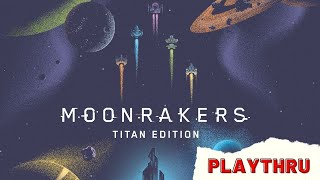
Moonrakers box art

Moonrakers

Game ID: GID0217014
Collection Status
Description

Moonrakers is a game of shipbuilding, temporary alliances, and shrewd negotiation set in a space-faring future. The players form a loose band of mercenaries, but while they are united in name, actual alliances are shaky as players are pitted against each other in the quest to become the new leader of the Moonrakers.

Moonrakers is a deck-building game in which players choose Contracts to attempt alone or with Allies in order to gain Prestige and Credits. After negotiating terms with Allies, players use their decks of Action cards to play Thrusters, Shields, Weapons, Reactors, and Crew to fulfill the requirements on each Contract. Each type of Action card has additional effects such as extra Actions, drawing additional cards, and protecting players from Hazards encountered while attempting Contracts.

Players create powerful decks and gain special abilities by upgrading their ships and hiring Crew Members. This helps them accomplish more difficult and rewarding contracts alone, letting them keep more Prestige and Credits for themselves.

Allies negotiate who will receive the Prestige, Credits, and risk of Hazard from Contracts, but if you don't make your offers enticing enough players may be tempted to betray you! The first player to 10 Prestige wins, but be careful as hazards encountered on Contracts reduce your Prestige!

-description from designer

Year Published
2020
Transcript Analysis
Browse transcript mentions, sentiments, pros/cons, mechanics, topics, quotes, and references.
Total mentions: 14
This page: 14
Sentiment: pos 12 · mix 0 · neu 1 · neg 0
Mentions per page
Top
Showing 1–14 of 14
Video Xil_Hhm-YXg Meeple Mountain game_review at 0:14 sentiment: positive
video_pk 36731 · mention_pk 110262
Meeple Mountain - Moonrakers video thumbnail
Click to watch at 0:14 · YouTube ↗
Overall sentiment (raw)
positive
Pros
  • Accessible and easy to teach, enabling quick onboarding for players of various experience levels.
  • A rich, emergent depth that comes from negotiation, betrayal, and strategic alliances rather than heavy rulebooks.
  • Excellent table presence with a thematic, sci-fi aesthetic that makes components feel meaningful and upgrades feel impactful.
  • Short-to-middling playtime (roughly 45 minutes to an hour) that scales well with player count, keeping sessions lively.
  • Distinct asymmetry created by varied crew and ship components that alter play patterns and open multiple viable strategies.
  • The endgame tension created by secret objectives adds a persistent layer of strategic diversification, encouraging players to shift focus mid-game.
Cons
  • The social deduction and negotiation aspects require a table of players who enjoy bluffing and strategic deception; groups who prefer straightforward, transparent play may find this less appealing.
  • Negotiation can sometimes stall the game, especially with large groups or players who over-negotiate, leading to long downtimes between decisive actions.
  • While rules are accessible, the depth is ultimately driven by player interaction; those seeking dense mechanistic complexity may find it lighter in that regard.
  • The treacherous element—betrayal and backstabbing—can alienate players who value consistent cooperation or fair play, potentially limiting its audience to certain groups.
Thematic elements
  • The core thematic concept centers on competitive ambition, diplomacy, and deception within a dynamic factional landscape. Players seek prestige by completing contracts and achieving secret objectives, all while negotiating with and sometimes betraying captains around the table to maximize their own standing. The game leverages an atmosphere of treachery, negotiation, and risk management as central experiences.
  • In a sprawling, near-future space opera, a faction called the Moonrakers is made up of fragmented groups and splintered factions vying for leadership, influence, and prestige within a galactic market. The setting blends high-tech ship design with political maneuvering, corporate intrigue, and a volatile alliance ecosystem where trust is scarce and every contract could shift the balance of power.
  • Procedural and outcome-driven, Moonrakers emphasizes tactical decision-making and social interaction rather than a fixed linear story. The narrative emerges from players’ choices around contracts, alliances, and the tactical use of crew, ship parts, and hazard mitigation. The storytelling is emergent, shaped by negotiation dynamics, hidden objectives, and the evolving table politics.
Comparison games
  • Secret Hitler
  • Werewolf
Mechanics (from transcript analysis)
  • contract-driven scoring — Contracts provide the bulk of the action economy and scoring in Moonrakers. They are color-coded by type (orange kill contracts, blue exploration, green rescue, and gold delivery) and come with specific card requirements and hazard costs. Completing contracts yields prestige and credits, with rewards sometimes including bonus cards that can further enhance a player’s deck. Some contracts are so demanding that they virtually require or strongly incentivize partnering with other players to accomplish them.
  • crew and ship components — Crew cards and ship components form the engine that drives deck customization and in-game power. Crew cards provide bespoke actions when played, including trashing unwanted cards to sculpt the deck, or generating credits and actions. Ship components slot onto a player’s ship and grant powerful activated abilities; each piece has prerequisites and costs, and players can own up to four active components at a time. The choices around which components to install, when to upgrade, and how to configure the ship for anticipated contracts are central to optimizing performance.
  • Deck building — Moonrakers begins with each player possessing a basic starting deck. Throughout the game, players draw five cards each turn and can acquire new action cards, crew, and ship components to upgrade their deck. Cards come in five primary types (misses, reactors, thrusters, damage, shields) plus crew cards with unique abilities. The core loop encourages balancing short-term card plays with long-term deck upgrades, as better cards enable meeting more demanding contract requirements and unlocking stronger components.
  • deck-building — Moonrakers begins with each player possessing a basic starting deck. Throughout the game, players draw five cards each turn and can acquire new action cards, crew, and ship components to upgrade their deck. Cards come in five primary types (misses, reactors, thrusters, damage, shields) plus crew cards with unique abilities. The core loop encourages balancing short-term card plays with long-term deck upgrades, as better cards enable meeting more demanding contract requirements and unlocking stronger components.
  • Hazard dice and risk management — Hazard dice introduce a probabilistic element to missions. The level of the contract dictates how many hazard dice must be rolled, and the result can cause prestige loss if hazards are not blocked by shields. Shields, then, serve as a critical resource to mitigate risk. The negotiation over who bears risk, how hazards are split, and which shields are allocated becomes another strategic axis at the table.
  • hidden objectives — In addition to visible contracts, players have secret objectives that contribute to endgame scoring. These objectives add depth and strategic uncertainty, as players must balance pursuing contractual prestige with pursuing personal goals that may require withholding or misdirecting information. The tension between short-term gains and meeting a concealed win condition contributes to the game’s replayability.
  • negotiation — A central pillar of Moonrakers is table negotiation. Players continually propose and counter offers to cooperate on contracts. Allies can help fulfill requirements, share rewards, or enable access to powerful cards from another player’s hand. Alliances are not guaranteed and can be fragile: allies may decide to withhold help, demand favorable terms, or pivot to another deal if it better serves their own interests. The negotiation phase drives the pacing of the game and creates dramatic swings in advantage.
  • Negotiation and alliances — A central pillar of Moonrakers is table negotiation. Players continually propose and counter offers to cooperate on contracts. Allies can help fulfill requirements, share rewards, or enable access to powerful cards from another player’s hand. Alliances are not guaranteed and can be fragile: allies may decide to withhold help, demand favorable terms, or pivot to another deal if it better serves their own interests. The negotiation phase drives the pacing of the game and creates dramatic swings in advantage.
  • risk management — Hazard dice introduce a probabilistic element to missions. The level of the contract dictates how many hazard dice must be rolled, and the result can cause prestige loss if hazards are not blocked by shields. Shields, then, serve as a critical resource to mitigate risk. The negotiation over who bears risk, how hazards are split, and which shields are allocated becomes another strategic axis at the table.
Video topics + discussion points
No key topics recorded for this video.
Quotes (from this video)
  • Moonrakers is a competitive victory point collection game
  • Moonrakers is composed of players building up their ship through various components that will upgrade how they play
  • I'm a sucker for deck builders
  • the treachery and the backstabbiness is actually really engaging
  • if you're into those types of games if you like deck builders then moonrakers is an easy insta buy for you
  • Moonrakers is accessible
  • I think it pops on the table and it's really really fun
  • with the right group this game is a treasure and a blast to play
References (from this video)
No references stored for this video.
Video NOU-ERNNNdg Board Game Garden top_100_list at 9:57 sentiment: positive
video_pk 27918 · mention_pk 148625
Board Game Garden - Moonrakers video thumbnail
Click to watch at 9:57 · YouTube ↗
Overall sentiment (raw)
positive
Pros
  • strong balance between interactive negotiation and euro mechanics
  • expansions add variety and depth
Cons
  • negotiation can be lengthy or heavy for some groups
Thematic elements
  • deck-building with negotiation and economy
  • spacefaring / negotiation-focused
  • interactive, negotiation-forward Euro with thematic flair
Comparison games
none
Mechanics (from transcript analysis)
  • Deck building — build a deck to optimize actions and combos
  • deck-building — build a deck to optimize actions and combos
  • negotiation — players negotiate trades/alliances to fulfill missions
  • tableau building — use cards to create a layered action economy
Video topics + discussion points
No key topics recorded for this video.
Quotes (from this video)
  • "Miabi is one of my favorite polyomino games it is number 70 here on the list"
  • "Seas of strife is absolutely fantastic it is such a fun game"
  • "Merchants Cove I do think that if I played this one more it actually can play solo as well"
  • "The Search for Planet X is my number 65"
  • "Parks is my number 62"
  • "Boku is my number 61"
References (from this video)
No references stored for this video.
Video mrmyW9PMW5s Heavy Cardboard general_discussion at 55:56
video_pk 13160 · mention_pk 38489
Heavy Cardboard - Moonrakers video thumbnail
Click to watch at 55:56 · YouTube ↗
Pros
none
Cons
none
Thematic elements
Comparison games
none
Mechanics (from transcript analysis)
Mechanics unknown.
Video topics + discussion points
No key topics recorded for this video.
Quotes (from this video)
  • I'm vocalizing what's going on in my head.
  • Gen Con is not a convention that I ever foresee myself going back to.
  • This is going to be a very long stream if I'm going to take this much time going through each of these.
  • We are going to do a BG auction cuz I imagine everybody that watches this is on BGG.
  • The designer is going to send it to you. He's going to pay the shipping and y'all are going to pay us and we get to keep the money.
References (from this video)
No references stored for this video.
Video Opyn7B4Xfcs Board Game Spotlight Podcast general_discussion at 11:11 sentiment: positive
video_pk 12805 · mention_pk 37365
Board Game Spotlight Podcast - Moonrakers video thumbnail
Click to watch at 11:11 · YouTube ↗
Overall sentiment (raw)
positive
Pros
  • engaging deck-building and negotiation loop
  • strong core mechanic with expansions that increase cooperation
  • high replayability with evolving alliances
Cons
  • potentially long discussions/negotiation
  • rules complexity can overwhelm new players
Thematic elements
  • corporate espionage, faction negotiation
  • space-faction intrigue in a sci-fi galaxy
  • story-driven negotiation with deck interaction
Comparison games
none
Mechanics (from transcript analysis)
  • deck-building — build a personal engine by drafting and playing cards
  • negotiation — form alliances, barter, and influence others to achieve goals
  • world/spaceship faction interaction — players operate within rival factions and complete co-op/competitive tasks
Video topics + discussion points
No key topics recorded for this video.
Quotes (from this video)
  • it's the easiest thing in the world i should just get better at my job
  • "the storyteller's job isn't for either side to wins almost like a dm in a dnd session; their goal is to make for an epic conclusion"
  • i'm elbow deep in bloodstone tidal blades 2 banner festival
  • you're basically space Uber or space lift
  • cash grab means that you put no or little effort into a product and then you over price it
References (from this video)
No references stored for this video.
Video 4X2sQYDig5w Unknown Channel playthrough at 0:00 sentiment: positive
video_pk 11791 · mention_pk 34570
Unknown Channel - Moonrakers video thumbnail
Click to watch at 0:00 · YouTube ↗
Overall sentiment (raw)
positive
Pros
  • Expansions introduce meaningful incentives to cooperate rather than soloing
  • New contracts (head-to-head and flex contracts) add varied strategic options
  • Binding Ties board and reputation mechanics add tangible, flexible reward systems
  • Aesthetic and component design with bold, retro-futuristic art
  • Solo and cooperative possibilities supported by upcoming Kickstarter content
Cons
  • Expansion complexity can increase the learning curve
  • Negotiation-heavy play can feel chaotic in larger player counts without clear orchestration
  • Rules references for some new symbols require checking the rulebook occasionally
Thematic elements
  • Interstellar piloting, faction politics, and reputation-driven cooperation versus competition
  • Spacefaring corporate setting with negotiation and contracts aboard a space-themed environment
  • Competitive negotiation with asymmetric contract types and escalating diplomacy
Comparison games
  • Foundations of Rome
  • Sorrow (as a reference for thematic discussion)
Mechanics (from transcript analysis)
  • deck-building — Players acquire and assemble ship parts, crew, and action cards to optimize their engine and options.
  • hand-management — Players manage a hand of action cards and resources, sequencing plays to maximize actions and effects.
  • negotiation — Contracts are negotiated between players with reputation and faction mechanics influencing outcomes and rewards.
  • resource-management — Credits, faction reputation, shields, and other resources are spent to complete contracts and upgrade ships.
  • set-collection / engine-building elements — Acquiring specific card types and ship parts enables ongoing combinations and boosts through the game.
Video topics + discussion points
No key topics recorded for this video.
Quotes (from this video)
  • this expansion takes away you can still play solo if you want to and try to complete contracts on your own
  • the aesthetic of it like the colors... it's got a very unique color scheme to it which really helps it stand like an 80s type
  • i drew my whole deck in one turn... this is insane
  • the cool part is that you can pay any amount of symbols to accomplish a flex contract
  • this deck is one of my favorite deck builders because all of these crew members are just crazy fun
References (from this video)
No references stored for this video.
Video _zTBevjBYEo Beyond Solitire interview at 57:19 sentiment: neutral
video_pk 11489 · mention_pk 33802
Beyond Solitire - Moonrakers video thumbnail
Click to watch at 57:19 · YouTube ↗
Overall sentiment (raw)
neutral
Pros
  • engaging combat mechanics
  • varied strategic paths
Cons
  • complex for newcomers
Thematic elements
  • space-adventure with competitive drafting
  • galactic exploration with deck-building twists
  • tabletop narrative through play
Comparison games
  • Star Realms
  • Dune: Imperium
Mechanics (from transcript analysis)
  • deck-building with asymmetric elements — Players build decks to optimize actions and combat outcomes.
Video topics + discussion points
No key topics recorded for this video.
Quotes (from this video)
  • Nostalgia doesn't sell the game. Nostalgia will capture your heart and interest, but we sell the game based on the merits of the game as a modern product in today's market.
  • Every game deserves another turn.
  • Transparency and connecting with our fan base is one of our core values.
  • Awareness is the number one barrier.
References (from this video)
No references stored for this video.
Video 5_NxlO4dB0o Board Game Club playthrough at 0:00 sentiment: positive
video_pk 10693 · mention_pk 31571
Board Game Club - Moonrakers video thumbnail
Click to watch at 0:00 · YouTube ↗
Overall sentiment (raw)
positive
Pros
  • Engaging deck-building arc with a tangible sense of power growth
  • Rich, interactive negotiation that drives memorable micro-drama
  • Gorgeous production and ship/board components
  • Strong sense of tension and payoff as contracts resolve
Cons
  • Can be long and chaotic due to heavy negotiation
  • Reliance on luck with hazard dice and draws, which can swing outcomes
  • Alliances can feel brittle or opportunistic, leading to misgivings among players
Thematic elements
  • Negotiation, alliance-building, and deck-based progression
  • Spacefaring factional conflict with ship upgrades and contracts
  • Competitive, player-driven negotiation within a deck-building engine
Comparison games
none
Mechanics (from transcript analysis)
  • Action tree / multi-card resolution — On each contract, players lay out a tree of card plays to fulfill contract requirements.
  • contract-based objectives — Contracts specify required card types and actions; success yields prestige and money, failure punishes points.
  • contracts — Contracts specify required card types and actions; success yields prestige and money, failure punishes points.
  • Deck building — Players build and upgrade their deck of ships, crew, and equipment to fulfill contracts.
  • deck-building — Players build and upgrade their deck of ships, crew, and equipment to fulfill contracts.
  • Hazard dice risk management — Contracts come with hazard dice; players must shield or mitigate against hazards to avoid penalties.
  • negotiation — Players bargain and form temporary alliances to complete contracts and maximize rewards.
  • negotiation / alliances — Players bargain and form temporary alliances to complete contracts and maximize rewards.
  • Resource and point economy — Money and prestige are earned to upgrade ships and win the race to 10 prestige points.
  • risk management — Contracts come with hazard dice; players must shield or mitigate against hazards to avoid penalties.
Video topics + discussion points
No key topics recorded for this video.
Quotes (from this video)
  • it's a deck building negotiation game
  • Moonrakers is part of negotiation part Deck Builder and all
  • I love the Arc of a deck building game, it's absolutely tremendous
  • Moonrakers and deck builders in general is you start the game feeling like tiny like an insignificant little fish
References (from this video)
No references stored for this video.
Video ZIrGCfvxekY The Broken Meeple analysis at 3:00 sentiment: positive
video_pk 9799 · mention_pk 28897
The Broken Meeple - Moonrakers video thumbnail
Click to watch at 3:00 · YouTube ↗
Overall sentiment (raw)
positive
Pros
  • Excellent deck building and negotiation mechanics
  • High player interaction
  • Engaging expansions with reputation track
  • Colorful and spacey artwork
  • Well-received by other creators
  • 1-2 hours playtime adequate for mid-weight game
  • Solo play option available
  • Can be played with 1-2 players
Cons
  • Very expensive total cost approximately 200 pounds
  • Shipping and VAT add additional cost
  • High price for mainly a card game
  • Components beyond cards are limited
Thematic elements
  • Space-based trading and negotiation
  • Space - mining and negotiation
  • Co-operative mission gameplay
Comparison games
  • Sushi Go Party
  • Stephen Wonders
Mechanics (from transcript analysis)
  • Deck building — Core mechanic allowing players to build their decks
  • Mission system — Players undertake missions and projects requiring specific colored cards
  • negotiation — Players negotiate with others to help on missions in exchange for points and credits
  • reputation track — New expansion mechanic tracking player reputation and faction interactions
Video topics + discussion points
No key topics recorded for this video.
Quotes (from this video)
  • the whole concept of it is like the well as titled with the series the fear of missing out which is oh this is a really cool game oh i should totally buy it
  • i don't want to generate artificial hype for kickstarters and that because the whole concept of it is like the well as titled with the series the fear of missing out
  • at 200 pound this just seems very very pricey and i'm curious as to what is generating that money
  • i really enjoyed this i got into the theme i that i thought it was very thematic i thought it was well produced it was a great little puzzle
  • i'm tempted to back this and but yeah i mean that's 200 bucks i'm not even including add-ons
  • but to know that i've gotta find a second player which is not easy because i live alone that's the problem
  • it's only a game whether it's retail or kickstarter expensive or cheap take care bye for now
References (from this video)
No references stored for this video.
Video hVyViVvSOA4 Board Game Spotlight general_discussion at 32:16 sentiment: positive
video_pk 9483 · mention_pk 28048
Board Game Spotlight - Moonrakers video thumbnail
Click to watch at 32:16 · YouTube ↗
Overall sentiment (raw)
positive
Pros
  • dynamic negotiation at multiple player turns
  • cards are powerful and meaningful
Cons
  • learning curve on optimal buys
  • cutthroat interaction may not suit all players
Thematic elements
  • corporate intrigue and contract contracts in space
  • space‑themed deck building with negotiation
  • glossy sci‑fi with high‑theory negotiations
Comparison games
none
Mechanics (from transcript analysis)
  • deck-building — players acquire cards to improve their deck and engine.
  • negotiation — players negotiate to trade resources and favors for contracts.
Video topics + discussion points
No key topics recorded for this video.
Quotes (from this video)
  • it's a really neat blend of deck building and negotiation
  • Veiled Fate is a social deduction game that i end up loving as well
  • Arc Nova is a heavy game
  • it's gorgeous, the pagoda is integrated into the game
  • Cascadia is the perfect kind of game for me to introduce to my son
References (from this video)
No references stored for this video.
Video NBkGiZXxd4M Becca Scott playthrough at 0:10 sentiment: positive
video_pk 4830 · mention_pk 14192
Becca Scott - Moonrakers video thumbnail
Click to watch at 0:10 · YouTube ↗
Overall sentiment (raw)
positive
Pros
  • Interesting expansion mechanics
  • Strategic deck-building
  • Varied contract options
  • Interactive player interactions
Cons
  • Complex rule set
  • Requires careful strategy
Thematic elements
  • Space bounty hunting
  • Space
  • Competitive deck-building
Comparison games
none
Mechanics (from transcript analysis)
  • Action Management — Limited actions per turn, with ways to gain additional actions
  • contract fulfillment — Players complete various space-themed contracts
  • contracts — Players complete various space-themed contracts
  • Deck building — Players build and improve their deck of cards throughout the game
Video topics + discussion points
No key topics recorded for this video.
Quotes (from this video)
  • You're a professional winner
  • Teamwork makes the dream work
  • All war all the time
References (from this video)
No references stored for this video.
Video wlfWy-OzmFc My Suggested Game top_10_list at 1:05 sentiment: positive
video_pk 4125 · mention_pk 12075
My Suggested Game - Moonrakers video thumbnail
Click to watch at 1:05 · YouTube ↗
Overall sentiment (raw)
positive
Pros
  • high player interaction
  • thematic sci-fi flavor
  • dense strategic choices
Cons
  • can be confrontational
  • ramped play may be long for newcomers
Thematic elements
  • deck-building with high player interaction
  • Sci-fi corporate intrigue in a competitive galaxy
  • competitive negotiation with asymmetric powers
Comparison games
  • Canvas
Mechanics (from transcript analysis)
  • area control / hand-attack interaction — players influence opponents’ positions and objectives through actions
  • deck-building — players draft and play from a deck to gain resources and abilities
Video topics + discussion points
No key topics recorded for this video.
Quotes (from this video)
  • Canvas is a really cool hand management set collection game with these really awesome transparent painting type cards that you layer on top of one another to score points
  • the art is just absolutely amazing
  • Wingspan continues to be one of my favorite games of all time
  • this game is perfect for anyone who's interested in escape rooms or ciphers and puzzles
  • it's really easy to get to the table which is one of the reasons why we played it so often
References (from this video)
No references stored for this video.
Video -TytZ4mhilE 3 Minute Board Games game_review at 0:11 sentiment: positive
video_pk 3812 · mention_pk 11222
3 Minute Board Games - Moonrakers video thumbnail
Click to watch at 0:11 · YouTube ↗
Overall sentiment (raw)
positive
Pros
  • Engaging negotiation adds depth beyond traditional deck-builders
  • Stylish art and unique ship/crew customization
  • Solo play option and expansions (Overload, Open Missions) enhance content
  • Banter-friendly group play with good synergy
Cons
  • One nagging player can derail the experience if not managed
  • Time can bloat due to prolonged negotiations
  • End-game can be anticlimactic if deals stall
  • Expansions may feel like cut content relative to core game
Thematic elements
  • deck-building and negotiation-driven missions to gain Prestige
  • Mercenary space captains negotiating and completing contracts in a sci-fi space setting
  • mercenary-for-hire space opera with player alliances and deals
Comparison games
  • Dominion
  • Starship Captains
Mechanics (from transcript analysis)
  • Action economy via reactor/crew cards — Actions come from playing reactor cards to gain more actions.
  • Deck building — Start with a basic set of cards and add more throughout the game.
  • Hazard dice risk management — Hazard dice introduce risk with potential hits and prestige loss.
  • Mission-based objectives — Complete missions with color-coded icons, hazards, and resource requirements.
  • negotiation — Players negotiate deals, trade points/credits for rewards and to manage hazards.
  • risk management — Hazard dice introduce risk with potential hits and prestige loss.
Video topics + discussion points
No key topics recorded for this video.
Quotes (from this video)
  • Moonrakers takes the fun of a basic Dominion style Deck Builder and gives it an entire new code of paint by turning the core gameplay into negotiation
  • The best thing about this game is building ships out in different roles I love being a helper that makes every Mission smoother
  • Moonrakers, with overload it's a gold medal game
References (from this video)
No references stored for this video.
Video dN0qa2iQkrU Our Family Plays Games general_discussion at 1:12 sentiment: positive
video_pk 3491 · mention_pk 10347
Our Family Plays Games - Moonrakers video thumbnail
Click to watch at 1:12 · YouTube ↗
Overall sentiment (raw)
positive
Pros
  • Deep, interactive negotiation and alliance dynamics
  • Engaging deck-building core
  • Strong thematic immersion and art
  • High replayability with multiple alliances and objectives
Cons
  • Can be harsh and competitive; not co-op
  • Complex for new players
  • Requires 3-5 players for ideal experience
Thematic elements
  • Corporate negotiation, alliance, betrayal and deck-building
  • Space moon base with competing factions seeking to become leader by completing contracts
  • Competitive, player-driven power struggle with backstabbing and alliance-building
Comparison games
none
Mechanics (from transcript analysis)
  • contract-based objectives — Complete contracts to gain prestige and credits
  • deck-building — Build and optimize action decks to fulfill contracts
  • Negotiation and alliances — Alliances allow combined actions and rewards, with potential backstabbing
  • Resource management — Gain credits and reputation to upgrade ships and crew
  • upgrade engine-building — Upgrade ships and hire crew to improve capabilities
Video topics + discussion points
No key topics recorded for this video.
Quotes (from this video)
  • is a deck building game in which players
  • it's a deck building game
  • it's a cool deck builder
  • this ain't no co-op no no it's there's no code wow
  • it's very competitive
  • you want to negotiate
  • the art is really cool and the production value
  • the binding ties really binds you to really make you allies
  • they encourage you to really ally
  • you want to ally with people to try to help you meet your objectives
References (from this video)
No references stored for this video.
Video GQTTk53Ow8M Our Family Plays Games general_discussion at 16:09 sentiment: positive
video_pk 2965 · mention_pk 8648
Our Family Plays Games - Moonrakers video thumbnail
Click to watch at 16:09 · YouTube ↗
Overall sentiment (raw)
positive
Pros
  • rich components
  • solid core mechanics
Cons
none
Thematic elements
  • deck-building, mission-based space conflicts
  • spacefaring factions vying for control
  • semi-cooperative with competitive edges
Comparison games
none
Mechanics (from transcript analysis)
  • deck-building — assemble a deck to perform actions and gain power
  • engine-building — progressively improve capabilities through cards
Video topics + discussion points
No key topics recorded for this video.
Quotes (from this video)
  • We love you and we will always love you.
  • these are games your family will enjoy.
  • I love Unmatched.
References (from this video)
No references stored for this video.
Transcript Navigation
Top
Showing 1–14 of 14
View on BoardGameGeek