
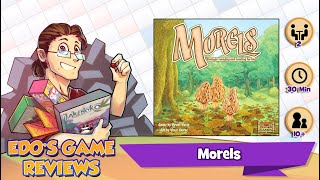









The woods are old-growth, dappled with sunlight. Delicious mushrooms beckon from every grove and hollow. Morels may be the most sought-after in these woods, but there are many tasty and valuable varieties awaiting the savvy collector. Bring a basket if you think it's your lucky day. Forage at night and you will be all alone when you stumble upon a bonanza. If you're hungry, put a pan on the fire and bask in the aroma of chanterelles as you sauté them in butter. Feeling mercantile? Sell porcini to local aficionados for information that will help you find what you seek deep in the forest.
Morels, a strategic card game for two players, uses two decks: a Day Deck (84 cards) that includes ten different types of mushrooms as well as baskets, cider, butter, pans, and moons; and a smaller Night Deck (8 cards) of mushrooms to be foraged by moonlight. Each mushroom card has two values: one for selling and one for cooking. Selling two or more like mushrooms grants foraging sticks that expand your options in the forest (that is, the running tableau of eight face-up cards on the table), enabling offensive or defensive plays that change with every game played. Cooking sets of three or more like mushrooms – sizzling in butter or cider if the set is large enough – earns points toward winning the game. With poisonous mushrooms wielding their wrath and a hand-size limit to manage, card selection is a tricky proposition at every turn.
Following each turn, one card from the forest moves into a decay pile that is available for only a short time. The Day Deck then refills the forest from the back, creating the effect of a walk in the woods in which some strategic morsels are collected, some are passed by, and others lay ahead.
- Beautiful art
- Solid tension between placement and scoring
- May not be a forever game
- Array
- Arctic exploration
- Strategic, card-driven
Mechanics (from transcript analysis)
- card drafting — Cards are drafted and placed to drive scoring across several criteria.
- Card placement — Placed cards contribute to multiple scoring tracks as the tableau develops.
- dice placement — Placed cards contribute to multiple scoring tracks as the tableau develops.
Video topics + discussion points
Quotes (from this video)
- I love Shallow Sea. I am really enjoying this one.
- I do not think it's forever game.
- There’s a fun little tension of laying cards down and trying to min-max where each card goes as it goes towards multiple scoring criteria.
- The Druids of Adora, I cannot wait to give you a review on this one, but I need more plays first.
- Onward is replacing Guards of Atlantis.
- Way Too Many Cats had way too many symbols and things going on to be able to at a glance understand what's happening.
References (from this video)
- small and portable
- fast gameplay (about 15 minutes)
- clever drafting and tableau scoring
- cool app prototype that enhances play
- limited depth due to short playtime
- gimmick (the song/visual gimmick) is optional and may be unnecessary
- mythology, danger of temptations, song-based scoring
- Ancient Greek myth: Odysseus and the Sirens lure sailors with song
- myth-inspired, narrative through scoring
Mechanics (from transcript analysis)
- card drafting — Two-round drafting of three cards per round with pick-pass mechanics
- pattern/flow scoring — Scoring based on color groups, flows between colors, and set collection-like bonuses
- tableau building — Arranging drafted cards into a scoring tableau to maximize patterns and color flows
Video topics + discussion points
Quotes (from this video)
- it's small it is portable
- the app is so cool
- it's a 15 minute game
- the gimmick is completely unnecessary but it is fun
References (from this video)
- High interactivity between players
- Dynamic scoring with color and adjacency incentives
- Engaging drafting mechanic with floating components
- Strong production quality and tactile components
- Not ideal for players prone to analysis paralysis
- Downtime can be noticeable at higher player counts
- Theme is abstract and may lack thematic immersion
- Abstract puzzle with color/adjacency scoring
- Floating components and floating boards between players in an abstract puzzle space
- Minimal narrative; emphasis on interactivity and strategic drafting
- Azul
Mechanics (from transcript analysis)
- drafting — Draft a card from a central area into your play area during your turn.
- Dual scoring patterns — Score based on color adjacency and/or spatial adjacency on scoring boards.
- Floating boards — Central/distributed boards between players create shared, dynamic scoring opportunities.
- Immediate scoring opportunities — Some cards can score immediately when activated, affecting turn tempo and tension.
- Round bag draft — Six stones are drawn from a bag and distributed to players, influencing drafting choices.
- Spell module — Optional modules that allow moving/removing tiles or obtaining specific tiles for benefit.
- Token placement and activation — Place a token on a card to activate it for scoring during the scoring phase.
Video topics + discussion points
Quotes (from this video)
- this game does some very unusual things
- I think this game is for Lovers of abstract strategy games
- we like interactivity in our games anyway so if it's going to be like a Euro game or an abstract puzzle game we like a high level of interactivity
- it's a really clever design
- one of my favorite games
References (from this video)
- Time travel and elemental energy interplay in abstract puzzle form
- Temporal exploration to locate Dominic Day; time travel and portal creation.
- abstract/puzzle-driven
- Ticket to Ride
Mechanics (from transcript analysis)
- Charging and placement — Charge key cards by placing required tokens, then place charged cards onto one of two elemental boards in ascending order for placement and scoring.
- drafting — Draft key cards and elemental tokens from dedicated drafting areas; card charge requirements shape early choices.
- End scoring — Total victory points across cards and board adjacencies determine the winner.
- Module support — Optional Magic Spells and Secret Signs modules add new actions and scoring twists; solo mode provides puzzle-like play.
- phase-based play — Four rounds, each with three phases: drafting, placing charged cards, and cleanup.
- Secret signs (module) — Secret patterns that grant bonus points when matched on boards.
- Shared boards — Players share two elemental boards; access is limited to the boards on your left and right.
- token placement and scoring — Place tokens on key cards and score points for color matches and adjacency on the elemental boards.
Video topics + discussion points
Quotes (from this video)
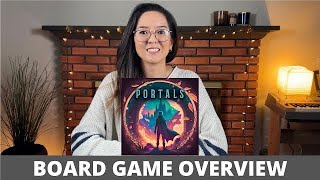
- Portals is absolutely gorgeous as you can tell by the cover
- this is probably one of my favorite covers I ever seen on a game
- the theme is there but you're definitely doing something very abstract it is very puzzly
- it plays one to four players which is exciting it has a solo mode
- the magic spells module and secret signs module add depth
References (from this video)
- accessible and quick to learn
- compact travel-friendly size
- prototype may differ from final production
- portal travel and puzzle solving
- multiverse portals; missing Dominic Day
- abstract/strategy puzzle
- Forever Home
Mechanics (from transcript analysis)
- abstract strategy drafting — Draft elemental stones from different areas; place on key cards; solve color-mit matching puzzles.
- action drafting — Draft elemental stones from different areas; place on key cards; solve color-mit matching puzzles.
- color-matching scoring (solo) — Score points by matching colors with board and key cards.
Video topics + discussion points
Quotes (from this video)
- Hadrian's Wall is my favorite game of all time
- I love the theme, it warms my heart
- The end of the first chapter broke my heart
- Portals is an abstract strategy game
References (from this video)
- Engaging solo puzzle with clear, actionable planning
- Compact setup and quick-turn flow in solo mode
- Rotatable patterns and spell interactions create depth
- Explicit, step-by-step teaching through demonstration
- Some players may find the color-matching and pattern-rotation loop repetitive over long sessions
- Rulebook availability and designer/year details are not provided in the video
- Magic keys, portal-based exploration, color-driven resource management
- A fantasy-inspired world-hopping adventure where a traveler follows a legendary wizard across multiple realms by collecting magic keys and opening portals.
- Solo, tutorial-driven, live-playthrough with learning-by-doing emphasis
- Evolution: Another World
- Fabled
Mechanics (from transcript analysis)
- card tableau management — Player selects key cards to place in a personal tableau; the tableau can hold up to four cards and refills after a card is taken.
- Elemental board pattern matching — Stones must match a rotating color pattern on the Elemental board; rotations enable flexible alignment of colors to maximize scoring.
- Pattern Building — Stones must match a rotating color pattern on the Elemental board; rotations enable flexible alignment of colors to maximize scoring.
- Scoring by completed cards — Points are earned based on how many stones match the Elemental board after completing a key card; matching more stones yields disproportionately higher rewards.
- Secret sign cards — Hidden patterns that yield bonus points when achieved on the board; patterns can be rotated to fit various layouts.
- Spell board actions — A set of four spells lets you move stones, activate key cards early, remove stones, or relocate stones from spells to key cards. Colors are color-locked per spell.
- Stone placement and resource flow — Colors of stones are placed on key cards; full rows enable moving stones to the Elemental board where color patterns matter for scoring.
- tableau building — Player selects key cards to place in a personal tableau; the tableau can hold up to four cards and refills after a card is taken.
Video topics + discussion points
Quotes (from this video)
- complete solo play of portals
- setup is fairly different from a multiplayer game
- our final score is 39 points
- we were one point away from being a master Mage
- you can look here to see how we did
- we've completed this card purple white purple green that's another four points
References (from this video)
- favorite box art style with circular portal motif
- color palette is appealing
- dimensional travel / portal exploration
- portal imagery with leaves and circles
- puzzly / abstract
- Crafting the Cosmos
- Wondrous Creatures
Mechanics (from transcript analysis)
- token drafting / layout placement — place tokens to create card layouts via portal circles
Video topics + discussion points
Quotes (from this video)
- Spirits of the Forest. Absolutely gorgeous box cover. I am just obsessed.
- I can't stop staring at it.
- Mysterium's box cover is gorgeous.
- I love the box art for Portals—the circle and portal motif just draws you in.
- Flamecraft is just so, so pretty.
References (from this video)
- Unique theme
- Interesting hand management
- Humorous narrative
- Limited hand size
- Complexity of collection
- Mushroom collection and cooking
- Forest foraging
Mechanics (from transcript analysis)
- hand management — Limited hand size, collecting mushrooms of same type to cook
Video topics + discussion points
Quotes (from this video)
- More than any video I've ever made I would swear by these games
- We've played over a thousand games together
References (from this video)
- strong tension and desperation as mushrooms vanish
- thematic humor (fun guy pun) lands well
- clear decision space with meaningful trade-offs
- might feel niche to players who dislike mushroom theming
- thematic humor can be hit-or-miss depending on players
- fungal foraging, resource management and cooking
- foraging for mushrooms in a forest
- humorous, light-hearted
Mechanics (from transcript analysis)
- foraging pressure and timing — Mushrooms disappear as the forest progresses; timing matters.
- hand management and set collection — Gather mushrooms, decide which types to keep for scoring.
- resource economy (pan, butter, cider) — Use frying pans to cook, and use butter or cider to boost points.
- risk versus reward decisions — Choose between easy but low-value mushrooms vs. rarer high-value options.
Video topics + discussion points
Quotes (from this video)
- Tac just flows.
- The fugitive is moving from one hideout to the next, leaving a trail behind him, but his options are limited.
- Each player has a god card, a special power that sets them apart.
- There are hundreds of god combinations, it's impossible to master Santorini.
- Sigrada is a delightful but cunning puzzle about making stained glass windows that will involve no broken glass, metaphorical or otherwise.
- The morel of the story is that you can't do everything, especially if you want to be a fun guy.
References (from this video)
- Simple rules, deep tactical planning
- Interesting tile combinations and line-building
- Abstract theme, limited narrative
- tile-line building with symbols
- abstract word game with symbols
- none
Mechanics (from transcript analysis)
- tile placement — players place colored-symbol tiles in lines to score points based on line length and color/symbol matches
- tile placement / set collection — players place colored-symbol tiles in lines to score points based on line length and color/symbol matches
Video topics + discussion points
Quotes (from this video)
- you take the game of Scrabble and you get rid of all of the letters from the tiles and you replace them with colored symbols
- this is a very tactics heavy game
- from turn-to-turn you are reading hand of cards and planning around options
- the legacy aspect introduces new rules
- it's my number one
References (from this video)
- Interesting card mechanics
- Potential solo and cooperative variants
- Escape/racing
- Racing from a volcano
Mechanics (from transcript analysis)
- Card-driven movement — Players race down a track using cards, moving based on card differences
- set collection — Collecting cards and barrels
Video topics + discussion points
Quotes (from this video)
- I usually don't make vlogs, but I thought, you know what? I will just record something.
- These are all the things that we played today.
- I usually always get at least one turtle when I'm on vacation.
References (from this video)
- Very relaxing two-player game
- Accessible hand management and quick play pace
- May feel repetitive for some players over many plays
- nature, foraging, set-building for scoring
- Forest foraging and mushroom collection for cooking
- cozy, domestic
- Lost Cities
- Race for the Galaxy
Mechanics (from transcript analysis)
- costly actions via sticks — Sticks act as a resource to pay for and enable card actions.
- hand management — On your turn you choose from the next two cards and manage set construction.
- set-collection and resource management — Collect mushroom types to complete sets for cooking points.
Video topics + discussion points
Quotes (from this video)
- Our commenters are way better than us.
- Segues—self-built segues—are a form of content engineering to keep the flow going.
- Relaxing endings are often found in simple games like Lovecraft Letter.