/pic4645233.jpg)
It’s the turn of the 20th century, the golden age of museums. As interest in and accessibility of museums grew exponentially, many institutions underwent an intense period of expansion on both an intellectual and physical level, searching to grow their collections for profit and science.
You play as a curator of one such museum and it’s your job to build the biggest, most coherent collection that you can in this game of collection and bartering featuring over 300 individual illustrations by Vincent Dutrait and authentic architectural facts. But it’s no simple task!
Each player in Museum has a small collection of relics to get them started, after which, they will have to send explorers around the world to uncover others. These relics each have a value which is either the cost to add them to your museum, or how much they contribute towards adding other relics to your museum. “Spent” Relics are added to your reserve. You can withdraw them from it by exchanging them for an equal number of items; however, your opponents also has access to your reserve!
During the game you will be required to assemble different collections. These can be from different categories (war, agriculture, architecture, etc) or periods (Ancient Egypt, Rome, Aztec, etc). Patron cards will give you bonus cards for amassing certain collections. Explorer cards will allow you to hire famous archeologists to confer bonuses to your museum and event cards will provide you with some game changing circumstances that you’ll have to work around, based on historical events!
All these different elements make compiling your collection an interesting and sometimes tricky experience! At the end of the game points are scored based on collections and their value and the player with the most points wins!
Solo play unlocked as a Kickstarter exclusive.

Museum in about 3 minutes

- Stunning art
- Fun core gameplay of building collections
- More player interaction than expected
- Enjoyable experience across different groups
- Came out of nowhere for the host, not initially aware of it.
- Running a museum, collecting artifacts
- Museum
Mechanics (from transcript analysis)
- Card Drafting — A card drafting set collection game about running a museum.
- Set Collection — A card drafting set collection game about running a museum.
- Take That — There's a little bit of take that in the game and you can take items from other people's discards.
Video topics + discussion points
Quotes (from this video)
References (from this video)
- Gorgeous artwork and presentation
- Interesting player interaction (sniping/stealing)
- Good for players who like set collection with light interaction
- Building a museum
Mechanics (from transcript analysis)
- Card Drafting — You can take cards from other people's discards.
- Set Collection — Museum is a set collection game about building collections in a museum.
Video topics + discussion points
Quotes (from this video)
References (from this video)

- Most beautiful looking games
- Interactive drafting
- Tricky card play
- Company went bankrupt, potentially out of print
- Curating a museum and collecting artifacts
Mechanics (from transcript analysis)
- Card Drafting — a tricky little car drive and set collection game
- Interaction — access other people's discard piles and take cards from them
- Set Collection — a tricky little car drive and set collection game
- Tableau Building — obtain artifacts to jam into your museum
Video topics + discussion points
Quotes (from this video)
References (from this video)
Mechanics (from transcript analysis)
Video topics + discussion points
Quotes (from this video)
- If you have any questions for me please write in the comment sections below
- You would help us by subscribing to Nippon University and hit the bell so you get notifications from us
- I also share my boardgame journey on Instagram so hopefully I'll see you there too
References (from this video)
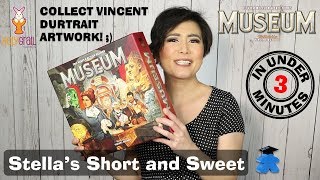
- Amazing artwork by Vincent d'etre
- Enjoyable picture of the artwork followed by flavor text
- Love the safe cards that help your game a lot
- Xplit cards have great functions like using the cross when adding relics or adding a color/symbol to your set collection at the last moment.
- Tricky to arrange relics cards as you need to put them next to each other to score points.
- Decorating a museum and collecting relics
- 20th century
Mechanics (from transcript analysis)
- Hand Management
- Set Collection — Collecting relics based on color and logo to your player board and arranging them next to each other to score points.
Video topics + discussion points
Quotes (from this video)
- If you have any questions for me please write in the comment sections below
- You would help us by subscribing to Nippon University and hit the bell so you get notifications from us
- I also share my boardgame journey on Instagram so hopefully I'll see you there too
References (from this video)
- Easy to teach
- Satisfying to build a collection
- Genuine sense of completion
- More interaction than other set collection games
- Collection goals give a good steer
- Favor cards shake up the game
- Stunning art
- Wonderful overall presentation
- Troubling theme of taking cultural treasures
- Some combinations of secret objectives were exceptionally powerful together
- Building the greatest collection of relics of the world as a museum curator
- 1900, the great imperial powers are busy collecting the treasures of the world to house in their great museums
- Ex Libris
- Seven Wonders
Mechanics (from transcript analysis)
- action selection — each turn is split into two main phases, the exploration phase and the action phase. The most common action to take is a furbish action which allows you to add objects to your museum. You can also add cards to your museum from your discard. Other players can add cards from your discard to their museum by paying the cost to your discard and giving you one prestige. the other main action is to refill your hand from your discard pile to seven cards. You can also recruit experts and arrange your collections.
- Drafting — each turn you will gain new objects from the board. there are two objects for each region available and the active player must select one to keep
- Hand Management — refill your hand from your discard pile to seven cards
- Press Your Luck — The game ends a turn after one player passes 50 points.
- Public Opinion — you lose points due to negative public opinion. if any are public opinion cards add a public opinion market to that region. cards in your discard at the end of the game from this region will lose you points.
- secret goals — points are earned from having collections of objects completing, secret goals
- Set Collection — objects earn more points when collected in sets. your collections need to be lined up well
Video topics + discussion points
Quotes (from this video)
- Kia Ora Koutou and welcome to museum in about three minutes
- Dateline: 1900 and the great imperial powers are busy collecting the treasures of the world to house in their great museums
- you are the curator of one of these museums riding the wave of growing public interest in the world
- Can you build the greatest collection of relics of the world? Or will public opinion turn against you, branding you as nothing more than a tomb robber?
- the game ends a turn after one player passes 50 points.
- points are earned from having collections of objects completing, secret goals, and filling your museum
- and you lose points due to negative public opinion
- competitive: only one player can have the most prestigious museum
- drafting: each turn you will gain new objects from the board
- set collection: objects earn more points when collected in sets
- each turn is split into two main phases, the exploration phase and the action phase
- the most common action to take is a furbish action which allows you to add objects to your museum
- To put an object in your museum you must discard cards of equal or greater value, you can also spend prestige
- you can add as many objects to your collection as you can afford
- they can only do that on their action turn
- the other main action is to refill your hand from your discard pile to seven cards
- for each object you placed in your museum advance your score marker
- when you pass one of these markers collect the favor card
- they are cards you can play in your turn for powerful bonuses
- you also recruit experts paying their cost and adding them to your museum
- and finally you can arrange your collections
- to score the most points your collections need to be lined up well
- after you are done replace the drafted cards and if any are public opinion cards add a public opinion market to that region
- cards in your discard at the end of the game from this region will lose you points
- and at the beginning of the first player's turn draw a headline card and resolve its effects
- why would you like this game?
- the core gameplay of museum is really straightforward draft cards and build collections
- and that makes it a game that's really easy to teach
- but it's also really satisfying to build a collection up, to snap up an object you need from someone else's discards
- and there's a genuine sense of completion
- there's also a bit more interaction than some other set collection games due to the ability to go after people's discards
- The collection goals give you a good steer from the start of the game
- and the favor cards give the game a shake up from time to time
- the best thing about this game is the art
- it's just stunning from top to bottom
- this is one of my favourite games in terms of overall presentation it's just wonderful
- however, the taking of cultural treasures, or Tāonga from around the world into colonial powers museums is a troubling topic for many
- so if you find that a sensitive topic this game might not be for you
- and we also found some combinations of secret objectives were exceptionally powerful together
- we ruled that you can't keep two objectives solely focused on the same civilization
- you want to build a collection but books are more your thing try ex-libris
- and if you like history and set collection there's also seven Wonders
- Museum an artwork in my personal collection
- if you enjoyed this video like it subscribe to the channel and support us on patreon
References (from this video)
- Engaging set-collection core with a museum-building payoff
- Thematic and aesthetically cohesive with an art-market flavor
- Clear objective to acquire, display, and refine collections
- Availability may be limited due to publisher status
- Older production quality may vary across copies
- Set collection and market-driven art acquisition within a prestige-focused museum-building motif.
- An art-world market environment where players assemble and exhibit a private museum, drawing from international markets to curate pieces for display.
- Array
- Museum Picture
Mechanics (from transcript analysis)
- Compound Scoring — Points are earned by how well pieces are grouped into themed displays and how efficiently the museum is built.
- exhibit scoring — Points are earned by how well pieces are grouped into themed displays and how efficiently the museum is built.
- market trading — Pieces are exchanged among players and with a market, creating dynamic negotiation and price-pressure decisions.
- Set Collection — Players collect art pieces to complete specific sets and maximize scoring opportunities tied to those sets.
Video topics + discussion points
Quotes (from this video)
- Holy Grail games unfortunately did not make it through the pandemic
- Museum was a set collection game where you were buying art pieces from International markets and exhibiting them in your Museum
- Picture are about to go out of print
- I can't really pick I have both
- I also have the expansions for Museum Picture they are still available despite the company going under
- it's going to play in about 60 Minutes for two to four players
References (from this video)
- Beautiful artwork and visually appealing components that reinforce the museum theme
- Strong set-collection backbone with clear, satisfying scoring paths
- Good variety and replay potential thanks to continent diversity and occasional expansions
- Accessible entry with deep strategic layers for experienced players
- Pacing can feel methodical or slow for some players
- Scoring rules and end-game conditions require careful tracking and can be complex on first play
- End-game triggers can feel abrupt if a deck is emptied, potentially leaving late starters with less agency
- Set-collection and museum curation across continents to maximize points from collections and exhibition value.
- The contemporary world across continents where players curate a physical museum by collecting and displaying relic cards.
- Informative, demonstrative, tutorial-like with live play-by-play explanation.
Mechanics (from transcript analysis)
- End Game Bonuses — The game ends when a score marker passes 50, or when two of the continent decks are emptied; timing affects final scoring.
- End-game conditions — The game ends when a score marker passes 50, or when two of the continent decks are emptied; timing affects final scoring.
- Events — Headline cards spawn events that can help or hinder players during rounds after each full turn cycle.
- Exhibit and discard-pile management — Exhibit cards to the Museum by paying costs with hand cards and/or Prestige; cards come from hand or other players’ discards.
- Exploration phase — Active player selects from available continent cards first; subsequent players may take from any continent, creating a prestige flow.
- Free actions (experts and favors) — Hire experts (costs Prestige) and play favor cards for either common effects (gain cards) or unique effects, expanding strategic options.
- Headlines and events — Headline cards spawn events that can help or hinder players during rounds after each full turn cycle.
- Influence Points — Prestige points serve as a currency to exhibit cards and hire experts; they can also be gained via inventory or other effects.
- Inventory action — Discard the entire discard pile back to hand, gain a Prestige point, and draw a favor card; prevents ongoing hand build-up.
- Prestige system — Prestige points serve as a currency to exhibit cards and hire experts; they can also be gained via inventory or other effects.
- Public Opinion tokens — Public opinion cards/tokens affect scoring possibilities and end-game points based on continents and discard piles.
- Set Collection — Players form collections (civilizations and domains) by placing cards in their Museum, scoring points based on collection size and type.
- Spatial organisation (museum layout) — Cards placed in the Museum must be arranged so sets can be formed — adjacency and alignment influence scoring, akin to a gallery layout.
Video topics + discussion points
Quotes (from this video)
- and well that's Museum and this is one of the best set collection games out there
- there is not that much going on besides collecting cards and using cards to place your other cards in your Museum
- you gotta love the art in this game
- grab the best relics with your family and friends in museum
- this is a set collection game by Holy Grail games
- the bigger your collection is or of whatever type the more points you'll get
References (from this video)

- Beautiful historical illustrations
- Approachable for both new and accomplished gamers
- Adjustable difficulty
- History, set collection
- World's museum, historical artifacts
- educational, strategic
Mechanics (from transcript analysis)
- History-based information — Artifacts are depicted with historical details; strategy adjustment.
- Set Collection — Collect artifacts to score.
Video topics + discussion points
Quotes (from this video)
- it's fun it's pink and it has lots of unicorns
- a large tera sized card deck with a lot of dragons
- cards feature only artwork with no text or iconography making it completely language and color independent
- drinking card game I had the joy of playing in myself and had lots of fun
- it's all about historical set collection
- it's a 4 to 10 player social detection game full of paradoxes and destruction
References (from this video)

- absolutely gorgeous to look at
- art and flavor text are compelling
- flow and pacing feel natural
- set collection may feel predictable after multiple plays
- curating exhibits across cultures
- world history museums and artifacts
- spatial puzzle with heavy art flavor
Mechanics (from transcript analysis)
- Set Collection — collect artifacts and arrange them into themed exhibits
- set collection / exhibit organization — collect artifacts and arrange them into themed exhibits
- Spatial Puzzle — optimal arrangement of cards on a shared or personal board
Video topics + discussion points
Quotes (from this video)
- it's a really therapeutic game
- the production is gorgeous
- I just enjoy looking at all the arts
- extremely relaxing to play
- I don't care about winning, I just enjoy the process
- lose myself in this one
References (from this video)

- most beautiful board games made
- gorgeous art
- clever mechanics
- rewarding collection building
- clever discard mechanics
- out of print
- company went under
- getting hard to find
- building art collection
- art museum
- aesthetic_collecting
Mechanics (from transcript analysis)
- Card Drafting — card drafting game
- discard pilfering — take cards from other players' discard piles
- Set Collection — set collection game
Video topics + discussion points
Quotes (from this video)
- this is my list the video says the top 100 board games of all time but it really is just my top 100 board games of all time
- three minute board games is an independent channel we dont take money from publishers and we do not do any form of paid content
- Mosaic has the ambitious goal of being a civilization game that can be played in two to three hours and it very much succeeds at this goal
- a game that does not need to be played with a traitor because the inherent selfish goals in this game created enough internal conflict
- I love space racing games and space corp is the game that is most racy as far as space racers go
- the term I use instead of gateway game is foundation game
- Sentinels could easily be a forever game the kind of game you just play over and over and over and over again endlessly
- Modern Art is a simple and brilliant and beautiful game and easily the best pure auction game Ive ever played
- Black Orchestra models some very clever things about how conspiracy is run
- when I asked the question hey what game should I play with my non-gamer friend who's interested in gaming but hasn't done much gaming I almost always answer Sentient Golem Edition
- Arkham Horror is the game that really made board gaming my number one hobby
- there are a few things more fun and rewarding in board gaming than organizing a fight in the arena
- Twilight Struggle is one of the best head-to-head games out there
- Santorini is the definition of an elegant design
- Arkham Horror the card game absolutely should be for you it's a hundred percent for me and it is my number one game of 2023
References (from this video)

- Stunning artwork and production
- Elegant dual-use card system (points and currency)
- Joyful and engaging to play with family and friends
- Can be heavy for players who dislike long setup or multiple layers
- curation, cultures, and genres
- Museum gallery of artifacts from around the world
Mechanics (from transcript analysis)
- currency/card economy — Cards serve as both scoring vehicles and currency to acquire more cards.
- deck/market interaction — Use discard piles and markets to influence what can be bought.
- Set Collection — Assemble artifacts into themed collections to score points.
Video topics + discussion points
Quotes (from this video)
- I thought 2019 was a really strong year for board gaming.
- it's just a nice, pleasant game there and I really hope this one gets some wind behind it sails because it's a really nice game.
- an absolute masterpiece in my opinion.
- Trismegistus the ultimate formula definitely my top game of 2019.
- this is undoubtedly the best deduction game out there.
- Museum is as you can see it has to be wonderful to look at artwork by vintage rate, who is undoubtedly probably the best artist in the business.