


































My City Deep Dive
What the Community Thinks About My City
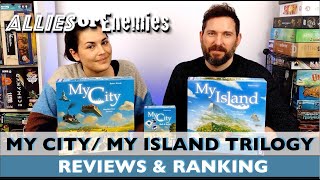
My City, designed by Reiner Knizia and published by KOSMOS, landed in 2020 as something genuinely unusual: a competitive legacy game built entirely on polyomino tile placement. The community response is enthusiastic but divided, and those divisions are revealing.
For reviewers who clicked with it, the reaction borders on evangelical. All You Can Board called it the number one game of 2020, describing it as "a legacy polyomino game, which is a genre mashup that I didn't know I needed but absolutely did." No Pun Included went even further, calling My City "a masterclass of emerging game design" and praising the way Reiner Knizia uses the legacy format to deliver a "roller coaster ride of plot twists." Rolls in the Family, currently mid-campaign, praised the low-pressure pacing, noting that My City doesn't carry the heavy commitment anxiety of larger legacy games.
The skeptics, meanwhile, center their criticism on the legacy wrapper itself. Adam in Wales, who completed the full campaign, felt conflicted: he genuinely enjoyed the experience but questioned whether the legacy format was necessary, arguing the game's variable scoring rules could simply have been a deck of cards for infinite replayability. Board Games Unlocked rated My City a five out of ten, finding the 24-episode arc overstayed its welcome and the legacy changes too incremental to sustain interest across the full campaign.
What nearly everyone agrees on: the core polyomino puzzle is clean and satisfying, the games play fast, and accessibility is genuine. The disagreement is almost entirely about whether the campaign structure earns its place.
Core Mechanics That Define My City
Polyomino Tile Placement
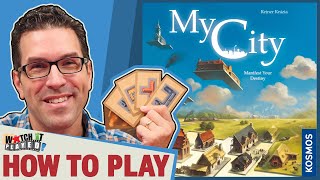
The engine at the heart of My City is as simple as it gets: each round, a construction card is flipped from a shared deck, every player finds the matching tile, and everyone places simultaneously. As Watch It Played explains in its rules tutorial, your first tile must be placed along the river, and every subsequent tile must connect orthogonally to something already placed. You cannot flip pieces, only rotate them. All players work with the same sequence of shapes but build completely independent cities, so divergent board states emerge quickly.
No Pun Included captures what makes this mechanic sing in practice: Knizia "gamified our lizard brains." Because tiles can only face one way, a Z-shaped gap will not always accept the Z-shaped tile when it arrives. The reviewer describes "involuntarily a plan starts forming in your head" only for the next draw to demolish it. This tension between preparation and improvisation is what separates My City from more sedate tile-placers.
Legacy Campaign Structure
My City spans 24 episodes divided into eight chapters, with components and rules sealed in envelopes that open three episodes at a time. As Gaming Rules! explains in its walkthrough of the digital version, new rules layer in progressively: episode one is pure placement, episode two adds scoring for grouped buildings by color, episode three introduces wells with adjacency bonuses, episode four adds mandatory church tiles. The game accumulates rules rather than replacing them, so later episodes carry the full weight of everything that came before.
The catch-up mechanism built into this legacy structure is notable. As Gaming Rules! describes, episode winners must place a rock sticker permanently on their board (a future penalty), while last-place finishers receive tree stickers (bonuses). This compound scoring keeps the campaign competitive. All You Can Board noted that even a bad game barely stings because you move immediately to the next episode: "one of the really fun parts about legacy games is when things are opening and things are changing, well this game just constantly puts you into a new situation."
The My City Experience
Discovery-Driven
The most distinctive thing reviewers describe about playing My City is the feeling of gradual revelation. No Pun Included spends considerable time on this: the early episodes seem deliberately sparse, almost underwhelming, but each new chapter introduces a rule that "seems utterly ludicrous but changes everything I understand about how this game works." That disorientation, followed by the dawning realization that you have adapted and are starting to master the new system, is the core experiential loop.
All You Can Board put it precisely: "play chapter three and you're familiar with the base mechanics but they've twisted in this brand new way that makes you have to rediscover everything." This quality of perpetual rediscovery is what separates My City from games that simply add complexity. Each envelope restarts the learning curve rather than extending it.
Cozy and Breezy
Despite the competitive scoring and the legacy stakes, My City plays fast and light. Rolls in the Family noted that individual episodes take roughly 15 minutes, making it possible to play through an entire chapter, including the between-episode envelope openings, in under an hour and a half. This pace removes the scheduling pressure that often accumulates around legacy games. There is no sense that you must block out an entire evening or lose momentum.
Adam in Wales played the full campaign with his wife over three or four days, and while his assessment was mixed, he acknowledged that "it was the legacy thing that drove me and my wife to play the entire thing" because they kept wanting to open the next envelope. All You Can Board described it as ideal for playing with a partner that will last multiple sessions "but doesn't demand hours and hours of your time each time you sit down."
What Makes My City Stand Out
Simultaneous Play That Scales Tension Intelligently
The simultaneous placement structure is not just a time-saving convenience. No Pun Included highlights the game's rule that pieces should be placed immediately after the card is flipped, arguing this quasi-time-pressure "stops you from overthinking it" while creating a comedy of cascading errors. Once placed, tiles cannot be moved, so a wrong placement locks in. The result is that "you might have just made the silly mistake of your game but oops too late time to make another one and another one." Individual frustration becomes shared entertainment.
Accessible Entry, Genuine Depth
My City is deliberately designed to be learned in under a minute. All You Can Board described the chapter one experience: "you flip a card and whatever tile it tells you to place, you place it. That's the game to start." Gaming Rules! noted that chapter one is so simple it might seem slight, but over 24 chapters, more and more rules layer in. This ramp means the game can be introduced to non-gamers without friction, then grow into something with genuine decision density. Rolls in the Family highlighted how the core puzzle, "how am I going to fit everything together in the most efficient way possible," is accessible to anyone who enjoys spatial thinking.
Potential Drawbacks
A Legacy Structure That May Not Earn Its Format
The most persistent criticism is that My City does not fully justify being a legacy game. Adam in Wales argued the variable scoring criteria could simply have been dealt from a card deck, giving the game infinite replayability without destroying components. He felt the legacy framing was "a slightly cynical marketing ploy." Board Games Unlocked went further, arguing the polyomino puzzle is "serviceable" but there is "not enough that the game brings to the table to keep that interesting" across 24 repetitions. The sticker-based catch-up mechanisms struck that reviewer as minimal: "that's the game for 24 episodes, it barely barely adjusts the needle."
Diminishing Returns in the Late Campaign
Even enthusiastic reviewers flag the back half of the campaign. No Pun Included acknowledges that around chapter six, "things get a little bit more thinky to the point where if you follow this rule at all the game would stop making sense." Board Games Unlocked suggested the game works better as a chapter-per-week experience rather than a marathon, and described being burned out by chapter three when playing concentrated sessions. The eternal mode on the reverse of the boards received little enthusiasm: Adam in Wales said at that point the game becomes "pretty forgettable," and he would always reach for Baron Park instead.
If You Enjoy My City
Reviewers pointed toward a cluster of games in the polyomino and light-legacy space. Patchwork gets comparisons as a similarly tactile, cozy two-player tile-placement experience. Adam in Wales grouped My City alongside Baron Park and Cartographers as accessible polyomino and grid-building games, ranking those two above My City for post-campaign replayability.
Board Games Unlocked mentioned Cosmic Colonies and Isle of Cats as fellow polyomino games for players who want the puzzle without the campaign commitment. Cartographers achieves similar variety through a deck of scoring objectives without any component destruction, making it the go-to post-campaign alternative for several reviewers. For players wanting a step up in complexity from the My City zone, Isle of Cats adds card drafting on top of the placement puzzle. Knizia's own follow-up, My Island, exists for those who want another campaign in the same style, though expectations should be calibrated.
What Reviewers Are Saying
"My city is a masterclass of emerging game design. The entire campaign is split up into eight chapters, each chapter is a play session but it's once again split into three episodes, each episode representing a game, meaning that when you sit down to play a game of My City you won't be playing one of them, you'll be playing three. Yet each time the rules will change. My City is like a roller coaster ride of plot twists where each time you start to get a handle on how it plays, it introduces a new rule that just seems utterly ludicrous but changes everything I understand about how this game works."
— No Pun Included
"This is a legacy polyomino game, which is a genre mashup that I didn't know I needed but absolutely did. The design is so tight and everything that they add makes every chapter feel like it's an expansion on the game, but a really good expansion on the game. Reiner Knizia is one of my favorite game designers and he's hit an absolute home run in marrying these two genres together."
— All You Can Board
"One of my favorite things about this is how fast it plays. You play a game of My City in like 15 minutes. And so you're just like, boom, play a game, okay cool, let's open the next thing, boom, okay. One of the really fun parts about legacy games is when things are opening and things are changing. Well this game just constantly puts you into a new situation."
— Rolls in the Family