/pic7825569.png)












My Favourite Things Deep Dive
What the Community Thinks About My Favourite Things
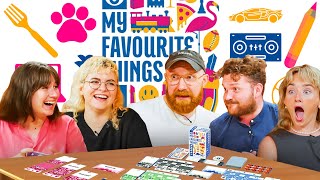
My Favourite Things occupies a unique space in the modern board gaming landscape. Reviewers like Game Night Picks and Grant's GameRex consistently highlight its unusual blend of two mechanics that rarely coexist: trick-taking gameplay combined with party-game sensibilities. This combination feels genuinely fresh, even within a hobby saturated with card games. The game has earned particular praise for its ability to generate memorable moments and conversations at the table, which reviewers identify as the true heart of what makes it work.
Core Mechanics That Define My Favourite Things
Trick-Taking Foundation
At its core, My Favourite Things is a trick-taking game where players compete to win tricks and collect points. The fundamental rule is simple: the player who plays the lowest numbered card wins the trick. There is one crucial exception: if a broken-heart card and a one are both played in the same trick, the broken-heart card trumps everything and takes the win. This twist on traditional trick-taking creates moments of tension and unexpected reversals that keep players engaged throughout.
The Hidden Ranking System
What sets My Favourite Things apart is how those card numbers come into being. Before each round, one player creates a category and passes it to another player, who then ranks items within that category on the cards themselves. These rankings are hidden from everyone else. The second player writes their five favorite items in that category onto cards numbered one through five, then slides a cover back over the numbers so no one else knows which item corresponds to which rank, and designates one item they actively dislike as the broken heart. When the cards return to the originating player for trick-taking, that player must guess and predict what their neighbor ranked, playing on intuition and knowledge of that person rather than certainty about the values.
The My Favourite Things Experience
The Social Engine
The actual experience centers far more on conversation and social interaction than on mathematical optimization. One reviewer described a game where the category was holidays, and a player ranked them Christmas first, Fourth of July second, and Thanksgiving third. This sparked genuine and prolonged disagreement, with others insisting the ranks were wrong and that Thanksgiving should rank higher. Months later, the conversation around those rankings persisted. The game essentially weaponizes personal knowledge, creating situations where players reveal how they actually think and then get challenged on it by people who know them.
Moments of Surprise and Revelation
Another memorable example involved a category about supermarkets. A player who had lived on the East Coast wrote down regional franchises completely unknown to the others, creating genuine confusion and hilarity during the trick-taking phase, because no one could mentally compare supermarkets they had never heard of. It led to meta-level conversation about regional familiarity and whether the ranking player was creating an unfair advantage. These moments, where card play becomes secondary to the stories people tell about themselves, define why the game resonates with reviewers.
What Makes My Favourite Things Stand Out
A Fresh Concept in Party Gaming
Reviewers emphasize that the concept feels genuinely unusual. Most party games run on a small set of proven templates: drawing, word association, bluffing. My Favourite Things takes the formal structure of trick-taking, a mechanism usually found in traditional card and strategy games, and uses it to create social tension and revelation. This cross-pollination is something reviewers note they have rarely seen. The game succeeds not because the trick-taking strategy is deep, but because the trick-taking serves as a vehicle for the party experience.
Accessibility Across Player Knowledge
One significant strength is that each round automatically generates a completely unique set of card values. Because players write their own rankings, the cards in your hand in round two look nothing like the cards in round one. This means experienced strategy players cannot gain a persistent advantage through memory or pattern recognition. Everyone resets and must recalibrate their understanding of which neighbor is which and what they might value. The game scales naturally to any table, because the strategic depth depends entirely on how well you know the people you are playing with.
Potential Drawbacks
Regional and Knowledge Gaps
The game relies on shared cultural reference points, or at least a shared willingness to navigate unknown territory. A player choosing a very niche category, or writing references most of the table has never encountered, can inadvertently create something more confusing than fun. This is less a bug than a feature that demands thoughtful category selection. Reviewers suggest good categories are broad enough that anyone can form an opinion, but specific enough to stay interesting.
Availability and Distribution
Reviewers note that My Favourite Things can be challenging to obtain, particularly in North America, owing to limited printings in English-speaking markets. One reviewer ranked it lower on a list specifically because it is hard to get and was concerned about availability for interested viewers. This barrier is purely logistical rather than mechanical, but it is worth noting for players who fall for the concept and want to track down a copy.
If You Enjoy My Favourite Things
If the trick-taking-meets-party-game concept appeals to you, reviewers recommend other games that blend mechanics in unusual ways. Codenames similarly creates social moments through elegant simplicity, and Skull offers bluffing and mind games in a pared-down format. Wavelength leans into the same revelation of how people think by asking players to align on a spectrum, while Sheriff of Nottingham rewards reading the people across the table through social negotiation.
What Reviewers Are Saying
"The concept is weird and unique and fun, and I love it. It's a trick-taking card game where you play cards down to try to win tricks, and winning tricks gets you points. So there's some strategy here, but the cards you have in your hand are totally unique each game, because you write a category down. That category could be breakfast cereals, favorite Christmas songs, whatever you want."
— Game Night Picks - Pair Of Dice Paradise
"You each give another player a category, like favorite holidays or favorite 1990s artists, and they write their favorite things for that category on the cards. Then they cover up all the numbers and hand the cards back to you. Now you're playing a trick-taking game trying to play the lowest value card to win, but you don't know what they've written."
— Grant's GameRex
"I'm still talking about this with my sisters, because one of them is still mad that I ranked Fourth of July as my number two and Thanksgiving as my number three. She's like, no, you like Thanksgiving more. This game creates memorable moments, and I feel like it's way more unique than most party games because it still has that strategy, trick-taking, card-playing element to it."
— Game Night Picks - Pair Of Dice Paradise