/pic7849476.jpg)


















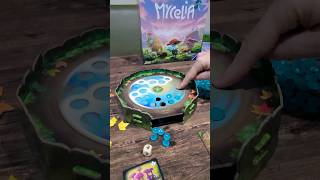















Mycelia Deep Dive
What the Community Thinks About Mycelia
Mycelia stands out as a surprising hit in the board game world. What began as a Kickstarter project that "broke the internet" has become a retail success story, delivering a fresh take on strategy gaming. Reviewers consistently praise the elegance of its design, balancing complexity with accessibility. The game offers something that feels different while maintaining clarity in its rules, making it a standout release in a crowded market. Whether players are seeking a nature-themed strategy experience, tactical depth, or simply beautiful card artwork, Mycelia delivers across multiple dimensions.
Core Mechanics That Define Mycelia
The Mycelial Network and Spore Placement
The heart of Mycelia lies in building and controlling your mycelial network through spore placement. When you spore a mushroom, the first spore always lands on the tile where that mushroom sits, then the wind die determines where subsequent spores spread. This mechanic intertwines randomness with strategy. Players must balance calculated risk against the unpredictability of the wind, rewarding smart placement while allowing tactical adaptation. The wind mechanic prevents the game from becoming rigid, adding a touch of wildness that energizes the board state. What makes this elegant is that your first spore is always guaranteed, meaning you can always plan around something specific, but the rest of the spread keeps you thinking on your feet.
Tile Placement and Network Control Through Dominance
Your mycelial network expands as you place mushroom tokens and spores across the modular board. Larger pieces dominate smaller ones, and your mother mushroom becomes your most powerful piece. When you move your mother mushroom onto a tile, you control all spores on that tile regardless of their color. This creates a dynamic of constant territorial negotiation. Players can deliberately block opponents by positioning their mother mushrooms strategically, cutting off network pathways and forcing difficult decisions. The network connectivity requirement means every placement matters. Spores must form unbroken links to be spent on fruiting new mushrooms, transforming the board into a living puzzle where control shifts with each movement.
The Mycelia Experience
Confrontational Strategy with Tactical Depth
While Mycelia carries a nature theme and mushroom aesthetic, it delivers a confrontational experience when players lean into competitive positioning. The game becomes a chess-like battle for board control and network dominance. You can deliberately block opponents, cut their networks, and claim their spores through strategic placement. This means every move matters, and the pressure builds as players compete to finish their mushroom lifecycles first. The game rewards efficient planning and punishes hesitation. Players must think several moves ahead while remaining flexible enough to respond to opponents' blocking tactics. This creates compelling back-and-forth gameplay where a single well-placed mushroom can shift the entire board balance.
Solitary and Puzzly Elements Within a Competitive Frame
Despite its competitive nature, Mycelia offers satisfying puzzle-like moments. Planning your network to string together the right spore colors, positioning your mushrooms to maximize future growth, and timing your spores to take advantage of the wind all reward careful thought. The decay mechanic adds another layer, as tucking cards beneath your player mat unlocks special abilities that can dramatically reshape your strategy. Some abilities enable more efficient sporing, while others grant ongoing benefits that persist for the entire game. This combination creates a solitaire-like satisfaction even in multiplayer, where you can focus on optimizing your forest ecosystem while staying aware of what opponents are doing. The game allows players to pursue their own puzzles while the competitive layer ensures those puzzles matter.
What Makes Mycelia Stand Out
Unique Triangle Tile Board and Wind-Driven Spore Spread
Most board games use square or hexagonal grids, making Mycelia's triangular tiles immediately distinctive. The three directions inherent to triangles align perfectly with the wind die, which shows three possible directions per symbol. Every location has three edges, three wind directions, and this thematic coherence makes the mechanics feel inevitable rather than arbitrary. The board grows organically as players explore, with each new tile bringing fresh tactical possibilities. Unlike fixed boards, the emergent shape creates different strategic landscapes in every game. Combined with the wind mechanic determining spore spread, the game creates meaningful uncertainty within a framework of strategic control. New players might see wind as chaotic, but experienced players recognize it as a spice that prevents predictability.
Deck-Building Integration Through Decay and Abilities
Mycelia merges area control with deck building through its decay mechanic. As mushrooms complete their lifecycle, the cards tuck beneath your player mat, permanently granting special abilities. This creates an engine-building aspect unusual for area control games. You accumulate abilities that make future actions more powerful, more efficient, or more flexible. Some abilities let you move extra spaces, spore additional mushrooms in one action, or permanently change how your mother mushroom behaves. The variety of decay abilities ensures that each game develops differently. Players pursuing different decay power combinations find themselves on distinct strategic paths. This transforms the game from pure territorial control into a hybrid that rewards both aggressive positioning and thoughtful deck optimization.
Potential Drawbacks
End Game Trigger Creates Rush-Driven Victory Patterns
The game ends the moment one player decays all mushrooms from their five slots, and that player receives a bonus tile worth five victory points. This sudden-death mechanism can create an interesting race, but some players report that rushing through decay becomes a dominant strategy. Whoever finishes first wins, which can feel more important than point accumulation. Experienced players may discover that the optimal path is simply to maximize decay triggers rather than carefully building their ecosystem. This can lead to games where players sprint through their mushrooms rather than exploring the subtle optimization puzzles the game offers. Players prone to analysis paralysis may find the pressure of a potential sudden end stressful rather than exciting.
Production Complexity and Colorblind Accessibility Concerns
While reviewers praise the card artwork, the triangular board presents visual challenges. The Celtic-inspired pattern covering the tiles, while attractive, creates a busy visual field that can obscure tile distinctions. Colorblind players report difficulty differentiating tile types, as the symbolic indicators added for accessibility remain too small to easily reference. The prototype versions shipped with symbols too faint to read comfortably without cross-referencing against cards repeatedly. Though the designer acknowledged this issue and promised enlargement for final production, this remains a concern for players with color vision deficiency. The board state becomes visually dense as play progresses, with spores, mushroom tokens, and mother mushrooms creating a congested landscape. Finding specific information quickly can become a challenge even for players with standard color vision.
If You Enjoy Mycelia
Players drawn to Mycelia likely enjoy games combining engine building with territorial control. Wingspan offers a similar nature theme with beautiful artwork and card-based progression, though with less direct player interaction. The Quest for El Dorado pairs deck building with a race to the finish, creating that same interplay of building your capabilities while racing toward a goal. Sunrise Lane provides lighter area control and tableau building with a serene aesthetic. Hey That's My Fish offers pure, mean area control in a compact package without the deck building complexity. For players specifically interested in spore-spreading mechanics and network-building, few games match Mycelia's unique approach, making it a natural centerpiece for gaming groups seeking strategic depth wrapped in a distinctive theme.
What Reviewers Are Saying
"It has a wonderful production, it does something in a unique and interesting way, it is highly interactive and strategic with a heavy dose of tactics in there as well. The artwork is absolutely sublime."
— Board Stupid
"The gameplay is just so good and honestly I'm quite surprised because this game does have quite a bit of player interaction and battling between players, which is something that I typically don't like in games. But in Mycelia I feel like it's simple enough that the back and forth creates a really nice dynamic."
— The Board Game Garden
"This is a very light game, you can play this with kids, you could play with your family, but we as two adults who have played hundreds of games at this point really enjoyed it. When I first read the rule book I was like oh wow this is really light, but it's light and fun."
— Foster the Meeple