






















Collection Status
Your Rating
Description
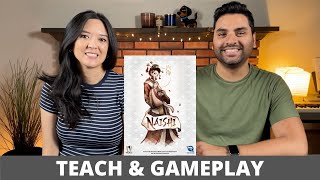
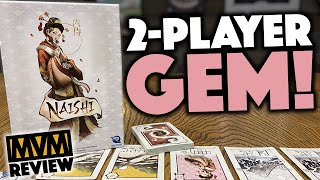
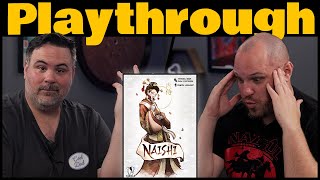
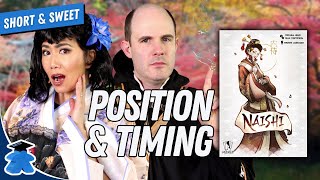
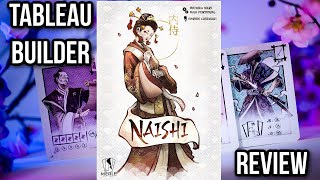
In Naishi, you will seek to improve your Japanese state as efficiently as possible. However, you will not be free to change the positioning of your cards at will. You must replace the cards in your hand and in your tableau with cards from the central river while respecting their positioning. You will also have the possibility to send your emissaries to reorganise states, create new opportunities or force your opponent into a trade
Year Published
2024
Featured Videos
Transcript Analysis
Browse transcript mentions, sentiments, pros/cons, mechanics, topics, quotes, and references.
Total mentions: 9
This page: 9
Sentiment:
pos 8 ·
mix 1 ·
neu 0 ·
neg 0
Showing 1–9 of 9
Video GXpsdYfXaiU
Unknown Channel general_discussion at 0:16 sentiment: positive
video_pk 62687 · mention_pk 155384
Click to watch at 0:16 · YouTube ↗
Overall sentiment (raw)
positive
Pros
- Cyberpunk theme
- Big production values
- High expectations
Cons
none
Thematic elements
- Array
- Cyberpunk future
- promotional preview
Comparison games
none
Mechanics (from transcript analysis)
Mechanics unknown.
Video topics + discussion points
No key topics recorded for this video.
Quotes (from this video)
- Dungeon Crawler Carl: Unstoppable, a solo or two-player deck builder with card crafting in that wild DCC world.
- "Tamashi from Awaken Realms. This game's got a cyberpunk theme, big production, big expectations, and I think might reach over $2 million."
- "So, which one are you backing?"
References (from this video)
No references stored for this video.
Video nHKhnkKMacg
Unknown Channel game_review at 0:02 sentiment: positive
video_pk 41883 · mention_pk 127023
Click to watch at 0:02 · YouTube ↗
Overall sentiment (raw)
positive
Pros
- Elegant, tight rules with depth in placement and order decisions
- Strong two-player focus with meaningful interaction via visible line and hidden hand
- Clear, position-based scoring that rewards planning and foresight
- Accessible to learn, but with room for strategic optimization
Cons
- Two-player-only design limits group play
- Rule constraint to not reorder cards can feel restrictive for some players
Thematic elements
- Political strategy and territory development through card-based scoring
- Feudal Japan, during the Shogunate era
- Abstract, strategic
Comparison games
none
Mechanics (from transcript analysis)
- asymmetric scoring by card type — Different card types (ni, advisers, sentinels) contribute distinct scores based on position and adjacency rules.
- card drafting — Players select cards from their hand or from the visible line; replacement cards are drawn from a river and inserted, with a rule preventing reordering of the affected hand.
- card drafting / draw from river — Players select cards from their hand or from the visible line; replacement cards are drawn from a river and inserted, with a rule preventing reordering of the affected hand.
- Compound Scoring — Different card types (ni, advisers, sentinels) contribute distinct scores based on position and adjacency rules.
- end-of-round / end-of-game scoring — At game end, players lay their five hand cards beneath the corresponding front-row cards and tally scores.
- grid-based tableau / area scoring on a 2x5 grid — Each player develops a personal 2x5 grid of cards; scoring at the end depends on the final arrangement and card types.
- hidden information vs visible information — Five cards are visible to the opponent in the line, while five cards remain hidden in your hand, creating information asymmetry.
- order maintenance / positional constraint — If you replace a card in your hand, you must preserve the relative order of cards, making ordering impactful.
Video topics + discussion points
No key topics recorded for this video.
Quotes (from this video)
- This is a two-player card game that has really impressed me.
- The Shogun's law is strict and forbids you from reorganizing the cards in front of you and in your hand.
- It's a fun game.
References (from this video)
No references stored for this video.
Video VT_cFoJAork
playthrough at 0:00 sentiment: positive
video_pk 39977 · mention_pk 152404
Click to watch at 0:00 · YouTube ↗
Overall sentiment (raw)
positive
Pros
- Deep, pattern-based engine with meaningful player choices
- Strong thematic setting with cyberpunk flavor and faction tensions
- Coherent solo playthrough with a companion bot (Jordan) and scalable difficulty
- Tactical combat with dice, shields, and pattern-based upgrades
Cons
- Complex setup and onboarding can be intimidating
- Rulebook and component labeling could be clearer in places
- Streaming quality issues in the sample run (camera, mic, and software complexity) may hinder accessibility
Thematic elements
- Identity, transhumanism, factional conflict, rescue missions in a paranoid cityscape
- A futuristic post-apocalyptic Cyberspace where consciousness can be uploaded into cybernetic bodies and controlled by a powerful AI overlord.
- Scenario-driven, prologue-based storytelling with evolving threats and branching alliances
Comparison games
none
Mechanics (from transcript analysis)
- Augments and upgrades — Memory and experience allow augment cards to modify patterns, attacks, and healing.
- card crafting — Memory and experience allow augment cards to modify patterns, attacks, and healing.
- Combat with dice and shields — Enemies attack with dice; players roll attack dice and use shields to block damage.
- Combat: Dice — Enemies attack with dice; players roll attack dice and use shields to block damage.
- Exploration and district tiles — Players reveal tiles to discover districts with special abilities and hazards.
- GPR and hostile towers — GPRS devices and towers serve as objectives and hazards in the geoh hunt scenario.
- Pattern Building — Players assemble color-coded tokens to create patterns on a grid, unlocking actions and body upgrades.
- Programming and pattern building — Players assemble color-coded tokens to create patterns on a grid, unlocking actions and body upgrades.
- Resource management — Tokens are drawn, stored in a bag or dump, and spent to perform actions and upgrade bodies.
- Resource management with data tokens and core data — Tokens are drawn, stored in a bag or dump, and spent to perform actions and upgrade bodies.
- Trace track and drone escalation — A world timer and trace track govern the arrival of Ascend drones and tick down world activity.
Video topics + discussion points
No key topics recorded for this video.
Quotes (from this video)
- you are a person who has had your essence uploaded into the cloud
- this cutting-edge piece of code that can fry device circuits
- you download yourself into various cybernetic bodies and explore this world
- a dangerous geoh hunt where underground signals and GPRS tech collide
References (from this video)
No references stored for this video.
Video VY_yhDFr99s
Game Boy Geek game_review at 0:00 sentiment: mixed
video_pk 36639 · mention_pk 109953
Click to watch at 0:00 · YouTube ↗
Overall sentiment (raw)
mixed
Pros
- Excellent quick two-player tableau-building experience with meaningful depth
- Lots of tactical interaction and ‘teeth’ without sacrificing speed
- Clear sense of agency over the endgame; you can pressure or even end the game on your terms
- Strong asymmetry between offense and defense via emissaries and decrees
- Good replayability due to varying setup and card combinations
Cons
- Score pad readability could be improved with color coding or clearer iconography
- Box size feels larger than the core component footprint; potential for a smaller packaging solution
- Long-term longevity may require expansions or standalone expansion options to keep life after ~10 plays
Thematic elements
- territory development via card-driven tableau, hidden information, and endgame control
- Feudal Japan-inspired landscape with mountains and rivers, framed as a two-player tableau-building contest to craft a prestigious domain.
- abstract/strategic with thematic flavor rather than a strict narrative
Comparison games
none
Mechanics (from transcript analysis)
- decree_defense — A decree slot allows a player to hinder an opponent's powerful plan, forcing a high-stakes decision at a critical moment.
- discard_and_replace — On a turn, a player discards a card from their row or hand and replaces it with a card from the middle column, maintaining streamlined turns.
- emissary_tokens_and_imperial_actions — Players can spend emissary tokens to manipulate the river/hand/line (swap, discard cards, reveal new cards). Tokens can be locked in place for powerful but costly effects.
- end game bonuses — The endgame is triggered when a pile in the middle is emptied, adding strategic pressure and the possibility of a last-turn swing.
- endgame_trigger_and_tension — The endgame is triggered when a pile in the middle is emptied, adding strategic pressure and the possibility of a last-turn swing.
- hand_management_and_hidden_information — A secret hand exists for each player; the arrangement of that hand relative to the river and the tableau influences scoring, creating tension and inference.
- tableau building — Players construct a personal tableau by placing cards from their hand or river into a forward-facing grid, with many scoring opportunities tied to adjacency and placement.
- tableau_building — Players construct a personal tableau by placing cards from their hand or river into a forward-facing grid, with many scoring opportunities tied to adjacency and placement.
- variable_setup_and_replayability — Different river cards and starting hands lead to varied strategies each game, increasing depth and replayability.
Video topics + discussion points
No key topics recorded for this video.
Quotes (from this video)
- great quick two-player tableau builder with teeth.
- It's got some teeth.
- I love it when you have agency over the end end of the game in any game.
- the games unfold depending on the setup because it's different every game.
- I like the intrigue of not knowing what's in people's hands because it's it adds a lot to the depth of the game.
References (from this video)
No references stored for this video.
Video wxF_2KphBxM
Lost in the Shuffle general_discussion at 6:00 sentiment: positive
video_pk 29622 · mention_pk 86977
Click to watch at 6:00 · YouTube ↗
Overall sentiment (raw)
positive
Pros
- Elegant two-player design with clean rules and deep decisions
- Clear thematic flavor tied to strategic card play
Cons
- Niche appeal; not a broad party title
- Availability can be variable depending on region
Thematic elements
- Strategic card management and tableau-building with a historical flavor
- Japanese Imperial Court with a strategic two-player duel
- Elegant, restrained strategic duel with emphasis on placement and timing
Comparison games
- Underwater Cities
- Camel Up
Mechanics (from transcript analysis)
- Compound Scoring — Each card type has its own scoring method, driving planning and prioritization.
- Deck-building / card drafting into a shared market — Players draft and place cards to their tableau or hand, shaping scoring opportunities.
- End-game scoring by card types — Each card type has its own scoring method, driving planning and prioritization.
Video topics + discussion points
No key topics recorded for this video.
Quotes (from this video)
- The quiz master becomes the house, the casino. They they always win.
- The house always wins. We sure don't.
- Naishi is not only really cool, but it's also available right now.
References (from this video)
No references stored for this video.
Video nL0xLWnmYeQ
Adam Porter analysis at 0:04 sentiment: positive
video_pk 11969 · mention_pk 93185
Click to watch at 0:04 · YouTube ↗
Overall sentiment (raw)
positive
Pros
- Fresh and offbeat puzzle twist within the roll-and-write genre
- Three-deck randomizer creates varied, interesting choices
- Clear mapping of numbers to bridge counts with non-crossing constraints
- Modular, adaptable framework that supports strategy and planning
Cons
- Minimal player interaction relative to some other genres
- Pacing can slow during turns with limited actions
Thematic elements
- networking and connectivity
- Island network puzzle theme; building bridges between islands
- abstract/puzzle-like
Comparison games
- Welcome 2
- Avenue
- Cartographers
- Floor Plan
- Quinto
- Silver and Gold
- Ganshon Clever
- Rolling Realms
- Harvest Dice
- Dice Stars
- Saint Marlow
- Cuvardus
Mechanics (from transcript analysis)
- Bridge-building with constraints — Islands require a specified number of bridges; bridges cannot cross; up to two bridges between islands.
- Card-driven randomizer — Three decks in play; reveal one card from each deck; each card combines a number and an action; players choose one combination.
- Choice-based actions — On a turn, players may write the number, draw bridges, or both based on the revealed card.
- End condition via island completion — Game progress toward satisfying all islands' bridge requirements.
Video topics + discussion points
No key topics recorded for this video.
Quotes (from this video)
- Hashi is based on a popular Japanese puzzle and it's challenging and offbeat—a refreshing title in a market saturated with very similar roll-and-write games.
- In Hashi, a single card is drawn but here the players have a choice write the number or draw the indicated bridges or do neither or do both.
- There are always three decks in play and one card revealed from each, so this creates three combinations a number and an action as displayed on the back of the top card of the deck.
References (from this video)
No references stored for this video.
Video 0yIV-Wv5TlA
Stonemire Games top_10_list at 20:34 sentiment: positive
video_pk 11179 · mention_pk 32866
Click to watch at 20:34 · YouTube ↗
Overall sentiment (raw)
positive
Pros
- Elegant bluffing balance and information management
- Tactically deep for a two-player game
- Satisfying 10-card tableau gameplay
Cons
- Might be prickly for new players due to information balance
- Requires careful teaching to avoid confusion
Thematic elements
- information as the resource and strategic bluffing
- two-player duel with information flow
- abstract strategic confrontation
Comparison games
- Kunshu-style tableau games
Mechanics (from transcript analysis)
- Betting and bluffing — balance between open information and private information drives decision making
- Bluffing and hidden information — balance between open information and private information drives decision making
- card replacement and scoring — choose which card to replace from the middle and where to place it for scoring effects
- two-row card tableau — columns of face-up and face-down cards that players swap in and out
Video topics + discussion points
No key topics recorded for this video.
Quotes (from this video)
- In the world of Vantage, nobody cares that I'm trans. I'm merely a passer by chatting with the Denizens, playing games, and participating in trials.
- Dispatch is eight scenarios. It's a little bit like a superhero animated TV show where you are making story choices.
- Inkorn is a deck builder in the style of Slay the Spire, but it adds a lot of things that aren't in Slay the Spire without overly complicating the game.
- Here Lies is a cooperative mystery solving game that does a brilliant thing with limited communication and limited information where one player has all the answers.
References (from this video)
No references stored for this video.
Video rcU9Pt9K9Cg
RNR Show top_12_list at 18:03 sentiment: positive
video_pk 8891 · mention_pk 26210
Click to watch at 18:03 · YouTube ↗
Overall sentiment (raw)
positive
Pros
- strong two-player interplay
- interesting scoring from dual tableau
- compact duration
Cons
- two-player only may limit audience
Thematic elements
- Japanese-inspired aesthetics
- two-player tableau-building theme
- tight two-player head-to-head
Comparison games
none
Mechanics (from transcript analysis)
- Hidden/dual tableau — Each player has a visible open tableau and a hidden hand tableau; scoring combines both tableaux; action tokens govern moves.
Video topics + discussion points
No key topics recorded for this video.
Quotes (from this video)
- Earth Under Siege Flashpoint... captures a stealth game in the way that I want stealth to be captured in a board game.
- Cat Packs is a fantastic little sweet, charming game.
- Race to Mars... two halves; draft for crew, then deck build; it’s so good I reorganized my collection around it.
- Bobblins Rebellion... the goblin cubes are adorable and the engine-building is a blast.
References (from this video)
No references stored for this video.
Video AXsmtHKcwWo
Going Analog Podcast general_discussion at 30:32 sentiment: positive
video_pk 5662 · mention_pk 16840
Click to watch at 30:32 · YouTube ↗
Overall sentiment (raw)
positive
Pros
- puzzle-like tension and quick playtime
- fast to teach and quick to play
Cons
- complex scoring visuals can be dense at first
Thematic elements
- card positioning puzzle
- two-player, abstract puzzle card game
- puzzle-driven end conditions
Comparison games
- Compile
Mechanics (from transcript analysis)
- hand arrangement — five cards in hand cannot be moved; cards in a line form a tableau
- limited movement via tokens — tokens grant targeted moves; endgame is triggered by tableau layout
- line/row scoring — end of game scoring based on placement and adjacency
Video topics + discussion points
No key topics recorded for this video.
Quotes (from this video)
- The metal system is like really cool.
- If you like Shards of Infinity or Ascension or Star Realms, check out Misborn because it's just this metal system is like really cool.
- Beaverton, Beaverton, Beaverton—beaver town vibes.
- This is a quick two-player card game.
- Zenith is a lane battle game at heart, but with a lot more depth.
References (from this video)
No references stored for this video.
Transcript Navigation
Showing 1–9 of 9