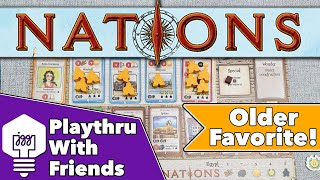
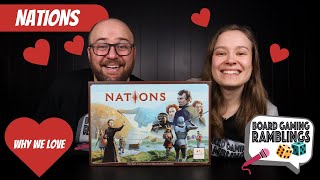
From the humble beginnings of civilization through the historical ages of progress, mankind has lived, fought, and built together in nations. Great nations protect and provide for their own, while fighting and competing against both other nations and nature itself. Nations must provide food and stability as the population increases. They must build a productive economy. And all the while, they must amaze the world with their great achievements to build up their heritage as the greatest nations in the history of mankind!
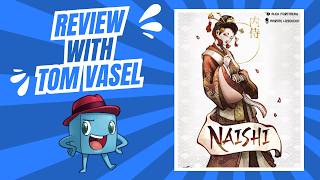
Nations is an intense historical board game for 1–5 players that takes 40 minutes per player to play. Players control the fate of nations from their humble start in prehistoric times until the beginning of World War I. The nations constantly compete against each other and must balance immediate needs, long-term growth, threats, and opportunities.
Gameplay introduction
Players choose a Nation and a difficulty to play at, similar to the Civilization computer games series. After the growth phase, 2 historical events are revealed, which the players will compete for during the round. Then players take a single small action each, in player order, as many times as they wish until all have passed. Actions are:
Buy a card
Deploy a worker
Hire an architect for a wonder
Special action provided by a card
Players each have individual boards that represent their Nation. There are many ways that players affect, compete, and indirectly interact with other players. But there is no map, no units to move around, and no direct attacks on other players.
When all have passed, there is production, new player order is determined (every position is competed for), the historical events happen, and if this is the last round of an age, the books are scored. At the start of a new round, most old cards are removed and new ones are put on the display.
Victory points are gained and lost during the game, and also awarded at the end of the game. The player with the most victory points is the winner.
See 'More information' below for link to rules, etc.
- Unique mana collection mechanic
- Strategic depth beyond similar games like Castle Panic
- Good family game with adjustable difficulty
- Pleasant surprise for the reviewer
- Satisfying puzzle-like experience
- Relies on a familiar 'defend the castle' trope
- Can feel generic outside of the core mana mechanic
- Cooperative defense against attacking monsters
- A besieged wall or citadel
- Castle Panic
Mechanics (from transcript analysis)
- action selection — Players choose actions such as moving, attacking, or collecting mana.
- Area Control — Players compete for control of areas to gain special abilities.
- cooperative play — Players work together to defeat monsters before they breach the wall.
- Modular Board — The game features a hexagonal board with districts and a central citadel.
- Resource Management — Collecting and managing colored mana tokens is crucial for defeating monsters.
- Set Collection — Players collect specific colors of mana to match monster strengths.
Video topics + discussion points
Quotes (from this video)
- It's like putting together just a perfectly fit puzzle.
- If you enjoy doing Excel spreadsheets, this game is for you.
- This game feels a lot like an RPG for miniatures.
- The math spreadsheet thinking part of the game, Oh My Heavens, our heads were hurting.
- It is it is is a social game it is a bidding game it is very much a economic game it's a bunch of different things crammed together that I think actually works pretty darn well.
References (from this video)
- civilization building
Mechanics (from transcript analysis)
Video topics + discussion points
Quotes (from this video)
- I want something simple and fast.
- I don't want the game to be fiddly before I've even started.
- I find it kind of fun and clever.
- I would like to just sort of trust people to be able to say okay well this one's mostly on one side so therefore this is a six but then what if it's like this you know what if it's again something a little thicker and to be honest I don't even want to have to think about that
- If I have the option I'm always going to pick blue
- if uh you could get Santa Claus or a loving spouse to give you any game uh what would it be
References (from this video)
- captures Nations vibe in a compact dice format
- fast, streamlined civilization engine
- limited diversity of tiles
- potentially repetitive after multiple plays
- dice-driven civilization lineage
- Equinox
Mechanics (from transcript analysis)
- Dice Drafting — draft dice and spend them to buy tiles that grant new dice with stronger abilities
- dice drafting to upgrade dice pool — draft dice and spend them to buy tiles that grant new dice with stronger abilities
- monument and resource progression — dice types (ore, gold) enable different advancement paths
- tile-purchasing and engine-building — tiles grant dice and advance your civilization engine
Video topics + discussion points
Quotes (from this video)
- I sat down I played a four-player game of it and it was great it was everything that I was hoping for it to be
- it's gorgeous the only flaw with the game is that monster track there are these Monster cards where you when you play them this track goes up and the higher up on the track you go the better rewards there are for the person who cashes out but there are so few Monster cards in the deck
- we died fast
- this game is very difficult
- it's like Equinox
- it's a tile L game they're they're cards but they're square tiles with a number in each side
- I got destroyed I got completely slaughtered
References (from this video)
- light and quick
- enjoying it so far
- unique dice engine-building concept
- initial tiles look similar; may affect replayability
- dice engine-building
Mechanics (from transcript analysis)
- bonuses via chits — Chits grant bonuses as the game progresses
- dice engine-building — Players develop a pool of dice and use them to perform actions
- dice pool growth — Start with five dice, end with many dice and bonuses
Video topics + discussion points
Quotes (from this video)
- I will be doing an exclusive once a month question-and-answer vlog
- the second thing is that one of the reviews I do each month is going to be voted on by the patrons
- I think that's a really great way that we can interact back and forth and we can just create a better channel together
- the Voyages of Marco Polo ... incredible amount of replayability
- the board is totally randomized every game
- it's a pusher luck deck-building game that plays one to four people
- I was super excited about penny press ... I was the person who was super far behind who got left out of a newspaper cycle
- the issues that I have with this game... area majority miss is too big of a deal
- the split personality disorder description for Welcome to the Dungeon
- great art aesthetic
- I think it's a great game
References (from this video)
- Roll for the Galaxy
Mechanics (from transcript analysis)
Video topics + discussion points
Quotes (from this video)
- by far in a way the most important life-altering thing that's happened to me in the last month is that I proposed to my then girlfriend now fiance Jessica
- I'm getting married
- I am pretty excited that I just finished recording my first question and answer Vlog
- the last one was in Alien Frontiers
- Welcome to the dungeon is a great idea
- it's gorgeous but it's not the most engaging thing ever
- I prefer this over Race for the Galaxy
- it's a cool pyramid building engine building out the Wazoo game with an auction mechanic that seems a bit thrown on
References (from this video)
- strong engine-building potential
- interesting global warfare dynamic
- reinvigorating with advanced cards
- rulebook can be intimidating
- may feel abstract to some players
- civilization development with military, stability, and economy
- civilization-building via card pooling and drafting
- engine-building with card pool drafting
- Through the Ages
Mechanics (from transcript analysis)
- card pool drafting with engine-building — draft from a pool of cards and upgrade buildings to generate gold, military strength, and stability.
- global warfare interactions — wars affect multiple players rather than targeting a single opponent.
Video topics + discussion points
Quotes (from this video)
- It's a very exciting time for the channel.
- I've filmed nine videos worth of content last week, actually in three days.
- I'm hoping to increase my output.
References (from this video)
Mechanics (from transcript analysis)
Video topics + discussion points
Quotes (from this video)
- I have a really big problem with the status quo.
- I'm desperately looking for more colonialism themed games at least from the Western colonial eyes.
- Don't ruin the magic if you prefer not to but do you preset the first few turns of a playthrough so that you could better show the rules or is it all standard setup and you show the rules as they come?
- I pre stack cards like in terraforming Mars I made sure that there were cards in people's hands so that a greenery tile would go down a Sydney tile would go down an ocean would go down that every single little button could be pressed in that first generation.
References (from this video)
- Regeneration ability ('Living Metal') enhances survivability.
- Good save rolls for Immortals (3+).
- Lacking in specialized weapon abilities compared to other factions.
- Necrons
Mechanics (from transcript analysis)
- fire teams — Can use Necron Warriors, Immortals, Deathmarks, or Flayed Ones.
- Model Count — Necron Warriors (5), Immortals (4 with a leader), Deathmarks (4), Flayed Ones (5).
- Save Rolls — Immortals have a 3+ save, Necron Warriors have a 4+ save, and Flayed Ones have a 4+ save.
- special abilities — The 'Living Metal' rule provides passive healing each turning point.
Video topics + discussion points
Quotes (from this video)
- it gives you a built-in reroll so it's a little kind of aim action for the tau there
- these guys could be interesting i think with a good mix of teams maybe battle suits with somebody else
- this is just one croot team it's gonna be one leader and also includes 12 operatives so this is going to be very much a swarm thing
- these guys are cool because they're just you can just deck them out and guns and things like that
- this seems like a cool team they give you some options to play with so i'm excited about this team
- the heavy rock cutter heavy rock drill heavy rock saw these are some big damage items there
- the five-up save just really just kills them
- I really liked that sort of aspect of that last edition
- the whole concealed versus engaged uh whatever the thing's called uh tactical marker right so I thought that was very very interesting
- the one thing i wanted to mention was we've been talking about kind of the older editions and stuff and shadow war and i couldn't really put my finger on it when i was doing the old review or the last review that's a week old but uh the melee the thing i really liked about it was it's hey it's actually kind of necromunda style melee
- i like that they in this case moved away from it because i don't always want to do that sometimes i just want to say you know what just hang in there and keep fighting
- this is not a games workshop game and it still feels like it in a way in a good way but they've done a lot of these little things i'm like oh cool they're really kind of breaking out of their their sort of design box with this one
- the one kind of worry that i have that they sort of lock stuff behind kind of a pay wall with these sort of thematic boxes
References (from this video)
- Tight, easy to learn for an engine-builder
- Engaging long-term goals with dynamic progression
- Thematic cohesion around classical music and legacy scoring
- engine building and contract fulfillment to create masterpieces
- classical music world focusing on composers and orchestration
Mechanics (from transcript analysis)
- Engine Building — Acquire resources (inspiration/tones) and use them to perform masterpieces; build an engine over the game.
- engine-building — Acquire resources (inspiration/tones) and use them to perform masterpieces; build an engine over the game.
- resource-based progression — Gaining patrons and fortune to support actions along the way.
- Track Advancement — Gaining patrons and fortune to support actions along the way.
Video topics + discussion points
Quotes (from this video)
- it's really fun to have to manage like the two different numbers because you're combining them so if you have to write 82 you also have to write 28 and then you have to hope that you can maybe connect 82 to 28 eventually down the road.
- I love the color scheme of this game it's really brightens up your day and you really do feel like you're in the heart of New Orleans
- it's engine building and almost contract fulfillment because you're trying to essentially acquire some resources which is inspiration tones in this game
- it's a work replacement game and what that means is you'll have little workers you'll send off to do various actions
- it's essentially a deck builder with an action sequence to it and your cards have a top and bottom
References (from this video)
- Terraforming Mars
Mechanics (from transcript analysis)
Video topics + discussion points
Quotes (from this video)
- it's a backwards episode
- it's a double call
- it's a tiny game but it's a great gateway to a system
- we are going to keep it forever
- Nations the Dice Game is a perfect example of a game dice game done right
References (from this video)
- Artwork is really nice, in the same vein as Twice.
- Hasn't been bettered in the realms of bag building Euro games.
- More thematic than your average Euro game.
- Doesn't really matter if you bling it out with deluxe counters, the core game is the focus.
- Medieval
Mechanics (from transcript analysis)
- Bag Building — Drawing workers from a bag and using them for actions.
- Track Advancement — Moving markers up on a series of tracks for bonuses.
- Worker Placement — Taking different workers out on the board and arranging them on your playmat.
Video topics + discussion points
Quotes (from this video)
- fear not after this there's only going to be two more segments and then it will be Christmas day
- this was made infinitely better with the first expansion where each player was given a role and each role had a unique special ability
- the artwork in all own is really really nice it's in the same vein as twice it's got that old medieval style artwork that is remin of the days before people invented caffeine
- kis is the granddaddy of worker placement games for a reason
- space base is another one of them games that takes an idea that's already been implemented and turns it into something else
- it's called the granddaddy of area control games in the same way that kis is called the granddaddy of worker placement games
- Dogs of War is one of the most overproduced games that you can imagine
- playing RV Caesar is like saying goodbye to the world off into the Wilderness and living in a cave
- the fact that seven wonders can condense an epic civilization building game down to 30 minutes or less is nothing short of astonishing
- the way that all the cards are related to historical events and historical facts even if they are a little bit B towards the United States and the West means that Twilight Struggle is a fascinating game
- Feed the Kraken is an absolutely fantastic party game
- if you can find it and you got a large number of people especially at your Christmas piss up this should be a game that you pull out instead of your penis
References (from this video)
- Strong engine-building feel
- Thematic alignment with music
- Elegant production design
- performances from small to large orchestras
- engine-building around a classical composer
Mechanics (from transcript analysis)
- engine-building — choose actions that cascade to build an engine and score points through performances.
- performances (small to large) — performances escalate from small to orchestra-scale as you progress.
- resource tracking by musical keys — resources are tracked across musical keys to represent different types of resources.
Video topics + discussion points
Quotes (from this video)
- this first game is an absolute home run
- as soon as you play this game you always want to play the other side
- I want to continue playing it again and again
- it's a spatial bidding game where you'll take turns bidding on this terrain
- planning your vacation and energy levels ... balance
References (from this video)
Mechanics (from transcript analysis)
Video topics + discussion points
Quotes (from this video)
- it's incredible it's fantastic I was super surprised by it it's really good
- quadropolis is a game I'd love on there I love quadropolis
- the tile placement game it's just one of those little perfect games
- transform your TBL toop into a Galaxy at your fingertips in flickering Stars
- flick your spaceship across the table
- quirl quirl is a fantastic game I I truly love it
References (from this video)
- Clear thematic flavor tied to aristocratic patronage
- Varied actions and meaningful choices via patronage and notes
- Combo potential when chaining actions
- High cognitive load and potential for planning paralysis
- Complex tracking with many moving parts and tokens
- Ambiguity or confusion at times about how combinations interact (as discussed by players)
- Patronage and musical performance within aristocratic society
- A salon-like setting where aristocrats judge musical performances and patronage.
- Abstract tableau-building with competitive scoring
Mechanics (from transcript analysis)
- combo/engine — Combos arise from chaining actions (inspiration, patronage, performance) to maximize scoring and resource gain.
- End Game Bonuses — Game ends when end conditions are met (specific performance goals and token usage) and final scoring occurs.
- end-game goals — Game ends when end conditions are met (specific performance goals and token usage) and final scoring occurs.
- inspiration economy — A shared currency used to perform actions; players can acquire two different inspiration types with one currency.
- note tokens and fortunes — Tokens spent to upgrade actions; fortune cards provide action bonuses.
- patronage — Mechanic to recruit patrons that grant scoring opportunities and trigger additional actions.
- performances — Two tiers of performances (chamber vs concert) with varying costs and requirements to fulfill for scoring points.
- Set Collection — Collect performance pieces (woodwinds, piano, etc.) to fulfill patron goals and score.
Video topics + discussion points
Quotes (from this video)
- Aristocrats—they're picky.
- It's a kind of tableau-buildingish card-driven game.
- This is a combo engine.
- Too much cognitive load.
References (from this video)
- clear thematic tie-ins to science
- beautiful production and accessible puzzle
- algae and microbiology
- scientific lab
- abstract puzzle
Mechanics (from transcript analysis)
- Pattern Building — build patterns on a microscope-themed board
- Tile Placement — place tiles to fit shapes on your board
- Top placement — top placement of tiles influences scoring opportunities
Video topics + discussion points
Quotes (from this video)
- Galactic Cruise is my number one game this month again.
- it's a bag builder where you're going to be putting a bunch of ingredients into a bag and then drawing them and mixing a potion
- the theme in this game is you are shoveling poop basically across London
- it's genuinely so much fun
- I think it's Sashi game
References (from this video)
Mechanics (from transcript analysis)
Video topics + discussion points
Quotes (from this video)
- This has debuted last year at Essence, so it's making its way through to North America.
- This is a great game. Uh definitely suggest that you pick this one up if you have the space for it because it is quite a large game.
- Drag queen at their booth.
- stay safe, and we'll see you next time.
References (from this video)
- two-player head-to-head format
- rewards for majority influence / banners
- familiar feel related to Abyss
- Abyss
Mechanics (from transcript analysis)
- Area Control — Aim to obtain the majority influence in districts and obtain banners to win.
- Card Drafting — Players play a legion card on their side of the city to recruit a war hero and gain the majority influence of the different districts and obtain special abilities.
- majority influence / area control — Aim to obtain the majority influence in districts and obtain banners to win.
- two-player head-to-head lane mechanics — Two-player back-and-forth head-to-head gameplay with lane-based actions.
Video topics + discussion points
Quotes (from this video)
- What drew me to Legions is more Abyss.
- Abyss is a fantastic game.
- Gloom Haven second edition, which is a revised and elevated version of the award-winning core game Gloom Haven.
- I like Aquatica.
- I have a huge heart for this game. I love Rivals for Katan.
- The Druids of Adora is a brand new Stefenfeld game that is just seems to have gone wildly unnoticed.
- I'm super excited about the druids of Adora.
References (from this video)
- Cool that they've explored the Abyss world
- Interesting game
- Felt like coach, need to play again to get a better sense
- Need to play again to get better at strategy
- Factional conflict, area control
- Abyss universe
- Abyss
- Hanabi
Mechanics (from transcript analysis)
- Area Control — Players try to gain influence over locations.
- Card Drafting — Players draft cards to play to different sides of a central board.
- tug-of-war — Mechanic where players vie for influence in a back-and-forth manner.
Video topics + discussion points
Quotes (from this video)
- The more we talk about this game, the more divisive I realize that it is.
- It's just it's it could be frustrating because it's a tugof-war, right? So you're like, "God, just give me this thing."
- Covenant fell flat for us. Felt like we didn't have enough time to upgrade our dwarves.
- I didn't do anything in this game.
- Concordia is such a classic.
- My short answer is Arcs is the worst game.
- Oh, Arcs is the worst game I've ever played in my life. Well, not worse. It's my least favorite game. That those are two different things.
- Star Wars Bounty Hunters. The game is trash.
- Dude, you should totally make a full Baron Park inspired park in Planet Zoo. That'd be epic, though. Severely on people watch it.
- Mountain goats is a great game.
- I love goats. Goats are cute.
- It's just a living lawn mower.
References (from this video)
- Amazing game
- Civilization building without being warfare focused
- Cards provide benefits for structures, income, and military
- Can gain resources through battles
- Opportunity to gain advisors and build wonders
- Has fallen from a higher rank
- Haven't played it in a while
- Can cause chaos, unbalance, or famine if too many workers are added without stability
- Longer game, doesn't get to the table often
- Civilization building
- Through the Ages
Mechanics (from transcript analysis)
- Area Majority — Deciding if you want to start wars to get resources from winning battles.
- Card Drafting — Buying cards that help with new structures, income, and military.
- civilization building — Managing a civilization, including income, military, advisors, and wonders.
- Resource Management — Managing a lot of resources, where there are never enough.
- Worker Placement — Placing workers in new structures.
Video topics + discussion points
Quotes (from this video)
- And you're all about upgrading your spaceship or space hub basically.
- The theme is great in this game.
- It's a longer game. And that's also why it doesn't get to the table.
- It was competitive, which was interesting because it's like a different style of of a most legacy games and campaign games are cooperative.
- And also the writing and the comedy was fantastic.
- It feels like a game where you're like, I've worked my butt off the entire game for this. And it gives me two and a half points.
- It is a worker placement game. You have one worker which is going to move around from building to building.
- The looks of this game will fool you because this is a game with a lot of brutality in it.
- It's a medium euro game with a lot of great depth of choices.
- You're basically running a hotel where you're trying to attract the right guests, give them the food in the cafe that they want to fulfill their needs before you tuck lock them in the
- Frost Haven is a fantastic game.
- H just a splendid game that I am super excited to play more.
- And you're basically running a hotel where you're trying to attract the right guests, give them the food in the cafe that they want to fulfill their needs before you tuck lock them in the
- It's a very weird theme because it's like people coming to your cafe and after they eat they get locked in a room.
- It's a fantastic game. It's all about combos, trying to get the most out of your actions as possible.
- Frost Haven basically came in and said like, you don't need to be here anymore.
- And I always I loved Gloom Maven. I loved so much about it. The story was decent, but it was okay written and it was fun. The characters were really fun.
- just a splendid game that I am super excited to play more.
References (from this video)
- Enjoyable cooperative game defending a tower
- Array
- Fantasy cooperative defense
- Casual impressions of early hobby world games
Mechanics (from transcript analysis)
Video topics + discussion points
Quotes (from this video)
- Twilight Struggle, amazing game.
- Ticket to Ride Marklin, which is my favorite Ticket to Ride.
- Five years ago, I reviewed Summoner Wars, which was absolutely amazing.
- Room 25 is kind of like that.
- Dive. Gorgeous game.
- Last year, I reviewed Box Monster, a game where you're for kids where you're sticking your hands inside a box to feel things out.
References (from this video)
- Faster and more streamlined than Through the Ages
- Innovative warfare mechanic
- Flexible and engaging worker placement
- High replayability
- Excellent for players who enjoy building their civilization's infrastructure
- Can be complex
- Might not appeal to those who prefer direct conflict
- Civilization building, historical progression
- Through the Ages
- Nations: The Dice Game
Mechanics (from transcript analysis)
- action selection — Players choose actions to develop their civilization.
- Asymmetric powers — Unique setups and asymmetric powers, especially with expansions, enhance replayability.
- Card Drafting — Cards are drafted and added to a civilization.
- civilization game — A civilization-building game considered an evolution of the genre.
- Warfare system — War is triggered by an objective, requiring opponents to meet a military strength level or suffer setbacks, without forcing direct military investment.
- Worker Placement — Players use meeples as workers on cards to activate benefits.
Video topics + discussion points
Quotes (from this video)
- I just love that resource progression.
- It the resource progression feels to me like that you start with a wheel then you get cards then you get uh spaceships right?
- The game is just way too heavy. It is insane.
- It's like a rock paper scissors. I'm building my ship this way to count to your ship. Then you should build your ship another way.
- Yeah. Because they are so heavy, right? They do take such an investment you want to like uh go through, but people were saying that that Colution was was awesome.
- I think the moral of this stream is we can call anything a Civ game if you try hard enough.
References (from this video)
- Recommended to play with its expansion for unique asymmetric player nations.
- One of the speaker's favorite dice chuckers.
- One of the speaker's favorite civilization building games.
- Distills the greatness of the original Nations into a tight, fast package.
- Love it to pieces.
- Expansion is highly recommended for the full experience.
- Civilization building
- Civilization
- Nations
Mechanics (from transcript analysis)
- Civ-building — Abstracts the core elements of the larger Nations game.
- Dice Rolling — A core mechanic for driving actions and progression.
- Tableau Building — Players build up their civilization's capabilities.
Video topics + discussion points
Quotes (from this video)
- I just love that resource progression.
- It the resource progression feels to me like that you start with a wheel then you get cards then you get uh spaceships right?
- The game is just way too heavy. It is insane.
- It's like a rock paper scissors. I'm building my ship this way to count to your ship. Then you should build your ship another way.
- Yeah. Because they are so heavy, right? They do take such an investment you want to like uh go through, but people were saying that that Colution was was awesome.
- I think the moral of this stream is we can call anything a Civ game if you try hard enough.
References (from this video)
- Cool concept
- Like the idea of this game a lot
- Like the flipping mechanic
- Neat concepts
- Symbology and stuff on the cards is a lot of brain burning
- Constantly having to look up what cards do
- Card order in hand cannot be changed after initial shuffle
- Specific needed cards might not come up or be at the bottom of a deck
- Game end can feel anti-climactic
Mechanics (from transcript analysis)
- Action Point Allowance — Players have one main action per turn, with options to spend tokens for extra actions.
- Card Drafting — Players select cards from a central 'river' or their own hand.
- End game trigger — The game can end when one pile in the 'river' is depleted, with one final turn for the opponent.
- Hand as board — The player's hand of cards also serves as their playing area or board.
- Set Collection — Certain card combinations like adjacent rice fields score points based on quantity and adjacency.
- variable scoring cards — Each card has a unique scoring condition, such as mountains, ninjas, rice fields, or ronin.
Video topics + discussion points
Quotes (from this video)
- Nations is a very weird game in which your hand is also your board, which is also your hand. Sort of.
References (from this video)
Mechanics (from transcript analysis)
Video topics + discussion points
Quotes (from this video)
- I've been really impressed with it
- the museum board is a big thing
- I would probably prefer to play Merv over a T-series game
- the Crew is easily my favorite trick taking game
- Through the Ages is a solid game
References (from this video)
- Incredible and unique theme
- Amazing and cool look with a glossy finish and recessed boards
- Clear iconography and helpful player guide
- Guest judges add variety to scoring
- Engaging solo mode
- Clever design and fun gameplay
- Glossy finish made distinguishing between blue/green and red/purple difficult under certain lighting
- Some personality scoring bonuses from guest judges can be overly intense and determine the winner
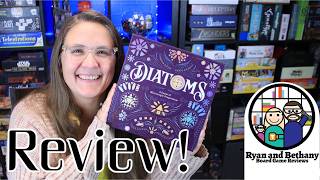
- Creating mosaics with one-cell algae on a microscopic level
- Victorian era
Mechanics (from transcript analysis)
- Pattern Building — You arrange the Datoms on your personal player board to create symmetrical patterns with lots of colors and shapes.
- Set Collection — With the colors from the placed tile, you pick up and earn Datoms (odd-shaped pieces) to place on your player board.
- solo mode — A full-fledged solo mode exists with a contract mechanism focused on building specific shapes or things to maximize points.
- Tile Placement — On your turn, you place a hex tile that gives you a variety of colors and quantities of those colors.
- Variable player powers — Guest judges can be optionally added to score different ways, offering 'nice' or 'personality' scoring objectives.
Video topics + discussion points
Quotes (from this video)
- Hi everybody. Hello. I'm Ryan. I'm Bethany. And we are Ryan and Bethany Board Game Reviews.
- We got to follow that. It'll give you a step by step how to actually play the game.
- I had never heard of this before. That is so cool uh and so weird and I am absolutely loving these weird themes like that on board games. Keep them coming.
- It's very clear. I like the glossy finish of everything. I think it looks really cool.
- I like having all these different cards you can use to mess with the scoring and they're double-sided so you can have, you know, there twice as many scoring options.
- This might come as a surprise, but we learn a lot of games. We play thousands of games and sometimes ones that we don't get a chance to play for a few years, we forget the rules.
- This game was provided to us by a publisher for in exchange for a fair and honest review.
References (from this video)
- engaging engine-building and resource-management core
- thematic integration with music is strong and resonant for players with a musical background
- asymmetric characters add replayability and variety
- player interaction is present without heavy direct antagonism, supported by the shared card pool
- short to moderate playtime with potential for depth, plus quick setup
- enjoyable theme touches, including attending others' performances and musical motifs
- shared pool means competition for key cards can slow down some turns and force adaptation
- no card-reservation/partial drafting mechanic can frustrate players who want to plan ahead
- late-game action tracking can become cognitively demanding and slow down play
- early downtime may occur as players figure out their engine direction
- not every strategy may align with every player's preferences due to card availability and drafting pressure
- music creation, performance, legacy patronage
- the world of classical music composition and performance, centered on becoming a renowned composer
- asymmetric character abilities with historical inspirations; player-driven engine-building progression
- Wingspan
- Parks
Mechanics (from transcript analysis)
- action_selection — on each turn, players choose one of four core actions (inspiration, fortune, patronage, or perform), driving engine growth or scoring opportunities
- asymmetrical_characters — six different historically-inspired composer characters provide unique abilities, enhancing replayability
- attending_other_concerts — players can visit other players’ concerts to gain inspiration and additional resources
- card_decks_and_acquisition — fortune cards, patron cards, maestro cards and legacy patron cards feed ongoing engine growth and endgame scoring opportunities
- Compound Scoring — legacy points from cards plus bonuses from unspent tickets drive endgame scoring
- Engine Building — the combination of cards, tokens, and performances creates an evolving engine that increases options over time
- engine_building — the combination of cards, tokens, and performances creates an evolving engine that increases options over time
- inspiration_tokens — inspiration tokens must be gathered to power actions and to access higher-value cards and effects
- music_notes_and_performances — music notes are earned via performances and are used to unlock actions and trigger effects; performances generate audience/point opportunities
- scoring_mechanics — legacy points from cards plus bonuses from unspent tickets drive endgame scoring
- shared_card_pool — cards are drawn from a common pool; competition for valuable cards can shape strategy and pacing
Video topics + discussion points
Quotes (from this video)
- it's got engine building it's got resource management and it's got like a race to the Finish kind of feel to it
- I think I'd give this one a standing ovation
- the goals for the game really drive what everybody will be doing
- there's a lot of variety that you can pivot your strategy to build up yourself as the best classical composer
- go to people other people's concerts
References (from this video)
- warn humanity about absurd dangers
Mechanics (from transcript analysis)
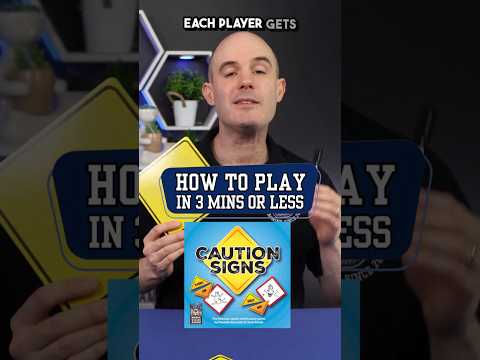
- Drawing — Each player gets a sign and a pen. ... The drawers get an adjective and a noun.
- guessing — It's the guesser's job to now put these signs together with their correct drawings.
- Real-Time — a frantic real-time doodling game where you have 20 seconds to warn humanity about absurd dangers.
- Set Collection — It's the guesser's job to now put these signs together with their correct drawings.
Video topics + discussion points
Quotes (from this video)
- Caution signs for three to nine players,
- a frantic real-time doodling game where you have 20 seconds to warn humanity about absurd dangers.
- Now it's time to do your work of art to save humanity from a trashy turtle.
- 20 seconds is not very long.
- I feel really sorry for the guesser.
References (from this video)
- Potions can be gotten back with interest.
Mechanics (from transcript analysis)
- Deckbuilding — Players pull synergizing cards from a deck of 50 cards.
- Set Collection — The player wants triples for more money.
- upgrading — There is a mention of not having upgraded yet.
Video topics + discussion points
Quotes (from this video)
- How crazy is that?
- More money, baby.
- This is bonkers.
References (from this video)
- Gorgeous visuals
- Smart decisions about placement and efficiency
- Solo mode available
- End condition can occur before board fills, requiring planning
- Abstract puzzle / pattern optimization
- Pattern-building puzzle with tiles that fit into slots to form designs
- Pure puzzle with aesthetic emphasis
Mechanics (from transcript analysis)
- Compound Scoring — Pieces have different values and contribute to scores
- incomplete boards ending the game — Game ends before full board is filled, forcing efficiency
- Pattern scoring — Pieces have different values and contribute to scores
- Player Board | Main Board — Game ends before full board is filled, forcing efficiency
- Tile Placement — Choose which pieces to place where to form patterns
- tile/piece placement — Choose which pieces to place where to form patterns
Video topics + discussion points
Quotes (from this video)
- This is a great game.
- I do really enjoy the solo mode on this.
- It's really fun.
- This is just a really fun game.
- It looks gorgeous on the table.
- Thanks. Bye.
References (from this video)
- Becoming a legend of classical music through composing and performances
- Classical music world / composer career
- Instructional/teaching with step-by-step actions
Mechanics (from transcript analysis)
- Concert and chamber performances — Performances are how players gain music notes (the only way to obtain notes) and complete pieces that match tones.
- End Game Bonuses — End occurs when only two Maestro cards remain; players score legacy points, tickets, and music performed, with tie-breakers.
- End-game and scoring — End occurs when only two Maestro cards remain; players score legacy points, tickets, and music performed, with tie-breakers.
- Fortune and Patron cards — Fortune cards provide enhancements to actions; patrons influence legacy points and card effects.
- inspiration resource management — Inspiration is the primary resource; most actions require spending inspiration and tones to perform tasks.
- maestro cards — Optional Maestro cards grant end-game triggers; players can take at most one per turn if eligible.
- Magnum opus cards — Magnum opus cards offer powerful but costly performances at game start; they provide higher point rewards.
- Main actions and bonus actions — On your turn you choose a main action and may take bonus actions or free actions; music notes regulate usage.
- Multi-Use Cards — Optional Maestro cards grant end-game triggers; players can take at most one per turn if eligible.
- Music notes as reusable tokens — Music notes are not spent or discarded; they return to supply each turn and enable bonus actions.
- Reclaim as Action — Refresh an entire row of cards at the cost of permanently discarding a music token.
- Resource Management — Inspiration is the primary resource; most actions require spending inspiration and tones to perform tasks.
- Temperamental artist action — Refresh an entire row of cards at the cost of permanently discarding a music token.
- Tickets and audience interaction — Attending performances grants tickets (which can be exchanged for inspiration or points); attendees earn the performer inspiration.
Video topics + discussion points
Quotes (from this video)
- Ovation is published by Looking Glass Workshop
- designed by Kirsten Lund Innovation
- your goal in this game is to be the player with the most legacy points by the end of the game
- that's Ovation with your music strike into the hearts of all
References (from this video)
- fast-paced and quick to learn
- simultaneous play and bluff add tension
- two paths to victory
- suitable for 2-4 players
- thematic visuals with cute aliens
- prototype copy; rules and components may not be final
- resource control, war and diplomacy among factions
- the moons of valious battle over the planet's resources
- simultaneous play with diplomacy/war decisions
Mechanics (from transcript analysis)
- Artifact and beast draws — Face-down draws can yield artifacts or beasts that modify valerium or combat dynamics
- Card/draft selection — Players draw five cards and choose three to add to hand, discarding two
- Central Supply and round progression — Players discard cards from convoys to the Central Supply and advance rounds
- Convoy selection and diplomacy state — Each round, players assemble a convoy of three aliens and select a diplomacy state (War/Defend/Peace)
- Diplomacy resolution — Resolution occurs by applying the chosen diplomacy state (Peace, Defend, or War) with consequences
- Elite alien auction — Elite aliens are bid on using valerium; the highest bidder gains the card
- Resource gathering and missions — Gather resources from convoys to meet mission requirements and earn valerium
- War combat with dice — If War is chosen, players roll dice to determine combat strength and potential valerium gain
Video topics + discussion points
Quotes (from this video)
- valious is a card and dice game in which leaders of the moons of valious battle over the planet's resources
- valerium which can be earned by spending resources to complete missions or by carefully managing peace war and diplomacy with the other players
- Valious is a quick tolearn game of simultaneous Bluff and take that coupled with contract fulfillment and both a valid paths to Victory
- the game features cute alien characters and familiar historical artifacts conceptualized by The Game's 15-year-old designer ion which makes for a visually thematic experience
- we're using a prototype copy of the game so the rules and components may not be final
References (from this video)
- Dice engine grows from a small start into a larger pool of color-coded dice
- Simple turn structure with low downtime
- Wonders and territories provide distinct, evolving options
- Lack of tile variety reduces replayability
- Setup/teardown feels lengthy relative to short play time
- Food and books are perceived as less interesting paths for scoring
- Tiles in later ages are similar/duplicative, reducing engagement
- Replayability suffers without expansions
- civilization-building through dice-based engine; upgrading buildings and constructing wonders
- tutorial/review with example setup and turn-by-turn discussion
- Roll for the Galaxy
Mechanics (from transcript analysis)
- age progression and tile replenishment — As ages advance, tiles and bonuses evolve; players refresh chits and dice between turns, with later ages offering different bonuses.
- book scoring phase — After all players pass, players generate books based on dice with a book face or a book icon, contributing to end scoring.
- dice faces and color-driven actions — Dice come in multiple colors with different strengths (white, gold, blue, red) and faces influence outcomes like gold, books, or combat.
- End Game Bonuses — End-of-round scoring includes famine and war bonuses; tiles grant victory points based on these conditions.
- Endgame scoring — At game end, players tally victory points from all tiles and bonuses; the highest total wins.
- exhaust and reroll — Exhausting a roll chit allows rerolling a number of dice on the board, affecting future results.
- Three actions per turn — On a turn, a player can purchase a tile, build a wonder, or exhaust a roll chit to reroll dice.
- Tile Placement — Players spend resources (swords, gold) to purchase tiles from an offer; tiles grant bonuses and must be placed on the board.
- tile purchasing — Players spend resources (swords, gold) to purchase tiles from an offer; tiles grant bonuses and must be placed on the board.
- war and famine scoring — End-of-round scoring includes famine and war bonuses; tiles grant victory points based on these conditions.
Video topics + discussion points
Quotes (from this video)
- the central idea for the whole game. And that is building a dice engine.
- I really like the simple turn order structure where you simply take one action from only three options and then it's the next person's turn and we just keep going around the table until everybody passes
- I really enjoy that process of starting with a small basic dice set and kind of customizing your own variety of dice
- There are lots of duplicates with these blue buildings.
- I really wish that the food and books, specifically the food, had been given more reason to even be in the game.
- There is an astonishing lack of variety in the tiles that come in the game.
- Ultimately, I feel like this game needed more variety like the territories and the wonders that are in here.
- Roll for the Galaxy pretty much every time I want to sit down and play a good dicebased engine building game.
References (from this video)
- Engaging engine-building with rich combo potential
- Tightly integrated theme that supports the mechanics
- High replayability, especially with the Magnus Opus module
- Clear paths to scoring through different card types and patron interactions
- Complex rules and numerous interactions may be daunting for new players
- Endgame and patron scoring can feel fiddly or opaque at first
- Longer setup and explanation may slow onboarding
- Musical composition and performance; patronage and card-driven progression
- Open drafting card game about composing music to achieve Maestro status
- Abstract/engine-driven with thematic performances
Mechanics (from transcript analysis)
- Action Drafting — Players draft actions from a set of four options each turn and place a composer token on their chosen action space.
- attendee attendance and tickets — Left/right neighbors may attend performances, granting inspiration and issuing tickets that convert to points or inspiration.
- card-based action economy — Fortune and Patron cards modify actions; cards slide under spaces and grant new effects when activated.
- Maestro cards and endgame — Maestro/Myestro cards are goals; only one per turn can be taken, with endgame triggered when two are left face up.
- Magnus Opus module — Optional expansion where high-reward cards exist, requiring more resources but awarding many points.
- Multi-Use Cards — Music notes power additional card activations and card abilities; notes are earned and spent to expand actions.
- music notes as a spendable resource — Music notes power additional card activations and card abilities; notes are earned and spent to expand actions.
- open drafting — Players draft actions from a set of four options each turn and place a composer token on their chosen action space.
- performing chamber vs. concert music — Players choose a card to perform; chamber music is easier and concerts yield more points but require higher skills or symbols.
- resource tracking via piano colors — Resources are tracked by colored markers (red, yellow, blue) on piano keys, representing passion, joy, and sorrow.
Video topics + discussion points
Quotes (from this video)
- Ovation by Grand Gamers Guild
- it's an engine building music game with great replayability
- there isn't just one way for victory in this game
References (from this video)
- Euro feel and peace-focused civ-building
- Card market creates tense, interactive decision points
- Robust resource and meeple management mechanics
- Multiple factions and strategic directions increase replayability
- Notable interaction that preserves a lively, dynamic space without purely aggressive play
- Can be lengthy and complex for new players
- Interactions can lean toward being a bit mean depending on table dynamics
- Heavy analysis and planning required to optimize rounds
- Civilization-building, diplomacy, and resource management with strategic card market tension.
- A Euro-centric civilization game focused on peaceful nation-building rather than direct conflict.
- Strategic abstraction with evolving card market and variable faction directions.
Mechanics (from transcript analysis)
- Asymmetric Mechanics — Different factions enable distinct strategic paths and affect how players pursue stability or other goals.
- Card Drafting — Central card display from which players purchase new cards, creating tense, dynamic round-by-round options.
- Card drafting/market — Central card display from which players purchase new cards, creating tense, dynamic round-by-round options.
- economic/military tension — Balancing economic development with military capability to avoid immediate wars or to provoke carefully timed conflicts.
- faction/strategy variance — Different factions enable distinct strategic paths and affect how players pursue stability or other goals.
- Resource Management — Balancing a variety of resources and maintaining strategic balance to enable growth while preparing for potential conflicts.
- round-to-round resource timing — Resources and cards cycle each round, with new cards appearing and strategic choices becoming available anew.
- Worker Placement — Meeples are allocated to produce resources, military power, or other actions; per-person placement influences production.
- worker placement/meeple management — Meeples are allocated to produce resources, military power, or other actions; per-person placement influences production.
Video topics + discussion points
Quotes (from this video)
- The Euro feel many of these Civilization games are more about fighting and being mean to each other but Nations came along and tried to be like a true DHS for people who like peace and not that much fighting
- It also has this super cool mechanism which is the card display which you every time you can buy a new card from there and it's so tense
- The resource management and especially the meatball management. I love the way Meeple work in this game
- you never have enough of them and then you can get more of them at the end of each round
- the euro-ish interaction... not I I have played through the 80s I like true theaters but it's a bit too mean for my Euro Euro mine
- this is kind of like a the same tension that you get in a work replacement game
- the chord and all these things make it a fantastic game
- Nations managed to do that very very well absolutely
References (from this video)
- deep strategic depth with multiple viable paths to victory
- strong thematic integration
- can be heavy for newcomers
- rule complexity may require references
- civilization growth, national governance, military and culture
- civilization development across history
- history-inspired, strategic
- Through the Ages
- Gaia Project
Mechanics (from transcript analysis)
- area control / resource management — managing resources and influence to progress across tracks
- Card Drafting — players choose actions from a hand to advance different aspects of their nation
- card drafting / action selection — players choose actions from a hand to advance different aspects of their nation
- worker-placement / resource management — placing actions on different tracks to advance civilization
Video topics + discussion points
Quotes (from this video)
- we are using a 10 point ranking system
- the sums of the parts are more important than the number at the end
- people are used to you doing it they're enjoying seeing like oh what is rating
- if you maybe don't have the time to watch the whole review and just go to final thoughts and hear some things and you see the number
- a 10 is the highest price I can hear for a game
- the best games to exist don't exist, the perfect game doesn't exist
References (from this video)
- Civilization-grade depth in a Euro framework
- Tightly integrated drafting and timing
- Can feel long and heavy for new players
- Civilization development on a map
Mechanics (from transcript analysis)
- Card Drafting — Draft cards to unlock actions and civilization capabilities.
- card tableau building — Limited slots for cards, with requirements to unlock card synergy.
- Tableau Building — Limited slots for cards, with requirements to unlock card synergy.
Video topics + discussion points
Quotes (from this video)
- This is not interesting to anybody but me.
- We love it. Love it. Love it. BG stats app. 600 thumbs up in the air.
- Candy
- If you want to see your videos, even if you are subscribed, you have to click the bell.
- I could play that 100 times and not be bored with it.
References (from this video)
- Deep strategic play
- Engaging engine-building
- Heavy and long
- Through the Ages
Mechanics (from transcript analysis)
- Card Drafting — Draft leaders and place workers to gain resources and abilities.
- Card drafting / worker placement — Draft leaders and place workers to gain resources and abilities.
Video topics + discussion points
Quotes (from this video)
- it's such an amazing experience, the story that we were in and explored.
- I think one of the heaviest game experiences I've ever had, but it's so so good.
- it's a heavy game to master, but the experience is worth it.
- it's the quintessential economic Euro game.
- this is such a good game, the White Castle is a perfect jam for me.
- you need everything and you need to plan ahead, and it's intense.
- the balance of high dice and low dice in Bora Bora is really interesting.
- Nations is the nicer Euro version of Through the Ages.
References (from this video)
- Deep strategic play
- Engaging engine-building
- Heavy and long
- Through the Ages
Mechanics (from transcript analysis)
- Card Drafting — Draft leaders and place workers to gain resources and abilities.
- Card drafting / worker placement — Draft leaders and place workers to gain resources and abilities.
Video topics + discussion points
Quotes (from this video)
- it's such an amazing experience, the story that we were in and explored.
- I think one of the heaviest game experiences I've ever had, but it's so so good.
- it's a heavy game to master, but the experience is worth it.
- it's the quintessential economic Euro game.
- this is such a good game, the White Castle is a perfect jam for me.
- you need everything and you need to plan ahead, and it's intense.
- the balance of high dice and low dice in Bora Bora is really interesting.
- Nations is the nicer Euro version of Through the Ages.
References (from this video)
- foil on box covers is stunning
- symmetrical design in artwork
- overall aesthetics are striking
- note about missing/desired color variations in background
- foil-forward aesthetic and symmetry
- abstract modern/puzzly vibe
- abstract/art-inspired
- Spirits of the Forest
Mechanics (from transcript analysis)
- Tile drafting / tile placement — tile drafting with foil accents on the board and cover
- Tile Placement — tile drafting with foil accents on the board and cover
Video topics + discussion points
Quotes (from this video)
- Spirits of the Forest. Absolutely gorgeous box cover. I am just obsessed.
- I can't stop staring at it.
- Mysterium's box cover is gorgeous.
- I love the box art for Portals—the circle and portal motif just draws you in.
- Flamecraft is just so, so pretty.
References (from this video)
- Smart and original theme that’s well-integrated into the mechanics
- Engaging engine-building that supports rewarding combo chains
- Intuitive card-tucking system that remains accessible while offering depth
- Strong presentation and thematic flavor that enhances immersion
- Limited player interaction; later turns can feel like multiplayer solitaire
- Luck can influence card availability; refreshing cards via discarding notes is a costly option
- pursuit of fame and financial stability through inspiration, fortune, patronage, and performances
- 18th–19th century European classical music scene; composer life and social circles
- engine-building with a life-as-a-musician narrative; competitive, theme-driven progression
- Gizmos
- Wingspan
- It's a Wonderful World
- Splendor
- Black Ramosa
Mechanics (from transcript analysis)
- card tuck — purchased cards are tucked under board spaces; enables ongoing strategic depth and planning
- Compound Scoring — points from maestro cards and tickets; endgame total determines winner
- Fortune cards — purchase cards that upgrade basic actions; placed under their matching action spaces for ongoing bonuses
- inspiration tokens — tokens come in three tones (passion, joy, sorrow); gain two on the seek inspiration action; used to activate cards
- maestro cards — endgame scoring objectives; game ends when two maestro cards remain or all Magnum Opus are performed
- magnum opus — optional high-impact performances that can be included with a module; powerful payoff for experienced players
- Multi-Use Cards — purchase cards that upgrade basic actions; placed under their matching action spaces for ongoing bonuses
- note tokens — start with one music note; earn an additional note each time you perform to enable more actions
- patronage — offload inspiration to gain patrons; patrons influence endgame scoring and provide bonuses
- perform — select a song to perform; pay the required inspiration to gain the card; options range from chamber to Magnum Opus
- scoring — points from maestro cards and tickets; endgame total determines winner
- tickets and attending — attend opponents' performances by giving tickets; attending player gains new inspiration
Video topics + discussion points
Quotes (from this video)
- the theme is smart and interesting, and it hasn't been overdone in other games.
- the engine building aspect allows for a decent buildup to some powerful combo chain turns.
- the card tucking system is intuitive and satisfying.
- the true melody that this game sings is not in the basic actions alone, but in the engine that each player gets to compose.
- Even Beethoven had to start somewhere.
References (from this video)
- epic scope
- great for longer sessions
- tone of the game can be heavy for casual players
Mechanics (from transcript analysis)
- multi-branch strategy / multiplayer — Long-form strategy with negotiation/alliances and varied victory conditions.
Video topics + discussion points
Quotes (from this video)
- February is already gone and March is here.
- we forgot last month but that is a new thing we want to do throughout the year.
- we started this year with 160 unplayed games in the house.
- the top three games that we played in February with that out of the way
- it's the funnest game it's the best one of the month
- click the pause button and go outside into the...
References (from this video)
- crunchy abstract puzzle with strong interactivity
- high variability via judge cards and color/shape goals
- can be dense for casual players
- requires concentration and planning
- pattern matching and color/shape synergies
- microscopic world of datoms, abstract life forms, hidden in water
- puzzle-like, abstract
Mechanics (from transcript analysis)
- color/shape matching puzzle — score based on matching colors and shapes across rings
- Pattern Building — score based on matching colors and shapes across rings
- self-building mosaic — each player builds their own board from matched colors/shapes
- Tile Placement — place one of three tiles into a shared grid to drive color/shape matching
- tile-placement in central grid — place one of three tiles into a shared grid to drive color/shape matching
Video topics + discussion points
Quotes (from this video)
- This game you're going to be basically dressing up uh the kids in different costumes.
- You're going to be mixing and matching or matching and placing them on different things.
- Waddle is kind of a meaner area control game.
- There's a little bit of everything here. There's pressure your luck. There's some planning and mitigating.
- Datoms is a crunchy puzzle to figure out.
- Ink is a lot nicer than Azul, I would say, uh because you can't really totally hoe someone by sticking them with tiles they can't have.
- Positano. Tons of interaction. If you like sort of meanness blocking with some secret auction, that is very interesting.
References (from this video)
- rich, crunchy puzzle with high player interaction
- interesting space of color/shape decisions and scoring incentives
- can be heavy for casual players
- rule-heavy at first glance
- pattern building and matching in abstract space
- microscopic world of datoms with geometric shapes
- abstract puzzle with elegant components
Mechanics (from transcript analysis)
- color/shape matching puzzle — score for matching colored shapes across groups and rings
- Pattern Building — score for matching colored shapes across groups and rings
- self-contained puzzle with judge cards — alternate goals and rotating bonuses modify scoring each game
- Tile Placement — place one of three tiles into a shared board, triggering interaction
- tile placement into a central grid — place one of three tiles into a shared board, triggering interaction
Video topics + discussion points
Quotes (from this video)
- This game you're going to be basically dressing up uh the kids in different costumes.
- You're going to be mixing and matching or matching and placing them on different things.
- Waddle is kind of a meaner area control game.
- There's a little bit of everything here. There's pressure your luck. There's some planning and mitigating.
- Datoms is a crunchy puzzle to figure out.
- Ink is a lot nicer than Azul, I would say, uh because you can't really totally hoe someone by sticking them with tiles they can't have.
- Positano. Tons of interaction. If you like sort of meanness blocking with some secret auction, that is very interesting.
References (from this video)
- Ambitious theme and scope; potential for deep play.
- Humorous commentary about the game’s appearance and age-appropriateness.
- Some outdated or stylized art detracts from clarity.
- Civilization development, leadership, and strategy
- Civilization-scale setting with ancient & historical themes
- Historical, grand strategy
- Beast Lord
- Hansa Teutonica
Mechanics (from transcript analysis)
- Civilization development — Players advance their civilization through actions and growth.
- player interaction — Diplomacy and competition shape outcomes.
- Resource Management — Managing resources to fuel expansion and scoring.
Video topics + discussion points
Quotes (from this video)
- it's insane it helps keep his body heated
- the moustache makes the picture
- the bear cloak going on is insane
- horizontal and vertical stripes and outfit
- the worst fashioned mistake a person could make
- naked with a hat and a rifle
- you better get off of my property
References (from this video)
- Cool faction system with variety
- Engaging worker placement
- Good use of expansions
- Solid Civilization-style gameplay
- Poor artwork and aesthetics
- Hasn't hit top 100 material
- Better as app than physical game
- Historical civilization development
- Civilization building
- Fruits of the Ages
Mechanics (from transcript analysis)
- asymmetrical factions — About 20 different faction boards to choose from
- Card-based development — Build wonders, gain advisors, combat units, production units
- Worker Placement — Place workers on cards to gain resources and abilities
Video topics + discussion points
Quotes (from this video)
- it's just like falling off it's just literally there are 100 better games in it
- Small Islands uh this is the one that i've been saying is a replacement for carcassonne
- way too complicated for its own good
- it is one of the most beautiful games in existence
- i still think five tribes is better than yamatai
- nations is still my preference to fruity ages in terms of playing a physical game
- really good negotiation game
- great teamwork cooperative very cool
- this is a really good solo
- the deductions are really hard it's a really tough one to do
- it's oh it's a mind bender gorgeous looking
- reef is still a really cool game
- azul is only that good at two player
- near and far still really good
- there's no reason to play that one if you have near and far
References (from this video)
- Elegant scope that captures history in a management friendly way
- Smart war mechanic aligns with the thematic dark side of humanity without being brutal
- Expansion content adds meaningful depth (Dynasties)
- Very long playtime, especially for two players
- Not ideal for players seeking a quick or casual experience
- Civilization development, warfare, diplomacy
- Historical sweep of humanity across civilizations
- Historical overview with macro progress
- Networks
- Santa Maria
- Hollertow
Mechanics (from transcript analysis)
- Card Drafting — Draft leaders, technologies, and cards to drive civilization development.
- military based conflict resolution — Wars occur at your military level; opponents can respond by upgrading or investing in infrastructure.
- technologies management — Limit of active technologies and replacing old ones as you progress.
Video topics + discussion points
Quotes (from this video)
- Nations is the civilization game to beat quite frankly.
- Two great two player games in one countdown; the golden age of two player gaming.
- Isle of Cats Explore and Draw is the second greatest roll and write of all time.
- The Rival Networks is fast, tight, and makes you sweat from start to finish.
References (from this video)
- More accessible than Through the Ages
- Includes randomness for surprise moments
- Tons of unique cards with varied effects
- Good resource management focus
- More random than Through the Ages
- Civilization building
- Historical progression
- Strategic development
- Through the Ages
Mechanics (from transcript analysis)
- Card building
- Card Crafting
- Card Drafting
- Engine Building
- Resource Generation
- Resource Management
Video topics + discussion points
Quotes (from this video)
- You get resources, you get resources, everybody gets resources
- Euro games are games all about economics, resources, selling resources to get more resources, and at the end of the game somebody gets points and usually wins
- Dune is a better game but Terraforming Mars is a better euro game
- The most unique thing about this game is the actions and how they play out
- It's a fantastic way how to mess up everybody's plans
- This game does the thing all games I think should do is make you feel like you've progressed and built something
References (from this video)
- calm but engaging civ-game feel
- accessible compared to similar massive civ-games
- strong thematic alignment with historical progression
- some fatigue from long-term planning
- requires familiarity with civ-game tropes to maximize enjoyment
- Historical civilizational development and governance
- Civilization-building through history
- Strategic and strategic-resource management with a historical lens
- Through the Ages
Mechanics (from transcript analysis)
- building and technology development — Acquire buildings and advancements to improve capabilities and scoring
- endgame scoring and dynamic point loss — The game ends when a victory point threshold is reached, with points awarded for various actions and structures
- worker placement and resource management — Place workers to collect resources and gain benefits; manage money, food, and production
Video topics + discussion points
Quotes (from this video)
- This game has the best character customization in board games period.
- I'm pretty sure it's going to be in Board Game Geek's Top 100 really soon.
- This is one of the surprises of the year so far.
- I think it's a perfect Pusher luck Gateway game.
References (from this video)
- Narrative-driven chaos that remains organized
- Highly replayable with many characters and rooms
- Steep learning curve due to many options
- Asymmetric hidden-role, social deduction with timed pressure
Mechanics (from transcript analysis)
- Hidden Roles — Players have secret objectives and identities to protect.
- timer-driven rounds — The game runs with a set number of minutes/rounds, raising tension.
Video topics + discussion points
Quotes (from this video)
- Twilight Imperium Fourth Edition is an absolute Masterpiece
- Vindication offers some shocking replayability value
- Memoir 44 is probably my favorite war game of all time
- Station 4 is probably the greatest achievement in board game design in the last 10 years
- Monikers is absolutely hilarious
- The cycles edition is about to drop in January
References (from this video)
- Solid game
- Still in print
- Good scheduling option
- Strategic nation building
- Civilization development
Mechanics (from transcript analysis)
Video topics + discussion points
Quotes (from this video)
- I used to call this a shelf of shame that was a pretty common thing to call it back in the day and I don't never really liked that term because I don't feel shame that I haven't got to these games
- this is mostly work like this is just a backload of things I probably should get to
- people will still be looking for it
- it doesn't matter if the game is like 20 years old people will still be looking for it
- I've painted this one and I spent a lot of time doing it
- there's no point putting them on the channel I think both of them have been out of print for like a decade
- one of the worst kickstarters by one of the worst studios in board gaming history
- Golden Bell Studios did everything wrong you could possibly think of
- purely toxic company run by incredibly terrible people
- it would be kind of a joke that I'd be able to do a three minute video of feudum
- this game has a tutorial video online that's like 40 minutes long
- The Rose explanation video feels like a parody but it's actually how the game is played
- nothing personally to me puts me off playing a game that then sitting down unboxing it and having a craft assignment
- stop making me spend hours assembling your damn games
- this is an uncontrollable mess right now
- I'm a full-time dad and I'm really doing this in the evenings
- I have a finite space and also it just puts pressure and stress on me having a whole bunch of crap there that I know I'm not going to get to
- I'm going to do a big cull
- I will be published by this company but that doesn't mean I'm going to be slavishly devoted to every single game they put out
- I am a sucker for cute animal games like I really am